Kaupapataka
Agenda
|
Te Rā Hui:
Meeting date:
|
Monday, 1 September 2025
|
|
Te Wā:
Time:
|
2.00pm
|
|
Te Wāhi:
Venue:
|
Council Chamber
Ground Floor
Civic Administration
Building
Lyndon Road East
Hastings
|
|
Te Hoapā:
Contact:
|
Democracy
and Governance Services
P: 06 871 5000
| E: democracy@hdc.govt.nz
|
|
Te Āpiha Matua:
Responsible Officer:
|
Transportation Manager - Jag Pannu
|
Hastings District Rural Community Board – Terms of Reference
The Community Board is a separate entity to the
Council. The role of the Community Board is set out in Section 52 of the
Local Government Act 2002. The Council is authorised to delegate powers
to the Community Board.
Membership (7
members)
·
Chair (elected by the Board).
·
Deputy Chair (elected by the Board).
·
4 Elected Community Board Members.
·
1 Mōhaka Ward Councillor.
·
1 Kahuranaki Ward Councillor.
·
1 Takitimu Ward Councillor.
·
1 non-voting Youth Council appointee.
Quorum – 4
members
|
DELEGATED POWERS
General
1)
To maintain an overview of services provided
by Council within the Community Board’s area.
2)
To represent, and act as an advocate for, the
interests of the community represented.
3)
To consider and report on all matters referred
to the Board by Council, or any matter of interest or concern to the
Community Board.
4)
To communicate with community organisations
and special interest groups within the community.
5)
To undertake any other responsibilities that
are delegated to it by Council.
6)
To appoint a member of the Community Board to
organisations approved by the Council from time to time.
|
Long Term
Plan/Annual Plan/Policy Issues
Authority to make a submission to the Long
Term Plan/Annual Plan process on activities, service levels and expenditure
(including capital works priorities) within the Board’s area or to make a
submission in relation to any policy matter which may have an effect within the
Board’s area.
Roading
and Traffic
Authority to exercise the Council’s
powers and functions in relation to roads within the Board’s area under
the following sections of the Local Government Act 1974:
·
Section 335 (vehicle crossings);
·
Section 344 (gates and cattle stops);
·
Section 355 (overhanding trees).
Authority to exercise the Council’s
statutory powers in accordance with Council policy (including any relevant
powers conferred by bylaw) over roads within the Board’s area in respect
of;
·
Road user behaviour at intersections.
·
Controls on stopping or overtaking.
·
Controls on turning.
·
Pedestrian safety.
·
Footpath maintenance and improvements.
·
Accident investigation studies, lighting and
other safety works.
For the avoidance of doubt, nothing in this
delegation authorises a Community Board to deal with a matter, in the exercise
of delegated authority, in a manner which is in conflict with any policy or
decision of Council or any standing committee of Council in relation to the
same matter.
Kaupapataka
Agenda
|
Mematanga:
Committee Members:
|
Heamana
Chair: Isabelle Crawshaw
Deputy Chair: Jonathan Stockley
Vicki Scoular and Abby Morley
Ngā KaiKaunihera
Councillors: Ana Apatu, Marcus Buddo and Tania Kerr
Youth Council appointee: - this position will be vacant
in 2025
|
|
Tokamatua:
Quorum:
|
4 members
|
|
Apiha Matua:
Officer Responsible:
|
Kaiwhakahaere Rōpū
Transportation Manager: Jag
Pannu
|
|
Te Rōpū Manapori me te Kāwanatanga:
Democracy & Governance
Services:
|
Louise Stettner (Ext 5543)
|
Te Rārangi Take
Order of Business
|
1.0
|
Apologies
– Ngā
Whakapāhatanga
At the
close of the agenda no apologies had been received.
At the
close of the agenda no requests for leave of absence had been received.
|
|
|
2.0
|
Conflict
of Interest –
He Ngākau Kōnatunatu
Members need to be vigilant to stand aside from
decision-making when a conflict arises between their role as a Member of the
Council and any private or other external interest they might have.
This note is provided as a reminder to Members to scan the agenda and assess
their own private interests and identify where they may have a pecuniary or
other conflict of interest, or where there may be perceptions of conflict of
interest.
If a Member feels they do have a conflict of interest,
they should publicly declare that at the start of the relevant item of
business and withdraw from participating in the meeting. If a Member
thinks they may have a conflict of interest, they can seek advice from the
General Counsel or the Manager: Democracy and Governance (preferably before
the meeting).
It is noted that while Members can seek advice and
discuss these matters, the final decision as to whether a conflict exists
rests with the member.
|
|
|
3.0
|
Confirmation
of Minutes –
Te Whakamana i Ngā Miniti
Minutes of the
Hastings District Rural Community Board held Monday 28 April 2025.
(Previously circulated)
|
|
|
4.0
|
Rural
Transportation Activity Report
|
9
|
|
5.0
|
Transportation
Cyclone Recovery Update
|
15
|
|
6.0
|
Te
Pōhue Rural Recycling Request
|
27
|
|
7.0
|
Minor Items
– Ngā Take
Iti
|
|
|
8.0
|
Urgent
Items –
Ngā Take Whakahihiri
|
|
Hastings
District Council: Hastings District Rural Community Board
Te Rārangi Take
Report to Hastings District Rural Community Board
|
Nā:
From:
|
Adam Jackson,
Transportation Operations Manager
|
|
Te Take:
Subject:
|
Rural Transportation
Activity Report
|
1.0 Executive
Summary – Te Kaupapa Me Te
Whakarāpopototanga
1.1 This
report is to update the Hastings District Rural Community Board with the Rural
Transportation Programmed Project Status and Activities Report.
1.2 This
report concludes by recommending that the report be received.
|
2.0 Recommendations -
Ngā Tūtohunga
That the Hastings
District Rural Community Board receive the report titled Rural Transportation
Activity Report dated 1 September 2025.
|
3.0 2025/2026 Major Works Programme
3.1 The 2025/26 financial
year is the second portion of the 2024-27 Long Term Plan programme.
3.2 The following is the
status of the final Area Wide Pavement Treatment programme for the 2025/26
financial year and beyond.
|
Road
|
Section
|
Status/Impact
|
|
Kererū Road
|
Maraekakaho to Aorangi Road – 5km
|
Large section of this road partially
affected by the effects of TC Gabrielle, predominantly significantly
increased quarry loadings. Design is complete, and contractor has been
selected. Due to risk of working during winter, construction has been postponed
until Spring 2025.
|
|
Matapiro Road
|
Km 0 to km2
Km7 to km10
|
Construction commenced. Due date for
completion is end of Feb 2026
Construction commenced. Due date for
completion is end of Feb 2026
|
|
Mangaroa Road
|
0 to 880m
|
Design finalised, works to start in
October.
|
|
Soldiers Settlement Road
|
Puketitiri Road to Pekapeka Stream
|
The designs have reached an advanced
stage with a technical review outstanding. The works are planned to be
completed by May 2026
|
|
Waipunga Road
|
State Highway 5 to bridge
|
The investigations and designs are in
progress – Works are planned to be completed by May 2026
|
|
Raukawa Road
|
Various sections
|
Designs are completed – moving to
procurement the week of the 25th of August 2025. Work to be completed by May
2026.
|
|
Puketitiri Road
|
Various sections
|
The investigations and designs are in
progress – Works are planned to be completed by May 2026
|
|
Others
|
various
|
Many other sections of damaged road are in
the design process. Advanced design is critical to enable works to be
delivered in a timely manner and during optimum conditions each construction
season.
|
3.3 The 2025/26 reseal
programme is finalised and pre-reseal repairs have started. Designs for all
25/26 reseals are also complete.
4.0 Bridge
Maintenance/Renewals Update
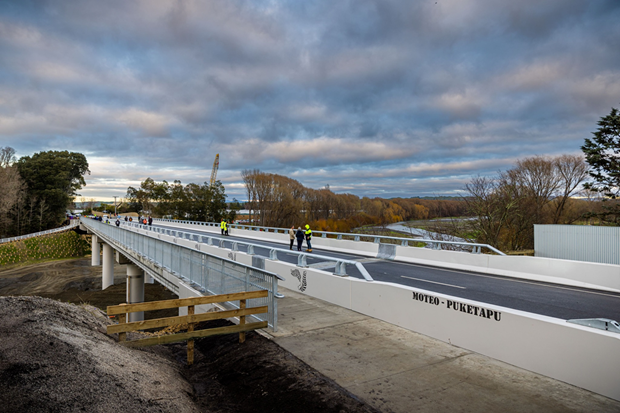
4.1 Moteo-Puketapu Bridge Replacement (Kaweka Ward)
The new bridge was
opened on 23 August. Improvements include two vehicle live lanes as
opposed to one and a shared pathway accommodating cycles and pedestrians,
separated from vehicular traffic.
4.2 Waitata Bridge Deck Replacement (Kaweka Ward)
The broken concrete
deck was replaced with a thicker, stronger precast deck. The former load
restrictions have been lifted. The bridge is now capable of carrying
General Access (46 t), 50MAX (50 t), and High Productivity Motor Vehicles
(HPMV, up to 62 t) BAU project.
4.3 Waikoau Gorge Bridge (Tutira Ward)
The cyclone damage has
been repaired and the bridge strengthened. Former weight restrictions
have been lifted. The bridge is now capable of carrying General Access
(46 t), 50MAX (50 t), and High Productivity Motor Vehicles (HPMV, up to 62 t)
4.4 Waikoau Road Slips (Tutira Ward)
The cyclone created
nine slips within the 1km long gorge section of the road. Two slips near
the bridge have been repaired as part of the bridge repair contract.
Seven slips remain. We are proposing a realignment around the hairpin to “get
away from the problem.” The slips repairs will be procured as a
package to be awarded to a single panel contractor. Price comparisons are
underway as we speak.
4.5 Rissington Bridge Replacement
Final stages of
procurement. Possible addition of Dartmoor Bridge, linked to take
advantage of efficiencies to be found in similar geographic area, bridge
geometry, and structural type. Bridge is a 2 lane 8.5m wide bridge able to
carry over dimension and overweight vehicles (with appropriate permits).
4.6 Aropaoanui Low-Level Bridge Repair
Detailed design to
commence this financial year.
4.7 Bridge Inspections
Next round of annual
inspections is being planned for November.
5.0 Rural Maintenance Contract Procurement
5.1 The rural road
maintenance contract expires on 31 June 2026. A report went to Council in May
advising of procurement options, contract models, and major changes that will
be included in the rewritten contracts
5.2 The contract was due
to expire in June 2022 however Tropical Cyclone Gabrielle put a halt to
the contract procurement despite it being written, and advertised.
5.3 The changes to the
2022 written contract are considered to be relatively minor in nature, and are
primarily due to industry changes, legislative changes, and opportunities for
continual improvement which is business as usual for operation contracts.
5.4 The rural contract is
expected to be tendered in mid November 2025 with tenders closing late January
2026.
6.0 Speed Limit
Review
6.1 As part of the setting
o speed limits for schools programme, significant work has taken place and is
further planned in installing new speed limit signs for rural school areas. To
date the following schools have had new signs installed:
· Bridge Pa School
· Maraekakaho School
· Omahu School
· Puketapu School
· Te Pohue School
· Waimarama School
6.2 Sherenden and
Districts School is pending, and Pukehamoamoa School is partially completed.
6.3 All remaining rural
schools will have signs installed by mid-September.
6.4 Signs installed are a
mixture of static signs and electronic variable speed signs. The electronic
ones are installed in the higher speed areas.
7.0 Hawke’s
Bay Regional Council Projects Ohiti Road and North Shore Road Stopbanks
7.1 The Hawke’s Bay
Regional Council have two projects underway that have impacts on Councils
roads. The two projects are Ohiti Road, and North Shore stopbanks.
7.2 Ohiti Road Stopbank
7.3 The Ohiti Road
stopbank project initiates a 1.0m (approx) lift on part of Ohiti Road and
Taihape Road. Detailed design is underway with construction expected to
commence in November 2025.
7.4 Investigations were
done by HBRC to determine the effects of the flood bank on Taihape Road. The
effects are noted in the table below. HDC’s asset managers will need to
consider lifting the bridge as and when it reaches it’s end of life, as well
as raise the road over time when road rehabilitations become required.
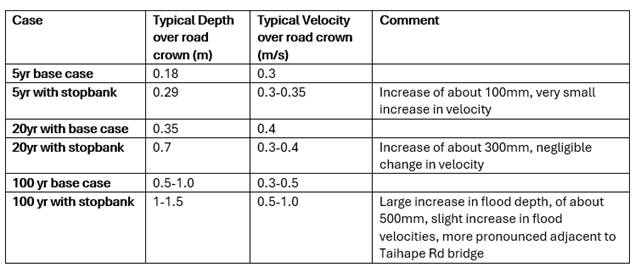
Table: Effects on water levels over
Taihape Road with varying storm return periods
7.5 North Shore Road Stopbank
7.6 The North Shore Road
stopbank project initiates a 1.0m (approx) lift on part of North Shore Rad and
State Highway 2. Detailed design is underway with construction expected to
commence in November 2025.
8.0 Waka Kotahi Update
8.1 Verbal update provided
by Waka Kotahi staff.
9.0 Works Update
9.1 Attachment 1
will provide the Board with a photographic snapshot of activities undertaken
between June 2025 and August 2025.
Attachments:
|
1⇨
|
Transport - Roads General (See notes) - RCB Photos - June
to Aug 25
|
TR-8-25-10208
|
Under Separate Cover
|
|
Summary of
Considerations - He Whakarāpopoto Whakaarohanga
|
|
Fit
with purpose of Local Government - E noho hāngai pū ai ki te
Rangatōpū-ā-Rohe
The Council is required to give effect to the purpose of
local government as set out in section 10 of the Local Government Act 2002.
That purpose is to enable democratic local decision-making and action by (and
on behalf of) communities, and to promote the social, economic,
environmental, and cultural wellbeing of communities in the present and for
the future.
Link to the
Council’s Community Outcomes –
Ngā Hononga ki Ngā Putanga ā-Hapori
This report promotes the performance of
regulatory functions for the purpose of providing safe, reliable, and
efficient transport networks.
|
|
Māori
Impact Statement -
Te Tauākī Kaupapa Māori
No known impacts for tangata whenua over
and above the impact on the rural district.
|
|
Sustainability
- Te
Toitūtanga
This is a progress report and
sustainability issues are not addressed.
|
|
Financial
considerations -
Ngā Whakaarohanga Ahumoni
The works identified within this
report are within existing budgets.
|
|
Significance
and Engagement - Te
Hiranga me te Tūhonotanga
This report has been assessed under the Council's
Significance and Engagement Policy as being of minor significance.
Individual projects will have been addressed under the significance and
engagement policy during the planning and decision-making phase of those
projects.
|
|
Consultation
– internal and/or external - Whakawhiti Whakaaro-ā-roto / ā-waho
No consultation is required as part of
this report.
|
|
Risks
Risk management and mitigation issues have been addressed
in project planning and organisational health and safety policies. The major
risk noted in this report is the potential for increase in tender costs in
the maintenance contract rewrite. There are many ways to manage this risk
such as decreased level of service, increased funding (and rate take), loan
funding projects and negotiations with successful tenderer.
|
|
Rural
Community Board –
Te Poari Tuawhenua-ā-Hapori
The Rural Community Board will have an
interest in the operations and transportation activities within the DRA2
rating area.
|
Hastings
District Council: Hastings District Rural Community Board
Te Rārangi Take
Report to Hastings District Rural Community Board
|
Nā:
From:
|
Anthony Van Rensburg,
Transportation: Project Delivery Manager
|
|
Te Take:
Subject:
|
Transportation Cyclone
Recovery Update
|
1.0 Executive Summary
– Te Kaupapa Me Te
Whakarāpopototanga
1.1 Cyclone Gabrielle
Recovery Programme has made substantial progress across the Hastings
District, restoring critical infrastructure impacted by the cyclone.
1.2 Over 140 sites have
been awarded, with many more in design, procurement,
or construction phases.
1.3 Key achievements
include:
· Completion
of major bridge and culvert rebuilds, restoring rural connectivity.
· Delivery
of slip repairs across multiple sites, improving road safety and
resilience.
· Acceleration
of road renewal works, with strategic upgrades to key transport routes.
1.4 The programme is supported
by NZTA and National Infrastructure Funding and Financing (NIFF), with
active collaboration between contractors, consultants, and HDC
teams.
1.5 Procurement
momentum remains strong, with a mix of ECI, managed,
and challenged sites progressing.
1.6 Several sites have
transitioned to defects liability or close-out stages,
indicating successful delivery.
1.7 Continued focus is
placed on winter delivery planning, variation management,
and community engagement.
|
2.0 Recommendations -
Ngā Tūtohunga
That the Hastings
District Rural Community Board receive the report titled Transportation
Cyclone Recovery Update dated 1 September 2025.
|
3.0 Background – Te Horopaki
3.1 Cyclone Gabrielle had
a devastating impact on our rural communities, damaging roads, bridges,
culverts, and hillsides across the Hastings District. Many families and farms
were cut off, and essential services were disrupted, making recovery a top
priority.
3.2 In response, Hastings
District Council, alongside national partners like the New Zealand
Transport Agency (NZTA) and the Crown through National Infrastructure
Funding and Financing (NIFF) formally known as Crown Infrastructure Partners
(CIP), launched the Cyclone Gabrielle Recovery Programme. This programme
is focused on rebuilding the infrastructure that connects our
communities—ensuring safe access to homes, schools, farms, and emergency
services.
3.3 The recovery effort
has involved:
· Engaging
with the community and prioritizing the most urgent repairs.
· Working
with local contractors and consultants to design and deliver solutions.
· Securing
funding to support long-term resilience and futureproofing.
· Coordinating
across agencies to ensure efficient and transparent delivery.
· This
programme is not just about fixing what was broken—it’s about
building back better, with stronger, safer infrastructure that supports the
wellbeing and livelihoods of our rural residents.
4.0 Discussion – Te Matapakitanga
4.1 The Cyclone Gabrielle
Recovery Programme continues to advance across a wide range of funded
infrastructure sites. Analysis of the current dataset reveals key insights into
both construction and design progress.
4.2 The estimated cost for
the Cyclone Gabrielle Recovery Phase is estimated to be $437 million which is
currently known, the team continues to monitor and update the scope. Some works
were unseen following the cyclone and prior to the cleanup. It should be noted
that this value excludes the initial response phase of the cyclone.
4.3 Section 4 provides a
high level perceptive of the cyclone recovery work to date. The figures below
are reported for sites where funding has been agreed. The funding requirements
are being discussed with funding partners on a continuing basis.
5.0 Funding for cyclone recovery work
5.1 Funding to complete
the Cyclone Gabrielle Recovery Programme has been secured through four key
sources. The largest contribution comes from the National Infrastructure
Funding and Financing (NIFF), formerly known as Crown Infrastructure
Partners (CIP), which provided NZD $224 million at a 100%
subsidy, enabling full coverage of eligible recovery works.
5.2 The second major
source is the New Zealand Transport Authority (NZTA), which initially
committed NZD $52 million, later increased to NZD $62.3 million,
delivered at a subsidy rate of 83%.
5.3 A third funding stream
is the Capability Fund, also referred to as the Prime
Minister’s Fund, which allocated NZD $1.4 million at
a 100% subsidy to support programme acceleration and Mana Whenua
engagement.
5.4 The final component of
funding is the ratepayer contribution, which complements the external
funding sources and ensures local investment in the district’s long-term
resilience and infrastructure recovery.
6.0 Capital Spend against the Long-Term Plan
(LTP)
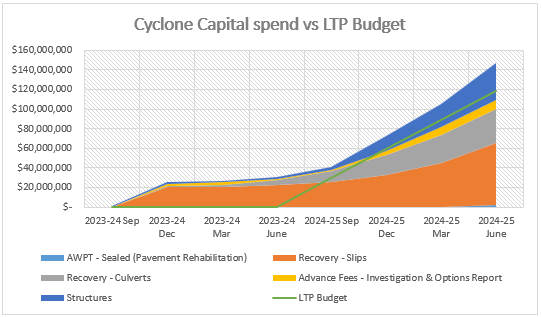
6.1 The visual
titled “Cyclone Capital Spend vs LTP Budget” illustrates
capital expenditure compared to the Long-Term Plan (LTP) through to the end of
June 2025.
6.2 A significant
acceleration in delivery is evident during the September 2024–25 period,
which aligns with the injection of NZTA funding. Overall, actual delivery has
outpaced the forecasted phasing outlined in the LTP, as indicated by the green
line. This surge in activity reflects the programme’s commitment to
restoring the roading network as quickly as possible.
6.3 While current spend
levels are elevated due to the recovery effort, they are expected to stabilise
and return to normal levels in future.
6.4 Notably, the current
costs of NIFF projects are being delivered at 14% under the awarded
funding, thanks to strategic procurement and competitive tendering. Major
bridge rebuilds—such as Rissington Bridge, Matapiro Bridge, and
Moteo-Puketapu Bridge are being actively managed and completed below budget.
These savings are expected to be reinvested to deliver additional projects at
the 100% subsidy rate, maximising value for ratepayers and
accelerating recovery outcomes.
7.0 Work allocation and progress to
finalisation
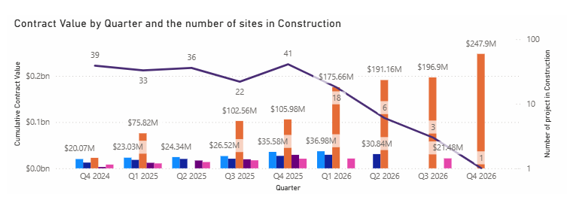
7.1 The visual
titled “Contract Value by Quarter and the Number of Sites in
Construction” presents a quarterly breakdown of tendered
contract values per contractor, alongside the number of sites commencing
construction.
7.2 Each bar represents
the cumulative contract value awarded or expected to be awarded, with color
coding distinguishing individual contractors. Notably, the orange
bars indicate work that has not yet been assigned and will
be tendered outside the contractor panel or into the open market.
A purple line overlays the chart, showing the number of sites
starting construction each quarter.
7.3 The data reveals
a peak in construction activity through 2025 and early 2026, followed by
a sharp decline in project volume beginning at the end of that year.
Despite this drop in quantity, spending continues to grow beyond Q2 2026,
driven largely by major bridge rebuilds—such as Brookfield and
Redclyffe bridges—which are predominantly outside the contractor panel.
7.4 This trend reflects a
shift toward fewer but significantly larger and more complex infrastructure
sites in the latter stages of the recovery programme.
8.0 Mana Whenua Engagement and Communication
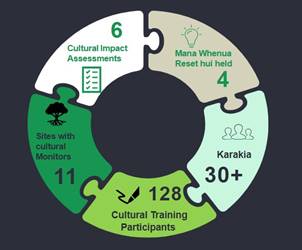
8.1 The visual highlights
the depth and breadth of engagement efforts across two key areas: Mana
Whenua Engagement and Community Communications.
8.2 In terms of Mana
Whenua Engagement, the project has actively collaborated with iwi and hapū
through six Cultural Impact Assessments, ensuring that cultural values are
respected in planning and execution. Four Reset Hui were held to
realign and strengthen relationships, while over 30 Karakia were
conducted to spiritually ground key milestones. Cultural understanding was
further promoted through training, with 128 participants completing
cultural competency sessions. Additionally, 11 sites were supported by
cultural monitors to safeguard heritage and tikanga during works.
8.3 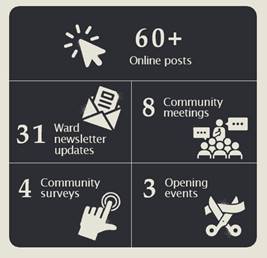
 On
the Communications front, the team maintained strong public
engagement through 60+ online posts, 31 ward newsletter updates,
and 8 community meetings. Feedback and inclusivity were prioritized
via 4 community surveys, and 3 opening events celebrated project
milestones with the public. These figures reflect a comprehensive and proactive
approach to both cultural partnership and community transparency.
On
the Communications front, the team maintained strong public
engagement through 60+ online posts, 31 ward newsletter updates,
and 8 community meetings. Feedback and inclusivity were prioritized
via 4 community surveys, and 3 opening events celebrated project
milestones with the public. These figures reflect a comprehensive and proactive
approach to both cultural partnership and community transparency.
8.4 Key highlights
include:
· Ceremonial
openings such as the Kererū Gorge Bridge, where Mayor Hazlehurst
and Kererū School children participated in a community-led event.
· Ongoing
collaboration with iwi representatives through project reference groups,
including for major infrastructure like the Redclyffe/Waiohiki Bridge.
· Community
engagement sessions held across affected areas to share updates, gather
feedback, and co-design solutions.
· Cultural
monitoring and karakia incorporated into construction milestones, ensuring
tikanga Māori is upheld throughout the programme.
8.5 These efforts have
strengthened relationships, built trust, and ensured that recovery is not only
about rebuilding infrastructure, but also about restoring community wellbeing
and resilience.
9.0 Design Status
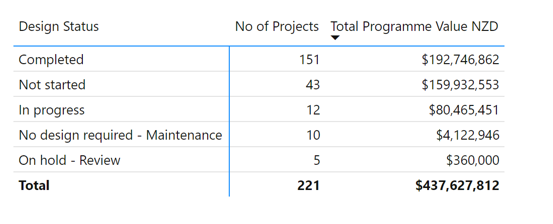
9.1 The table provides a
snapshot of the design status across 221 sites. Most sites 151 in
total have reached the Completed stage, representing a significant
portion at $192.7 million, indicating strong delivery momentum.
9.2 Meanwhile, 43
sites have Not Started, yet they account for a
substantial $159.9 million, these relate to large ticket items like bridge
rebuilds which are progressing through feasibility stages
9.3 A smaller group
of 12 sites are In Progress, valued at $80.5
million. 10 sites fall under No Design Required –
Maintenance, with a modest value of $4.1 million, these sites are of a low
complexity covering routine or minor works. Lastly, 5
sites are On Hold – Review, totalling $360,000, which
indicates that the delivery team are reviewing the designs are potentially
investigating alternate and more cost effective solutions.
· Most sites
have completed design, enabling procurement and construction.
· A significant
number are not yet designed, often due to complexity or seasonal constraints.
· A small group
is on hold or under review, pending further scope clarification or funding
10.0 Procurement Status
10.1 The procurement status table outlines
the current progress of 221 sites, offering insight into how far each
initiative has advanced through the procurement pipeline. The majority, 140
sites—have reached the Awarded stage, representing $188.5
million, indicating that contracts have been finalised.
10.2 In some cases, the work has been
awarded but the physical work is yet to start. 46 sites are in
the Early Contractor Involvement (ECI) phase, valued at $17.7
million, this in a new initiative introduced to involve the constructor at an
early stage to participate in the design process thus reducing the costs of
extensive design work.
10.3 Thirty sites have Not Started, yet they
account for the largest value at $206 million NZD, while the value is high
the quantity is relatively low, and this is due to these sites mostly being
bridges.
10.4 Meanwhile, 3
sites are On Hold, with value of $238,000, these sites are On
Hold awaiting other external dependencies not being met. One project is at
the Recommendation Memo stage, valued at $25 million NZD, this
project is a bridge rebuild which will be awarded in the next two weeks, the
value of the award will be adjusted at the time of the award. Another project
is currently in the Tender Process, the value is withheld at this stage
due to commercial sensitivity. This distribution reflects a healthy pipeline
with a strong focus on delivery.
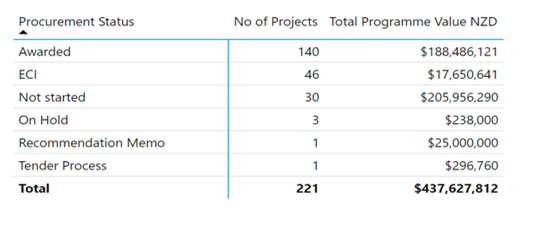
10.5 Procurement activity within the Cyclone
Gabrielle Recovery Programme reflects a diverse and active pipeline of
infrastructure delivery.
· Awarded
contracts represent the bulk of procurement activity, indicating strong
engagement with contractors and readiness for delivery.
· ECI
sites show a collaborative approach to early planning and risk management.
· Recommendation
Memos and Tender Processes are progressing, reflecting active
procurement planning.
· A small number of
sites are on hold, typically due to scope clarification or external
dependencies.
· This procurement
spread demonstrates the programme’s strategic balance between immediate
delivery and long-term planning, ensuring resilience and responsiveness across
the recovery effort.
11.0 Construction Status
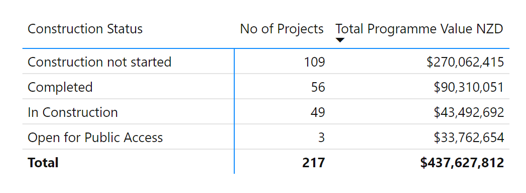
11.1 The construction status table provides
a clear overview of construction progress.
11.2 Fifty-six sites have
been completed, representing $90.3 million, showcasing substantial
progress in restoring infrastructure. 49 sites are currently in
construction, with a combined value of $43.5 million, indicating active
delivery across the region.
11.3 Additionally, 3 sites have
reached the stage of being open for public access, valued at $33.8
million, marking key milestones in community recovery and accessibility.
11.4 A portion, 109 sites, have not yet
started construction, with 34 sites already been awarded. These sites are
strategically timed to begin during the spring and summer construction
season, particularly at high-altitude sites where colder winter
temperatures pose challenges for efficient delivery. 44 sites are undergoing
Early Contractor Engagement, 5 sites of these are on hold or in recommendation
memo phase and 27 the procurement has not started.
11.5 This distribution reflects a well-paced
programme that balances seasonal constraints with delivery momentum, ensuring
that awarded sites are mobilised at the most opportune time while maintaining
steady progress across the network.
11.6 Key Insights:
· Completed
sites reflect successful delivery and restored infrastructure.
· In-construction
sites show active delivery across the district.
12.0 Progress in pictures
|
Moteo-Puketapu
Bridge – Complete and open to the public 23 August.
|
|
|
|
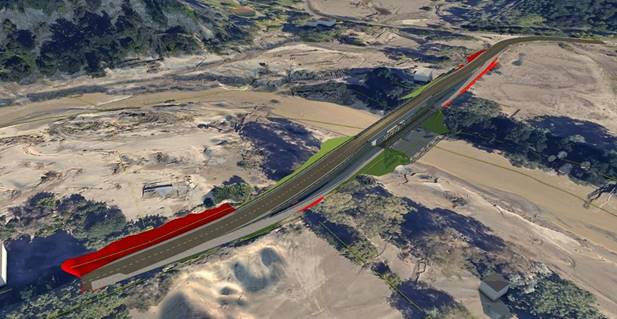
Rissington Bridge
The new bridge is
about 1.3 m higher than the old one, and considerably longer and wider.
It’s designed for two full traffic lanes and modern heavy vehicles.
The bridge is
designed for the heaviest trucks and loads allowed on NZ roads, including
overweight vehicles with special permit, ensuring its future-proofed for
modern freight and farm traffic.
The bridge is built
to handle a 1-in-50-year flood and is much more resilient to debris and
extreme weather. Maintenance should be minimal for the first 25+ years (steel
barriers), and 100+ years for the main structure.
|
|
|
|
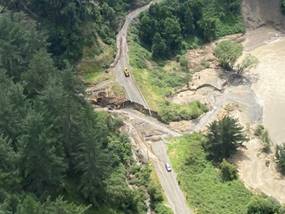
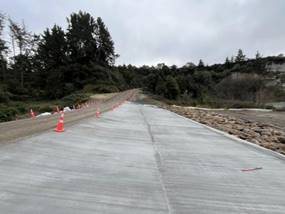
McVicars Culvert – Completion in August 2025
|
|
|
|
|
Aerial image of McVicars Culvert damage
|
McVicars Road Slipway – July 2025
|
|
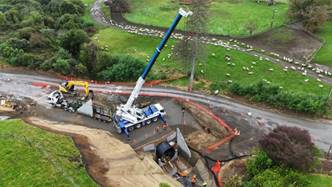
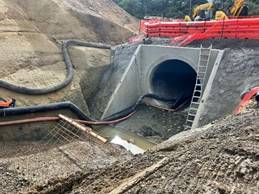
Patoka Culvert – Completion
in September 2025
|
|
|
|
|
Culvert washout. Utilised repurposed pipe from
Chrystal Twin Culvert.
|
First of its kind fish ramp designed in
collaboration with mana whenua, ecology and WSP consultants to accommodate
safe passage through the culvert fish.
|
|
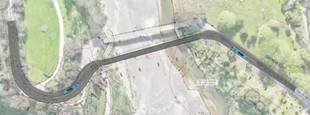
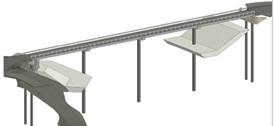
Dartmoor Bridge
· Construction starts late 2025, with an estimated
build time of nine months.
· Rissington tender allows for Council to negotiate
with the successful tenderer for this project.
· Four spans, 104m total length. Temporary bridge
remains open during works.
|
|
|
|
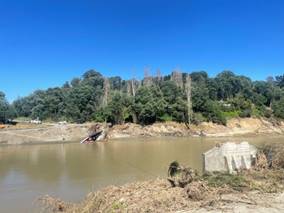
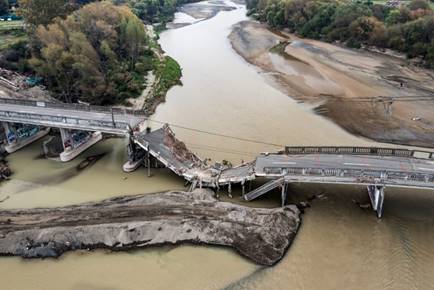
Redclyffe/Waiohiki
Bridge
· Funding has been secured for site investigation and
detailed design.
· Project Reference Group established and met for the
first time early August.
· Span is 220-240m depending on alignment option.
|
|
|
|
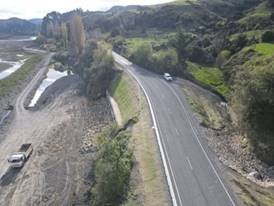
Dartmoor Road RP7.69
– 100% complete
|
|
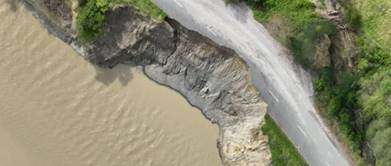
Before: Two major slips spanning 40m each in length
|
|
|
|
After: Reinforced earth wall and new 2.1m culvert
with rip-rap protection.
|
|
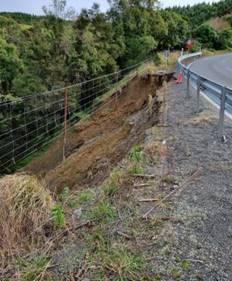
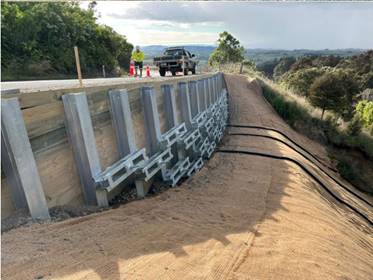
Taihape Road – 10
Slip package of works complete
|
|
|
|
|
|
Consisted of four
under slips in proximity. Fix involved building four steel piled anchored
retaining walls, stormwater improvement and lengthening the existing
guardrail.
|
|
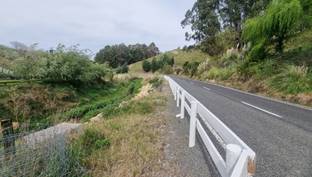
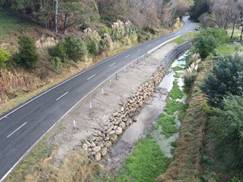
Puketitiri Road Slip
Package
|
|
|
|
|
Scope of works:
· Gabion retaining wall construction
· Reinstatement of the road shoulder
· Hydroseeding
· Fish passage management
Sustainable outcome:
Local Hapu group
participated in fish relocation and caught a koura (freshwater crayfish) for
breeding programme. Use of local river boulder to fill gabions.
|
|
|
|
Attachments:
There are no attachments for this report.
Te
Hui o Te Kaunihera ā-Rohe o Heretaunga
Hastings
District Council: Hastings District Rural Community Board
Te
Rārangi Take
Report to Hastings District Rural Community Board
|
Nā:
From:
|
Danny McClure, Solid
Waste Operations & Contract Manager
|
|
Te Take:
Subject:
|
Te Pōhue Rural
Recycling Request
|
1.0 Executive Summary – Te Kaupapa Me Te
Whakarāpopototanga
1.1 The
purpose of this report is to seek support from the Rural Community Board to
install a permanent rural recycling facility at Te Pōhue.
1.2 This
matter arises from a Te Pōhue community request to increase the recycling
level of service and is in line with the Joint Waste Management Minimise Plan.
|
2.0 Recommendations - Ngā Tūtohunga
A) That
the Hastings District Rural Community Board receive the report titled Te
Pōhue Rural Recycling Request dated 1 September 2025.
B) That
the Board approve the establishment of a rural recycling facility at Te
Pōhue for a 12 month trial period. The success of the trial will be
measured on participation, contamination and illegal dumping at the site.
|
3.0 Background – Te Horopaki
3.1 In
the 2014/2015 Annual Plan, Council resolved to proceed with the development of
rural recycling facilities, looking at a potential eight sites across the
district. Since then, six permanent sites have been established.
3.2 In
2019 a new recycling service contract was procured, and this new contract
allows for additional sites to be serviced under the contract.
3.3 Rural
recycling facilities provide a drop off service for common recyclables, glass,
plastics, cans, paper and cardboard.
3.4 Several
requests have been received by Council Officers from the residents in the Te
Pōhue Community to have access to a recycling service/facility year-round.
3.4.1 The
2020 closure of the public drop off facility in Onekawa, Napier requires
northern Hastings District Residents to travel further to another Napier City
Council facility (Redcliffe Refuse Transfer Station) – currently there
are no Hastings recycling services for residents in this area of the district.
3.5 The
current annual budget for servicing the six rural recycling sites is $60,000
per annum. There are sufficient funds to cover estimated additional
servicing costs in the 25/26 budget for rural recycling.
3.6 There
have been several previous attempts to install a rural recycling drop-off
facility in Te Pōhue:
· 2015
– discussions were held with Maungaharuru-Tangitū Trust regarding
the possibility of installing a facility on the same land.
· 2020
– after community consultation, indicating support, a consent application
lodged to install the facility next to the Te Pōhue water supply facility
which was being constructed at the time. However, a neighbouring property
changed hands, and the new owner opposed the setting up of the site.
· 2023
– a private residential request was made to set up a drop-off facility on
a paper road behind the Te Pōhue golf course. The access was via a
private road owned by Rainer Matariki Forests and indemnity was not provided to
use as access.
4.0 Discussion – Te Matapakitanga
4.1 A
potential site has been identified within Te Pōhue, located on leased Iwi
land for the local community and camp site users. Council officers have
completed a site visit to determine the feasibility of the location and agree
the site could be used with little construction costs for the trial.
4.2 The
recycling container configuration would consist of 1 x 20ft container with 4
cells – same set up as the Tūtira site.
4.3 Norm
Brown (camp custodian) has engaged with Iwi and confirmed they are open to the
idea of a rural recycling facility onsite. Norm also confirmed there is CCTV to
monitor the site at his cost.
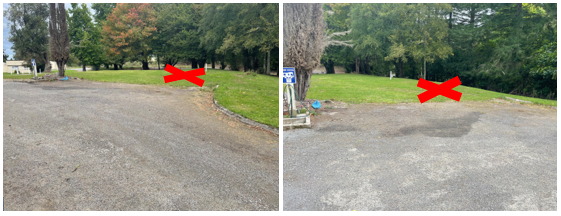
4.4 Imagery
below highlights the agreed area onsite for an initial trial, with minimal cost
impact initially.
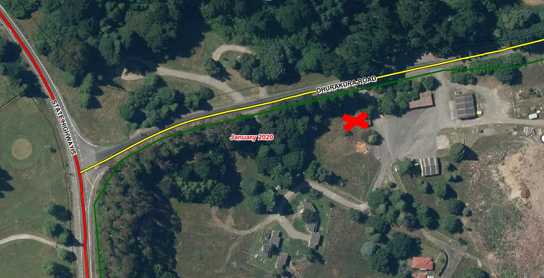
4.5 The
estimated costs for a one-year trial are:
4.6 Servicing
costs $3,185
(based on servicing every 6-8 weeks).
4.7 Bin
configuration set up costs $4,500
4.8 Site
set up costs $1,000
4.9 Signage
costs $2,000
4.10 Total
estimated costs $10,685
4.11 The
25/26 rural recycling R&M budget is $34,900 and has funds to cover these
costs in the repair and maintenance portion of this budget
4.12 The
establishment of permanent sites have historically been funded using
Council’s Waste Disposal Levy funds, however servicing and operational
costs are funded through the Community & Resource Management Rate.
5.0 Options – Ngā Kōwhiringa
Option One - Recommended Option -
Te Kōwhiringa Tuatahi – Te Kōwhiringa Tūtohunga
5.1 Install
a rural recycling drop off facility at Te Pōhue on the Te Pohue Camp
property, at 22 Ohurakura Road, Te Pohue.
5.2 The
facility will be installed for a 12-month trial period during which time
participation, contamination and illegal dumping will be monitored and
assessed.
Advantages
· Provides
a 12-month service to residents in the Te Pōhue and wider rural community.
· Community
to monitor and “own” to ensure the site is looked after.
· Bin
provision will be covered using the existing fleet of green bins and with no
purchase required.
Disadvantages
· Additional
cost to service, not budgeted for in the 25/26 Annual Plan, circa $3,185.00 per
annum (funds are available within this budget)
· Contamination
of product within bins with passing travellers using site/bin as dumping ground
for rubbish (as it’s unmanned).
· The
site may have to be closed if contamination levels become a problem.
Success of the trial will be assessed
on the following points.
· Participation /
use of the facility measured through number of times the bin is serviced over
the quiet winter period.
· Contamination of
recycling material, to always be less than 2%.
· No illegal dumping
of rubbish at the site.
Option Two – Status Quo - Te Kōwhiringa Tuarua – Te
Āhuatanga o nāianei
5.3 Not
support the request to trial a rural recycling drop-off facility at Te
Pōhue.
Advantages
· No
additional costs
Disadvantages
· Rural
residents do not have recycling service
· Recycling
continues to go to landfill
6.0 Next steps – Te Anga Whakamua
6.1 Works
will commence after input and approval has been obtained by the Rural Community
Board.
6.2 Advise
Te Pōhue Camp Ltd – Norm Brown and Henry Tahu who are the lease
holders on the site and have fully endorsed this initiative, along with Mark
Rutene from Maungaharuru-Tangitū Trust.
6.3 If
a permanent site was to be established after this initial trial period, a more
formalised lease to occupy the camp site would need to be implemented and
investment would need to be applied in the form of a concrete pad, static
foundations for steps, bin stop and guide.
Attachments:
There are no attachments for this report.
|
Summary of
Considerations - He Whakarāpopoto Whakaarohanga
|
|
Fit
with purpose of Local Government - E noho hāngai pū ai ki te
Rangatōpū-ā-Rohe
The Council is required to give effect to the purpose of
local government as set out in section 10 of the Local Government Act 2002.
That purpose is to enable democratic local decision-making and action by (and
on behalf of) communities, and to promote the social, economic,
environmental, and cultural wellbeing of communities in the present and for
the future.
Link to the
Council’s Community Outcomes –
Ngā Hononga ki Ngā Putanga ā-Hapori
This proposal promotes the local public
services wellbeing of communities in the present and for the future
supporting a community which wastes less.
|
|
Māori
Impact Statement -
Te Tauākī Kaupapa Māori
This initiative will have no direct
impact on the Maori community.
|
|
Sustainability
- Te
Toitūtanga
The establishment of a permanent rural
recycling facility at Waipatiki aligns with Action 1.7 of the Joint Waste
Management and Minimisation Plan 2025-31; Provide kerbside, transfer station
and rural
recycling services to recover materials
in line with standardisation requirements set by central government, or where
viable end markets exist and there is no product stewardship schemes i.e.
e-waste. This may also include capital
and plant expenditure costs.
|
|
Financial
considerations -
Ngā Whakaarohanga Ahumoni
Servicing of the bin for a 12mth
period is estimated to be $3185.00, this coupled with set up costs of
$10,685.00 are covered within the 25/26 budget and Community &
Resource Management rate revenue.
|
|
Significance
and Engagement -
Te Hiranga me te Tūhonotanga
This decision/report has been assessed under the Council's
Significance and Engagement Policy as being not of significance.
|
|
Consultation
– internal and/or external - Whakawhiti Whakaaro-ā-roto / ā-waho
Consultation regarding rural recycling
facilities was undertaken as part of the 2014/2015 Annual Plan, no further
consultation is required.
|
|
Risks
Opportunity: to extend rural recycling services in line with action 1.7 of the
Joint Waste Management and Minimisation Plan.
|
REWARD – Te Utu
|
RISK – Te Tūraru
|
|
Increased accessibility to recycling facilities to
support the goals, objectives and targets of the Joint Waste Management and
Minimisation Plan.
|
There is a risk that the site may be subjected to
dumping of rubbish or contamination of recyclable material. There is
no higher risk at this site than any other rural recycling site. The
community will be responsible for the management and oversight of use of a
daily basis.
Additional cost to service may exceed existing budget.
|
|
|
Rural
Community Board –
Te Poari Tuawhenua-ā-Hapori
This request is being presented to the
Rural Community Board for consideration.
|