Kaupapataka
Open Agenda
|
Te Rā Hui:
Meeting date:
|
Tuesday, 14 July 2020
|
|
Te Wā:
Time:
|
1.00pm
|
|
Te Wāhi:
Venue:
|
Council Chamber
Ground Floor
Civic Administration
Building
Lyndon Road East
Hastings
|
|
Te Hoapā:
Contact:
|
Democracy
and Governance services
P: 06 871 5000
| E: democracy@hdc.govt.nz
|
|
Te Āpiha Matua:
Responsible Officer:
|
Chief Executive - Nigel Bickle
|
Kaupapataka
Open Agenda
|
Mematanga:
Membership:
|
Tiamana
Chair: Mayor Sandra Hazlehurst
Ngā KaiKaunihera
Councillors: Bayden Barber,
Alwyn Corban, Malcolm Dixon, Damon Harvey, Tania Kerr (Deputy Chair), Eileen
Lawson, Simon Nixon, Henare O’Keefe, Peleti Oli, Ann Redstone, Wendy Schollum,
Sophie Siers, Geraldine Travers and Kevin Watkins
|
|
Tokamatua:
Quorum:
|
8 members
|
|
Apiha Matua
Officer Responsible:
|
Chief Executive – Nigel
Bickle
|
|
Te Rōpū Manapori me te Kāwanatanga
Democracy and Governance Services:
|
Jackie Evans (Extn 5018)
|
Te Rārangi Take
Order of Business
|
1.0
|
Opening
Prayer – Karaki
a Whakatūwheratanga
|
|
|
2.0
|
Apologies
& Leave of Absence – Ngā Whakapāhatanga me te Wehenga ā-Hui
At the
close of the agenda no apologies had been received.
At the close
of the agenda no requests for leave of absence had been received.
|
|
|
3.0
|
Seal
Register– Te
Rēhita Hira
|
|
|
4.0
|
Conflict
of Interest –
He Ngākau Kōnatunatu
Members need to be vigilant to stand aside from
decision-making when a conflict arises between their role as a Member of the
Council and any private or other external interest they might have.
This note is provided as a reminder to Members to scan the agenda and assess
their own private interests and identify where they may have a pecuniary or
other conflict of interest, or where there may be perceptions of conflict of
interest.
If a Member feels they do have a conflict of
interest, they should publicly declare that at the start of the relevant item
of business and withdraw from participating in the meeting. If a Member
thinks they may have a conflict of interest, they can seek advice from
the General Counsel or the Manager: Democracy and Governance (preferably
before the meeting).
It is noted that while Members can seek advice and
discuss these matters, the final decision as to whether a conflict exists
rests with the member.
|
|
|
5.0
|
Confirmation
of Minutes –
Te Whakamana i Ngā Miniti
Minutes of the
Council Meeting held Thursday 25 June 2020.
(Previously circulated)
|
|
|
6.0
|
Chief
Executive's Report to Council
|
9
|
|
7.0
|
Resolution
to set the Rates for the 2020/21 Financial Year
|
13
|
|
8.0
|
Speed
Limit Review - Proposed Bylaw Amendments for Public Consultation
|
23
|
|
9.0
|
Arts,
Culture and Events Recovery Plan
|
37
|
|
10.0
|
Plan
Change 2 to the Partially Operative District Plan - Engineering Code of
Practice
|
43
|
|
11.0
|
Council
Submission to Regional Plan Change No.9 - Management of Tank Freshwater
Catchments
|
49
|
|
12.0
|
Flaxmere
Learn to Swim Funding Application to Trust House
|
61
|
|
13.0
|
Office
Accommodation
|
65
|
|
14.0
|
Youth
Council Appointments to Council Subcommittees
|
69
|
|
15.0
|
Minor
Amendment to the Committee and Rural Community Board Register of Delegations
2019 -22
|
73
|
|
16.0
|
Status
of Items Under Action from Previous Meetings
|
75
|
|
17.0
|
Minor Items
– Ngā Take
Iti
|
|
|
18.0
|
Urgent
Items –
Ngā Take Whakahihiri
|
|
|
19.0
|
Recommendation
to Exclude the Public from Item 20
|
77
|
|
20.0
|
Civic
Honours Award Nominations 2020
|
|
Hastings
District Council: Council Meeting
Te Rārangi Take
Report to Council
|
Nā:
From:
|
Nigel Bickle, Chief Executive
|
|
Te Take:
Subject:
|
Chief Executive's Report
to Council
|
1.0 PURPOSE AND SUMMARY -
TE KAUPAPA ME TE WHAKARĀPOPOTOTANGA
1.1 The
purpose of this report is to provide executive context for the strategic items
on this Council Meeting Agenda. The remaining items are important operational
matters and are well traversed within the Officer Reports.
Rates
Strike for Financial Year 2020/2021
1.2 The COVID-19 Pandemic
has been and continues to be an extraordinary social and economic challenge for
all communities. Following community consultation, Council adopted the
2020/2021 Annual Plan at its meeting on 25 June 2020.
1.3 Council revised its
original Draft Annual Plan Budget down to a Rating Revenue Increase of 1.9%
from 4.4%. It was felt that this level of increase still allowed Council to
fulfil an essential role in stimulating the economy, sustaining employment and
retaining an ability to add to local support initiatives alongside
Government’s financial packages supporting business and employees.
1.4 I am confident the
Annual Plan still allows Council to continue with its essential infrastructure
renewal works, programmed delivery of growth infrastructure and continuity of
core Council Services.
1.5 Council Officers have
carefully calculated the rates as detailed in the report recommendations for
Council to collect our revenue needs (1.9% increase) for 2020/2021 commencing 1
July 2020.
Speed Limit Review
1.6 It is the responsibility
of Council as the Road Controlling Authority to implement safe and appropriate
speed limits across the road network.
1.7 Council officers have
prepared a ‘Statement of Proposal’ which identifies speed limits to
be made or amended under the Council bylaw, for public consultation and the
future opportunity for public submissions.
1.8 The precursors for
change to speed limits tend to be public requests and crash report
recommendations from fatal and serious injury vehicle crashes and incidents.
Officers then undertake evidence based research to determine safe and
appropriate speed limit recommendations in accordance with the New Zealand
Transport Agency Information and Speed Management Guide.
1.9 Ensuring our Roading
Network remains as safe as possible is essential for the wellbeing of our
community.
Council Submission to Regional Plan Change
No 9
1.10 The 2014 National Policy Statement for
Freshwater Management requires the Hawke’s Bay Regional Council (HBRC) to
set freshwater objectives, including allocation limits and targets for water
bodies in Hawke’s Bay.
1.11 Officers and our consultants (after
workshops with Council) have drafted a Submission to the HBRC Proposed Change
No. 9 to the Regional Resource Management Plan which relates to the management
of fresh water in the Greater Heretaunga Catchments (Tutaekuri, Ahuriri,
Ngaruroro and Karamu) known as the TANK Catchments.
1.12 Ensuring ongoing sufficient and safe
supply of quality water for domestic, commercial, industrial and rural
productive demands, is a very complex series of challenges and opportunities
for current generations and indefinitely into the future.
1.13 Council as a Territorial Local
Authority have a responsibility under the Local Government Act to play a broad
role in promoting the social, economic, environmental, and cultural well-being
of our communities, and taking a sustainable development approach.
1.14 Officers in developing the recommended
submission, have tried to take a balanced and pragmatic approach to achieving
good environmental outcomes over reasonable timeframes and acknowledging the
overarching purpose of The Resource Management Act is to promote the
sustainable management of natural and physical resources. There has been
significant investment in land based primary production in Hastings District
and associated downstream processing and logistics infrastructure, particularly
over the last 30 years. Water is the fuel that keeps everything operating and
underpinning our wellbeing.
1.15 Accordingly the recommended submission
seeks changes to the rules to provide Council with more flexible options to
meet our ongoing growth requirements and associated statutory responsibilities
to facilitate sufficient housing and business capacity to meet growth demands.
Arts and Culture Recovery Plan
1.16 The COVID 19 Pandemic and consequential
border closures currently in place are presenting barriers to our arts, culture
and events industries operating to their full potential.
1.17 The recommended Recovery Plan aims to
provide foundational support until the Creative Sector can return to a more
normal operating environment. The focus of the Plan is to deliver a series of
‘activation’ activities and events to enable community resilience
and pride and generally sustain the creative sector.
Youth Council Appointments to Council
Subcommittees.
1.18 Council recognises the positive
contribution young people make to a strong, diverse, resilient and inclusive
community. The Youth Council provides a vehicle for members to be actively
engaged in our planning and decision making.
1.19 This report is recommending that Youth
Council members be appointed to Council subcommittees (2 per committee) as
non-voting members so they can participate in discussions and debate. This will
bring a real time youth perspective to the shaping and development of Council
strategy and policy.
1.20 The Youth Council, note in their Annual
Plan that barriers to the Youth Council succeeding include;
· Reputation
– Often youth are perceived as incapable and ignorant. This means people
don’t value our opinion that much.
· Tokenism-
Often we are engaged with by groups so they can tick a box, and not for genuine
reasons.
· Lack
of Support, Systems and Resources – To achieve our larger goals, we are
held back by the lack of help available to us.
1.21 I have been concerned about these
barriers as presented by Youth Council members. Like all communities within our
Hastings community, the Youth community is an important voice and should
actively participate in local government. I’m hopeful Youth Council
appointments to Council subcommittees will be an effective step in addressing
the barriers.
Conclusion
1.22 This is another busy Agenda for
Council. It is reflective of the substantial and complex work programme being
delivered by staff under the strategic and policy direction set by Council. I
remain confident we have the capacity and capability to operate efficiently and
effectively in our ongoing environment of budgetary restraint to deliver our
ambitious programme of work this year for our community.
|
2.0 RECOMMENDATIONS
- NGĀ TŪTOHUNGA
A) That
the Council receives the report titled Chief Executive's
Report to Council.
|
Attachments:
There are no attachments for this report.
Hastings
District Council: Council Meeting
Te Rārangi Take
Report to Council
|
Nā:
From:
|
Ashley Humphrey, Financial Policy Advisor
|
|
Te Take:
Subject:
|
Resolution to set the
Rates for the 2020/21 Financial Year
|
1.0 Executive Summary
– Te Kaupapa Me Te
Whakarāpopototanga
1.1 The
purpose of this report is to obtain a decision from the Council to adopt the
Rates Resolution to set rates for the 2020/21 Financial Year commencing 01 July
2020.
1.2 This
decision contributes to the purpose of local government by meeting the current and
future needs of communities for good quality local infrastructure, local public
services, and performance of regulatory functions in a way that is most
cost–effective for households and businesses. Good quality means
infrastructure, services and performance that are efficient and effective and
appropriate to present and anticipated future circumstances.
1.3 Following
consultation, Council adopted the 2020/21 Annual Plan at its meeting on 25 June
2020. It now needs to assess and set the rates described in its Rating Policy
and Funding Impact Statement in order to collect the revenue needed for the 2020/21
Financial Year commencing 1 July 2020.
1.4 This
report concludes by recommending that the Council set the rates as detailed,
adopt the differential categories and the payment due and penalty dates set out
in the recommendations. All rates are shown as inclusive of Goods and Services
Tax of 15%.
|
2.0 Recommendations – Ngā Tūtohunga
A) That the
Council receives the report titled Resolution to set the Rates for the
2020/21 Financial Year.
B) That
pursuant to the Local Government (Rating) Act 2002 the Hastings District
Council makes the rates on rating units in the District for the financial
year commencing on 01 July 2020 and ending on 30 June 2021 and adopts the due
dates and penalty dates for the 2020/21 financial year, as follows:
INTRODUCTION
Hastings District Council has adopted its 2020/21
Plan. This has identified the Council’s budget requirement, and
set out the rating policy and funding impact statement. The Council
hereby sets the rates described below to collect its identified revenue needs
for 2020/21 commencing 01 July 2020. All rates are inclusive of Goods
and Services Tax.
GENERAL RATES
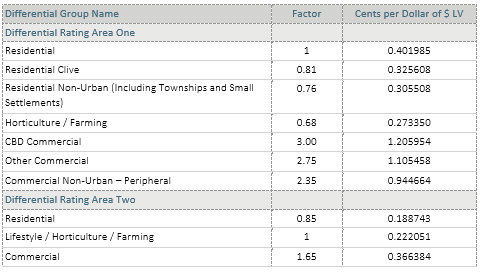
A general rate set and
assessed in accordance with Section 13 of the Local Government (Rating) Act
2002, on the land value of all rateable land within the district on a
differential basis as set out below:
UNIFORM ANNUAL GENERAL
CHARGE
A uniform annual general
charge set and assessed in accordance with Section 15 of the Local Government
(Rating) Act 2002, of $200 on each separately used or inhabited part of a
rating unit within the district.
TARGETED RATES
All differential categories
of targeted rates areas are as defined in the Funding Impact Statement for 2020/21.
For the purposes of the Havelock North Promotion, Hastings City Marketing,
Hastings CBD Targeted Rate, Havelock North CBD Targeted Rate, and Security
Patrols (Hastings and Havelock North), a commercial rating unit is one
that fits the description as set out under DRA1 CBD Commercial and DRA1 Other
Commercial in Part B of the Funding Impact Statement for 2020/21.
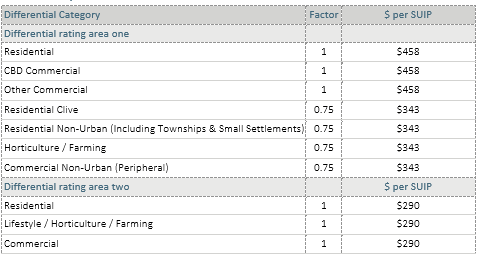
COMMUNITY SERVICES &
RESOURCE MANAGEMENT RATE
A targeted rate set and
assessed in accordance with Section 16 of the Local Government (Rating) Act
2002, on a differential basis, on each separately used or inhabited part of a
rating unit as follows:
HAVELOCK
NORTH PROMOTION
A targeted rate set and
assessed in accordance with Section 16 of the Local Government (Rating) Act
2002, on the land value of any commercial rating unit located within Havelock
North as defined on Council Map “Havelock North Promotion Rate”,
of 0.110909 cents per dollar of land value.
SWIMMING POOL SAFETY
A targeted rate set and
assessed in accordance with Section 16 of the Local Government (Rating) Act
2002, as a fixed amount on every rating unit where a swimming pool (within
the meaning of the Fencing of Swimming Pools Act 1987) is located, of $64 per
rating unit.
HAVELOCK NORTH PARKING
A targeted rate set and
assessed in accordance with Section 16 of the Local Government (Rating) Act
2002, on a differential basis, on each separately used or inhabited rating
unit located within Havelock North as defined on Council Map “Havelock
North Parking”, as follows:

HASTINGS CITY MARKETING
A targeted rate set and
assessed in accordance with Section 16 of the Local Government (Rating) Act
2002, on the land value of any commercial rating units located within
Hastings as defined on Council Map “Hastings City Marketing
Rate”, of 0.235554 cents per dollar of land value.
HASTINGS CBD TARGETED RATE
A targeted rate set and
assessed in accordance with Section 16 of the Local Government (Rating) Act
2002, on the land value of any commercial rating unit located within Hastings
as defined on the Council Map “Hastings CBD”, of 0.140007 cents
per dollar of land value.
HAVELOCK NORTH CBD
TARGETED RATE
A targeted rate set and
assessed in accordance with Section 16 of the Local Government (Rating) Act
2002, on the land value of any commercial rating unit located within Havelock
North as defined on Council Map “Havelock North CBD”, of 0.0552960
cents per dollar of land value.
SECURITY PATROLS
Targeted rates set and
assessed in accordance with Section 16 of the Local Government (Rating) Act
2002, on the land value of any commercial rating unit located within each
respective Council Map defined “Hastings Security Patrol Area” and
“Havelock North Security Patrol Area”, as follows:
Hastings Security Patrol Area
- 0.099904 cents per dollar of land value.
Havelock North Security
Patrol Area - 0.053613 cents per dollar of land value.
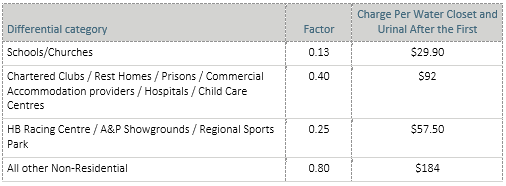
SEWAGE DISPOSAL
A differential targeted rate
set and assessed in accordance with Section 16 of the Local Government
(Rating) Act 2002, based on the provision or availability to the land of the
service. The rate is set as an amount per separately used or inhabited part
of a rating unit.
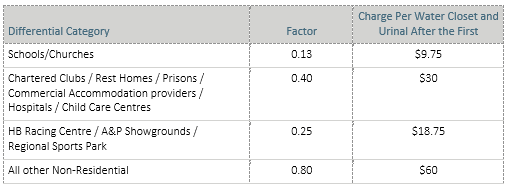
A differential targeted rate
for all non-residential rating units classified as “connected”,
based on the use to which the land is put. The rate is an amount for each
water closet or urinal after the first.
The rates apply to connected
or serviceable rating units in all areas excluding those in the Waipatiki
scheme area.
The rates for the 2020/21 year are:

Where connected, in the case
of non-residential use, the differential charge for each water closet or
urinal after the first is as follows:
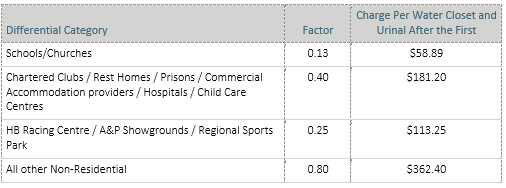
WAIPATIKI SEWAGE DISPOSAL
A differential targeted rate
set and assessed in accordance with Section 16 of the Local Government
(Rating) Act 2002, based on the provision or availability to the land of the
service. The rate is set as an amount per separately used or inhabited part
of a rating unit.
This rate applies only to
connected or serviceable rating units in the Waipatiki scheme area.
The rates for the 2020/21 year are:

Where connected, in the case
of non-residential use, the differential charge is set for each water closet
or urinal after the first as follows:
WASTEWATER TREATMENT
A differential targeted rate
set and assessed in accordance with Section 16 of the Local Government
(Rating) Act 2002, based on the provision or availability to the land of the
service. The rate is set as an amount per separately used or inhabited part
of a rating unit.
A differential targeted rate
for non-residential rating units classified as “connected”, based
on the use to which the land is put. The rate is an amount for each water
closet or urinal after the first.
The rates apply to connected or serviceable rating units in all
areas excluding those in the Waipatiki scheme area.
The rates for the 2020/21 year are:

Where connected, in the case
of non-residential use, the differential charge is set for each water closet
or urinal after the first as follows:
WATER SUPPLY
Targeted rates set and
assessed in accordance with Section 16 of the Local Government (Rating) Act
2002, on each separately used or inhabited part of a rating unit and based on
the provision or availability to the land of the service, on a differential
basis as follows.
The rates for the 2020/21
year are:

WATER BY METER
A targeted rate set and
assessed in accordance with Section 19 of the Local Government (Rating) Act
2002, on the volume of water supplied as extraordinary water supply, as
defined in Hastings District Council Water Services Policy Manual (this
includes but is not limited to residential properties over 1,500m2 containing
a single dwelling, lifestyle lots, trade premises, industrial and
horticultural properties) of $0.81 per cubic metre of water supplied over and
above the typical household consumption as defined in the Hastings District
Council Water Services Policy Manual.
RECYCLING
A targeted rate set and
assessed in accordance with Section 16 of the Local Government (Rating) Act
2002, on each separately used or inhabited part of a rating unit and based on
the provision or availability to the land of the service provided in the
serviced area.
Rating units which Council
officers determine are unable to practically receive the Council service and
have an approved alternative service will not be charged the rate.
The rate for 2020/21 is $70
per separately used or inhabited part of the rating unit.
REFUSE
A targeted rate set and
assessed in accordance with Section 16 of the Local Government (Rating) Act
2002, on each separately used or inhabited part of a rating unit,
differentiated based on the use to which the land is put.
Rating units which Council
officers determine are unable to practically receive the Council service and
have an approved alternative service will not be charged the rate.
Residential rating units
currently receive a weekly collection. Commercial rating units located
within Hastings as defined on Council Map “Hastings CBD Refuse”,
and located within Havelock North as defined on Council Map “Havelock
North CBD Refuse” currently receive a twice weekly collection.
The rates for the 2020/21
year are:

WAIMARAMA
REFUSE
A targeted rate set and
assessed in accordance with Section 16 of the Local Government (Rating) Act
2002, on each separately used or inhabited part of a rating unit located
within Waimarama as defined on Council Map “Waimarama Refuse Collection”,
and based on the provision or availability to the land of the service
provided, of $80 per separately used or inhabited part of the rating unit.
CAPITAL COST OF SUPPLY
EXTENSIONS
Targeted rates set and
assessed in accordance with Section 16 of the Local Government (Rating) Act
2002, on each separately used or inhabited part of a rating unit, and based
on the provision or availability to the land of the service provided, to fund
the capital cost of the extension to the water supply and sewerage networks
in each of the following locations, as follows:
Whirinaki Water Supply:
$270 per separately used or
inhabited part of a rating unit (over 4 instalments) for those rating units
where the ratepayer elected for a 25 year targeted rate option and elected
not to pay a lump sum option at the time of scheme inception.
Waipatiki Sewage Disposal:
$1,312 per separately used or
inhabited part of a rating unit (over 4 instalments) for those rating units
where the ratepayer elected for a 10 year targeted rate option and elected
not to pay a lump sum option at the time of scheme inception.
WAIMARAMA
SEA WALL
A targeted rate set and
assessed in accordance with Section 16 of the Local Government (Rating) Act
2002 on a differential basis, on each separately used or inhabited
part of a rating unit within each individual zone defined on Council Map
“Waimarama Sea Wall Zone” of the following amounts per separately
used or inhabited part of the rating unit:
Zone 1 shall pay 67% of the
cost to be funded, whilst Zone 2 shall pay 23% of the cost and Zone 3 10% of
the cost, based on the extent of the provision of service.

DUE DATES AND PENALTY
DATES
Due Dates for Payment and
Penalty Dates (for Rates other than Water by Meter Rates):
The Council sets the
following due dates for payment of rates (other than Water by Meter) and
authorises the addition of penalties to rates not paid on or by the due date,
as follows:
Rates will be assessed by
quarterly instalments over the whole of the district on the due dates below:
|
Instalment
|
Due Date
|
Penalty Date
|
|
1
|
21 August 2020
|
26 August 2020
|
|
2
|
20 November 2020
|
25 November 2020
|
|
3
|
26 February 2021
|
3 March 2021
|
|
4
|
21 May 2021
|
26 May 2021
|
A
penalty of 10% will be added to any portion of rates (except for Water by
Meter) assessed in the current year which remains unpaid after the relevant
instalment due date, on the respective penalty date above.
Arrears Penalties on
Unpaid Rates from Previous Years
Any portion of rates
assessed in previous years (including previously applied penalties) which
remains unpaid on 20 July 2020 will have a further 10% added. The penalty
will be added on 21 July 2020.
A further additional penalty of 10% will be added to any portion of rates
assessed in previous years which remains unpaid on 20 January 2021. The
penalty will be added on 21 January 2021.
Due Dates for Payment
and Penalty Dates (for Water by Meter Rates):
For those properties that
have a metered water supply, invoices will be issued either three-monthly or
six-monthly.
Three Monthly Invoicing:
|
Instalment
|
Invoicing Due Date
|
Penalty Date
|
|
1
|
20 October 2020
|
22 October 2020
|
|
2
|
20 January 2021
|
22 January 2021
|
|
3
|
20 April 2021
|
22 April 2021
|
|
4
|
20 July 2021
|
22 July 2021
|
Six
Monthly Invoicing:
|
Instalment
|
Invoicing Due Date
|
Penalty Date
|
|
1
|
20 January 2021
|
22 January 2021
|
|
2
|
20 July 2021
|
22 July 2021
|
A
penalty of 10% will be added to any portion of water supplied by meter,
assessed in the current year, which remains unpaid after the relevant
instalment due date, on the respective penalty date above.
Arrears Penalties on
Unpaid Water by Meter Rates from Previous Years
Any portion of Water by
Meter rates assessed in previous years (including previously applied penalties)
which remains unpaid on 20 July 2020 may have a further 10% added. The penalty
will be added on 22 July 2020.
A further additional penalty of 10% may be added to any portion of rates
assessed in previous years which remains unpaid on 25 January 2021. The
penalty will be added on 26 January 2021.
With the reasons for this
decision being:
The Council is required to
collect funds from rates on properties to undertake the functions outlined in
the 2020/21 Plan.
|
3.0 Background – Te Horopaki
3.1 Council
adopted the 2020/21 Annual Plan, which identified the Council’s budgetary
requirements, at its meeting on 25 June 2020.
3.2 It
now needs to assess and set the rates described in its Rating Policy and
Funding Impact Statement in order to collect the revenue needed for the 2020/21
Financial Year commencing 01 July 2020.
4.0 Discussion – Te Matapakitanga
4.1 To
enable the rates to be levied on properties for 2020/21 the Council needs to
pass the resolution to set the rates for the 2020/21 Financial Year. This is a very
important procedural matter following the consultation which occurred during
the 2020/21 Annual Plan process.
4.2 The
rates have been calculated to ensure that the correct revenue is collected to
meet the budget.
5.0 Options – Ngā Kōwhiringa
5.1 The
resolution enables the collection of Council’s rate funding requirement
based on the budget and policies adopted in the 2020/21 Annual Plan. This is
the only option that allows Council to collect rates to fund the expenditure
requirements.
5.2 For
any specific questions councillors may have or an indication of sample property
impacts, please contact Ashley Humphrey on 06 8715012.
Attachments:
There are no attachments for this report.
|
Summary of
Considerations - He Whakarāpopoto Whakaarohanga
|
|
Fit
with purpose of Local Government - E noho hāngai pū ai ki te
Rangatōpū-ā-Rohe
The Council is required to give effect to the purpose of
local government as set out in section 10 of the Local Government Act 2002.
That purpose is to enable democratic local decision-making and action by (and
on behalf of) communities, and to promote the social, economic, environmental,
and cultural wellbeing of communities in the present and for the future.
|
|
Link to the Council’s Community Outcomes – Ngā Hononga ki Ngā Putanga ā-Hapori
This proposal promotes the
social and economic wellbeings of communities in the present and for the
future.
|
|
Māori
Impact Statement -
Te Tauākī Kaupapa Māori
N/A
|
|
Sustainability
- Te
Toitūtanga
N/A
|
|
Financial
considerations -
Ngā Whakaarohanga Ahumoni
The outcome of this report and
recommendation will enable Council to generate the budgeted rates income.
|
|
Significance
and Engagement - Te
Hiranga me te Tūhonotanga
This decision has been assessed under the Council's
Significance and Engagement Policy as being of high significance.
|
|
Consultation
– internal and/or external - Whakawhiti Whakaaro-ā-roto / ā-waho
The budget used to set Rates for the
2020/21 financial year was consulted upon through the 2020/21 Annual Plan.
|
|
Risks:
Legal - Ngā
Tūraru: Ngā Ture
rates resolution and Funding Impact Statement were
reviewed by Simpson Grierson in 2019 to ensure compliance with the
legislative requirements of the Local Government (Rating) Act. Only minor
changes were made to the 2020/21 documents.
|
|
Rural
Community Board –
Te Poari Tuawhenua-ā-Hapori
The Rural Community Board has received
information on the impacts for Rating Area 2.
|
 Te Hui o Te Kaunihera ā-Rohe o Heretaunga
Hastings
District Council: Council Meeting
Te
Rārangi Take
Report to Council
|
Nā:
From:
|
Lachlan Crawford, Traffic Engineering Officer
|
|
Te Take:
Subject:
|
Speed Limit Review -
Proposed Bylaw Amendments for Public Consultation
|
1.0 `Executive Summary
– Te Kaupapa
Me Te Whakarāpopototanga
1.1
The purpose of this report is to obtain a decision from the Council to adopt
for public consultation the proposed speed limit amendments to the Speed Limits
Bylaw 2012 and the accompanying Statement of Proposal.
1.2 It
is the responsibility of Hastings District Council as the Road Controlling
Authority to implement safe and appropriate speeds across the road
network.
1.3 This
proposal arises from the need to review the speed limits on a number of roads
for the following reasons:
· Previous
Council resolution to review public requests,
· NZTA
identified “Top 10% death and serious injury reducing” sites,
· Alignment
with neighbouring Councils proposed speed limit changes,
· Changes
in the road and land usage caused by development.
1.4 The
requested roads have been assessed and the recommended speed limit changes are
detailed in the attached Statement of Proposal.
|
2.0 Recommendations – Ngā Tūtohunga
A) That
the Council receives the report titled Speed Limit Review - Proposed Bylaw
Amendments for Public Consultation
B) That
the Council determine:
i. That
a bylaw is the most appropriate way of addressing the setting of safe and
appropriate speed limits as it is the only method mandated by the Land
Transport Rule: Setting of Speed Limits 2017,
ii. That
the bylaw as proposed to be amended is the most appropriate form of
bylaw,
iii. That
the right to control speed limits is granted by Parliament to territorial
authorities and the limitations proposed are justified limitations in terms
of section 5 of the New Zealand Bill of Rights Act 1990 and that there is
accordingly no breach of the New Zealand Bill of Rights Act.
C) That
the Council adopt the attached Statement of Proposal to go out for public
consultation in accordance with the special consultative procedure under the
Local Government Act 2002 and the Land Transport Rule: Setting of Speed
Limits 2017.
|
3.0 Background – Te Horopaki
3.1 In
2003 the Government delegated responsibility for setting speed limits on local
roads to road controlling authorities (“RCAs”). For the
purposes of this report the RCA is Hastings District Council (“the
Council”). This delegation was originally contained in the Land
Transport Rule: Setting of Speed Limits 2003. This rule was recently replaced
with the Land Transport Rule: Setting of Speed Limits 2017 (“the
Rule”).
3.2 The
Rule specifies the legal procedure for establishing speed limits on public
roads. That procedure includes that an RCA must set speed limits (other than
temporary speed limits) by way of a bylaw under the relevant enactment,
currently the Local Government Act (“LGA”) 2002. The Rule sets out
the approach for evaluating and determining speed limits within the Speed
Management Guide.
3.3 The
Hastings District Council Speed Limits Bylaw was first established in 2005 and
has been reviewed on several occasions. There have been a number of speed limit
changes made since the original bylaw, including its replacement by the Speed
Limits Bylaw 2012.
3.4 The
Council can change existing speed limits by making a new bylaw, or amending an
existing Speed Limits Bylaw. This requires adherence to the special
consultative procedure under the LGA. The Rule also provides its own
consultation requirements for setting speed limits.
3.5 It
is the responsibility of Hastings District Council as the Road Controlling
Authority to implement safe and appropriate speeds across the road
network.
3.6 In
summary, the process for reviewing and setting a new speed limit is generally
as follows:
· Council
is required by the Rule to, or decides, of its own volition or on written
request, to review a speed limit;
· Technical
work is undertaken to establish the safe and appropriate speed limit for the
road in accordance with the Rule, New Zealand Transport Agency (NZTA)
Information and Speed Management Guide (Attachment 2 under separate cover to
follow);
· Council
resolves to amend the schedules of the Speed Limits Bylaw to set the speed
limits it proposes. The usual process for amending a bylaw under the LGA
is followed;
· A
Statement of Proposal is prepared which includes a draft of the bylaw to
be made or amended, the reasons for the proposal and a report under s 155 of
the LGA, and a summary of the Statement of Proposal (Attachment 3 under
separate cover to follow);
· The
proposal is publicly notified with a reasonable period being provided for
submissions (not less than 1 month);
· In
addition to the LGA public notification requirements, the Rule requires that
certain people, organisations and communities affected by the proposed speed limits
are consulted;
· All
submissions are received and acknowledged, and submitters are given a
reasonable opportunity to be heard;
· The
Council is required to take account of submissions received during consultation
on the proposed speed limit;
· After
considering submissions and other relevant material, the Council sets a speed
limit it considers the safe and appropriate speed limit for the particular road
by making any amendments to the Bylaw that are necessary;
· The
Director of NZTA and the Commissioner of Police are notified;
· Details
of the speed limits are recorded in a register;
· Any
required speed limit signs are erected.
· This
process is followed in full for setting all speed limits (except temporary
speed limits) on public roads.
3.7 The
Government is proposing changes to speed management to tackle unsafe speeds on
New Zealand roads.
3.8 The
proposed changes are part of the “Immediate set of actions for
2020-2022”, and will require changes to the Land Transport Act 1998 and
the Land Transport Management Act 2003 and substantial changes to the Land
Transport Rule: Setting of Speed Limits, which are currently going through
parliamentary process.
3.9 The
two key elements of these changes are:
· Improving
how councils and the Transport Agency plan for, consult on and implement speed
management changes. The proposal as it stands will result in speed limit
reviews to be undertaken at a regional level and no longer be set by a Local
Authority bylaw, and as such the decision making will be taken away from
Councils.
· Transitioning
to lower speed limits around schools to improve safety and encourage more
children to walk and cycle to school.
4.0 Discussion – Te Matapakitanga
4.1 Council
has received requests to amend speed limits on local roads from various
parties. These requests can be generally categorised into 4 groups:
· Public
requests,
· NZTA
identified “Top 10% death and serious injury reducing” sites,
· Alignment
with neighbouring Councils proposed speed limit changes,
· Changes
in the road and land usage caused by development.
4.2 This
review includes the community requests received since the last full speed limit
review process which was undertaken in 2017.
4.3 The
requested changes have been evaluated and are discussed in detail in the Statement
of Proposal document as appended to this report. The table below provides
a high level summary of the proposed speed limit changes
|
ROAD NAME
|
FROM
|
TO
|
CURRENT SPEED LIMIT
|
PROPOSED SPEED LIMIT
|
|
HAVELOCK SOUTH
|
|
|
|
|
|
Gilpin Road
|
Te Aute Road
|
Middle Road
|
100km/h
|
Reduce to 80km/h
|
|
Iona Road
|
Existing 50km/h Speed limit signs
|
Middle Road
|
100km/h
|
Reduce to 80km/h
|
|
Middle Road
|
Existing 50km/h Speed limit signs
|
School Road
|
100km/h
|
Reduce to 80km/h
|
|
Te Aute Road
|
Existing 50km/h Speed limit signs
|
Longlands Road East
|
100km/h
|
Reduce to 80km/h
|
|
WAIPATU
|
|
|
|
|
|
Apatu Road
|
Bennett Road
|
End
|
70km/h
|
Reduce to 50km/h
|
|
Bennett Road
|
Otene Road
|
Existing 70km/h Speed limit signs
|
80km/h
|
Reduce to 60km/h
|
|
Bennett Road
|
Existing 70km/h Speed limit signs
|
SH51
|
70km/h
|
Reduce to 50km/h
|
|
Elwood Road
|
Existing 70km/h Speed limit signs
|
SH51
|
70km/h
|
Reduce to 50km/h
|
|
Kauru Road
|
Bennett Road
|
End
|
70km/h
|
Reduce to 50km/h
|
|
Panapa Road
|
Bennett Road
|
End
|
70km/h
|
Reduce to 50km/h
|
|
Paraire Road
|
SH51
|
End
|
80km/h
|
Reduce to 60km/h
|
|
Waipatu Settlement Rd
|
SH51
|
End
|
80km/h
|
Reduce to 60km/h
|
|
Watson Road
|
SH51
|
End
|
80km/h
|
Reduce to 60km/h
|
|
FLAXMERE - OMAHU
|
|
|
|
|
|
Chatham Road
|
Omahu Road
|
Existing 50km/h Speed limit signs
|
50km/h
|
Increase to 60km/h
|
|
Henderson Road
|
Omahu Road
|
Existing 50km/h Speed limit signs
|
70km/h
|
Reduce to 60km/h
|
|
Kirkwood Road
|
Omahu Road
|
Existing 50km/h Speed limit signs
|
70km/h
|
Reduce to 60km/h
|
|
Omahu Road
|
250m West of Jarvis Road
|
Existing 50km/h Speed limit signs
|
70km/h
|
Reduce to 50km/h
|
|
Omahu Road
|
Existing 100km/h Speed limit signs
|
250m West of Jarvis Road
|
70km/h
|
Reduce to 60km/h
|
|
Omahu Road
|
SH50
|
Existing 100km/h Speed limit signs
|
100km/h
|
Reduce to 80km/h
|
|
Wilson Road
|
Omahu Road
|
Existing 50km/h Speed limit signs
|
70km/h
|
Reduce to 60km/h
|
|
HASTINGS SOUTH
|
|
|
|
|
|
Algernon Road
|
Norton Road
|
End
|
100km/h
|
Reduce to 80km/h
|
|
Davis Road
|
Railway Road South
|
Riverslea Road
|
100km/h
|
Reduce to 80km/h
|
|
France Road
|
Railway Road South
|
End
|
100km/h
|
Reduce to 80km/h
|
|
Heathcote Road
|
Maraekakaho Road
|
Southland Road
|
100km/h
|
Reduce to 80km/h
|
|
Norton Road
|
Existing 50km/h Speed limit signs
|
Algernon Road
|
100km/h
|
Reduce to 80km/h
|
|
Park Road
|
Existing 70km/h Speed limit signs
|
Algernon Road
|
100km/h
|
Reduce to 80km/h
|
|
Railway Road South
|
Existing 50km/h Speed limit signs
|
250m South of Longlands Road
|
100km/h
|
Reduce to 80km/h
|
|
Railway Road South - Rural intersection
advance warning sign (RIAWS) site
|
Northern extent of RIAWS signage
|
Southern extent of RIAWS signage
|
70km/h
|
Reduce RIAWS to 60km/h
|
|
Riverslea Road South
|
Longlands Road
|
Tollemache Road East
|
100km/h
|
Reduce to 80km/h
|
|
Southland Road
|
Heathcote Road
|
Tollemache Road West
|
100km/h
|
Reduce to 80km/h
|
|
Tollemache Road West
|
Southland Road
|
Norton Road
|
100km/h
|
Reduce to 80km/h
|
|
Wellwood Road
|
Heathcote Road
|
End
|
100km/h
|
Reduce to 80km/h
|
|
TWYFORD
|
|
|
|
|
|
Carrick Road
|
Nicholl Road
|
End
|
100km/h
|
Reduce to 80km/h
|
|
Curtis Road
|
Twyford Road
|
End
|
100km/h
|
Reduce to 80km/h
|
|
Evans Road
|
Twyford Road
|
Trotter Road
|
100km/h
|
Reduce to 80km/h
|
|
Evenden Road
|
SH2
|
Raupare Road
|
100km/h
|
Reduce to 80km/h
|
|
Hill Road
|
Omahu Road
|
End
|
100km/h
|
Reduce to 80km/h
|
|
Jarvis Road
|
Omahu Road
|
Existing 70km/h signs
|
70km/h
|
Reduce to 50km/h
|
|
Jarvis Road
|
Existing 70km/h signs
|
Thompson Road
|
100km/h
|
Reduce to 80km/h
|
|
McNab Road
|
Raupare Road
|
End
|
100km/h
|
Reduce to 80km/h
|
|
Nicholl Road
|
Raupare Road
|
Trotter Road
|
100km/h
|
Reduce to 80km/h
|
|
Ormond Road
|
Existing 60km/h Speed limit signs
|
End
|
100km/h
|
Reduce to 80km/h
|
|
Raupare Road
|
Omahu Road
|
End
|
100km/h
|
Reduce to 80km/h
|
|
Thompson Road
|
Twyford Road
|
Raupare Road
|
100km/h
|
Reduce to 80km/h
|
|
Trotter Road
|
Raupare Road
|
Evans Road
|
100km/h
|
Reduce to 80km/h
|
|
Twyford Road
|
Omahu Road
|
Existing 70km/h signs
|
70km/h
|
Reduce to 60km/h
|
|
Twyford Road
|
Existing 70km/h signs
|
Thompson Road
|
100km/h
|
Reduce to 80km/h
|
|
PUKETAPU
|
|
|
|
|
|
Dartmoor Road
|
Existing 50km/h Speed limit signs
|
870m west of the entrance to Puketapu
Park
|
100km/h
|
Reduce to 80km/h
|
|
Puketapu Road
|
Existing 50km/h Speed limit signs
|
70m South of Existing 50km/h Speed limit
signs
|
100km/h
|
Reduce to 50km/h
|
|
Vicarage Road
|
Omarunui Road
|
Existing 50km/h Speed limit signs
|
100km/h
|
Reduce to 80km/h
|
|
Vicarage Road
|
Omarunui Road
|
Existing 50km/h Speed limit signs
|
100km/h
|
Seasonal 50km/h Speed Limit – 1
December to 31 January
|
|
CLIVE TO CLIFTON
|
|
|
|
|
|
Clifton Road
|
Existing 50km/h Speed limit signs at
Haumoana
|
Existing 50km/h Speed limit signs at Te
Awanga
|
100km/h
|
Reduce to 80km/h
|
|
Clifton Road
|
Existing 50km/h Speed limit signs at Te
Awanga
|
30m South-east of existing 50km/h Speed
limit signs at Te Awanga
|
100km/h
|
Reduce to 50km/h
|
|
Clifton Road
|
30m South-east of existing 50km/h Speed
limit signs at Te Awanga
|
End
|
100km/h
|
Reduce to 80km/h
|
|
East Road
|
Parkhill Road
|
Existing 50km/h Speed limit signs
|
100km/h
|
Reduce to 80km/h
|
|
Haumoana Road
|
Mill Road
|
50m South of existing 50km/h Speed limit
signs
|
100km/h
|
Reduce to 80km/h
|
|
Haumoana Road
|
50m South of existing 50km/h Speed limit
signs
|
Existing 50km/h Speed limit signs
|
100km/h
|
Reduce to 50km/h
|
|
Lawn Road
|
Napier Road
|
Mill Road
|
100km/h
|
Reduce to 80km/h
|
|
Mill Road
|
Existing 50km/h Speed limit signs
|
Tuki Tuki Road
|
100km/h
|
Reduce to 80km/h
|
|
Parkhill Road
|
Haumoana Road
|
End
|
100km/h
|
Reduce to 80km/h
|
|
Tuki Tuki Road
|
Mill Road
|
Waimarama Road
|
100km/h
|
Reduce to 80km/h
|
|
OTHER SITES
|
|
|
|
|
|
Brookfields Road
|
Pakowhai Road
|
NCC boundary
|
100km/h
|
Reduce to 80km/h
|
|
Omarunui Road
|
SH50 (Korokipo Road)
|
Strome Road
|
100km/h
|
Reduce to 80km/h
|
|
Pakowhai Road
|
Start of Existing 60km/h section
|
End of Existing 60km/h section
|
60km/h
|
Increase to 80km/h
|
|
Springfield Road
|
Puketapu Road
|
NCC boundary
|
100km/h
|
Reduce to 80km/h
|
|
Waiohiki Road
|
SH50 Links Road
|
NCC boundary
|
70km/h
|
Reduce to 50km/h
|
|
Havelock North CBD
|
Extents provided in Statement of Proposal
|
|
50km/h
|
Reduce to 30km/h
|
|
RURAL INTERSECTION ADVANCE WARNING SIGNS (RIAWS)
|
|
|
|
Pakowhai Road / Elwood Road
|
On Pakowhai Road, from 150m
North-east of Elwood Road
|
150m South-west of Elwood Road
|
80km/h
|
Introduce 80/60km/h RIAWS zone on
Pakowhai Road
|
|
Mill Road / Richmond Road
|
On Mill Road, from 150m North of
Richmond Road
|
150m South of Richmond Road Road
|
100km/h
|
Introduce 80/60km/h RIAWS zone on Mill
Road
|
4.4 When
presented with the above proposals for feedback, Council raised some queries
that required further officer action. These actions are summarised below:
|
ITEM
|
ACTION REQUIRED
|
INVESTIGATION
|
RECOMMENDATION
|
|
Hastings CBD
|
Consult Hastings
business association and seek feedback on speed limit change options
|
Feedback
received from Hastings Business Association survey yielded 50% support for a
30km/h speed limit (32 people surveyed). Request from Business Association to
delay public consultation until a reasonable consultation with business and
building owners can be done.
|
Remove Hastings CBD Speed
limit from proposal
|
|
Havelock North
CBD
|
Consult Havelock
North business association and seek feedback on speed limit change options
|
Havelock North
Business Association Board discussed and agree with the proposed idea of a
30km/h CBD Speed limit.
|
Include Havelock North CBD
speed limits in Statement of Proposal for Public consultation
|
|
Lawn Road
|
Officers to
reassess and also consider alternative options to speed limit reductions
|
Officers will begin a Crash
Reduction Study on Lawn Road this financial year. The number of driveways
accesses and roadside hazards are the key reasons that Lawn road was included
in the NZTA Top 10% Death and Serious Injury reducing sites and recommended
for a speed limit reduction. Lawn Road sits between Napier Road (80km/h) and
Mill Road (Proposed 80km/h) and as such a reduction to 80km/h would be
consistent with the rest of this area. Initial officer investigation suggests
that to make the road safer would require hazard protection or removal, which
on this route means the power poles, deep drains and driveway culverts. The
likely cost of providing guardrail on both sides of the road would be in the
order of $3million, and would introduce operational issues with maintaining
the open drains. Piping the open drains could cost in the order of $4 million
to $8 million, and is not likely feasible due to the flat terrain and the
resulting reduction of stormwater capacity. This also does not reduce the
number of driveways that access Lawn Road, which is a key driver of the
recommended 80km/h speed limit.
|
Include Lawn Road in
Statement of Proposal for Public consultation
|
|
East Clive
|
Officers to
assess roads in East Clive
|
The speed limit
for these roads could be reduced to 50km/h, however these roads do not look
or feel like urban roads the way those in the urban centres do. This could
set a precedent for future urban speed limits on semi-rural roads.
|
Retain existing 70km/h
speed limit
|
|
Longlands/Railway
|
Officers to
consider alternative options to reducing RIAWS site to 60km/h
|
Reducing the
speed limit to 80km/h on Railway Road through to the RIAWS site would require
Council to reduce the RIAWS speed limit to 60km/h, and for the RIAWS to
remain at 70km/h the approaching speed limit must remain at 100km/h. Through
officers investigation and discussion with NZTA it was determined that the
RIAWS site could not be used as a speed limit change point, and as such three
options are presented:
1. Reduce Railway Road to 80km/h from the existing
50km/h signs to a point 300m north of Longlands Road, the RIAWS site would
remain 100/70 km/h.
2. Reduce Railway Road to 80km/h from the existing
50km/h signs to a point 250m south of Longlands Road, the RIAWS site would
change to 80/60 km/h.
3. Reduce Railway Road to 80km/h from the existing
50km/h signs to a point 250m south of Longlands Road and remove the RIAWS
system.
The existing RIAWS site has
been in operation since 2014, and has provided significant safety benefits at
this intersection - there have been no injury crashes since its installation,
and officers do not recommend removing it. If the RIAWS were to remain at
100/70 and an 80km/h limit implemented north of the intersection, this would
result in the speed limits on Railway Road heading into Hastings being
inconsistent i.e. 100 – 70 – 100 – 80, which is not
best practice.
It should be noted that the
RIAWS speed limits must be approved by NZTA, and are strictly controlled.
|
Option 2: Reduce Railway Road to 80km/h from the
existing 50km/h signs to a point 250m south of Longlands Road, the RIAWS site
would change to 80/60 km/h.
|
|
Puketapu Park
|
Consider
seasonal speed limit for park frontage
|
The entrance to
Puketapu park is some 300m from the urban boundary. The park entrance is
generally only busy during summer weekends and as such compliance with a
50km/h speed limit at all other times would be low. The 80km/h proposed speed
limit will provide safety benefits at the entrance of the park.
|
Proceed with 80km/h speed
limit as recommended.
|
|
Haumoana Road
|
Officers to
consider extending 50km/h speed limit
|
Agree with the
request to extend 50km/h section by 50m.
|
Include extension of the 50km/h
section in the Statement of Proposal
|
|
Elwood Road
|
Consider
extending speed limit change to Otene Road
|
The section that is
currently 80km/h between the existing 70km/h signs and Otene Road does not
look like an urban 50km/h speed limit, and the calculated safe and
appropriate speed matches the current posted speed limit. Compliance with a
speed limit lower than 80km/h here would likely be very low. Introducing
urban speed limits on rural roads could cause a lack of compliance which is
likely to spread, and drivers may start to ignore the valid 50km/h speeds
limits that have been introduced in urban areas where there are urban issues
such as pedestrians and cyclists present.
|
Retain existing 80km/h
speed limit on northern section
|
4.5 The
roads in following table were reviewed, however the recommendation is to retain
the existing speed limit.
|
ROAD
|
REQUESTS
|
REASON FOR NO SPEED LIMIT CHANGE
|
|
Apley Road
|
Lower Speed Limit
|
Improved signage and
delineation would have a greater effect at improving safety
|
|
Ellis Wallace Road
|
Lower Speed Limit
|
Improved signage and
delineation would have a greater effect at improving safety
|
|
Gilbertson Road
|
Lower Speed Limit
|
Existing speed limit
appropriate. Improvements to discourage speeding and antisocial behaviour to
be considered.
|
|
Havelock Road
|
Raise Speed Limit, Lower
Speed Limit
|
Existing speed limit
appropriate
|
|
Longlands Road
|
Lower Speed Limit
|
Existing speed limit
appropriate. Improved intersection treatments would have a greater effect at
improving safety
|
|
Napier Road
|
Lower Speed Limit
|
Existing speed limit
appropriate. Officers to begin Crash Reduction Study following construction
of the cyclepath.
|
|
Ngatarawa Road
|
Lower Speed Limit
|
Improved signage and
delineation would have a greater effect at improving safety
|
|
Otene Road
|
Lower Speed Limit
|
Existing speed limit
appropriate. Improvements to discourage speeding and antisocial behaviour are
being considered.
|
|
Puketitiri Road
|
Lower Speed Limit
|
Improved signage and
delineation would have a greater effect at improving safety
|
|
Romanes Drive
|
Increase Speed Limit
|
Existing speed limit
appropriate
|
|
Ruahapia Road
|
Lower Speed Limit
|
Existing speed limit
appropriate. Improvements to discourage speeding and antisocial behaviour are
being considered.
|
|
Swamp Road
|
Lower Speed Limit
|
Existing speed limit
appropriate. Officers to conduct Crash Reduction Study.
|
|
Taihape Road
|
Lower Speed Limit
|
Improved signage,
delineation and hazard protection would have a greater effect at improving
safety. Crash reduction study has been completed and the recommended safety
interventions are programmed.
|
|
Te Mata Mangateretere Road
|
Lower Speed Limit
|
Improved signage and
delineation would have a greater effect at improving safety
|
|
Te Mata Peak Road
|
Lower Speed Limit
|
Improved signage and
delineation would have a greater effect at improving safety
|
|
Waimarama Road
|
Lower Speed Limit
|
Improved signage,
delineation and hazard protection would have a greater effect at improving
safety. Crash reduction study has been completed and the recommended safety interventions
are programmed.
|
|
Waipunga Road
|
Lower Speed Limit
|
Improved signage and
delineation would have a greater effect at improving safety
|
|
Whakatu Road
|
Lower Speed Limit
|
Existing speed limit
appropriate. Improved intersection treatments would have a greater effect at
improving safety
|
4.6 The
roads in the following table were requested to be reviewed, however were not
considered for various reasons.
|
ROAD
|
REQUESTS
|
REASON FOR NO SPEED LIMIT CHANGE
|
|
All Country Roads
|
Lower Speed Limit
|
Rural delineation policy
under review
|
|
North Shore Road
|
Lower Speed Limit
|
Traffic Calming
consultation beginning shortly
|
|
Nottingley Road
|
Lower Speed Limit
|
Traffic monitoring ongoing
|
|
Tauroa Road
|
Lower Speed Limit
|
Traffic calming
implemented. Future speed limit will be considered following CMP study
|
|
Various roads outside all
Marae
|
Lower Speed Limit
|
Speed limit in front of
Marae will be considered as part of the regional speed limit reviews.
Investigation of safety and access needs for Marae is proposed in next LTP.
|
|
Various roads outside
schools
|
Lower Speed Limit
|
Awaiting government
direction
|
|
Whirinaki Road
|
Lower Speed Limit
|
Traffic Calming
consultation beginning shortly
|
4.7 Officers
have identified that the most appropriate method for administering these
changes is for Council to propose to “set” those speed limits under
the Rule and to undertake consultation on that proposal as required by the Rule
and the Local Government Act 2002.
4.8 This
report considers the potential amendment of an existing bylaw under Section 156
of the Local Government Act 2002. As such the controls in Section 155 of that
Act do not explicitly apply. Those controls are however useful touchstones
against which these changes can be measured.
4.9 Section
155(1) asks whether a new bylaw is the best way to address a perceived problem.
In this case it is the only way by which to change a speed limit. Section
155(2)(a) raises whether the form of the proposed bylaw is the most
appropriate. Again, there is limited flexibility in that regard, but essentially
that is a question about whether the proposed speed is the best one. Officers
have recommended the speeds that they consider most appropriate but ultimately
this is a decision for the Council.
4.10 Subsections
155(2)(b) and 155(3) ask the local authority to consider if any New Zealand
Bill of Rights Act (BORA) issues are raised. These matters have been considered
by the Council’s General Counsel, and while a lowering of a speed limit
might have been thought to lessen the freedom of movement protected by Section
18(1) of BORA, that impact is not of a nature that is more than de minimis.
4.11 The
previous reports as listed below have been reconsidered by officers and except
as otherwise subsequently amended are still considered relevant.
· Speed
Limits Bylaw 2012 (Amendments 2019)
· Speed
Limits Bylaw 2012
· Speed
Limits Bylaw 2011
· Speed
Limits Bylaw 2009
· Speed
Limits Bylaw 2007
· Speed
Limits Review 2006
4.12 The
Council is required, under the bylaw-making provisions of the Local Government
Act 2002 and the Land Transport Rule: Setting of Speed Limits 2017, to use the
special consultative procedure to make, amend or revoke a bylaw.
4.13 Should
the Council determine to proceed with the recommended Option 1, then the
attached Statement of Proposal (“the SOP”) will need to be publicly
notified and made available. It will be available at the Council offices,
its libraries and on the website as well as being posted out on request. The
SOP will provide guidance on the procedure for making submissions on the Speed
Limits Bylaw.
4.14 The
attached communication plan has been developed which details the consultation
process and the method in which HDC will engage the community and receive
submissions. The specifics in the communication plan will be updated to reflect
the decisions made by Council
4.15 All
affected parties will receive a “Summary Statement of Proposal”
that includes written notification of the consultation period and where a copy
of the SOP can be viewed or obtained.
4.16 In
addition to general consultation with the community, and specific consultation
with affected parties (including occupiers of adjacent properties where the
speed limit changes are proposed), the Council will be consulting with the
other parties scheduled in the Rule, at 2.5(2), namely:
· New
Zealand Police;
· New
Zealand Transport Agency;
· New
Zealand Automobile Association Inc.;
· Road
Transport Forum New Zealand;
· Any
other organisation or road user group the Council considers affected,
· Adjacent
Territorial Authorities:
- Napier
City Council
- Wairoa
District Council
- Taupo
District Council
- Rangitikei
District Council
- Hawkes
Bay Regional Council
- Central
Hawkes Bay Council
4.17 The
minimum period for consultation under the special consultative procedure is one
month. Officers are proposing a six week consultation period.
5.0 Options – Ngā Kōwhiringa
Option One - Recommended Option
- Te Kōwhiringa Tuatahi – Te Kōwhiringa Tūtohunga
5.1 Propose
to amend the Speed Limit Bylaw and to proceed with public consultation on the
Statement of Proposal by way of the special consultative procedure in
accordance with the Local Government Act 2002 and the Rule.
· Advantages
- Improved
safety performance by reducing the likelihood and severity of crashes on these
roads.
· Disadvantages
- Speed
limit reductions are generally not supported by the public.
Option Two – Status Quo - Te Kōwhiringa Tuarua – Te
Āhuatanga o nāianei
5.2 Take
no further action and retain the existing bylaw including its schedules
· Advantages
- Reduced
resourcing requirement for Council officers
· Disadvantages
- Offers
no safety improvements to Hastings District Council roads through speed
management. To receive the same safety benefits through infrastructure
improvements alone will require increased funding.
- Further
delaying the review of public requests and NZTA Top 10% DSi reducing sites.
This was a criticism raised by the public, NZTA and Police during the previous
speed limit review.
6.0 Next steps – Te Anga Whakamua
6.1 Should
the Council determine to proceed with the recommended Option 1, officers will
proceed the actions in the attached communications plan.
6.2 The
general timeline is as follows:
· Public
Consultation Commences – 3rd August 2020
· Public
Consultation Closes – 14th September 2020
· Submission
Hearings – 12th – 17th November 2020
· Report
to Council to confirm bylaw – December 2020
· Implementation
of any speed limit changes – December 2020 / January 2021
Attachments:
|
1⇨
|
Communications Plan - Speed Limit Consultation 2020
|
PRJ20-36-0001
|
Under Separate Cover
|
|
Summary of
Considerations - He Whakarāpopoto Whakaarohanga
|
|
Fit
with purpose of Local Government - E noho hāngai pū ai ki te
Rangatōpū-ā-Rohe
The Council is required to give effect to the purpose of
local government as set out in section 10 of the Local Government Act 2002.
That purpose is to enable democratic local decision-making and action by (and
on behalf of) communities, and to promote the social, economic,
environmental, and cultural wellbeing of communities in the present and for
the future.
This decision contributes to the purpose of local
government by primarily promoting social wellbeing
Link to the Council’s
Community Outcomes –
Ngā Hononga ki Ngā Putanga ā-Hapori
The Council’s strategic objective of safe transport
options
|
|
Māori
Impact Statement -
Te Tauākī Kaupapa Māori
N/A:
|
|
Sustainability
- Te
Toitūtanga
N/A:
|
|
Financial
considerations -
Ngā Whakaarohanga Ahumoni
It is estimated that the cost of
implementation for all of the recommended sites is in the order of $100k.
This will be funded from existing transportation budgets.
|
|
Significance
and Engagement -
Te Hiranga me te Tūhonotanga
This decision/report has been assessed under the Council's
Significance and Engagement Policy as being of high significance.
|
|
Consultation
– internal and/or external - Whakawhiti Whakaaro-ā-roto / ā-waho
Consultation will take place following
the decision to proceed with the Special Consultative Procedure. A
communications plan has been developed to support the process.
|
|
Risks:
- Ngā
Tūraru:
|
REWARD – Te Utu
|
RISK – Te Tūraru
|
|
Decrease the likelihood
and severity of crashes on these roads.
Balance outcomes with achieving
transport vision which is to move people and goods around safely and
efficiently.
|
Speed limit reductions
are generally not well supported by the travelling public.
Gap between proposed
speed limits and community expectations. This will be managed through the
communications plan.
Perception of restricting
economic activity. The technical investigation found that for many of these
roads, the current operating speeds are close to the proposed speed limits.
|
|
|
Rural
Community Board –
Te Poari Tuawhenua-ā-Hapori
Various rural roads are part of this
proposal. Rural Community Board members have been consulted with and raised
no concerns with the proposals.
|
 Te Hui o Te Kaunihera ā-Rohe o Heretaunga
Hastings
District Council: Council Meeting
Te
Rārangi Take
Report to Council
|
Nā:
From:
|
Megan Peacock-Coyle, Manager, Hawke's Bay Opera
House Precinct
Kevin Carter, Community Grants Advisor
|
|
Te Take:
Subject:
|
Arts, Culture and Events
Recovery Plan
|
1.0 Executive Summary – Te Kaupapa Me Te
Whakarāpopototanga
1.1 The
purpose of this report is to request that Council adopt the Hastings District
Council Arts, Culture and Event Recovery Plan (Attachment one) and
provide additional financial resources to deliver the Recovery Plan.
1.2 The
Arts, Culture & Events Recovery Plan is focussed on delivering events,
performances, installations and exhibitions for our community to enjoy and feel
part of a vibrant and exciting future for our district and our region
1.3 This
plan has been created to develop, produce and present opportunities for our
community and local artists that would normally have been filled by national
and international touring productions, exhibitions, installations and events.
1.4 COVID19
has changed how the New Zealand arts, culture and events industry will operate
for the next 6 months, the Arts, Culture & Events Recovery Plan aims to
ensure the sector is well supported.
1.5 The
preferred option is to fund the plan up to the value of $300,000. This gives
Council the opportunity to deliver a meaningful level of activity and will meet
the objectives of the recovery plan. Staff will approach other funding
opportunities to support this plan with the aim to deliver even more for the
community including the two major light and sound installations.
|
2.0 Recommendations – Ngā Tūtohunga
A) That
the Council receives the report titled Arts, Culture and Events Recovery
Plan.
B) That
the Council adopt the Arts, Culture & Events Recovery Plan as set out in
the report at (A) above.
C) That
the Council approves funding from the Covid Recovery Contingency Budget up to
the value of $300,000 to a fund number of events listed to deliver on the Arts,
Culture and Events Recovery Plan over the next six months.
D) That
staff are to actively pursue corporate sponsorship and other funding
opportunities to support activities and installations and minimise ratepayer
funding.
|
3.0 Background – Te Horopaki
3.1 COVID-19
has changed how the arts, culture and events industry operates and how it
influences community wellbeing. This change has had a big impact on our local
arts and events industry and this framework shows how we can ensure ongoing
community engagement and support.
3.2 Arts,
culture and events range from major large-scale international activities which
deliver significant economic, social and promotional benefits to New
Zealand through to domestic, regional and local community activities which deliver
local economic, cultural and social benefits.
3.3 These
activities can improve social cohesion, community resilience, spirit and pride;
develop a stronger identity and sense of place; support local artists,
performers and the creative sector; improve cultural awareness and
understanding; stimulate domestic and international tourism and generate
national and global media profile.
3.4 The
Arts Culture and Events Recovery Plan has been developed to respond quickly to
the Toi-tū Strategic Framework that was adopted by the council last
year
3.5 Toi-tū
Hawke’s Bay is a framework for the development of current and future
arts, culture and creative strategy and projects within Hawke’s Bay. The
framework was created from conversations with the creative sector. It is a
response to identified gaps - areas where action can result in long-term and
far-reaching change. Implementation of Toi-tū will see a region-wide
expression of Hawke’s Bay’s unique identity, cultural diversity,
heritage and sense of place.
4.0 Discussion – Te Matapakitanga
4.1 Council
was briefed on the Arts, Culture & Events Recovery Plan at a workshop in
June 2020.
4.2 The
benefits for implementing the Arts, Culture and Event Recovery Plan to the
Hastings district include:
· Re-energised
community through participation in arts and cultural events and experiences;
· Empowered
and supported arts, culture and events partners and individuals working
locally;
· A
collaborative arts sector throughout Hawke’s Bay working externally and
internally;
· New
processes and structures focused on the community feeling comfortable attending
larger events in the future;
· Confidence
to attend outdoor and indoor events presented by HDC facilities, events teams
and arts partners;
· A
vibrant, safe and activated city centre - the heart of the city is enlivened by
bringing the arts, culture and events into public spaces; and
· A
successful transition back into larger events for the urban centres and wider
region.
4.3 It
is proposed that the Council adopts the Arts, Culture and Events Recovery plan
and provides funding to deliver it over the next 6 months. Officers presented a
number of options to fund a recovery plan which were discussed in detail at a
Council workshop on 23 June 2020. Officers were tasked with preparing a report
setting out options and recommending a recovery plan which provided the best
returns for the community and value for money. These options are set out in the
table below:-
|
4.4 Option One:
Additional funding of $140,000 and includes:
· Lightboxes; 6 multiuse light boxes that can be used
as art installations advertising of upcoming exhibitions and events,
directional signage and storytelling.
· Augmented Reality; Takitimu Performing Arts students
telling stories of Ngā Pou and Artists telling stories on the Art
Walking Tours and stories of many other local landmarks in the Civic
Square/Arts Precinct area
· Titiro Mai; Community Arts and Cultural Facilities
Open Day, to provided vibrancy and activity back into the CBD based council
facilities
· Te Kāhui Group; The establishment of a
Toi-Tū cross sector leadership group that advocates for the District
from a creative perspective and as a creative region
· Heretaunga Stories; Capturing artists responses to
living in our diverse community through Literary, Visual & Performing
Arts
· Mīharo Excerpts; Free monthly performances,
performed live at Toitoi
· Walking Art Tours; Weekly guided tours of the
central city art installations
· Online library programmes; Free additional online
library programmes for the community with a storytelling, arts and culture
focus.
|
|
4.5 Option Two: Additional funding of $300,000 and includes:
· Includes all activities in option one with the
addition of:
· Christmas Decorations throughout City Centre; large
scale interactive Christmas themed installations in the CBD
· Santa’s Grotto/Winter wonderland; large scale
outdoor Christmas decorations around the CBD
· Christmas at Functions on Hastings: Decorated and
themed for community use by day -corporate hire by night.
|
|
4.6 Option Three:
Resourcing to the value of $400,000
· Includes all activities in option one and two with
the addition of:
· Two major light and sound installations; Extra-large
scale light and sound installations, first time in New Zealand
|
4.7 The
investments outlined in options 1 and 2, include one off investments like the
lightboxes, the augmented reality and the Christmas decorations that will be
available to be reused, reactivated and repurposed for future opportunities.
4.8 The
Titiro Mai is an event that gave Council the opportunity to move forward, to
show our community that we are indeed ‘open and safe’. It enabled
momentum to be maintained and has been covered to-date using operational
budgets to cover the costs. The main costs for this event were marketing
and artist’s fees.
4.9 While
there are some limited operational budgets that can be redirected to the
delivery of this plan, they are limited in value and therefore restrict the
ability to deliver much of what is outlined above. The funding request is
therefore unbudgeted. In the 2020/21 Annual Plan Council established a Covid-19
Recovery Contingency fund of $1m from the sale proceeds of the Orchard Road
depot. To date $150,000 has been allocated to the Hastings Urban Centres
(Hastings CBD, Havelock North and Flaxmere) Recovery, leaving $850,000 from
this contingency fund for allocation and investment, should there be the need
and justification to do so.
4.10 Option
Two is the recommended level of funding requested of Council as this allows the
‘quick wins’ to facilitate community activation but also shows
investment in the celebration of Christmas in our community. It is an
opportunity to go all out and really light up the city, as well as our
facilities.
4.11 There
are other funding opportunities that Council can approach to support the
initiatives outlined above and if successful could possibly enable Council to
deliver more for the community. There is the boosted campaign that is currently
live for 20 more days and has raised $3270 towards the Heretaunga Stories
collaboration with Toitoi, Hastings City Art Gallery and Library. The
Creative New Zealand grant for the regional arts sector has re-opened and is an
opportunity for the ACE Recovery Plan to apply for, Creative New Zealand are
very interested in working closely with local government to increase
participation in the arts in NZ. The Creative New Zealand Funding Opportunity
looks to “incentivise local and regional stakeholder investment in the
development and presentation of local arts activity outside the main centres
(Auckland, Wellington and Christchurch) (Ngā Toi ā Rohe – Arts
in the Regions Fund)”.
4.12 A
number of the installations outlined in the options above lend themselves to
corporate naming and funding opportunities, particularly with the two major
light and sound installations outlined in option 3.
5.0 Options – Ngā Kōwhiringa
Option One - Recommended Option -
Te Kōwhiringa Tuatahi – Te Kōwhiringa Tūtohunga
5.1 That
the Council adopts the Arts, Culture & Events Recovery Plan and provides
funding of up to $300,000 from the Covid-19 Recovery Contingency to deliver the
programme of events and installations as set out in paragraph 4.5 above. With
opportunities explored to maximise external funding to enable more to be
delivered, including the potential delivery of installations outlined in option
3.
Advantages
5.2 This
allows the ‘quick wins’ to facilitate community activation but also
shows investment in the celebration of Christmas in our community. It is an
opportunity to go all out and really light up the city, as well as our
facilities. This investment also enables council staff to start to look for
additional sponsorship and continue to work towards achieving the goal of
Hastings being the instillation capital of New Zealand. These installations,
with all of the above options, will certainly help Hastings shine and promote
community wellbeing through the arts, culture and events.
Disadvantages
5.3 This additional activity is unbudgeted, any resourcing will need to
come from the Covid‑19 Recovery Contingency Budget. The investment
requested from Council for these initiatives is significant and will be a major
draw on the Covid-19 Contingency reserve.
Option Two – Status quo
5.4 It
is possible that the council can adopt the Arts, Culture & Events recovery
plan in principle without providing additional financial resourcing, although
staff would not be able to deliver any additional projects and activations or
support artists outside their current operational budgets.
5.5 Not
resourcing the recovery plan misses an opportunity to show Hastings off as the
‘City of Christmas’, where tourists and locals will flock to enjoy
the vibrancy and celebration of Christmas.
6.0 Next steps – Te Anga Whakamua
6.1 Depending
on the level of investment approved officers will work quickly to implement the
plan as per the attached document:
Attachments:
|
1⇨
|
Arts Culture And Events-Recovery Plan
|
CG-16-2-00264
|
Under Separate Cover
|
|
Summary of
Considerations - He Whakarāpopoto Whakaarohanga
|
|
Fit
with purpose of Local Government - E noho hāngai pū ai ki te
Rangatōpū-ā-Rohe
The Council is required to give effect to the purpose of
local government as set out in section 10 of the Local Government Act 2002.
That purpose is to enable democratic local decision-making and action by (and
on behalf of) communities, and to promote the social, economic,
environmental, and cultural wellbeing of communities in the present and for
the future.
This proposal promotes the Social and Cultural wellbeing
of communities
Link to the Council’s
Community Outcomes –
Ngā Hononga ki Ngā Putanga ā-Hapori
The Arts, Culture & Events Recovery Plan covers events
and activations.
|
|
Māori
Impact Statement -
Te Tauākī Kaupapa Māori
The Arts, Culture & Events Recovery
Plan also covers cultural events and activations.
|
|
Sustainability
- Te
Toitūtanga
N/A
|
|
Financial
considerations -
Ngā Whakaarohanga Ahumoni
Covered in paragraph 4.9 above.
|
|
Significance
and Engagement -
Te Hiranga me te Tūhonotanga
This decision/report has been assessed under the Council's
Significance and Engagement Policy as being of low significance.
|
|
Consultation
– internal and/or external - Whakawhiti Whakaaro-ā-roto / ā-waho
Engagement with the wider arts sector is
underway.
|
|
Risks:
- Ngā
Tūraru:
Opportunity:
Set out in paragraph 4.2 above
Risk; Set
out in para 5.3above
|
|
Rural
Community Board –
Te Poari Tuawhenua-ā-Hapori
N/A
|
Hastings
District Council: Council Meeting
Te Rārangi Take
Report to Council
|
Nā:
From:
|
Rowan Wallis, Environmental Policy Manager
|
|
Te Take:
Subject:
|
Plan Change 2 to the
Partially Operative District Plan - Engineering Code of Practice
|
1.0 Executive
Summary – Te Kaupapa Me Te
Whakarāpopototanga
1.1 The
purpose of this report is to obtain a decision from Council on whether to adopt
a Change to the Partially Operative Hastings District Plan for public notification
under the Resource Management Act 1991(the RMA) process.
· The
Proposed Plan change is to incorporate the relevant amendments to the district
plan that have arisen from the review of the Engineering Code of
Practice.
1.2 Proposed Plan Change 2
is required to update the District Plan in response to the recently reviewed
Hastings Engineering Code of Practice, 2020 (ECOP (2020)) including adopting
the New Zealand Transport Agency’s ‘One Network Road
Classification’ (ONRC) hierarchy. The main points from the reviewed ECOP
that require the partially operative district plan to be amended are;
· Consistent
referencing of the Engineering Code of Practice throughout the Plan and a new
definition of the Engineering Code of Practice.
· Changes
to the roading hierarchy to reflect the New Zealand Transport Agency’s
One Network Road Classification. Requires a new road hierarchy map and changes
to the classifications of ‘roading’ in the definition section of
the Plan.
1.3 This
Plan Change is largely a technical change which will ensure that where the
Engineering Code of Practice is cited in the district plan the newly amended
version is referenced. Due to its largely technical nature it is not envisaged
that the Plan Change will be controversial. The Engineering team have
previously worked through the proposed amendments to the ECOP document with
stakeholders and this plan change does not allow for submissions on the ECOP
document itself.
|
2.0 Recommendations – Ngā Tūtohunga
A) That the
Council receives the report titled Plan Change 2 to the Partially Operative
District Plan - Engineering Code of Practice.
B) That the
Council adopt Plan Change 2 and the Section 32 Evaluation Report for public
notification and submission pursuant to Schedule 1 of the Resource Management
Act 1991.
|
3.0 Background
– Te Horopaki
3.1 The review of the
Engineering Code of Practice that has recently taken place provides improved
and new methods for compliance with the District Plan and RMA when undertaking
subdivision and land development in line with current best practice.
3.2 The review of ECOP was
undertaken in consultation with a number of stakeholders in the development
community.
3.3 The key changes to the
updated ECOP (2020) include:
· An
updated district roading hierarchy based on the New Zealand Transport
Agency’s ‘One Network Road Classification’ (ONRC);
· Recognition
of latest construction practices;
· Clearer
guidance in the Standard Construction Drawings including amendments to Drawing
C6, C7, C19 & C19A, C31;
· Amended
guidance for Three Waters reflecting recent changes in policy and regulation
including a new set of Water Services Drawings (WS101 – 108, WS101-207;
WS301- 303, WS 401-4-7, and WS501 509;
· Introduction
of Drawings LD1 and LD2 providing typical tree planting detail for trees in
road reserves; and
· Introduction
of a Street Lighting Code of Practice including a set of Standard Drawings
SL000 – SL0006.
3.4 Only some of these
changes require amendment to the District Plan and these are discussed in the
following section.
4.0 Discussion – Te Matapakitanga
4.1 ECOP is embedded in
the District Plan both through identifying it as a method of meeting the
objectives and policies of the Plan and also by identifying the road hierarchy
that influences a number of the transportation provisions within the
Plan. It is necessary to amend the District Plan to ensure referencing to
the correct version of the ECOP and to make any consequential changes to ensure
that subdivision and land development in Hastings District continues to be
designed and implemented in accordance with latest relevant policy and
engineering best practice.
4.2 No significant changes
are required to plan objectives or policies, or rules and, with the exception
of the amended roading hierarchy, most changes relate to updating the various
references to the Engineering Code of Practice in the District Plan to reflect
the latest version.
4.3 This Plan Change
provides new maps to replace Appendix 69, and proposes inclusion of an
associated ‘Roading Hierarchy Table’ alongside Appendix 69 that
describes the characteristics and types of roads included in the hierarchy. The
changes to the classifications resulting from the New Zealand Transport Agency
can be summarised as;
· Regional
Arterials become Arterials
· District
Arterials become Primary Collectors
· Collector
Routes become Secondary Collector
· Local
Streets become Access Roads
4.4 The majority of the
changes to the partially operative District Plan are providing the correct
reference to the updated ECOP document and these occur throughout the Plan. The
changes to the road classifications mostly affect the transportation section of
the Plan which is Section 26.1. All of the proposed changes can be viewed in Attachment
A.
4.5 The adoption of the
Engineering Code of Practice as an alternative method to the Plan provisions
requires that an evaluation Report be prepared under Section 32 of the Resource
Management Act 1991.
4.6 The Evaluation Report
concludes that the amendments sought by proposed Plan Change 2 are
efficient and effective in that they will enable the effects of subdivision and
land development (including effects on the transport network) to be managed in
a way that reflects best practice, is consistent with the regional policy
statement, and which enables people and communities to provide for their
social, economic, and cultural wellbeing while mitigating adverse effects of
activities on the environment. The full S32 Evaluation Report can be viewed in Attachment
B.
5.0 Options – Ngā Kōwhiringa
Option One - Recommended Option -
Te Kōwhiringa Tuatahi – Te Kōwhiringa Tūtohunga
5.1 To adopt the Plan
Change to provide for the relevant amendments from the ECOP Review and notify
it for submission :
Advantages
· To
ensure that the best practice in engineering design is adopted for the
subdivision and land development process.
· To
ensure that the latest New Zealand Transport Agency (NZTA) roading
classifications are correctly referenced in the district plan.
Disadvantages
· The
resources involved in the notification and hearing process to make a change to
the district plan
Option Two – Status Quo - Te Kōwhiringa Tuarua
– Te Āhuatanga o nāianei
5.2 The status quo would
result in the 2011 ECOP remaining as the reference in the district plan, along
with a road hierarchy and roading classifications that do not match those
adopted by the New Zealand Transport Agency.
Advantages
· Cost
savings
Disadvantages
Being unable to
legally apply the reviewed ECOP document and not correctly administering the
roading classification that have been set by the NZTA. This could potentially
result in a loss of funding from NZTA.
6.0 Next steps – Te Anga Whakamua
6.1 The next step would be
to publicly notify the proposed changes to the District Plan under the first
schedule of the Resource Management Act. This allows for any member of the
public to make a submission on the proposed changes. The submissions received
are then summarised and open for submissions of support or opposition.
Following this, the hearing of submissions is held with recommendations from
the Hearings Committee coming back to the Council for adoption.
6.2 Once the decisions on
submissions have been made and the appeal period has closed any amendments to
ECOP arising from the decisions on submissions will be made, and the document
can be made final.
Attachments:
|
1⇨
|
Plan Change 2 ECOP FINAL pdf version
|
ENV-17-1-20-4
|
Under Separate Cover
|
|
2⇨
|
Plan Change 2 Section 32 report
|
ENV-17-1-20-6
|
Under Separate Cover
|
|
Summary of
Considerations - He Whakarāpopoto Whakaarohanga
|
|
Fit
with purpose of Local Government - E noho hāngai pū ai ki te
Rangatōpū-ā-Rohe
The Council is required to give effect to the purpose of
local government as set out in section 10 of the Local Government Act 2002.
That purpose is to enable democratic local decision-making and action by (and
on behalf of) communities, and to promote the social, economic,
environmental, and cultural wellbeing of communities in the present and for
the future.
The ECOP provides for all four community wellbeings to
greater and lesser extents. The primary purpose is to ensure that economic
development within the district is facilitated while ensuring that the
natural and physical environment is protected. The principal changes to the
district plan are around introducing NZTA’s new roading classifications
and this contributes to the purpose of local government by promoting social
and economic well-beings
Link to the Council’s
Community Outcomes – Ngā Hononga ki Ngā Putanga ā-Hapori
This proposal promotes the economic and
social well-being of communities in the present and for the future. It does this
by meeting the following objectives set by Council to ensure that the
outcomes for local infrastructure are met.
• Accessible
range of safe transport options.
• Efficient
movement of goods.
• Infrastructure
supporting economic growth.
• Sustainable
use of land and water resources.
|
|
Māori
Impact Statement -
Te Tauākī Kaupapa Māori
There are no known impacts for Tangata
Whenua but indirectly the Engineering Code of Practice puts in place a means
of compliance that will assist in achieving improved environmental outcomes.
|
|
Sustainability
- Te
Toitūtanga
The Engineering Code of Practice does
take a long term view of management the natural and physical resources
associated with land development. Similarly the roading hierarchy takes a
longer term view for the sustainable management of the road network in the
district to ensure the safe and efficient movement of traffic:
|
|
Financial
considerations -
Ngā Whakaarohanga Ahumoni
There are no financial implications
for the Plan Change which is provided for in the Environmental Policy budget.
|
|
Significance
and Engagement - Te
Hiranga me te Tūhonotanga
This decision/report has been assessed under the Council's
Significance and Engagement Policy as being of mediumsignificance
as the major stakeholders in the land development sector have been consulted
and the amendments that are required to the District Plan are to ensure
correct referencing rather than altering objectives, policies or rules.
|
|
Consultation
– internal and/or external - Whakawhiti Whakaaro-ā-roto / ā-waho
External consultation has been undertaken
with stakeholders in the development sector. If the Plan Change is adopted
this will create a further opportunity for the wider community to submit on
the proposals, as set out in Schedule 1 of the Resource Management Act.
|
|
Risks:
- Ngā
Tūraru:
|
REWARD – Te Utu
|
RISK – Te Tūraru
|
|
The latest version of the
ECOP document will be correctly referenced in the district plan which means
that best practice in engineering design will be adopted for the
subdivision and land development process.
|
There are no financial implications as the plan change
is budgeted and has been through a consultation phase with stakeholders
including iwi. The plan change will go through a public notification
process under the Resource Management Act The level of risk is considered
to be low with small chance of legal challenge.
|
|
|
Rural
Community Board –
Te Poari Tuawhenua-ā-Hapori
The Proposed Plan Change principally
involves referencing matters and therefore it is considered that there are no
specific implications for the Rural Community Board.:
|
Hastings
District Council: Council Meeting
Te Rārangi Take
Report to Council
|
Nā:
From:
|
Mark Clews, Principal Advisor: District Development
|
|
Te Take:
Subject:
|
Council Submission to
Regional Plan Change No.9 - Management of Tank Freshwater Catchments
|
1.0 Executive Summary
– Te Kaupapa Me Te
Whakarāpopototanga
1.1 The
purpose of this report is to authorise a submission to the Hawke’s Bay
Regional Council’s (HBRC) Proposed Change No. 9 to the Regional Resource
Management Plan (RRMP) dealing with the management of fresh water in the
Greater Heretaunga Catchments collectively known as the TANK Catchments.
1.2 The
report summarises the intent of the proposed plan change and the implications
for this Council (HDC) and the community, suggests how it could be changed to
enable HDC to better undertake its water related functions within appropriate HBRC
to advance those changes
|
2.0 Recommendations – Ngā Tūtohunga
A) That
the Council receives the report titled Council Submission to Regional Plan
Change No.9 - Management of Tank Freshwater Catchments
B) That
the Council approve the Proposed Submission attached (REF) for lodgement with
the Hawke’s Bay Regional Council under Clause 6 of the First Schedule
of the Resource Management Act, subject to any changes authorised by the
Mayor, Deputy Mayor, Chair of the Policy and Strategy Committee and the Chief
Executive arising from the discussions referred to in paragraph 6.2 of this
report.
|
3.0 Background – Te Horopaki
3.1 This
issue arises from the HBRC’s obligation to implement the 2014 National
Policy Statement for Freshwater Management (NPSFM) in the Tutaekuri, Ahuriri,
Ngaruroro and Karamu (TANK) catchments.
3.2 The
NPSFM requires regional councils to set freshwater objectives, including
allocation limits and targets for every water body in their region, including
aquifers and wetlands, in order to maintain and improve water quality.
3.3 In
this case the HBRC adopted a combined catchment approach to reflect the
interconnectedness of the Heretaunga Plains aquifer and the surface water
resources in these TANK catchments as shown in Figure 1 below.
Figure 1 TANK Catchments
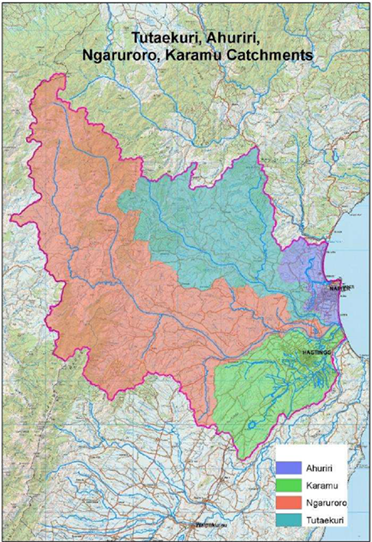
3.4 The
HBRC elected to use a stakeholder based collaborative planning exercise to
determine how water bodies within the TANK catchments should be managed to meet
the diverse interests and needs of the community. The TANK group was
established in 2012 and comprises over 30 groups and organisations representing
a spectrum of water users, environmental interests, recreationalists and
Tangata Whenua/Mana Whenua groups. The process included Hastings District and
Napier City Council officers, but industrial abstractors reliant on their own
bores instead of municipal supply were not specifically represented.
3.5 HDC’s
roles and interests in the issue as a territorial authority include:
· Abstracting
groundwater for municipal supply and discharging urban stormwater to freshwater
receiving bodies
· Having
land use planning responsibilities under the RMA that affect freshwater
· Advocating
for district rural and urban dwellers economic and social wellbeing where this
is dependent upon water quality and quantity.
3.6 These
roles are however, tempered by an overarching responsibility under the Local
Government Act to take a sustainable development approach, including the need
to maintain and enhance the quality of the environment and take the into
account the cultural wellbeing of people and communities.
3.7 In
that respect it is noted that Tangata Whenua have not necessarily found either
the process or the outcomes satisfactory in terms of recognising and providing
for their values. Discussion with officers of the Taiwhenua and NKII
(participants in the TANK process) reveal a concern that Proposed Plan change
does not go far enough quickly enough, particularly in terms of water
allocation and they have major reservations about proposals for mitigating
effects through stream flow maintenance from groundwater.
3.8 While
it is not the HDC’s role to represent Maori values, it is important that
they are respected and accounted for in its position to the extent that they
can be. In that regard this report allows for further discussion with Iwi to
identify areas of common concern, or areas of conflict so that these can be
managed in a mutually respectful way before lodging a submission.
3.9 The
collaborative TANK Group finally presented a draft plan change to the HBRC
Regional Planning Committee (RPC) in August 2018 while noting some significant
areas of non-consensus. Given the non-consensus it was not until March 2020
that the RPC was in a position to recommend a plan change to the HBRC for
notification, although a pre-notification draft was released for consultation
in March 2019.
3.10 In mid-March
2020 the HBRC resolved that the Change be publicly notified on 28 March for a
period of 42 working days (to the end of May). In April however, the HBRC
resolved to defer notification of the Proposed TANK Plan Change to 2 May 2020
with a nine week submission period to 3 July, because of the impact of the
COVID19. Subsequently the HBRC extended submission period to 14 August 2020.
4.0 Discussion – Te Matapakitanga
4.1 The
plan is required to give effect to national and community values for freshwater
and compulsory values have been set by the NPSFM for ecosystem health and human
health for recreation. Beyond that the NPSFM requires that regional councils
set limits and targets, include measures that prevent or reduce
over-allocation, both in relation to water quantity and the capacity of the
environment to assimilate diffuse discharges from land use on water quality.
4.2 Once
sustainable limits have been set to protect instream values, the Plan must
manage the allocation and re-allocation of the water available for abstraction
and the application of nutrients to land in an equitable way among a wide range
of water users.
4.3 In
March last year HDC had two workshops on the Draft Plan Change and a report to
the March meeting considered possible submissions in response to the challenges
for water allocation and management it posed for the HDC and community.
HDC’s concerns with the Plan Change related mainly to the provisions of
the Plan concerning water quantity limits and allocation provisions, rather
than quality concerns (where there is largely a consensus of views).
4.4 While
these were nevertheless significant issues for the HDC and the economy, it was
accepted that there is now a new reality around freshwater resources nationally
and within the Heretaunga Catchments as a result of:
· Greater
National Direction on freshwater management, urban development and protection
of versatile soils;
· Heightened
public awareness and expectations on quality;
· Groundwater
/surface water connectivity in the TANK catchments is much greater than
previously understood;
· The
scale of potential over-allocation versus actual allocation is better
understood in the TANK catchments;
· Greater
understanding of abstraction effects on groundwater and surface water levels in
the TANK Catchments;
· Increased
innovation in water use and allocation management;
· Integration
of Three waters thinking and Government Review.
4.5 These
are longer term enduring changes that present challenges which will not be met
taking a short or even medium term view (5-10 years) and cannot be
satisfactorily addressed through a modified “business as usual”
approach. Increasingly decisions about land and water will also need to be made
against the backdrop of the government’s desire to move New Zealand
towards a low carbon economy as signalled by the Zero Carbon Act.
4.6 In
light of that HDC endorsed officers commencing work separately on a possible
long term strategic approach beyond the plan change process in the form of an
intergenerational water strategy. The purpose of that strategy would be to help
facilitate economic and urban growth within the limitations of current and
future freshwater resources of the Heretaunga Plains.
4.7 To
that end HDC also resolved to take a positive, but focussed and pragmatic
approach to the Plan Change itself, by seeking changes that would enable the
HDC and the community to better position themselves to rise to the challenges
of growing within the limits of the water resource. A submission was duly made
on the draft to do that and a number of changes were made as result.
4.8 A
briefing workshop was held last month with HDC on the Notified Plan Change to
review how the Plan Change had been modified in relation to the earlier
suggestions it had made, but more particularly to focus further on the residual
concerns and any new matters of concern that had been introduced as a result of
the RPCs deliberations. Specifically the remaining areas where change is
recommended by way of a formal submission from HDC are as follows:
Water Allocation
4.9 While
there are now various provisions to provide for existing takes, there is no
clear pathways or provisions for new takes/opportunities i.e. industrial and
commercial takes. This needs to be resolved so as to not adversely affect the
economic and social wellbeing of the Hastings District. Greater flexibility and
clarity is also sought around different pathways for municipal takes to meet
growth demand in an equitable and cost effective way, within overall water
limits.
4.10 Accordingly the submission seeks:
· Greater
recognition of the unique nature of urban growth demands and the need to
recognise the Heretaunga Plains Urban Development Strategy (HPUDS) and
subsequent reviews as providing guidance around minimum demands;
· Recognition
of wider community needs when considering municipal community and domestic
needs, beyond just human biological health needs;
· Ability
to consider exceptional/high value opportunities when allocating and
re-allocating water versus blanket prohibition;
· Consideration
of growth planned at the time of the original consent beyond historic use when
replacing industrial and commercial takes;
· Greater
flexibility for transfers of water as a means of enabling opportunity,
including for and between municipal use to support urban growth for existing
industrial users within limits;
· Investigation
of flexible management initiatives such as augmentation and global consents
ahead of the replacement process.
· Consideration
of the long term sustainable equilibrium of the groundwater resource (up or
down) alongside other matters when reviewing the allocation limit.
· Allow
for TAs to manage some individual allocations on a collective basis (i.e.
bundling) for urban activities not supplied from existing municipal systems to
encourage efficient use and headroom for growth.
Source Protection
4.11 Specifically
the submission supports the spatial definition of Source Protection Zones
(SPZs) for HDC to have a greater level of understanding as to activities in the
SPZs that have the potential to impact on the safety of drinking water.
4.12 The
submission seeks to ensure that these are legal (and therefore able to be
relied upon), provide certainty for water suppliers and plan users alike, and
provide adequate protection of source water from the time the provisions become
operative. In particular, the submission seeks clarification of the following:
· The
status of the SPZ maps within the Plan;
· The
legality and implementation implications of using a consent process to amend
the spatial extent to which regulatory provisions (rules) apply;
· That
the provisional status of source protection does not preclude the regulatory
provisions from applying;
· Guidance
for applicants to engage with Water Suppliers;
· Considerations
should apply irrespective of treatment;
· The
requirement for Farm Environment Plans should be a high priority in SPZs;
· Smaller
suppliers should be able to retain the default SPZ on renewal;
· Provide
clarity as to process for updating SPZs.
Stormwater
4.13 The HDC has
been actively involved in the development of the stormwater provisions via the
Stormwater Working Group since the Draft was released. The submission therefore
supports the direction towards alignment between the three Councils through an
Integrated Catchment Management Approach and working to align policies,
standards and bylaws to achieve water quality objectives.
4.14 To ensure
that integrated management can be achieved however, the submissions seeks
changes to provide:
· Greater
clarity on roles and responsibilities, particularly with respect to defining
receiving environments and managing land uses which may impact indirectly on
stormwater services (e.g. via overland flow);
· Remove
direction to amend District Plans due to third party rights of objection and
appeal;
· Further
refinement of the risk matrix for industrial and trade premises to
appropriately define low, medium and high risk sites;
· Clarity
as to definition of high-risk sites / areas and confirmation of the rule status
for medium risk sites.
4.15 These are
developed in more detail in Appendix 1, which sets out the provisions of
concern, the reasons for the concern and the remedy sought in relation to those
concerns.
5.0 Options – Ngā Kōwhiringa
5.1 The
options available to HDCl are to;
· Make
comment to the HBRC on the matters of support and concern to HDC along the
lines described in Section 4.0 of the report.
· Oppose
the Plan Change provisions that limit water allocation and/or impose
significant water quality improvement costs on land users.
· Make
no comment to HBRC on the draft plan change and wait until the summary of
submissions to decide on whether to support or oppose the submissions of other
parties.
Option One -
Recommended Option - Te Kōwhiringa Tuatahi – Te Kōwhiringa
Tūtohunga
5.2 Make
comment to the HBRC on the matters of support and concern to HDC along the
lines described in Section 4.0 of the report.
Advantages
· For
the reasons outlined above this is the preferred option. The submission
attempts to strike a balance in terms of promoting development within
environmental limits, and the overarching purpose of the RMA to promote
sustainable management of natural and physical resources. Importantly it
recognises the significant investment in land based primary production and
processing, particularly over the last 30 years, and the role water plays in
the supporting the economic foundations of the regional economy. Notwithstanding
the accepted impacts that this has had on the environment, the submission takes
pragmatic approach to achieving environmental outcomes over reasonable time
frames, where the level of regulation is proportionate to the environmental
benefits to be gained.
· The
submission seeks changes to the rules to provide the HDC with more flexible and
agile options for meeting its growth needs through multiple pathways. In that
way it maximise its ability to meet its statutory obligations to support
housing and business capacity to meet growth demands.
· Specifically
it seeks changes to the plan change that will better enable HDC to take a
longer term strategic approach that works within the limitations of the current
water resources, and to facilitate growth through investment in augmentation;
innovation and excellence in water management, and changing community awareness
and behaviour.
Disadvantages
· It
could however, be argued that the submission takes the position that favours
economic stability and growth over a need for fundamental land use change to
achieve environment and ecological restoration within shorter timeframes. In
that respect HDC could take a more aggressive approach that advocates for a
reduction in allocable volume below the interim allocation limit of 90m m3
and increase in environmental trigger flows for rivers and streams with the
attendant economic impacts. In that respect HDC would need to accept that,
without rapid development of larger and more complex storage and enhancement
scheme, this would drive fundamental land use change toward lower value crops
with flow on effects through the processing and support sectors.
Option Two –
Te Kōwhiringa Tuarua
5.3 Oppose
the Plan Change provisions that limit water allocation and or impose
significant water quality improvement costs on land users.
· On
the other hand HDC could adopt a position of opposing those provisions that
tightly limit water allocation. Under the Plan Change the capping of allocation
to existing use, clawing back over-allocation where that exists, limiting
offsetting of stream depletion effects to existing use through storage and/or
aquifer fed stream flow enhancement, will leave no room for growth, or
intensification of land based production and associated processing industries.
· Allocation
for municipal supply to deal with urban growth will also be limited, meaning
this will not be a ready source of alternative water for industrial processing
use in lieu of new bores, or increased takes from existing bores. Indeed, it
appears at present that municipal needs associated with growth will also
potentially need to be met through storage with potentially greater pragmatic
and cost difficulties.
· Although
the Plan Change seeks to ensure existing use is maintained with a reasonable
security of supply, growth will be severely constrained. Until the
re-allocation to existing use is completed and a review of sustainable
allocation completed alongside feasibility studies for water storage and flow
enhancement, there simply will not be any available water for intensification
or new use. This could take ten years to complete.
· Opposing
these provisions however, would run counter to the HDC’s sustainable
development approach and strategic objectives listed (See summary of
considerations below). A growth philosophy based on unlimited access to water
is not likely to be supported given significant changes in the operating
environment over the last ten years summarised in paragraph 4.4 earlier.
· Under
this option the HDC would likely find itself out of step with community
sentiment and would incur significant costs in promoting an alternative regime,
including attempting to gathering the necessary evidence base to support it.
Option Three – Kōwhiringa
Tuatoru
5.4 Make no comment to
HBRC on the draft plan change and wait until the summary of submissions to
decide on whether to support or oppose the submissions of others.
· Under
this option HDC would not make a submission of its own and wait until the
summary of submissions is published before taking a position. It could then
decide whether to lodge a further submission to support or oppose the
submissions of others as it saw fit. The risk with this option is that other
parties may not lodge submissions in relation to matters that impact directly
on HDC, leaving a “gap” in submission content. That would limit
this HDC’s ability to seek changes and provide less influence over the
nature of changes sought by others and ultimately the final outcome.
· There
are no particular advantages with this option, given that HDC can still lodge a
further submission in support of others whether it lodges its own original
submission or not. The only possible advantage would be a saving in staff time
and possibly avoid upsetting other parties who might otherwise be unhappy with
the changes HDC seeks under Option 1. Some parties may for example, oppose
provisions that favour allocation to municipal abstraction for growth, leaving
less for irrigators.
6.0 Next steps – Te Anga Whakamua
6.1 The
next step will be to finalise and lodge a submission to the HBRC by 14 August.
For the reasons given above option 1 is the preferred option and recommended
for adoption based on Appendix 1 attached,
6.2 There
will still be an opportunity to make changes to the draft submission attached
as a result of:
· Discussions
with Iwi Partners on points of common concern;
· Discussions
with Napier City Council to facilitate a common submission or at least mutually
reinforcing points of common concern;
· Consideration
of the Joint Working Group on Source Protection Zones for Drinking Water;
· Any
advice received from the HBRC on the likely interpretation of clauses that
officers are seeking clarification on;
6.3 In
that respect these Draft submissions have been shared with Napier City Council
already include some concerns raised by them earlier, but this is
still a work in progress. Napier City Council staff have indicated
that they are comfortable with the concept of this submission being a joint
submission, but with any additional concerns not shared between the two being
separately identified.
6.4 Officers
have also met with representative of Ngati Kahungunu Iwi Incorporated and Te
Taiwhenua o Heretaunga to establish whether there are similarly shared concerns
that can be signalled to the HBRC in the submission. It is planned to hold a
further meeting with the Mayor, Deputy Mayor and Chair of the Strategy and
Policy Committee and the chairs of the Taiwhenua and the NKII to further
understand respective positions and areas of common concern and greater
understanding where there are concerns that are not shared or in conflict.
6.5 In
order to incorporate any common concerns/expectations of the Napier City
Council and Iwi partners, it is suggested that the Mayor, Deputy Mayor, Chair
of the Policy and Strategy Committee and the Chief executive be delegated
authority to sign-off on a completed submission, following completion of the
matters outlined in paragraph 6.1 above.
6.6 In
due course the HBRC will publish a summary of submissions and call for further
submission in opposition or support of those received. Hearing of submissions
is likely to follow throughout the later part of the year and into the New Year
before decisions are issued. Any subsequent Environment Court Appeals could
take the process into 2022.
Attachments:
|
1⇨
|
Draft Submission Cover Letter
|
EXT-11-02-20-913
|
Under Separate Cover
|
|
2⇨
|
HDC Draft Submission to HBRC Regional Resource Management
Plan Change 9 TANK Appendix 1 Submission Table
|
EXT-11-02-20-914
|
Under Separate Cover
|
|
Summary of
Considerations - He Whakarāpopoto Whakaarohanga
|
|
Fit
with purpose of Local Government - E noho hāngai pū ai ki te
Rangatōpū-ā-Rohe
The HDC is required to give effect to the purpose of local
government as set out in section 10 of the Local Government Act 2002. That
purpose is to enable democratic local decision-making and action by (and on
behalf of) communities, and to promote the social, economic, environmental,
and cultural wellbeing of communities in the present and for the future.
This proposal promotes the social and environmental
wellbeing of communities.
|
|
Link to the Council’s Community Outcomes – Ngā Hononga ki Ngā Putanga ā-Hapori
The proposal relates to all four of the
community well-beings in the present and for the future as water is central
to the environment, our economy, our social interaction with the environment
and our cultural wellbeing, especially for Tangata Whenua, and of course it
is central to our bio-physical health. This proposal links to the
HDC’s Community Outcomes specifically, through the sustainable use of
land and water resources, healthy waterways and drinking water and a
community which wastes less. It is also central to HDC’s strategic
objectives relating infrastructure supporting economic growth and building a
resilient and job rich local economy that is resilient to natural hazards and
shocks such as droughts in particular.
The following HDC strategic objectives and outcomes can be
identified as relating to the substance of this report:
|
· Sustainable use of land & water resources
|
· Healthy drinking water and sanitary services
|
|
· Healthy waterways
|
· Building a resilient and job rich local economy
|
|
· Reducing public nuisance and threats to public
health & safety
|
· Infrastructure supporting economic growth
|
|
· Appealing visitor destination
|
· Industrial development opportunities
|
|
· Sites and places of significance to mana whenua
are protected
|
· Supporting and attracting business
|
|
· Fostering recreational participation
|
· A community which wastes less
|
|
|
Māori
Impact Statement -
Te Tauākī Kaupapa Māori
Water is taonga to Maori and central
to their physical social and cultural (and spiritual) wellbeing. The
background section of the proposed plan changes states:-
“The process used by
HBRC to prepare this Plan Change has been a community based collaborative
approach dependent on considerable input by the TANK Group members. This has
involved consensus decision making by local representatives of a variety of interest
and stakeholder groups and the significant influence of tangata whenua to
develop the recommendations leading to this Plan Change.
Tangata whenua have been involved
in and contributed to the collaborative process in a way that has enabled
better community decision making. This is because being part of the
collaborative process has ensured the wider TANK group better understood and
accounted for tangata whenua aspirations and values during this process.
HBRC’s Treaty obligations are also accounted for by not only ensuring
Treaty parties were invited to be part of the TANK collaborative process, but
also through the legal decision making framework provided by the Regional
Planning Committee.”
Notwithstanding this there are
significant areas of non-consensus with Maori interests as discussed in the
body of the report, particularly with respect to water quantity provisions.
In the process to date HDC has taken the stance of supporting provisions that
relate directly to improving water quality, but taking a more pragmatic
approach to water quantity. This is on the basis that the environmental
benefits of significantly and rapidly reducing abstraction could be out of
proportion to the impacts on the regional economic and community wellbeing
based on that resource over decades and reducing allocation should be
approached cautiously.
|
|
Sustainability
- Te
Toitūtanga
Water is central to sustainability,
across all four well beings and under the RMA the Plan Change is required to
promote sustainable management of natural and physical resources. Decisions
made on the Plan Change will have significant implications for land uses that
are dependent upon water to sustain crops and also the manner in which urban
growth demands are promoted and met. The flip side of that is how much water
needs to be reserved for eco-system health and the cultural wellbeing of
tangata whenua.
Sustainable development will be
promoted by balancing these values where these are in conflict, while bearing
in mind that sustainable management involves setting environmental bottom
lines within which the use and development of land can operate. The
allocation of water will largely mean that growth is constrained without some
form of storage and/or stream flow maintenance and enhancement schemes.
Indeed without these being developed to off-sit, or mitigate the stream flow
effects of existing abstraction, there could be a need for significant land
use change away from cropping and horticulture to lower water use activities
with attendant effects on the reginal economy and associated community
wellbeing.
Subject to managing environmental effects
the capping of allocation to current use, mitigating effects of existing
abstraction through storage and stream flow maintenance projects, promoting
new growth through more efficient use and adding further augmentation from
storage, would better promote sustainable development, rather than forcing
wholesale land use change by reducing allocation or providing for growth
through increasing allocation limits.
|
|
Financial
considerations -
Ngā Whakaarohanga Ahumoni
The recommended option does come with
some costs in terms of specialist planning and legal support to represent HDC’s
viewpoint in the submissions and hearings process. Budget allowance been made
in the 2019-2020 year and the balance of this will need to be carried forward
or re-budgeted due to the delay in the plan change being notified by the
HBRC. It is expected that the costs could amount to around $60-80,000 not
including any appeals to the Environment Court which will likely need to be
budgeted for in the 2021-2022 year should they eventuate. This could add a
further $60-80,000 to the costs. These cost are also likely to be incurred
with option 2 and to a lesser extent option 3.
|
|
Significance
and Engagement - Te
Hiranga me te Tūhonotanga
This decision/report has been assessed under the HDC's
Significance and Engagement Policy as being of low significance
from an operational and organisation sense, although the subject matter the
report relates to has huge significance for the District and Region,
including how HDC supplies water for municipal growth in the future.
Responsibility for decision making however, sits firmly with the HBRC in the
first instance in that regard, with the territorial authorities being stakeholders
or affected parties.
|
|
Consultation
– internal and/or external - Whakawhiti Whakaaro-ā-roto / ā-waho
The TANK process has been a form of
consultation in its own right and HDC is acting in a stakeholder capacity,
rather than in a final decision making role. The major stakeholder interests
are already covered in the process and the public will have an opportunity to
lodge submissions in their own right. No separate HDC consultation is
therefore required on this matter. Discussions are underway with Napier City
Council on the prospect of a joint submissions and discussions have been
initiated with NKII and the Taiwhenua to identify points of common concern.
|
|
Risks:
Legal - Ngā
Tūraru: Ngā Ture
While there are no specific legal or
health and safety risks, there is a high likelihood that appeals will be made
the Environment Court and HDC may wish to become a party to those. In
addition the final plan will, have the force of a regulation made under the
Resource Management Act that will apply to water users, including HDC either
by specific rules or conditions of consent. It is intended that a legal
review be undertaken by HDC’s Solicitors prior to lodgement.
|
|
Rural
Community Board –
Te Poari Tuawhenua-ā-Hapori
This matter was the subject of a briefing
paper to the Rural Community Board in June of last year. The next meeting of
the Rural Community Board is not until September, i.e. well after the closing
deadline for submissions. In any event rural sector interest groups have been
well represented throughout the process to date and will likely also
participate formally in the submissions and hearings process.
|
Hastings
District Council: Council Meeting
Te Rārangi Take
Report to Council
|
Nā:
From:
|
Kevin Carter, Community Grants Advisor
Peran Hutchings, Splash Planet Manager
|
|
Te Take:
Subject:
|
Flaxmere Learn to Swim
Funding Application to Trust House
|
1.0 Executive Summary
– Te Kaupapa Me Te
Whakarāpopototanga
1.1 The
purpose of this report is to obtain a decision from Council to apply to Trust
House Foundation for $25,000 to support Flaxmere Primary Schools to participate
in the Learn to Swim and Survive Aquatics Programme over the 2020-2021
financial year at Flaxmere Aquatics.
1.2 The Trust House
Foundation requires a Council resolution as part of the application, as only
one application per year, per organisation is accepted.
1.3 In response to meeting
the needs of the community and the New Zealand Schools curriculum “It is
expected that all children by the end of year 6 will have had opportunities to
learn basic aquatic skills” Flaxmere Primary, Irongate, Peterhead and
Kimi Ora Community schools have been regular participants of the Programme due
to the support of external funding.
1.4 Council has been
successful in receiving funding for the past four years. Although in principle
the funding application has been supported by Trust House, releasing the
funding is reliant on a resolution from Council.
|
2.0 Recommendations – Ngā Tūtohunga
A) That the
Council receives the report titled Flaxmere Learn to Swim Funding Application
to Trust House
B) That the
Council approve the funding application to Trust House Foundation for $25,000
that will support Flaxmere Primary, Irongate, Peterhead and Kimi Ora
Community schools to participate in the Learn to Swim and Survive Education
programme at Flaxmere Aquatics
|
3.0 Background – Te Horopaki
3.1 Flaxmere Aquatic
Centre provides learn to swim and survive education to four primary schools
within the Flaxmere community.
3.2 With many schools no
longer having aquatic facilities onsite, having access to an aquatic facility
all year round means our schools can ensure their timetables can be managed in
a way that students have access to quality programmes.
3.3 With the New Zealand
drowning statistics identifying the rising drowning rate in NZ over recent
years and with the biggest risk being Māori and Pacific ethnicities, our
community schools predominately fit within those ethnicity groups.
3.4 The Trust House
funding has historically supported Flaxmere Primary, Irongate, Peterhead and
Kimi Ora Community schools. With the reduced current cost to schools of $2.60
per student per swim (compared to $10.00 per lesson with a private learn to
swim provider) is far more sustainable for schools to continue to support
children over their primary years, giving them life skills that as adults can
make safer choices around water.
3.5 In recent decades part
of teacher training was based around providing aquatic education to students.
This was due to many schools throughout New Zealand having school pools.
3.6 Nowadays teachers are
not given the necessary skills to deliver aquatic education and organisations
such as Swimming New Zealand do not have the resources to provide Professional
Development to Schools.
3.7 Although there is no
official limit to the amount of funding we can apply to the Trust House
Foundation for, we have been advised that $25,000 would be the correct amount
to seek for this project.
3.8 Funding from the Trust
House Foundation must be used for projects within the Flaxmere area, This
funding opportunity had been discussed with the HDC Lead team and there are no
other larger projects that would currently meet the criteria. Officers
recommend the Flaxmere Learn to Swim programme to be the best use of this
funding opportunity
4.0 Discussion – Te Matapakitanga
4.1 Council has
successfully applied for funding to Trust House for the past 4 years and
supports four Flaxmere schools and their students to participate in the Learn
to Swim & Survival Aquatics Programme. In the 2016/17 financial year the
grant was increased from $20,000 to $25,000. The remaining costs to run the
programme is covered by the schools. It is also important to note that
community do have access to the facilities during the school programme
sessions.
4.2 As identified in
Council’s Long Term Plan, this funding is an opportunity for Council to work
with others to reduce levels of social disadvantage and income gaps in our
community.
4.3 The significance of
this programme is great and without the support from council and Flaxmere
Aquatics, schools will no longer be able to continue or meet the needs around
“aquatic education”. Teachers at primary school get no
support or training around teaching basic aquatic skills therefore are unable
to deliver the skills to their students.
5.0 Options – Ngā Kōwhiringa
Option One - Recommended Option -
Te Kōwhiringa Tuatahi – Te Kōwhiringa Tūtohunga
5.1 To support
the funding application of $25,000 that will lower the cost for four Flaxmere
schools and their students to access quality learn to swim programmes.
Option Two – Status Quo - Te Kōwhiringa Tuarua
– Te Āhuatanga o nāianei
5.2 Not to support his
application and to pass the additional cost on to the individual schools
6.0 Next steps – Te Anga Whakamua
6.1 If approved, Council
Officers will forward the required documents to Trust House which will
formalise the process and release the funding of $25,000 to support the
implementation of the Learn to Swim and Survival Aquatics Programme at Flaxmere
Aquatics.
Attachments:
There are no attachments for this report.
|
Summary of
Considerations - He Whakarāpopoto Whakaarohanga
|
|
Fit
with purpose of Local Government - E noho hāngai pū ai ki te
Rangatōpū-ā-Rohe
The Council is required to give effect to the purpose of
local government as set out in section 10 of the Local Government Act 2002.
That purpose is to enable democratic local decision-making and action by (and
on behalf of) communities, and to promote the social, economic,
environmental, and cultural wellbeing of communities in the present and for
the future.
This report contributes to the purpose of local government
by primarily promoting social wellbeing
|
|
Link to the Council’s Community Outcomes – Ngā Hononga ki Ngā Putanga ā-Hapori
This proposal contributes to the Council’s strategic
objective of reducing levels of social disadvantage and income gaps in our
community.
|
|
Māori
Impact Statement -
Te Tauākī Kaupapa Māori
With the New Zealand drowning statistics
identifying the rising drowning rate in NZ over recent years and with the
biggest risk being Māori and Pacific ethnicities, our community schools
predominately fit within those ethnicity groups.
|
|
Sustainability
- Te
Toitūtanga
No implications
|
|
Financial
considerations -
Ngā Whakaarohanga Ahumoni
No implications
|
|
Significance
and Engagement - Te
Hiranga me te Tūhonotanga
This decision/report has been assessed under the Council's
Significance and Engagement Policy as being of low significance.
|
|
Consultation
– internal and/or external - Whakawhiti Whakaaro-ā-roto / ā-waho
There has been no external consultation
for this application however this programme has been funded through
Trusthouse for the past four years.
|
|
Risks:
- Ngā
Tūraru:
|
REWARD – Te Utu
|
RISK – Te Tūraru
|
|
Providing swimming lessons to children who might not
otherwise have the opportunity to have swimming lessons
|
No risks
|
|
|
Rural
Community Board –
Te Poari Tuawhenua-ā-Hapori
No specific implications for the rural
community.
|
Hastings
District Council: Council Meeting
Te Rārangi Take
Report to Council
|
Nā:
From:
|
Regan Smith, Risk and Corporate Services Manager
Scott Smith, General Counsel
Bruce Allan, Group Manager Corporate
|
|
Te Take:
Subject:
|
Office Accommodation
|
1.0 Executive Summary
– Te Kaupapa Me Te
Whakarāpopototanga
1.1 Council
needs to establish a lease for office space to accommodate staff that have been
displaced from Heretaunga House due to the building being deemed earthquake
prone. The term will need to cover a timeframe that allows a permanent
replacement to be established.
1.2 The standing
delegation to the Chief Executive to enter in to a lease is limited to under 2
years.
1.3 It is likely that a
lease that includes rights of renewal will take the term of any lease to the 4
– 5 year range, and therefore, outside the Chief Executive’s
standing delegation.
1.4 It is recommended that
the Chief Executives delegation for entering into lease arrangements be
extended, specifically for the purpose of providing office accommodation for
staff displaced from Heretaunga House.
|
2.0 Recommendations – Ngā Tūtohunga
A) That the
Council receives the report titled Office Accommodation
B) That the
Council delegate authority for the Chief Executive to enter in to a lease,
including rights of renewal of up to and including 5 years, specifically for
the purpose of providing office accommodation for staff displaced from
Heretaunga House.
C) That the
Chief Executive will report back to Council on the lease arrangement entered
into under this delegation.
|
3.0 Background – Te Horopaki
3.1 Council needs to
establish a lease for office space to accommodate staff that have been
displaced from Heretaunga House due to the building being deemed earthquake
prone.
3.2 The alternative office
space will be required until the Heretaunga House situation can be resolved.
Due to the current level of uncertainty about the future works required, it is
expected that a short to medium term lease will be required.
3.3 The standing
delegation to the Chief Executive to enter in to a lease is limited to under 2
years, and leases of 2 years and over are to be approved by Council.
4.0 Discussion – Te Matapakitanga
4.1 In order to secure a competitive
leasing rate, it is likely that Council will need to enter in to a lease with
an initial term, or rights of renewal, of more than 2 years.
4.2 To retain operational
flexibility, Officers will be looking to establish the shortest reasonable initial
lease term, and include a series of rights of renewal for contingency in case a
permanent resolution takes longer than expected.
4.3 There are a number of
options that officers are exploring that could be suitable, however office
accommodation of the size and requirements required are limited in Hastings and
there appears to be external interest and demand for these properties. Therefore
time is of the essence in making decisions to ensure appropriate accommodation
is secured and displaced staff can be appropriately rehomed.
5.0 Options – Ngā Kōwhiringa
Option One - Recommended Option -
Te Kōwhiringa Tuatahi – Te Kōwhiringa Tūtohunga
5.1 Delegate authority for
the Chief Executive to enter into a lease, including rights of renewal of up to
and including 5 years, specifically for the purpose of providing office
accommodation for staff displaced from Heretaunga House.
Advantages
· Allows
Council to negotiate and secure suitable office accommodation with minimal
delay.
Disadvantages
· The
Council will not be able to review the specific lease negotiated by the Chief
Executive.
Option Two – Status Quo - Te Kōwhiringa Tuarua
– Te Āhuatanga o nāianei
5.2 Rely on the Chief
Executive’s standing delegation and require any new lease to be decided
upon by Council.
· This
may slow the negotiation process resulting in Council missing out on the most
suitable option. The Chief Executive would report back to Council on the lease
arrangement entered into under this delegation, providing the necessary
transparency for Council on the decisions made.
6.0 Next steps – Te Anga Whakamua
6.1 A project governance
structure consisting of executive team members will be established to oversee
delivery of the office relocation project.
Attachments:
There are no attachments for this report.
|
Summary of
Considerations - He Whakarāpopoto Whakaarohanga
|
|
Fit
with purpose of Local Government - E noho hāngai pū ai ki te
Rangatōpū-ā-Rohe
The Council is required to give effect to the purpose of
local government as set out in section 10 of the Local Government Act 2002.
That purpose is to enable democratic local decision-making and action by (and
on behalf of) communities, and to promote the social, economic,
environmental, and cultural wellbeing of communities in the present and for
the future.
Link to the Council’s
Community Outcomes – Ngā Hononga ki Ngā Putanga ā-Hapori
This proposal promotes effective local public services wellbeing of communities in the present and for the future.
|
|
Māori
Impact Statement -
Te Tauākī Kaupapa Māori
No known impacts for Maori:
|
|
Sustainability
- Te
Toitūtanga
Energy efficiency will be considered in
weighing up potential office accommodation:
|
|
Financial
considerations -
Ngā Whakaarohanga Ahumoni
Funding invested in Heretaunga House
as part of Council’s use of the office space is to be reallocated to
cover the cost of any future lease.
|
|
Significance
and Engagement - Te
Hiranga me te Tūhonotanga
This decision/report has been assessed under the Council's
Significance and Engagement Policy as being of low significance.
|
|
Consultation
– internal and/or external - Whakawhiti Whakaaro-ā-roto / ā-waho
No consultation is required:
|
|
Risks:
Legal - Ngā
Tūraru: Ngā Ture
Opportunity: Provision of suitable office
accommodation for Council staff.
|
REWARD – Te Utu
|
RISK – Te Tūraru
|
|
- Staff provided accommodation of at least the same
quality as provided in Heretaunga House.
- Chance to use the alternative work space as a
pilot for open plan workspace following the central Government Good
Practice Guide.
|
- Safety of staff in the new workspace. Mitigated
though a due diligence review of shortlisted properties, specifically
addressing seismic performance.
- Entering in to a lease term longer than required
resulting in unnecessary financial commitment. This will be mitigated by
minimising the fixed lease term.
- Business disruption during the move. This is being
mitigated through an engagement with a professional project management
company to plan the relocation.
- Possible reputation issues associated with the
cost of lease additional space. This will be mitigated through a proactive
communications plan.
-
|
|
|
Rural
Community Board –
Te Poari Tuawhenua-ā-Hapori
No additional considerations for the
Rural Community Board:
|
Hastings
District Council: Council Meeting
Te Rārangi Take
Report to Council
|
Nā:
From:
|
Jackie Evans, Manager: Democracy and Governance
Dennise Elers, Acting Group Manager: Community
Wellbeing & Services
|
|
Te Take:
Subject:
|
Youth Council
Appointments to Council Subcommittees
|
1.0 Purpose and summary - Te Kaupapa Me Te Whakarāpopototanga
1.1 The
purpose of this report is to advise the Council that members of the Youth
Council have expressed an interest in attending some of the Council’s
Subcommittee meetings and being able to contribute to the debate.
1.2 At the meeting held on
the 17 June 2020 the Youth Council expressed an interest in getting involved
with the Council’s Subcommittees which aligned to the following Youth
Council Subcommittees which had been set up to achieve the objectives set out in
their Annual Plan (Attachment 1) under separate cover.
1.3 The
Youth Council Subcommittees are:
· Health
& Diversity Arts
· Culture
& Communications
· Rangatahi
Co-Lab
· Environment.
1.4 The Youth Council
values are;
· Manaakitanga
· Balance
· Compassion
· Positive
Influence.
1.5 The four Youth Council
goals are;
· Youth
Engagement
· Youth
Perspective Valued
· Mental
Health Support
· Community
Promotion
1.6 The
Council Subcommittees which most closely align to the Youth Council Committees
are:
· District
Development (Housing, Transport, CBD Development, A Vibrant Economy etc)
· Eco
District (Climate Change, Coastal Hazards, Sustainable Hastings, Waste
Minimisation etc)
· Great
Communities (Community Plans, Youth Pathways, Arts/Toitoi, Fabulous Flaxmere
etc)
It is therefore
recommended to appoint two non-voting Youth Council appointees and an
alternate to the above subcommittees. The potential appointees who have
expressed an interest are:-
1.6.1
|
Name
|
School/College/
Organisation
|
Subcommittee
|
Interests
|
|
|
Keelan
Heesterman
|
Karamu
|
District
Development
|
Local
and central politics, government policy, debating, public speaking, music,
problem solving
|
Elected
|
|
Sam
Wixon
|
HNHS
|
District
Development
|
Business,
politics, Maori culture and design, Maori impact and treatment in health,
education and corrections
|
Elected
|
|
Louis
Gaffaney
|
St
Johns.
|
District
Development
|
Politics,
performing arts, debating and speaking, small business
|
Alternate
|
|
Matilda
Ellis
|
Woodford
House
|
Eco
District
|
Caring
for environment, reducing carbon in everyday life and sustainability
|
Elected
|
|
Thea
Morton
|
Karamu
|
Eco
District
|
Running,
the environment, debating, politics, dance.
|
Elected
|
|
Zoe
Smith
|
HGHS
|
Eco
District
|
Government
and business, local government, looking after the environment.
|
Alternate
|
|
Finley
Duncan
|
Lindisfarne
|
Great Communities
|
Drama,
NZ culture, chess, tennis, agriculture, healthcare, reading
|
Elected
|
|
Brooke
Hemmings
|
Karamu
|
Great
Communities
|
The
arts, drama, helping people, the events and entertainment industry
|
Elected
|
|
Romona
Wainohu
|
Karamu
|
Great
Communities
|
Music,
kapa haka, anything on a stage. Helping at marae and getting involved in the
community. Studying for medicine, travelling and tutoring others.
|
Alternate
|
1.7 In order to help the
Youth Council appointees to get the most out of this experience it is
recommended that each subcommittee provides a mentor from the elected
membership of the Subcommittee to provide advice and guidance on the work of
the Subcommittee.
1.8 Youth Council
appointees also will receive an induction session on Council meeting protocols,
Standing Orders and information relevant to participate in Subcommittees. It is
recommended that the Youth Council appointees should not be present in the meetings
for consideration of Public Excluded reports.
|
2.0 Recommendations
– Ngā Tūtohunga
A) That the
Council receives the report titled Youth Council Appointments to Council
Subcommittees
B) That the
Council approve the non-voting appointment of the following Youth Council
representatives to the following Subcommittees for the length of their term
of office with the Youth Council:
|
Name
|
School/College/Organisation
|
Subcommittee
|
|
Keelan
Heesterman
|
Karamu
|
District
Development
|
|
Sam
Wixon
|
HNHS
|
District
Development
|
|
Louis
Gaffaney (Alternate)
|
St
Johns
|
District
Development
|
|
Matilda
Ellis
|
Woodford
House
|
Eco
District
|
|
Thea
Morton
|
Karamu
|
Eco
District
|
|
Zoe
Smith
(Alternate)
|
HGHS
|
Eco
District
|
|
Finley
Duncan
|
Lindisfarne
|
Great Communities
|
|
Brooke
Hemmings
|
Karamu
|
Great
Communities
|
|
Romona
Wainohu
(Alternate)
|
Karamu
|
Great
Communities
|
C) That the
2019-22 Schedule of Appointments to Committees, Subcommittees and other
External Organisations and the Hastings District Council Committee and Rural
Community Board Register of Delegations 2019 -22 be amended accordingly.
|
Attachments:
|
1⇨
|
Youth Council Annual Plan 2020
|
COP-09-02-20-981
|
Under Separate Cover
|
Hastings
District Council: Council Meeting
Te Rārangi Take
Report to Council
|
Nā:
From:
|
Jackie Evans, Manager: Democracy and Governance
|
|
Te Take:
Subject:
|
Minor Amendment to the
Committee and Rural Community Board Register of Delegations 2019 -22
|
1.0 PURPOSE AND SUMMARY - TE
KAUPAPA ME TE WHAKARĀPOPOTOTANGA
1.1 A minor
amendment to the Hearings Committee Terms of Reference is required to allow the
Hearings Committee to determine matters under the Hastings District Council
Class 4 Gambling Act Policy.
1.2 The
following amendment to the current wording is recommended:-
Hearings Committee - Fields of Activity
1.3 The Hearings Committee is
established to assist the Council by hearing and determining matters where a
formal hearing is required in respect of a planning or
regulatory function of the Council, including under the provisions of
the:
· Resource Management Act 1991;
· Building Act 2004;
· Health Act 1956;
· Dog Control Act 1996;
· Litter Act 1979;
· Hastings District Council Bylaws;
· Local Government Act 1974;
· Local Government Act 2002; and
· Hastings District Council Class 4 Gambling Venue
Policy [Extract]
1.4 Part
4 (39) (c) of the Local Government Act 2002 states that a local authority
should ensure that as far as the practicable, responsibility and
processes for decision-making in relation to regulatory responsibilities is
separated from responsibility and processes for decision-making for
non-regulatory.
1.5 Section
39 Schedule 7 (30 -32) of the Local Government Act sets out the powers of
terrestrial authorities to appoint committees and subcommittees and delegation
arrangements.
1.6 A
resolution of Council is required to make amendments to the Hearings Committee
delegations.
|
2.0 RECOMMENDATIONS
- NGĀ TŪTOHUNGA
A) That the Council
receives the report titled Minor Amendment to the Committee
and Rural Community Board Register of Delegations 2019 -22.
B) That
the Council approve that the Hastings District Hearing
Committee Terms of Reference be amended to read as follows:-
a. The Hearings Committee is
established to assist the Council by hearing and determining matters where a
formal hearing is required in respect of a planning or regulatory function of
the Council, including under the provisions of the:
· Resource Management Act 1991;
· Building Act 2004;
· Health Act 1956;
· Dog Control Act 1996;
· Litter Act 1979;
· Hastings District Council Bylaws;
· Local Government Act 1974;
· Local Government Act 2002; and
· Hastings District Council Class 4 Gambling Venue Policy. [Extract]
C) That
the Hastings District Council Committee and Rural Community Board Register of
Delegations 2019 -22 be updated accordingly.
|
Attachments:
There are no attachments for this report.
Hastings
District Council: Council Meeting
Te Rārangi Take
Report to Council
|
Nā:
From:
|
Jackie Evans, Manager: Democracy and Governance
|
|
Te Take:
Subject:
|
Status of Items Under
Action from Previous Meetings
|
1.0 Purpose and summary - Te Kaupapa Me Te Whakarāpopototanga
1.1 The purpose of this
report is to update Council on actions raised at previous meetings.
1.2 The Council requested
that officer’s report back at each meeting with progress that has been
made on actions that have arisen from Council meetings. Attached as Attachment
1 is the status of items under action as at 1 July 2020.
|
2.0 Recommendations
– Ngā Tūtohunga
A) That the
Council receives the report titled Status of Items Under Action from Previous
Meetings, and notes actions taken since the last meeting of Council.
|
Attachments:
|
1⇩
|
Items Under Action as at July 2020
|
CG-16-2-00239
|
|
|
Items
Under Action as at July 2020
|
Attachment 1
|
|
Items
Under Action as at 1 July 2020
|
|
|
Date Raised
|
Due Date
|
Completed
|
Description and Action
|
Lead Officer
|
|
1
|
27.11.19 Council
|
March 2020
|
Arranging for July/Oct Operations &
Monitoring Committee
|
The Hawke’s Bay Museums Trust
Chair, Richard Grant, be invited to update the Council on the work being
undertaken by the Trust.
|
Bruce Allan
|
|
2
|
10.12.19 Council
|
2020
|
To be arranged.
|
For new Councillors to visit the
Cranford Redevelopment site.
|
Bruce Allan
|
|
3
|
20.2.20
|
2020
|
Finance 101 training– to be
rescheduled.
|
Rural/Urban Rates –
briefing on how this is calculated and whether thesplit is equitable across
the district
|
Bruce Allan
|
HASTINGS DISTRICT COUNCIL
Council MEETING
Tuesday, 14 July 2020
RECOMMENDATION TO EXCLUDE THE PUBLIC
SECTION 48, LOCAL GOVERNMENT OFFICIAL INFORMATION AND
MEETINGS ACT 1987
THAT the public now be excluded from the following part of
the meeting, namely:
20 Civic
Honours Award Nominations 2020
The general subject of the matter to be considered while the
public is excluded, the reason for passing this Resolution in relation to the
matter and the specific grounds under Section 48 (1) of the Local Government
Official Information and Meetings Act 1987 for the passing of this Resolution
is as follows:
|
GENERAL SUBJECT OF
EACH MATTER TO BE CONSIDERED
|
REASON FOR PASSING
THIS RESOLUTION IN RELATION TO EACH MATTER, AND
PARTICULAR INTERESTS
PROTECTED
|
GROUND(S) UNDER
SECTION 48(1) FOR THE PASSING OF EACH RESOLUTION
|
|
|
|
|
|
20 Civic
Honours Award Nominations 2020
|
Section 7 (2) (a)
The withholding of the
information is necessary to protect the privacy of natural persons, including
that of a deceased person.
To protect the privacy of
the nominees pending decision making on the selection process.
|
Section 48(1)(a)(i)
Where the Local Authority is
named or specified in the First Schedule to this Act under Section 6 or 7
(except Section 7(2)(f)(i)) of this Act.
|