Kaupapataka
Agenda
|
Te Rā Hui:
Meeting date:
|
Thursday, 24 October
2024
|
|
Te Wā:
Time:
|
1.00pm
|
|
Te Wāhi:
Venue:
|
Council Chamber
Ground Floor
Civic Administration
Building
Lyndon Road East
Hastings
|
|
Te Hoapā:
Contact:
|
Democracy
and Governance Services
P: 06 871 5000
| E: democracy@hdc.govt.nz
|
|
Te Āpiha Matua:
Responsible Officer:
|
Chief Executive - Nigel Bickle
|
Kaupapataka
Agenda
|
Mematanga:
Membership:
|
Tiamana
Chair: Mayor Sandra Hazlehurst
Ngā KaiKaunihera
Councillors: Ana Apatu,
Marcus Buddo, Alwyn Corban, Malcolm Dixon, Michael Fowler, Damon Harvey, Henry
Heke, Kellie Jessup, Tania Kerr (Deputy Mayor), Eileen Lawson, Hana
Montaperto-Hendry, Simon Nixon, Wendy Schollum, Heather Te Au-Skipworth and Kevin
Watkins
|
|
Tokamatua:
Quorum:
|
8 members
|
|
Apiha Matua
Officer Responsible:
|
Chief Executive – Nigel
Bickle
|
|
Te Rōpū Manapori me te Kāwanatanga
Democracy and Governance Services:
|
Louise Stettner (Extn 5543)
|
Te Rārangi Take
Order of Business
|
1.0
|
Opening
Prayer – Karakia
Whakatūwheratanga
|
|
|
2.0
|
Apologies
& Leave of Absence – Ngā Whakapāhatanga me te Wehenga ā-Hui
At the
close of the agenda no apologies had been received.
Leave of Absences
had previously been granted to Councillor Heke and Councillor Dixon
|
|
|
3.0
|
Conflict
of Interest –
He Ngākau Kōnatunatu
Members need to be vigilant to stand aside from
decision-making when a conflict arises between their role as a Member of the
Council and any private or other external interest they might have.
This note is provided as a reminder to Members to scan the agenda and assess
their own private interests and identify where they may have a pecuniary or
other conflict of interest, or where there may be perceptions of conflict of
interest.
If a Member feels they do have a conflict of
interest, they should publicly declare that at the start of the relevant item
of business and withdraw from participating in the meeting. If a Member
thinks they may have a conflict of interest, they can seek advice from
the General Counsel or the Manager: Democracy and Governance (preferably
before the meeting).
It is noted that while Members can seek advice and
discuss these matters, the final decision as to whether a conflict exists
rests with the member.
|
|
|
4.0
|
Confirmation
of Minutes –
Te Whakamana i Ngā Miniti
Minutes of the
Council Meeting held Tuesday 27 August 2024.
(Previously circulated)
Minutes of the
Council Meeting held Thursday 19 September 2024.
(Previously circulated)
|
|
|
5.0
|
Mayor's
Verbal Update
|
9
|
|
6.0
|
Howard
Street (Designation HDC - 25) Road Naming
|
11
|
|
7.0
|
Waimārama
Bylaw Update Report
|
23
|
|
8.0
|
Adoption
of Annual Report and Annual Report Summary for the year ended 30 June
2024
|
35
|
|
9.0
|
Proposed
Amendments To Schedule Of Meetings
|
39
|
|
10.0
|
Plan
Change 5 - Recommendations of the Hearings Committee
|
41
|
|
11.0
|
Local
Alcohol Policy Review
|
45
|
|
12.0
|
Risk
and Assurance Committee Recommendations from 14 October 2024 meeting
|
57
|
|
13.0
|
Waiver
of Building / Resource Consent Fees for Cyclone Recovery Residential Building
Work
|
59
|
|
14.0
|
Requests
Received Under The Local Government Official Information and Meetings Act
1987 (LGOIMA) Update
|
63
|
|
15.0
|
Minor Items
– Ngā Take
Iti
|
|
|
16.0
|
Urgent
Items –
Ngā Take Whakahihiri
|
|
|
17.0
|
Recommendation
to Exclude the Public from Items 18, 19 and 20
|
67
|
|
18.0
|
Office
Building Lease
|
|
|
19.0
|
Municipal
Building Tenancy
|
|
|
20.0
|
CE
Matters (Supplementary Agenda to be circulated separately)
|
|

|
Thursday, 24 October 2024
|
Hastings
District Council: Council Meeting
Te Rārangi Take
Report to Council
|
Nā:
From:
|
Sandra Hazlehurst, Mayor
|
|
Te Take:
Subject:
|
Mayor's Verbal Update
|
1.0 Purpose and summary - Te Kaupapa Me Te Whakarāpopototanga
1.1 The purpose of this
report is to provide the opportunity for a regular verbal update from the
Hastings District Council Mayor regarding current activities and events.
|
2.0 Recommendations -
Ngā Tūtohunga
That Council receive the report titled Mayor's Verbal
Update dated 24 October 2024.
|
Attachments:
There are no attachments for this report.

|
Thursday, 24 October 2024
|
Te
Hui o Te Kaunihera ā-Rohe o Heretaunga
Hastings
District Council: Council Meeting
Te
Rārangi Take
Report to Council
|
Nā:
From:
|
Georgia Hollier,
Environmental Planner - Consents
Shane Lambert, Team
Leader Environmental Consents/Subdivision
|
|
Te Take:
Subject:
|
Howard Street
(Designation HDC - 25) Road Naming
|
1.0 Executive Summary – Te Kaupapa Me Te Whakarāpopototanga
1.1 The
purpose of this report is to obtain a decision from Council on the proposed
road naming of two designated local roads within the Howard Street Development
Area. The Councils Road Naming Policy has been followed as part of this report.
|
2.0 Recommendations - Ngā Tūtohunga
A) That
Council receive the report titled Howard Street (Designation HDC - 25) Road
Naming dated 24 October 2024.
B) That
pursuant to Section 319 of the Local Government Act 1974, the Council approve
one of the following road name combination options:
Option One:
Either:
i. Valona
Drive (Pink line) and Masters Lane (Blue line).
Or
ii. Masters
Drive (Pink line) and Valona Lane (Blue line.
Or
Option Two:
iii. Te
Ara Ngākaroro (Pink Line) and Te Ara Ngāhari (Blue Line).
Or
Option Three:
iv. Braeburn
Drive (Pink Line) and Sturmer Lane (Blue Line).
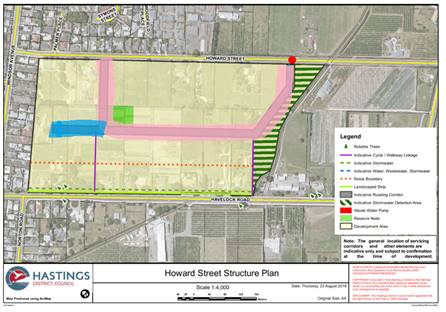
Figure
one: Map of the two roads to be named.
|
3.0 Background
– Te
Horopaki
3.1 The
Howard Street Development Area is located between Howard Street and Havelock
Road. An area of this development has been Designated HDC – 25 for the
roading corridors to run through to provide access to the internal sites. The
two designated local roads run through 13 adjacent sites as a part of the
Howard Street Structure Plan, see figure 2 below. There is no road hierarchy
difference between these two roads as they are both classed as local roads. The
first local road is of a crescent shape with two junctions direct with Howard
Street, it includes an off-street parking section of the road adjacent to
Parkvale School. The second local road is a cul-de-sac, coming off the crescent
road. Two local road names are required as a result as shown above in Figure 1.
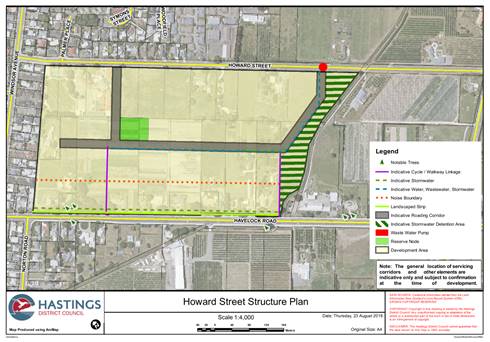
Figure two: Howard Street Structure
Plan
3.2 Consultation
with the Hastings – Havelock North Ward Councillors:
The Councils Road Naming Policy
requires consultation with the ward Councillors for the proposed location. The
Howard Street Development Area is within the Hastings – Havelock Ward.
The following feedback has been received:
Hastings –
Havelock North Ward Councillors Suggestion 1: Masters Family
· It was
suggested that one of the local roads be named after the Masters Family who
have been orcharding/using the land productively, in that area for more than
four generations and are well known in this area. Following this suggestion,
Council officers have been in contact with and met Heather and Tim Masters.
· Alfred and
Lydia Masters purchased a 40-hectare block of hops in 1889, situated on the
northern side of the Hastings – Havelock Road and extended back from the
road between Windsor Ave and St Georges Road. In 1897 the Heretaunga Plains
flooded, and the Masters family used their Oast House (Hop Kiln) as a dry
refuge for many displaced families. The area of hops was later reduced to about
8 acres in the vicinity of where the 'Appledore' property now stands at 180-200
Havelock Road. In 1916 hops were cheaper to import and as new stock was needed,
it was decided to cease production and remove the last of the hop plants. Some
of the property was converted into orchard by Alfred’s son, Sydney in
1922 and was then taken over in 1936 by Sydney’s son, Fred. In 1927 the
hop kiln building, and curtilage was sold to the Anglican Church and was used
as the St Barnabus Mission Hall. Alfred’s great grandson, Anthony (Tony)
purchased the property in 1980 and continued growing and packing apples and
pears on the 10.927 hectares.
· It is noted
here respectfully, that sadly, Tony Masters, Husband of Heather Masters, passed
away this year on the 30th of April 2024. The Masters family still
own land within the Howard Street Development Area.
· The
Masters family has kindly shared their family history with this area, this is
attached to this report.
Hastings – Havelock North Ward
Councillors Suggestion: Chinese Market Gardens Acknowledgement and Ken Gee
· It was
suggested to contact the family involved with the Chinese Market Gardens that
covered a large part of this site. Following the suggestion of the Chinese
Market Gardens acknowledgement, Council officers have made contact with and met
Ken and Trina Gee.
· The
Gee’s owned and/or leased a lot of the area where the Howard Street
Development is now. They owned Valona Gardens which was established in 1970 and
utilised many hectares of the Gee’s land and leased large areas of the
neighbour’s land over time.
· It is noted
here respectfully, that sadly, Eileen Gee, wife of Ken Gee, passed away on the
12th of January 2021. The Gee family remain as owners of land within
the Howard Street Development Area.
· Ken and
Eileen Gee named the market gardens as ‘Valona’ which stands for:
Vegetables, Are, Life, Offering, Necessity, Always. The Gee family still own
three titles within this block and the new road runs through their current and
past properties.
· The Gee
family has kindly shared their family history in this area, this is attached to
this report.
Hastings – Havelock North Ward
Councillors Suggestion: Varieties of Apples
· Councillors
provided another suggestion that the roads within the area could also be named
after different varieties of apples such as Braeburn Drive, Sturmer Road, and
Gravenstein Avenue. These were suggested to recognise Hastings as the
Apple Capital of the World and this block previously had apple orchards.
3.3 Consultation
with the Hastings District Councils Principal Advisor:
The Councils Road Naming Policy
requires consultation with/through the Principal Advisors, for appropriate te
reo road name suggestions for the two designated local roads.
During the early phases of the
designation of this road previously, the former Pou Ahurea Matua, Principal
Advisor, discussed the potential name of ‘Awahou’. This was
discussed as a name due to the site’s relative proximity to the Awahou
Stream. Translated Awahou means new (hou) river (awa) and is also a variety of
harakeke (flax) which was prevalent in this area.
Principal Advisor: Relationships,
Responsiveness and Heritage, then provided further suggestions relating to the
cultural and historical landscape of marshes, wetland lakes, streams, and the
former Ngaruroro River course now known as the Karamū. A memo with
supporting information was provided and is attached.
Cultural landscape names of former
environmental features can provide a direct cultural/historical connection, and
also a common theme for road naming.
The cultural place-based road naming
recommendations from the Principal Advisor are:
1. Waipoaka
(Black Pied Stilt marshland)
2. Ngākaroro
(The Seagulls)
3. Ngāhari
(Freshwater Clams)
4. Awahou
(Phormium Tenax)
All the above names connect with the
whenua, and it is noted that Ngākaroro and Ngāhari are most directly
linked with the vicinity of the proposed roads. It is considered that as they
are directly connected, that they are equally recognised as a second option for
road naming combinations.
The Howard Street Development area
used to be an area of wetland lakes, as can be seen in the two images below
(figures 3 and 4, provided by the Principal Advisor).
The remaining two names,
‘Waipoaka’, and ‘Awahou’, can also be retained as
suggestions for any future road names in this area, as the land is subsequently
subdivided, and other roads are developed through it.
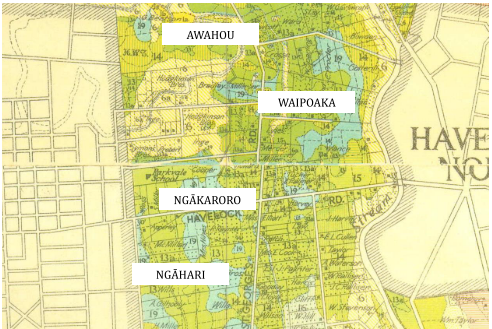
Figure three: 1938 Soils Map
– Howard Street Development is located under the word Ngākaroro for
reference.
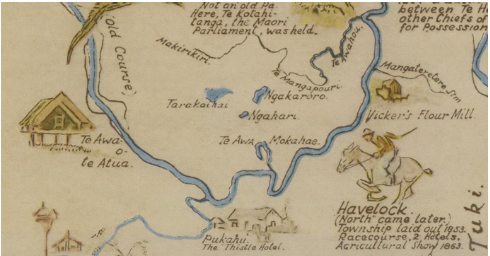
Figure four: Map showing cultural
features.
4.0 Discussion – Te Matapakitanga
4.1 The Hastings District
Council Road Naming Policy lists the following criteria for evaluation of the
suitability of proposed road names:
· Cultural
Significance
· Existing
or common theme
· Significant
feature
· Historical
event or person, and
· Personal
name for special services
4.2 In
addition to this, in order to be accepted by Land Information New Zealand the
road names will also have to fit with the criteria set out in the Australia/New
Zealand Standard for Rural and Urban Addressing.
4.3 Council
officer’s evaluation of the suggested names has revealed that all the
names suggested, except for ‘Gee’, meet the NZS Rural and Urban
Addressing Standard stipulation that the name element, regardless of any
difference in road type, shall not be the same as an existing road name where
the existing road name is in the same locality. There are no other instances of
the suggested names in adjoining local authorities that may cause confusion,
and Fire and Emergency NZ have not raised any concerns with the recommended
names suggested.
4.4 It
is noted here that the family name ‘Gee’ which would have had a
strong and direct connection with the location, unfortunately is not compatible
as part of the Road names here, because there is a ‘Gee Place’ in
Taradale (family related), which is not supportable by the above standard and
by FENZ requirements and could potentially cause confusion in the event of an
emergency.
4.5 There
is no current prevalent theme in this new development area, however, the
recommended options each have a theme:
· ‘Masters’
and ‘Valona’ are a proposed theme based around previous landowners
and their families who had gardens and orchards in this area and are still
owners today. This could be considered to be an appropriate recognition of the
families of the late Tony Masters (30/4/24), and Eileen Gee (12/1/21). Both
families have been advised of this report and recommended Road names being put
forward for the two designated local roads.
· ‘Ngākaroro’
and ‘Ngāhari’ have the theme of two wetlands that were
previously located in this vicinity.
· ‘Braeburn’
and ‘Sturmer’ have the common theme of apple varieties that links
to the areas previous use as an orchard.
4.6 The
suggestion of the names ‘Ngākaroro’ and ‘Ngāhari’
hold cultural and historical significance to the area as there were previously
wetland lakes of value to mana whenua.
4.7 In
terms of any of the suggestions put forward, that are not utilised to name the
two designated local roads this time, it can be noted that they can be
considered in the future when the land titles in this area are subject to
subdivision. There are likely to be a number of public and private roads that
will occur as this area develops.
4.8 Although
not part of this road naming recommendation and decision, Council should note
that as part of the Howard Street Structure Plan, a reserve is indicated on the
Gee family land as shown in figure five below. The future establishment of that
park and its naming is subject to a separate park naming process which will
also come to Council at some point in due course. It is noted that there are
discussions with the Parks team and Ken Gee on that park and its potential
purchase and naming.
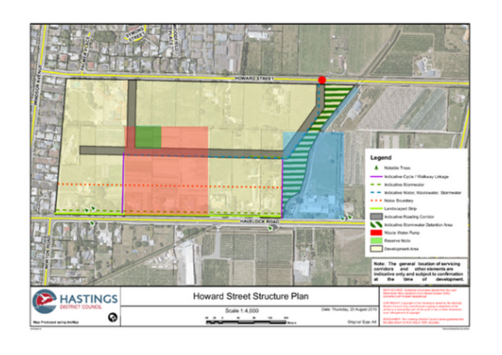
Figure five:
Howard Street Structure Plan – Green square is the reserve and the Lots
highlighted over in red is the current Gee family land. The Lot highlighted in
blue is the current Masters family land.
4.9 Four
of the recommended name options, being ‘Valona’,
‘Masters’, ‘Ngākaroro’, ‘Ngāhari’,
hold the most significant connections to the site (under the Road Naming Policy
criteria), with the wetlands being located in the direct area, the Masters
Family residing and growing produce in this block since 1889, the Gee Family
residing and growing produce in this block since 1970.
4.10 The
Gee Family are the current owners of a larger area of the two designated local
roads. The Masters Family are the current owners of an area of one of the
designated local roads.
4.11 Options
One A and B, and Option Two are all supported by the Road Naming Policy, they
are all equally recognised depending on what perspectives are favoured.
4.12 It
is recommended that Option One, A or B, presents an opportunity to celebrate
two prominent families who are directly connected with the land, and with
Heretaunga Hastings.
5.0 Options – Ngā Kōwhiringa
Option One
– Te Kōwhiringa Tuatahi
5.1 Option
one is to name the crescent shaped local road Valona Drive and the cul-de-sac
local road Masters Lane, OR to name the crescent shaped local road Masters
Drive and the cul-de-sac local road Valona Lane:
Advantages
· This could honour
and celebrate both the Gee and Masters families and the late Eileen Gee and
Tony Masters.
· Provides direct
acknowledgement and representation of previous long-standing landowners who
contributed to their community
· Can create a
common theme.
· There are no
duplicates of these names within the area.
· Both these names
could be used on either local Road, or could have different road type names if
considered appropriate (e.g. Way, Crescent, Close)
· There is a
potential to link ‘Valona’ with the future reserve identified on
the Gee Family property.
Disadvantages
· It is difficult to
recommend one name over the other on each designated local road, because they
are both strongly linked to this land. Both families have indicated they
support and have a preference that their name (‘Valona’ and
‘Masters') be used for the crescent shaped local road. Both have
indicated they recognise it is Council’s decision to make on naming the
local roads.
Option Two -– Te
Kōwhiringa tuarua
5.2 Option
two is to name the crescent shaped local road Te Ara Ngākaroro and the
cul-de-sac local road Te Ara Ngāhari
Advantages
· Acknowledges and
connects with the cultural and historical significance of the area through the
former significant features of the wetland lakes and naming the local roads
‘Ngākaroro’ and Ngāhari
· There are no
duplicates of these names within the area.
· Both these names
could be used on either Road, or could have different road type names as
appropriate (e.g. Ara, Te Ara)
· This option
creates a theme, linking the two wetlands to each other and the land.
Disadvantages
· This option would
miss out on the opportunity to celebrate the Gee family, and Masters family,
being previous and current landowners.
· There is a strong
desire from the Gee Family and Masters Family that the roads in this location
are named with their association.
Option Three
– Te Kōwhiringa tuatoru
5.3 Option
three is to name the two new designated local roads Braeburn Drive and Sturmer
Lane
Advantages
· Creates a common
theme of apple varieties
· The area was
previously used in part as apple orchards, and the names could connect with the
previous horticultural feature of this area.
Disadvantages
· The linkage with
apple varieties for this location, is not considered as strongly linked or as
appropriate given the prominence of the Gee and Masters families and the
wetlands, ‘Ngākaroro’ and ‘Ngāhari’
6.0 Next steps – Te Anga Whakamua
6.1 The
next steps if, option one A or B adopted, will involve advising the Gee and
Masters families of this decision, and following that advising Land Information
New Zealand (LINZ) so that the road names can be updated in the national
database.
Attachments:
|
1⇨
|
Howard Street Development Titles
|
CG-17-1-01157
|
Vol 6
|
|
2⇨
|
Howard St Rd Naming Family Backgrounds
|
CG-17-1-01218
|
Vol 6
|
|
3⇨
|
Howard Street Development Road Naming Cultural Brief
|
CG-17-1-01216
|
Vol 6
|
|
4⇨
|
Masters history - Havelock Road
|
CG-17-1-01217
|
Vol 6
|
|
Summary of
Considerations - He Whakarāpopoto Whakaarohanga
|
|
Fit
with purpose of Local Government - E noho hāngai pū ai ki te
Rangatōpū-ā-Rohe
The Council is required to give effect to the purpose of
local government as set out in section 10 of the Local Government Act 2002.
That purpose is to enable democratic local decision-making and action by (and
on behalf of) communities, and to promote the social, economic,
environmental, and cultural wellbeing of communities in the present and for
the future.
Link to the
Council’s Community Outcomes –
Ngā Hononga ki Ngā Putanga ā-Hapori
This proposal promotes the local
infrastructure which contributes to public health and safety, supports
growth, connects communities, activates communications, helps protect the
natural environment, and promotes the wellbeing of communities in the present
and for the future.
|
|
Māori
Impact Statement -
Te Tauākī Kaupapa Māori
Consultation has occurred with Councils Principal Advisor
and the name suggestions of Ngākaroro and Ngāhari were put forward.
These names are clearly connected and relevant to the whenua and is supported
to be used for other roads in this area (as part of the current/future
subdivisions that occur).
|
|
Sustainability
- Te
Toitūtanga
N/A. This report is procedural in nature.
|
|
Financial
considerations -
Ngā Whakaarohanga Ahumoni
The erection of the street signs will
just come out of the operational budget for road construction.
|
|
Significance
and Engagement -
Te Hiranga me te Tūhonotanga
This decision/report has been assessed under the
Council’s Significance and Engagement Policy as being of low significance.
Notwithstanding this, consultation with Councils Principal
Advisor has taken place and the names ‘Ngākaroro’ and
‘Ngāhari’ were suggested to acknowledge and connect with the
area previously being wetland lakes.
|
|
Consultation
– internal and/or external - Whakawhiti Whakaaro-ā-roto / ā-waho
Section 78 of
the Local Government Act 2002 sets out what is required of a local authority
in considering community views, and is summarised by the following:
“…Must give consideration
to the views and preferences of persons likely to be affected by, or to have
an interest in, the matter.”
Internal consultation occurred with the Councils Principal
Advisor, which resulted in the name suggestion Ngākaroro (The Seagulls)
and Ngāhari (Freshwater Clams) to represent the previous wetland lakes
that was located in this vicinity.
External consultation occurred with Fire and Emergency NZ
(FENZ) who maintain the Emergency Services address database. Assistant Area
Commander Glen Varcoe from FENZ has advised that they have no concerns with
any of the suggested names.
Internal consultation with the Hastings – Havelock
North Ward Councillors who were all in agreeance with the name suggestions of
the Gee Family, Masters Family, and the apple varieties.
External consultation occurred with members of the Gee and
Masters families. We note with gratitude that Ken and Trina Gee, and Heather
and Tim Masters were very generous taking time to meet and talk through the
road naming process with Council officers.
|
|
Risks
Opportunity: To enable the recognition,
acknowledgement and celebration of the Gee and Masters Families long-standing
landownership and connection with the land within the Howard Street
Development area.
|
REWARD – Te Utu
|
RISK – Te Tūraru
|
|
Local Road names that reflect the history and identity
of the Howard Street Development area as well as ensuring ease of
identification for the council, emergency services, and others.
|
There are no substantial risks to Council as the
families of the recommended names (Masters and Valona) have been consulted
with. However, the families could not come to a complete agreement on which
local road would have their name.
There are no risks to option three being chosen.
As this is two new designated local roads, no landowners
will need to change their address.
The recommended names meet all of the requirements of
LINZ and FENZ.
|
|
|
Rural
Community Board –
Te Poari Tuawhenua-ā-Hapori
The Rural Community Board will not be
affected by the proposed road naming.
|

|
Thursday, 24 October 2024
|
Te
Hui o Te Kaunihera ā-Rohe o Heretaunga
Hastings
District Council: Council Meeting
Te
Rārangi Take
Report to Council
|
Nā:
From:
|
Colin Hosford, Advisor -
Asset Management
|
|
Te Take:
Subject:
|
Waimārama Bylaw
Update Report
|
1.0 Executive Summary – Te Kaupapa Me Te Whakarāpopototanga
1.1 In
2023 safety concerns were raised about vehicle use and
public safety on Waimārama
Beach. Through two rounds of consultations between December 2023
and May 2024, Council asked the community for feedback on how safety could be
improved and whether the
existing rules for vehicles on Waimārama Beach should be changed.
1.2 Considering
this feedback, at its 27 June 2024 meeting, Council proposed to adopt a
‘hybrid version’ and extend the Waimārama Beach vehicle ban,
from the southern end of the beach adjacent to the end of Harper Road going
north to a point 1.7km north of Tiakitai Road beach access. The ban would
be all day, every day, year-round; with two designated boat/fishing access
points. The change would be managed by a resolution of Council under the
existing beach bylaw.
1.3 Consultation
on the proposed bylaw amendment commenced on 13 July and closed on 29 July
2024, with 817 submissions received (once duplicates were removed).
Approximately 33% of submissions were from Waimārama. 81% of
submissions received said that they did not support the proposed change.
19% said they did support the proposed change.
1.4 The
analysis of the written text of the submissions revealed that the positions of
the submitters were more nuanced than a simple 80/20 split for and
against. For example, some submitters that did not support the change
were not necessarily against more vehicle restrictions on the beach. In
some cases, they wanted a different form of management, or they wanted greater
restrictions than what was proposed in the consulted option.
1.5 A
submission was also received from the Trustees of Waipuka 2E who were concerned
about vehicle access via the former Waingongoro Stream bed. Given these
concerns, officers have commissioned a Heritage Assessment of these
reserves.
1.6 In
addition, the Waimārama Working Group was formed in early August,
following a community meeting held to discuss the proposed vehicle
restriction. Members of the Group were selected to represent the
different groups and marae in Waimārama, with the aim to see if a
community led compromise outcome could be identified and supported.
1.7 The
Waimārama Working Group has proposed the introduction of a trial bylaw for
a 12-month period, based on a permit system. It is proposed that only
4-wheel quads and side by sides be permitted vehicles on the beach, with 2
wheel motorbikes, cars and utes banned. During summer (Labour Weekend
– Easter) permitted vehicles could access the beach from Airini Road and
travel north only. During winter permitted vehicles could access the
beach from Airini Road, and travel anywhere on the beach, north or south.
1.8 Officers
have obtained a legal opinion regarding the ability for Council to adopt the
proposal of the Waimārama Working Group and introduce a ‘trial
bylaw’ to be in place this summer. The legal opinion
recommends that the proposal, particularly the permit scheme, would likely
require a further round of consultation.
1.9 Given the
uncertain community consultation feedback, the alternative proposal submitted
by the Waimārama Working Group, together with the pending Heritage
Assessment related to the Waingongoro Reserves, the Report recommends
that Council
· Resolve to hold the current proposed vehicle restriction
resolution on the table; and instruct officers to investigate the feasibility
of the Waimārama Working Group’s
alternative proposal, to bring back for Council’s consideration and
future consultation.
1.10 Adopting
this recommendation would see the status quo bylaw apply for the 2024/25
summer with vehicle restrictions in place from Labour weekend to 30 April
2025. It is proposed that, within the context of those existing
restrictions, additional steps will be taken to address the impacts of vehicles
on the beach this summer season. In this regard, Officers will seek to
improve signage and beach user education, assess the access point at Airini
Road regarding beach user and vehicle access; work in conjunction with the
Police in terms of education and enforcement of the existing vehicle ban area,
and current 20km/h speed limit.
1.11 Officers
will seek to monitor the situation over summer, in terms of numbers, behaviours
and issues. This will provide useful information for Council when it
considers the matter next year.
|
2.0 Recommendations - Ngā Tūtohunga
A) That Council receive the
report titled Waimārama Bylaw Update Report dated 24 October 2024.
B) That
Council resolve to leave its resolution from its Council Meeting (27 June
2024) namely ‘That Council adopt for community consultation the
following option and draft resolution, Extend the vehicle ban from the
southern end adjacent to the end of Harper Road going north to a point 1.7km
of Tiakitai Road year-round with specified Vehicle Restriction areas
available for limited purposes (hybrid version)’ to lie on the
table.
C) That
officers investigate the feasibility of the proposal submitted by the
Waimārama Working Group, and report back for Council’s
consideration and future consultation alongside the existing proposal.
D) That Council notes the existing Waimārama Beach
Bylaw will remain in place this year, from Labour Weekend 2024 to 30 April
2025.
|
3.0 Background – Te Horopaki
Existing Bylaw
3.1 On 25 July 2013
Council resolved to prohibit the use of motor vehicles on a portion of
Waimārama Beach, pursuant to Hastings District Council’s
Consolidated Bylaws (Part 14 Public Places, Section 11.2). This was in
response to community concerns regarding vehicles on Waimārama
Beach.
3.2 The
resolution stated:
(C) That
pursuant to Hasting’s District Council’s Consolidated Bylaws, Part
14 Public Places, Section 11.2, Council hereby prohibits the use of motor
vehicles on a portion of Waimarama Beach, as marked in red on the plan attached
as Attachment 1,
i) Commencing
on Hawke’s Bay Anniversary, each and every year, and ending on 30 April,
the following year, between the hours of 8.00am until 8.00pm each day.
Except:
ii) on
defined access ways
iii) for
vehicles otherwise authorised by Council, including emergency services’
vehicles, police vehicles and surf lifesaving vehicles.
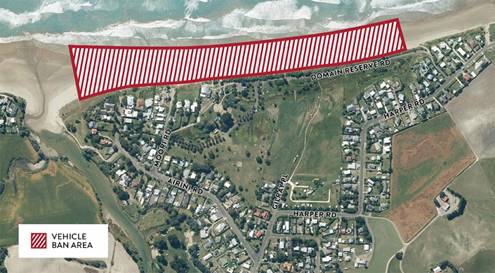
3.3 The
current vehicle ban area is shown on the map below.
3.4 This
is the existing vehicle ban that is currently in place. It applies
between Hawke’s Bay Anniversary and 30 April every year, between the
hours of 8am – 8pm, and applies to all vehicles (except emergency
service, police and surf lifesaving vehicles).
3.5 Of
note, at all other times, and all other areas, all registered and warranted
vehicles are permitted on the beach, provided they follow the speed limit
(20km/hr), with drivers holding a current drivers licence.
3.6 In
late 2023, a group of residents, supported by the Police, raised concerns with
Council about beach users’ safety due to unsafe driver behaviour.
Vehicles on Waimārama Beach - Community
Consultation Stage 1
3.7 In
response to the concerns raised Council held a drop-in day on 2 December 2023
at the Waimārama Hall to canvass wider community feedback on the
issue. Feedback was also sought via a survey, with the community
asked to tell Council whether they considered vehicle use on the beach to be an
issue; and whether the rules for vehicles on Waimārama Beach should be
changed.
3.8 On
11 December 2023, large rocks were placed on a portion of the Waingongoro
Stream Recreation Reserve and beach entry point, limiting vehicle access to the
beach from one of the existing vehicle access points, at the end of Tiakitai
Road. From this date, vehicle access has been limited to the Airini Road
and Harper Road access points.
3.9 The
closing date for feedback was 22 December 2023, with 533 responses received.
51% of respondents were Waimārama residents, 44% non-Waimārama
residents and 5% as non-permanent residents.
3.10 The
findings of this first round of community consultation were reported to Council
at their 14 March 2024 meeting.
3.11 Suggested
solutions for addressing the impacts of vehicle use on the beach ranged from a
total ban (43%) to maintaining the status quo (37%). Other suggestions
included increased policing and enforcement, requiring vehicle permits, signage
and education and infrastructure improvements.
3.12 Given
the breadth of feedback, Officers recommended that community engagement
continue, but with a focus on four options for consideration. The
purpose of this was to assess if there was a majority preference for a
recommended pathway forward to improve management (via bylaw amendments) of
vehicle access on the beach.
3.13 At
this 14 March 2024 meeting, Council resolved to:
B) That
Council note and endorse the Council Officers to continue engagement with all
identified communities of interest for Waimārama Beach, around the options
in Recommendation C, to assess if there is a majority community preference for
a recommended pathway forward to improve management (via Bylaw amendments) of
vehicle access on Waimārama Beach for the improved wellbeing of all
communities of interest.
C) Council
notes the options in Recommendation B include Bylaws and effective enforcement:
· The existing Hastings District Council Bylaw 2021
2.4.1 (a)
· Hastings District Council Bylaw 2021 2.4.1 (a) enacted
permanently (365/6 days per year)
· Hastings District Council Bylaw enacted permanently
and extended to south of the Tiakitai Road access point. (365/6 days per year)
· Hastings District Council Bylaw enacted permanently
and extended to the beginning of the legal unformed road (Waipuka 2C1). (365/6
days per year)
Vehicles on
Waimārama Beach - Community Consultation Stage 2
3.14 On
20 April 2024 a community drop-in day was held at the Waimārama Hall,
where residents were invited to provide written feedback on the four
options. On 24 April a drop-in day was held at Waimārama
Marae, for mana whenua to provide their written feedback regarding the options
and process.
3.15 A
mail drop with feedback forms and information sheets were delivered to all
Waimārama residents at the beginning of the second consultation process
with feedback to be provided to Council by 10 May 2024.
3.16 Officers
also met with local representatives of emergency responders. No major
issues were raised by Fire and Emergency New Zealand, St Johns Ambulance,
Hawke’s Bay Emergency Management, Surf Lifesaving, and Police regarding
any impacts of the options. Police reiterated their concerns for
Beach user safety due to bad driving behaviours. Officers also held
meetings with mana whenua, Forest and Bird and recreational fishers.
3.17 The
findings of this second round of community consultation were reported to
Council at their 27 June 2024 meeting.
3.18 721
items of feedback were received, with the following numbers supporting each of
the four options:
|
Number
|
Option
|
Responses
|
|
1
|
Keep the current vehicle
ban area, which is in force from 8am to 8pm ever day from Labour Weekend
Saturday to April 30
|
332
|
|
2
|
Retain the current ban
area, but extend it to year-round
|
113
|
|
3
|
Extend the ban northwards
up to but including the Tiakitai Road access, year-round
|
63
|
|
4
|
Extend the ban north, to a
point 1.7km north of the Tiakitai Road beach access, year-round
|
213
|
3.19 The
majority of respondents favoured Options 1 and 4; with Waimārama residents
also evenly split in favour of Options 1 and 4.
3.20 On
this basis, Officers recommended the adoption of a ‘hybrid version’
of the 4 options presented to the community; which sought to address: (1)
adjoining landowners concerns about the impacts of vehicles damaging the
environment; (2) recreation access where vehicles can drive onto the beach in
designated areas (Tiakitai and Paparewa); as well as (3) beach user safety by
banning vehicles from most of the beach.
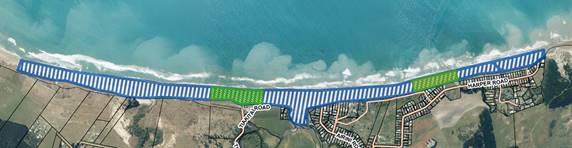
3.21 At the 27 June 2024 meeting,
Council resolved to adopt the ‘hybrid version’ which extended the
motorised vehicle ban from the southern end adjacent to the end of Harper Road
going north to a point 1.7km north of Tiakitai Road year-round with specified
Vehicle Restriction areas available for limited purposes. The adopted
area is identified in the Map below with the blue area only for those
vehicles authorised by Council (including emergency services’ vehicles,
police and surf lifesaving vehicles); and the green area for those
vehicles authorised by Council as blue area and vehicles used solely for the
purpose of recreational fishing, boat launching vehicles and mobility card
holders.
3.22 The
resolution authorised that the hybrid version be adopted for the purposes of
consultation, and directed the Chief Executive to commence community
consultation, including:
· Publish the draft resolution and supporting material
· Directly notify per section 22AD(3) Land Transport Act
1998
- The occupiers of any properties adjoining the
“road” (in this case the Beach) to which the proposed bylaw would
apply; and
- Any affected local community; and
- The Commissioner of Police; and
- Any other organisation or road user group that the
Council considers affected; and
- The New Zealand Transport Agency.
· Ensure a two-week period is provided for people to
make submissions.
· Schedule a hearing if Council wishes to hear from
people.
· Summarise all submissions for consideration at a
Council meeting.
3.23 The
resolution also directed the Chief Executive to report back to Council on
completion of the community consultation.
Community Consultation - Proposed
Vehicle Restriction Amendment
3.24 The
draft resolution and supporting material was published online on 11 July with a
public notice placed in the HB Today on 13 July, inviting people to make
submissions, with a closing date of 29 July 2024. A public notice was
also placed in the Hastings Leader on 17 July.
3.25 Submission
boxes were placed at the Waimārama Store and in the Hastings, Flaxmere,
and Havelock North libraries. In addition, a mail drop delivered
submission forms directly to Waimārama residents.
3.26 Consultation on the proposed bylaw
amendment commenced on 13 July and closed on 29 July 2024, with 817 submissions
received (once duplicates were removed). Approximately 33% of submissions
were from Waimārama.
3.27 81%
of submissions received said that they did not support the proposed
change. 19% said they did support the proposed change. The analysis
of the written text of the submissions revealed that the positions of the
submitters were more nuanced than a simple 80/20 split for and against.
For example, some submitters that did not support the change were not
necessarily against more vehicle restrictions on the beach. In some
cases, they wanted a different form of management, or they wanted greater restrictions
than what was proposed in the consulted option.
3.28 Key
themes for not supporting the proposed change:
· Community
Opposition and Enforcement Concerns
· Impact on
Accessibility
· Community Division
and Consultation Process
· Alternative Solutions
Proposed
· Cultural and
Environmental Considerations
3.29 Key
themes for supporting the proposed change:
· Safety Concerns
· Environmental
Impact
· Cultural and
Historical Significance
· Proposed Solutions
and Compromises
· Public Sentiment
and Collaboration
Waipuka 2E
3.30 A submission was also received from
the Trustees of Waipuka 2E who were concerned about vehicle access via the
former Waingongoro Stream bed at Tiakitai Road. Following new information
regarding the importance of this land to mana whenua, officers have commissioned
a Heritage Assessment of the two reserves. The outcome of this and
wishes of the Waipuka 2E Trustees will determine the acceptability or otherwise
of utilisation of the Tiakitai Road access point for vehicles.
Waimārama Community Group
3.31 The Waimārama Working Group
was formed in early August, following a community meeting held to discuss the
proposed vehicle restriction amendment. Members of the Group were
selected to represent the different groups and marae in Waimārama, with
the aim to see if a community led compromise outcome could be identified and
supported. It is noted that the Group has no formal mandate from the
community but considers that it is representative of the community.
3.32 The
Working Group have taken into account the current archaeological investigations
being undertaken at Waingongoro Reserves in the preparation of their draft
proposal which was shared with officers in early September.
3.33 The submission of the Working Group
proposes the introduction of a trial bylaw for a 12 month period, based on a
permit system. It is proposed that only 4 wheel quads and side by sides
be permitted vehicles on the beach, with 2 wheel motorbikes, cars and utes
banned. During summer (Labour Weekend – Easter) permitted vehicles
would be able to access the beach from Airini Road and travel north only.
During winter permitted vehicles would be able to access the beach from Airini
Road, and travel anywhere on the beach, north or south.
3.34 Officers
have obtained a legal opinion regarding the ability for Council to adopt the
community proposal and introduce a ‘trial bylaw’ to be in place
this summer.
3.35 In
terms of the ability for the Council to adopt the Working Group’s
proposal, the legal opinion indicates that:
· The Working Group
proposal would be likely to be considered ‘significantly different’
to the proposal as notified. This is due to differences in the type of
vehicle able to access the beach, the purpose for access, the permitting system,
the fact that there would be a charge for a permit and a change to the access
points and areas able to be accessed;
· If the Council was
inclined to accept the Working Group proposal, it would need to consider
whether it was appropriate to re-consult. While it would be a decision
for the Council, it may well be that it was reasonable to allow the community
an opportunity to have their say on the changes now proposed;
· At a minimum, it is
suggested that the permit scheme, and the charges for a permit, would need to
be the subject of consultation, with the requirement to obtain a permit
possibly requiring a change to the Bylaw itself (as opposed to being required
through a resolution, which is the current mechanism proposed). This will
also require a costing of the measures required to restrict access and operate
the permit scheme as the fees to be charged cannot exceed Council’s
reasonable costs;
· While it would be
possible to make some of the changes proposed (for instance, banning
motorcycles), the Working Group’s proposal is put together as a
‘package deal’ and it is unlikely advancing parts of it would
achieve the outcome sought and the working group’s support
3.36 In
terms of a trial period, a trial period can be achieved through the Council
resolving to review the vehicle restrictions within 12 months.
4.0 Discussion – Te Matapakitanga
4.1 There
are four options available for consideration by Council:
1. Resolve
to adopt the proposed Vehicle Restriction amendment (hybrid version), as
adopted for consultation purposes on 27 June 2024
2. Resolve
to not adopt the proposed Vehicle Restriction amendment (hybrid version), as
adopted for consultation purposes on 27 June 2024
3. Resolve
to adopt an alternative Vehicle Restriction amendment (as requested by the
Waimārama Working Group)
4. Resolve
to hold the proposed Vehicle Restriction amendment (hybrid version), as adopted
for consultation purposes on 27 June 2024 on the table and instruct Officers to
investigate the feasibility of the alternative
proposal submitted by the Waimārama Working Group, to bring back for consideration and potential future
consultation.
Current Vehicle
Restriction Amendment
4.2 With
regard to the current proposed Vehicle Restriction amendment, as adopted for
consultation purposes on 27 June 2024, Council can consider two options: (1)
Adopt as notified; (2) Do not Adopt as notified.
4.3 As
identified in Section 3.27, 81% of submissions received said that they did not
support the proposed change. 19% said they did support the proposed
change. The analysis of the written text of the submissions revealed that
the positions of the submitters were more nuanced than a simple 80/20 split for
and against. For example, some submitters that did not support the change
were not necessarily against more vehicle restrictions on the beach. In
some cases, they wanted a different form of management, or they wanted greater
restrictions than what was proposed in the consulted option.
4.4 Given
the uncertain outcome of the community consultation, together with the pending
Heritage Assessment related to the Waingongoro Reserves which will determine
the suitability or otherwise of the Tiakitai vehicle access point, it is
advised that Council does not have adequate information to make a fully
informed or community supported decision with regard to either adopting, or
discarding the current proposed Vehicle Restriction amendment, as consulted
on.
4.5 This
option may however be deemed feasible in the future, if an alternative vehicle
access point can be obtained via Tiakitai Road, with the support of Waipuka 2E
following the outcome of the Heritage Assessment. It is therefore
recommended that this option is left on the table pending the outcome of the
Heritage Assessment.
Waimārama
Working Group Proposal
4.6 Officers
recognise and commend the work undertaken by the Waimārama Working
Group’s endeavours to provide an alternative solution, led by, and
supported by the community.
4.7 However,
it is recommended that this alternative solution is not adopted at this stage
for the following reasons:
· Legal advice
considers that the alternative solution is ‘significantly
different’ to the proposal as notified, and therefore is likely to
require further consultation, prior to being adopted by Council.
· While the
Waimārama Working Group consider that they are representative of the
community, they also recognise they have no formal mandate from the community.
· Officers
have not had the time to fully investigate the practicality, feasibility and
operational costs of implementing a permit system
4.8 Given
the amount of work undertaken by the group, it is however recommended that
Officers be instructed to investigate the operational
costs and feasibility of the Waimārama Working Group, to be brought back for consideration at a future meeting,
together with the outcome of the Archaeological Assessment.
5.0 Options – Ngā Kōwhiringa
5.1 Option
One - Recommended Option - Te Kōwhiringa Tuatahi – Te
Kōwhiringa Tūtohunga
5.2 Option
1 is recommended, and that Council resolve to hold the current proposed vehicle
restriction resolution (the consulted ‘hybrid version’) on the
table; and instruct officers to investigate the
feasibility of the alternative proposal submitted by the Waimārama
Working Group, to bring back for consideration and
future consultation alongside the existing proposal.
5.3 This
will provide officers the time to undertake a full feasibility and cost
assessment of the proposal put forward by the Waimārama Working Group, to be presented back to a future Council
meeting.
5.4 It will also ensure that the findings of the Heritage
Assessment can be fully considered as part of any future proposal.
5.5 In
addition, the Waimārama Working Group have identified that their proposal
represents a significant compromise from all parties, but one that has been
agreed as a preferred alternative to the Council current proposed
amendment. Should Council resolve to reject the proposed vehicle
restriction amendment, and progress solely with investigating the feasibility
of the Working Group proposal, it may be that in the new year, the incentive to
achieve a compromise may be reduced or lost.
5.6 Officers
consider that keeping the current proposal ‘on the table’ will
provide Council and the community with more options and scope when it comes to
determining an approach best reflecting the outcomes sought by the
community.
Option Two – Status Quo - Te Kōwhiringa Tuarua – Te
Āhuatanga o nāianei
5.7 Option
2 would be for Council to adopt the proposal to amend the existing bylaw to ‘extend
the motorised vehicle ban from the southern end adjacent to the end of Harper
Road going north to a point 1.7km north of Tiakitai Road year-round with
specified Vehicle Restriction areas available for limited purposes’.
5.8 This
is not recommended, given the uncertain outcome of the community consultation,
and the alternative proposed presented by the Waimārama Working
Group. In addition, this option cannot be implemented in good faith
until the Heritage Assessment is complete regarding Waingongoro Reserves, and
beach access in this area.
6.0 Next steps – Te Anga Whakamua
6.1 The
preferred option would see the status quo apply in the meantime, with the
existing bylaw vehicle restrictions in place from Labour weekend.
6.2 This
will mean that the existing bylaw will continue to be in effect this summer
(Labour Weekend – Easter); that is no vehicles on the area of beach
adjacent to Waimārama Domain between 8.00am and 8.00pm (unless authorised
by Council, including emergency, police and surf lifesaving vehicles).
6.3 It
is proposed that, within the context of those existing restrictions, interim
steps need to be taken to address the impacts of vehicles on the beach this
summer season particularly with the only legitimate access point during the day
being Airini Road, travelling north over the Pouhokio Stream.
6.4 In
this regard, Officers will seek to improve signage and beach user education,
assess the access point at Airini Road with regard to beach user and vehicle
access; work in conjunction with the police in terms of education and
enforcement of the existing vehicle ban area, and current 20km/h speed
limit. In addition Officers will investigate how to monitor the situation
over summer, in terms of numbers, behaviours and issues. This will
provide useful information when Council comes to reconsider restrictions next
year.
Attachments:
There are no attachments for this report.
|
Summary of
Considerations - He Whakarāpopoto Whakaarohanga
|
|
Fit
with purpose of Local Government - E noho hāngai pū ai ki te
Rangatōpū-ā-Rohe
The Council is required to give effect to the purpose of
local government as set out in section 10 of the Local Government Act 2002.
That purpose is to enable democratic local decision-making and action by (and
on behalf of) communities, and to promote the social, economic,
environmental, and cultural wellbeing of communities in the present and for
the future.
Link to the
Council’s Community Outcomes –
Ngā Hononga ki Ngā Putanga ā-Hapori
This proposal promotes the social wellbeing of communities
in the present and future. It does this by providing legislative
services to enhance social, cultural, and environmental wellbeing.
|
|
Māori
Impact Statement -
Te Tauākī Kaupapa Māori
Mana
whenua hapū of Waimārama are Ngāti Kuru, Ngāti Whakaiti,
Ngāti Kurukuru, Ngāti Urakiterangi. Waimārama hapū
have maintained their mana whenua status for one millenia and have held the
beach with high esteem as a gateway to and from Te Moananui a Kiwa The
Pacific Ocean.
Mana
whenua hapū have great concerns about open access of vehicles to the
beach area. A current By-law exists across a restricted part of
Waimārama Beach, and a wider exclusion zone has a positive impact to
mana whenua hapū in the following ways:
Whānau
safety and wellbeing – the safety
and wellbeing of whānau is paramount for mana whenua hapū as they
use the beach. Whānau visiting Waimārama beach is for both
the leisure and spiritual wellbeing of whānau, which can be disturbed by
the use of vehicles on the beach.
Manaakitanga
sharing of the Beach –
Waimārama beach is a popular cultural tourist destination for foreign
and domestic tourists. Across the Māori world, Waimārama is
seen as a place of high spirituality and connection with its heritage and
genealogical connection to other iwi tribes. It is of importance
to mana whenua to share the beach and its important cultural stories and
genealogies with visitors in a safe way that provides the most memorable
cultural experience.
Taiao
environmental wellbeing of the Beach
– the natural beach environment is home to significant flora and fauna
with shifting sands, grasses, and lifeforms. Mana whenua hold that free
and uncontrolled vehicle use disturbs the special natural characteristics of
Waimārama beach. Protection of the natural environment is of
importance to mana whenua.
Tikanga
Māori Customary Practices – Waimārama mana whenua have a positive reputation for
maintaining Tikanga Māori associated with waimoana oceanic waters.
Customary practices include mahinga kai food gathering, mahinga toi
arts practice, karanga, pure, ritual rites. Prohibiting
vehicle access enables good Tikanga Māori practices for mana whenua
hapū.
Wāhi
Tapu – the beach area contains
many sacred areas and former villages. In recent times these sacred
areas have been identified with cultural markers and pou whenua, carved by
the late Phil Belcher. The cultural markers indicate to the public the
special cultural heritage of Waimārama, positively contributing to the
cultural landscape of the area.
Sustainability
- Te
Toitūtanga
Sustainability outcomes will be considered in any future
reports to Council which may recommend any changes to existing Council Resolutions
or Reserve Management Plans
|
|
Financial
considerations -
Ngā Whakaarohanga Ahumoni
There are no
financial implications associated with the adoption of Option 1. There
may however be some costs to undertaking interim steps to address the impacts
of vehicles on the beach this summer season, which will be funded from
existing parks and marketing and communication operational budgets.
|
|
Significance
and Engagement -
Te Hiranga me te Tūhonotanga
There is strong community interest in this matter. Council
has undertaken an extensive engagement with communities of interest.
|
|
Consultation
– internal and/or external - Whakawhiti Whakaaro-ā-roto / ā-waho
There is strong community interest in this matter. Council
has undertaken an extensive engagement with communities of interest.
|
|
Rural
Community Board –
Te Poari Tuawhenua-ā-Hapori
The Rural Community Board were updated on
25 June 2024
|

|
Thursday, 24 October 2024
|
Hastings
District Council: Council Meeting
Te Rārangi Take
Report to Council
|
Nā:
From:
|
Jess Noiseux, Strategic Financial
Advisor
|
|
Te Take:
Subject:
|
Adoption of Annual
Report and Annual Report Summary for the year ended 30 June 2024
|
1.0 Executive Summary
– Te Kaupapa Me Te
Whakarāpopototanga
1.1 The purpose of this
report is to:
· Advise
that the recommendation from the Risk and Assurance Committee held on 14th
October 2024 be received by Council; and
· Obtain
a decision from Council on the adoption of the 2023/24 Annual Report and
2023/24 Summary Annual Report.
1.2 Draft copies of the
2023/24 Annual Report and 2023/24 Summary Annual Report were presented to the
Risk and Assurance Committee on 14 October 2024. These were in draft as
Councils’ auditors Ernst & Young (EY) had not yet completed all
fieldwork at the time of reporting.
1.3 EY presented their
Closing Report (Attachment 1) to the Risk and Assurance Committee and
were confident that all material matters were resolved with no major amendments
expected between then and the presentation of this report.
1.4 In finishing their
review of the Annual Report, EY found a few classification adjustments that
impacted the balance sheet. However Officers are pleased to report that there
were no significant changes to the Annual Report and Summary Annual Report, and
all minor amendments have been reviewed and approved by the Chief Financial
Officer.
1.5 Please refer to attachment
2 for the Annual Report 2023/24 and attachment 3 for the Summary
Annual Report 2023/24.
|
2.0 Recommendations -
Ngā Tūtohunga
A) The
following recommendations of the Risk and Assurance Committee meeting held 14
October 2024 be received:
B) That Council
receive the report titled Adoption of Annual Report and Annual Report Summary
for the year ended 30 June 2024 dated 24 October 2024.
C) That Council
adopts the 2023/24 Annual Report.
D) That Council
adopts the 2023/24 Summary Annual Report.
|
3.0 Background – Te Horopaki
3.1 This report enables
Council to meet the legislative requirements of the Local Government Act 2002
which requires Council, through section 98 of the Local Government Act 2002, to
adopt the Annual Report within four months of the end of the financial year (by
31 October).
3.2 Council is also
required to produce an Annual Report Summary that must represent fairly and
consistently, the information regarding the major matters dealt with in the
Annual Report.
3.3 The reports must
comply with generally accepted accounting practice as determined by various financial
reporting standards. A number of other statutory requirements must also be met.
4.0 Discussion – Te Matapakitanga
4.1 A
summary of the unaudited accounting results was presented to the Performance
and Monitoring Committee on 19 September 2024. The audited accounting results
have not changed materially with only a minor adjustment made after review from
audit.
|
Statement of Financial Performance
2023/24
|
Unaudited result present to
Performance and Monitoring Committee
$'000
|
Final audited result
$'000
|
Variance
|
|
Operating Revenue
|
310,705
|
310,705
|
-
|
|
Less: Operating Expenditure
|
301,689
|
301,703
|
14
|
|
Net Surplus/(Deficit)
|
9,016
|
9,002
|
(14)
|
|
Unrealised movement on interest rate swaps
|
(1,016)
|
(1,016)
|
-
|
|
Net Surplus/(Deficit) after Swaps
|
8,000
|
7,986
|
(14)
|
|
Gain/(Loss) on Revaluations and Other Movements
|
288,136
|
286,823
|
(1,313)
|
|
Total Comprehensive Revenue &
Expense
|
296,136
|
294,809
|
(1,327)
|
Revaluations
4.2 With
the significant rebuild programme occurring on the roading network, Officers
opted to get a full revaluation completed again for the Roading asset class to
ensure that the fair value is accurately represented. Council was also due for
a land and building revaluation with the previous valuation occurring in 2021.
This resulted in the following valuation movements:
|
Asset Class
|
Asset value pre-valuation $000
|
Valuation per valuation reports
$000
|
Increase/(decrease) in asset
value $000
|
% increase/ (decrease)
|
|
Bridges
|
$141,425
|
$233,002
|
$91,577
|
65%
|
|
Roading other
|
$1,091,725
|
$1,274,999
|
$183,274
|
17%
|
|
Land and Buildings
|
$390,455
|
$402,656
|
$12,201
|
3%
|
|
TOTAL
|
$1,623,605
|
$1,910,657
|
$287,052
|
|
4.3 The significant uplift
in Bridges reflects the availability of more accurate unit rate data than previously
available. Bridges are not built often, but with the number of destroyed
bridges being rebuilt, alongside the increased costs of construction, there is
more cost data available. This has resulted in a large increase to reported
bridge valuations.
4.4 The increase in other
Roading reflects the significant amount of repair works that have occurred
across the roading network on slips from Cyclone Gabrielle. Approximately 577
slips have been repaired across the network and the increase in valuation reflects
this.
4.5 The relatively small
increase in land and building assets reflects the current market conditions in
housing.
Audit Opinion
4.6 For the last four
years, Council have received a qualified audit opinion over the activity
groups’ statement due to:
· incomplete
information about the numbers of complaints Council received after hours in
relation to 3 waters complaints; and
· Insufficient
data available to accurately determine water loss % across Council’s
water supply network.
4.7 Officers are pleased
to report that after review of treatment across the sector, as well as improved
disclosure and reporting from the 3Waters team, EY have removed the
qualification for the water loss measure from their opinion.
4.8 Officers continue to
work with the after hours service provider on the remaining qualified
performance measure to ensure sufficient information is available in relation
to 3 waters complaints.
Attachments:
|
1
|
Hastings DC EY Audit Close Report 2024 Final
|
FIN-07-01-24-494
|
Vol 7
|
|
2
|
2024 Annual Report
|
FIN-07-01-24-495
|
Vol 7
|
|
3
|
2024 Summary Annual Report
|
FIN-07-01-24-496
|
Vol 7
|

|
Thursday, 24 October 2024
|
Hastings
District Council: Council Meeting
Te Rārangi Take
Report to Council
|
Nā:
From:
|
Louise Stettner,
Manager, Democracy & Governance Services
|
|
Te Take:
Subject:
|
Proposed Amendments To
Schedule Of Meetings
|
1.0 Purpose and summary - Te Kaupapa Me Te Whakarāpopototanga
1.1 The
purpose of this report is to consider amendments to the schedule of Council and
Committee Meetings for the 2024 Meetings Calendar which was adopted by Council on
14 November 2023.
1.2 The
Local Government Act 2002, Schedule 7, Clause 19 states:
“A
local authority must hold meetings at the times and places that it
appoints”.
If a local authority adopts a schedule of meetings-
a) The schedule-
i) may cover
any future period that the local authority considers appropriate, and
ii) may be amended.
Although a local authority must hold the ordinary meetings
appointed, it is competent for the authority at a meeting to amend the schedule
of dates, times and number of meetings to enable the business of the Council to
be managed in an effective way.
1.3 It is
proposed that the meeting schedule be amended as outlined in the
recommendations of this report.
|
2.0 Recommendations -
Ngā Tūtohunga
A) That Council
receive the report titled Proposed Amendments To Schedule Of Meetings dated 24
October 2024.
B) That Council
adopt changes to the 2024 Schedule of Meetings as follows:
|
Thursday 7 November
2024, 1pm
Council Chamber
|
New Meeting
|
Council
|
|
Thursday 28
November 2024, 9am
Council Chamber
|
New Meeting
|
Council
|
|
Monday 9 December
2024, 10:30am (was 2pm)
Landmarks Room
|
Change in time
|
Rural Community
Board
|
|
Monday 9 December
2024, 1pm
Landmarks Room
|
New Meeting
|
Rural Halls
Subcommittee
|
|
From Thursday 7
November 2024 1pm to:
Thursday 5 December,
1pm
Landmarks Room
|
Postponement
|
District
Development Subcommittee
|
|
Thursday 28 November
2024 1pm (was 9am)
Council Chamber
|
Change in time
|
Community
Wellbeing Subcommittee
|
|
Attachments:
There are no attachments for this report.
|
Thursday, 24 October 2024
|
Hastings
District Council: Council Meeting
Te Rārangi Take
Report to Council
|
Nā:
From:
|
Anna Summerfield, Senior
Environmental Planner - Policy
|
|
Te Take:
Subject:
|
Plan Change 5 -
Recommendations of the Hearings Committee
|
1.0 Summary
1.1 This
Reports recommends Council adopt the recommendations from the Hearings
Committee which commenced on 4 April 2024, continuing on 5 April and 11 April
2024, in respect of Plan Change 5: Right Homes Right Place, which seeks to
enable more housing to be developed within existing urban areas located within
400m of the Hastings Central Business District and Havelock North and Flaxmere
town centres.
1.2 Council
is required to give effect to the purpose of local government as set out in
section 10 of the Local Government Act 2002. That purpose is to enable
democratic local decision-making and action by (and on behalf of) communities,
and to promote the social, economic, environmental, and cultural well-being of
communities in the present and for the future.
1.3 The
objective of this decision relevant to the purpose of local government is the
performance of a regulatory function through the provision of a District Plan
which will help to create a sustainable environment for people, which promotes
the best use of natural resources, and which is responsive to community
needs.
1.4 The
Report concludes by recommending that the Council adopt the recommendations of
the Hearings Committee on the submissions received to Plan Change 5 and that
Council formally notifies its decision on the submissions.
1.5 The
relevant Hearings Committee recommendations to be ratified are set out in the
attachments to this Report.
|
2.0 Recommendation– Ngā Tūtohunga
A) That
Council receive the report “Plan Change 5 - Recommendations of the
Hearings Committee”.
B) That
pursuant to Clause 10, Schedule 1 of the Resource Management Act 1991, the
recommendations of the Hearings Committee meeting held 4, 5 and 11 April 2024
and set out in the attachments to the report in A) above, be ratified,
adopted and publicly notified.
|
3.0 Background
3.1 Plan Change 5 will
align the Hastings District Plan with Policy 5 of the National Policy Statement
on Urban Development 2020 (NPS-UD). Policy 5 of the NPS-UD requires that the
Hastings District as a Tier 2 urban environment, notifies a plan change to “enable
heights and density of urban form commensurate with the greater of either:
(i) the level of accessibility to a
range of commercial and community activities or
(ii) demand for housing in that
location”.
3.2 The Resource
Management Act 1991 requires that District Plans give effect to National Policy
Statements and therefore the Council is bound by legislation to make changes to
the District Plan to enable more housing to be built within existing urban
areas that have proximity to commercial areas that provide access to a range of
facilities and services.
3.3 The express purpose of
Plan Change 5 is to provide a more enabling framework for residential
intensification in appropriate locations within existing urban areas in
Hastings, Havelock North and Flaxmere and to provide more certainty through a
less onerous rule framework that encourages high quality medium density
housing.
3.4 Plan Change 5
identifies a new Medium Density Residential Zone (MDRZ) within 400m of the main
commercial centres of Hastings, Havelock North and Flaxmere which will enable
more housing to be built in these areas giving effect to the NPS-UD Policy 5.
The purpose of Plan Change 5 is consistent with and central to achieving
Council’s strategies to provide for growth over the next 10-30 years
increasingly within existing urban areas rather than expanding out onto the
versatile soils of the Heretaunga Plains.
3.5 The hearings committee
appointed by Council as the panel of Commissioners to hear submissions and
provide the council with recommendations on plan change 5 included George Lyons
(Independent Chair), Bill Wasley (Independent Commissioner) and Councillors Alwyn
Corban, Tania Kerr and Wendy Schollum.
3.6 The report and
recommendations from the Hearings Committee (attachment 1) provides a summary
of the key issues raised in submissions, describes the hearing process followed
and the reasons for decisions on key issues and recommended changes to Plan
Change 5.
3.7 In providing
recommendations to Council the Hearings Committee have considered all
background material to Plan Change 5, the section 32 and section 32AA
evaluation reports, all submissions received, the evidence and submissions
given at the hearing and the s42A report by Council’s reporting officers
and all other relevant matters.
3.8 The recommendation
from the hearings committee is that Plan Change 5 be approved with some
modifications, and that the submissions be accepted or accepted in part or
rejected in line with the overall recommendations contained within Attachments
3-8 (inclusive).
4.0 Options
4.1 The Council has two
options to consider.
4.2 Option 1 is to adopt
the recommendations of the Hearings Committee and approve the plan change with
the modifications suggested by the Committee and contained in their report.
4.3 Option 2 is to not
adopt the recommendations of the Hearings Committee and to re-hear the
submissions and evidence on Plan Change 5 which would require notifying all
submitters of the further opportunity to speak to their submission at a hearing
by Council.
4.4 The time and cost of
option 2 could be significant and is not recommended given the time already
taken by the Hearings Committee to hear and consider submissions and evidence
on behalf of Council and the length of time it has taken to get to this stage of
the process (approximately 2 years since the date the Plan Change was
originally publicly notified). Any further delays could create
uncertainty for both residents, submitters and the development community.
4.5 Option 1 adopting the
recommendations of the Hearings Committee will still enable those submitters
who wish to appeal the decision on their submission the opportunity to appeal
to the Environment Court and for their concerns to be heard and addressed through
mediation or alternatively at an environment court hearing.
5.0 Next Steps
5.1 If the Council adopt
the recommendations of the hearings committee (option 1), then the decisions on
submissions contained in attachments 3-8 inclusive would be publicly notified
and submitters would be advised directly.
5.2 Appeals to the
decisions on submissions can be lodged with the Environment Court by any person
who made a submission, for a period of 30 working days from the service of the
notice of decision.
5.3 Plan Change 5
provisions will not become operative until any and all appeals have been
resolved. If there are no appeals to a specific provision or rule in Plan
Change 5 then following the end of the appeal period, it can be treated as if
it is operative in the assessment of any resource consent applications.
5.4 If the Council decide not
to adopt the recommendations of the Hearings Committee (option 2), there
will be a need to notify all submitters and the public of this decision.
In addition, another hearing date(s) would need to be set and submitters
invited to speak at the hearing.
5.5 The Plan Change 5
provisions would not become operative. This may delay potential
housing developments waiting for Plan Change 5 provisions to become
operative. It may also create additional uncertainty for residents and
submitters by further delaying decisions on submissions.
Attachments:
|
1⇨
|
Plan Change 5 Hearings Committee Report and
Recommendations
|
ENV-17-4-24-585
|
Vol 1
|
|
2⇨
|
Plan Change 5 Record of Attendees and Apologies from
Submitters for this hearing
|
ENV-17-4-24-569
|
Vol 1
|
|
3⇨
|
Plan Change 5 Summary Recommendations - Topic 1 - final
|
ENV-17-4-24-563
|
Vol 1
|
|
4⇨
|
Plan Change 5 Summary Recommendations Report - Topic 2
final
|
ENV-17-4-24-564
|
Vol 1
|
|
5⇨
|
Plan Change 5 Summary Recommendations Report - Topic 3
final
|
ENV-17-4-24-565
|
Vol 1
|
|
6⇨
|
Plan Change 5 Summary Recommendations Report - Topic 4
final
|
ENV-17-4-24-566
|
Vol 1
|
|
7⇨
|
Plan Change 5 Summary Recommendations Report - Topic 5
final
|
ENV-17-4-24-567
|
Vol 1
|
|
8⇨
|
Plan Change 5 Summary Recommendations Report - Topic 6
final
|
ENV-17-4-24-568
|
Vol 1
|
|
9
|
Plan Change 5 Section 32 Evaluation Report
|
ENV-17-4-23-323
|
Vol 2
|
|
10
|
Plan Change 5 Section 32AA Evaluation Report
|
ENV-17-4-24-558
|
Vol 2
|
|
11
|
Plan Change 5 Hearings Committee Recommended Hastings
Medium Density Residential Zone Map
|
ENV-17-4-24-582
|
Vol 2
|
|
12
|
Plan Change 5 Hearings Committee Recommended Flaxmere
Medium Density Residential Zone Map
|
ENV-17-4-24-581
|
Vol 2
|
|
13
|
Plan Change 5 – Hearings Committee Recommended
Havelock North Medium Density Residential Zone Map
|
ENV-17-4-24-583
|
Vol 2
|
|
14
|
Plan Change 5 - District Plan Tracked Changes - Section
2.4 Urban Strategy
|
ENV-17-4-24-526
|
Vol 2
|
|
15
|
Plan Change 5 - District Plan Tracked Changes - Section
2.6 Medium Density Residential Strategy
|
ENV-17-4-24-527
|
Vol 2
|
|
16
|
Plan Change 5 - District Plan Tracked Changes -
Residential Overview Chapter
|
ENV-17-4-24-528
|
Vol 2
|
|
17
|
Plan Change 5 - District Plan Tracked Changes Section
Medium Density Residential Zone Chapter
|
ENV-17-4-24-570
|
Vol 2
|
|
18
|
Plan Change 5 – District Plan Tracked Changes
- Edited Section 7.2 Hastings General Residential Zone
|
ENV-17-4-24-577
|
Vol 3
|
|
19
|
Plan Change 5 - District Plan Tracked Changes -
Edited Section 8.2 Havelock North General Residential Zone
|
ENV-17-4-24-578
|
Vol 3
|
|
20
|
Plan Change 5 – District Plan Tracked Changes -
Edited Section 9.2 Flaxmere General Residential Zone
|
ENV-17-4-24-579
|
Vol 3
|
|
21
|
Plan Change 5 – District Plan Tracked Changes Edited
Section 30.1 Subdivision and Land Development
|
ENV-17-4-24-580
|
Vol 4
|
|
22
|
Plan Change 5 - District Plan Tracked Changes Edited
Section 33.1
|
ENV-17-4-24-584
|
Vol 4
|
|
23
|
Plan Change 5 – District Plan Tracked Changes -
Appendix 26
|
ENV-17-4-24-535
|
Vol 5
|
|
24
|
Plan Change 5 - District Plan Tracked Changes - Appendix
27
|
ENV-17-4-24-536
|
Vol 5
|
|
25
|
Plan Change 5 – District Plan Tracked Changes -
Appendix 28
|
ENV-17-4-24-537
|
Vol 5
|
|
26
|
Plan Change 5 – District Plan Tracked Changes -
Appendix 29
|
ENV-17-4-24-538
|
Vol 5
|
|
27
|
Plan Change 5 - District Plan Tracked Changes -
Appendix 38
|
ENV-17-4-24-539
|
Vol 5
|
|
28
|
Plan Change 5 – District Plan Tracked Changes -
Appendix 60
|
ENV-17-4-24-540
|
Vol 5
|
|
Thursday, 24 October 2024
|
Hastings
District Council: Council Meeting
Te Rārangi Take
Report to Council
|
Nā:
From:
|
Janine Green, Licensing
Inspector
|
|
Te Take:
Subject:
|
Local Alcohol Policy
Review
|
1.0 Executive
Summary – Te Kaupapa Me Te
Whakarāpopototanga
1.1 This
Report updates Council on the Hastings District Council and Napier City Council
Joint Local Alcohol Policy (LAP).
1.2 This Report seeks a
decision whether to continue with the LAP, and if so, whether to maintain a
joint LAP with Napier City Council (NCC) or have a HDC specific LAP.
1.3 Section
75 of ‘The Sale and Supply of Alcohol Act 2012’ (the Act) specifies
that a territorial authority (TA) may have a LAP relating to the sale, supply,
or consumption of alcohol within its district.
1.4 Section
76 of the Act specifies that two or more TA’s may adopt a single LAP.
1.5 Council
resolved in 2013 that Napier and Hastings would develop a joint LAP for the
region to provide consistency under Section 76 of the Act.
1.6 At
a Council Meeting on 16 July 2019, Council approved the final LAP with an
enforcement date of 21 August 2019, and 21 November 2019, for the hours
provisions as required under the Act.
1.7 Section
97 of the Act specifies that “a territorial authority that has a LAP
must review it utilising the Special Consultative Procedure (under the Local
Government Act 2002) no later than 6 years after it came into force.”
1.8 At
its Meeting on 13 July 2021 Council resolved to review the policy in six years
rather than three.
“That the Council approve a review of the
Hastings District Council and Napier City Council Local Alcohol Policy in six
years (commencing October 2024) or sooner if required, as per Section 97 of the
Sale and Supply of Alcohol Act 2012.”
1.9 This
Report recommends that Council continue to have a LAP and reviews the LAP in accordance
with the Act.
1.10 This
Report recommends transitioning to an individual LAP as part of the Review
process to simplify administration and improve efficiencies/effectiveness.
Officers recommend this approach captures efficiency gains whilst enabling the
two Councils to administer consistent policies and collaboratively contribute
to reductions in alcohol related harm in Hawke’s Bay.
1.11 This Report
recommends Council establishes a suitable joint governance structure with NCC
to oversee the LAP Review for consistency as appropriate.
1.12 If
Council resolves to revoke the LAP, it is a requirement under the Act to still
complete a Special Consultative Procedure. Revocation of the LAP means Council
would administer the Act under the more lenient Act provisions.
1.13 NCC
will consider a similar Report at their committee meeting on 24 October.
|
2.0 Recommendations -
Ngā Tūtohunga
A) That
Council receive the report titled Local Alcohol Policy Review dated 24
October 2024.
B) That
Council resolves to continue to have a Local Alcohol Policy (LAP) under
Section 75 of The Sale and Supply of Alcohol Act 2012 (The Act).
C) That
the Chief Executive Reviews Councils LAP under Section 97 of The Act with the
goal of contributing to the reduction of alcohol related harm in our
community.
D) That
Council resolves to have an individual LAP for the Review process in
Recommendation C.
E) That
Council establishes a suitable joint governance structure with Napier City
Council to oversee the LAP Review for consistency as appropriate.
F) Council
notes a Draft LAP and Statement of Proposal will be bought back to Council
for approval prior to commencement of the Special Consultative Procedure
under The Local Government Act 2002, which is a requirement under the Act
when reviewing an LAP under Section 97 of The Act.
|
3.0 Background – Te Horopaki
3.1 The Act allows Councils to have an LAP to control where and when
alcohol can be sold.
3.2 Council resolved in 2013 that Napier and Hastings would develop a
joint LAP for the region to provide consistency under Section 76 of the Act.
3.3 The joint LAP was developed over several years between 2012 –
2017. The Special Consultative Procedure (SCP) was completed in 2013 as part of
that process.
3.4 The LAP was appealed by three parties and a negotiated settlement
was made with those parties. The LAP came into force in August 2019, with the
hour’s provisions coming into force three months later in November 2019,
as required by law. (LAP attached as Attachment One)
3.5 On
the 16 July 2019 Council resolved:
“That in accordance with Section 90 of the Sale and Supply of
Alcohol Act 2012:
· The Local Alcohol Policy is publicly notified
· The Local Alcohol Policy comes into force on 21 August 2019
· The Local Alcohol Policy hours provision in Section 5 of the Local
Alcohol Policy, come into force on 21 November 2019.
That
a preliminary review be considered in three years after the policy becomes
operative with a full review required within 6 years of the enforcement date.
That a research working party of the key agencies is developed to start
gathering evidence to support the review of the Local Alcohol Policy in 6 years
by the Sale and Supply of Alcohol Act 2012.”
3.6 Under
Section 97 of The Act, ‘A territorial authority that has a LAP must
review it, using the SCP no later than 6 years after it came into force.”
3.7 In
July 2021 Council and NCC resolved:
“That the
Council approve a review of the Hastings District Council and Napier City
Council Local Alcohol Policy in six years (commencing October 2024) or sooner
if required, as per Section 97 of the Sale and Supply of Alcohol Act
2012.”
3.8 Between
2019 and 2024 stakeholder meetings have occurred and research and data
collection has been undertaken to inform the LAP Review process.
4.0 Discussion
4.1 Since
July 2021, Officers have obtained, completed, and considered,
· Research and data capture
as required under Section 78 of the Act
· Legal advice
· Other council LAP
reviews
· Changes to
legislation
· Stakeholder
feedback
· Advantages and
disadvantages of maintaining a LAP and the merits of individual LAP’s.
4.2 Continuing
with an LAP
4.2.1 Research and Data
4.2.2 Data has been gathered in 2021 and again in 2024 as per the
requirements of The Act. Alcohol related harm Emergency Department (ED)
presentation data has shown a reduction over time. In the 2019 financial year
there were 896 alcohol related ED presentations reducing to 618 for the 2024
financial year. Presentations tend to peak from 8.00pm and over the weekend.
4.2.3 Police data shows that alcohol related crime and incidents have
fluctuated over the last 5 years. Incidents are higher in the summer months.
Incidents tends to be at their highest over the weekend and steadily increase
from 5.00pm, peak at 11.00pm and continue to the early hours of the morning.
4.2.4 Stakeholder Feedback
4.2.5 Both Police and Health believe the LAP is an effective tool, is
contributing to a reduction in alcohol related harm and should be maintained
and strengthened.
4.2.6 Changes to Legislation
4.2.7 Under the original legislation submitters could appeal the LAP
provisions. Council and NCC were previously appealed by three parties and a
lengthy and expensive process resulted in a negotiated settlement.
4.2.8 Clauses within the Act which allowed organisations and individuals
to appeal LAP’s have been revoked. Parties can seek a Judicial Review on
process issues only.
4.2.9 Other Council LAP reviews
4.2.10 There have been 10 LAP reviews and 8 are in progress. Generally
other council reviews have kept the current provisions in their original
LAP’s or made them more restrictive by making changes to opening hours,
density provisions and increased discretionary conditions.
4.2.11 Auckland Council’s adoption of their LAP, after several years
of appeals has set an example for Councils who had either discarded their LAP
or are reviewing their LAP, to make their provisions more stringent subject to
public support and supporting data.
4.2.12 The Auckland Council case law has removed the need for a direct
causal nexus between policy and alcohol related harm data. It has allowed for a
precautionary principal approach in policy making that legitimises the adoption
of preventative measures to address potential risks to the public of alcohol
related harm.
4.2.13 HDC
other Alcohol harm reduction work
4.2.14 Council and NCC in collaboration with various agencies, adopted a
Joint Alcohol Strategy (JAS) in 2017 aimed at minimising alcohol-related harm.
The JAS supports a combination of regulatory, preventative and educational
interventions to address alcohol-related issues.
4.2.15 Within this strategic framework, the LAP is one of six Council areas
of influence designed to reduce alcohol-related harm.
4.2.16 The LAP serves as a robust legislative instrument for regulating
alcohol licensing, which plays a critical role in reducing alcohol-related harm
within our community.
4.2.17 Council and NCC are reviewing the JAS. The LAP Review is required by
legislation and independent of the JAS review. Officers will continue to work
together to ensure a cohesive Council approach to alcohol harm reduction.
4.2.18 The diagram shows how the LAP fits within the JAS.
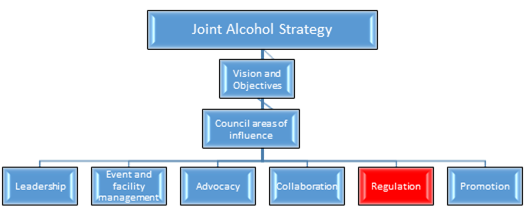
4.3 The
LAP review process
4.3.1 The diagram
illustrates the process for the LAP Review.
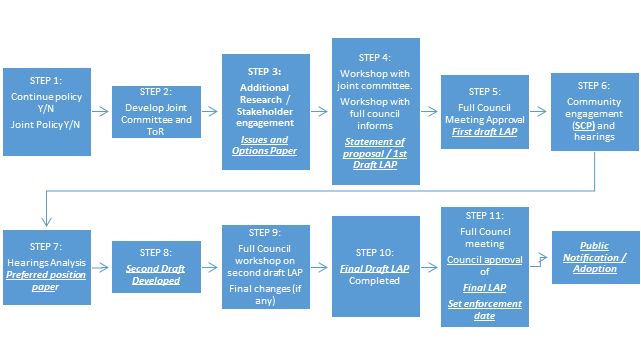
4.4 Revoke
the LAP - Process
4.4.1 If
Council resolves to revoke the LAP, a SCP is required under Section 96 of the
Act. The provisions under the LAP (hours, location provisions, discretionary
conditions) would be revoked and all conditions would revert to the more
lenient Act provisions.
|
Element or
provision
|
SSAA 2012 Default
restrictions
|
LAP
restrictions
|
|
Hours – On licences
|
Monday to Sunday - 8.00 am to
4.00 am
|
Taverns/bars/pubs/night-clubs:
Monday to Sunday - 8.00 am to 3.00 am AND
One way door from 2.00 am
Cafes/restaurants/wineries/winery
restaurants – 8.00am to 2.00 am
|
|
Hours – Club
licences
|
Monday to Sunday - 8.00 am to
4.00 am
|
Monday to Sunday - 8.00am to
1.00 am
|
|
Hours – Off licences
|
Monday to Sunday - 7.00 am to
11.00pm
|
Grocery Stores and
Supermarkets: Monday to Sunday – 7.00 am to 10.00 pm
All other Off licences:
Monday to Sunday – 9.00 am to 10.00 pm
|
|
Hours – remote sales
(internet only)
|
Any day at Any time
|
Any day at Any time
|
|
Special Licences
|
Any day at Any time
|
Any day at Any time (with
restrictions under the District Plan)
|
|
Other conditions
|
None
|
No Further off licences
(bottle stores) within:
Flaxmere
Camberley
Maraenui
Discretionary conditions
guided by principals – connection, impact and reasonableness:
CCTV / Exterior lighting
No glass containers at
specific times
Number of security or door
staff
Limits on number of drinks
per sale, drink sizes and types
|
4.5 Rationale
for Transitioning to Individual LAPs
4.5.1 When the LAP process began in 2013, the rationale
for Council and NCC to have a Joint LAP included improved efficiency, shared
financial responsibilities for potential legal appeal costs, and consistency in
policy provisions across the region.
4.5.2 Based on subsequent operational experience, the
LAP process and legislative change (removal of LAP appeal rights), Officers
recommend transitioning to individual LAP’s to simplify the process and
improve efficiency and effectiveness.
4.5.3 Consistency
in policies
4.5.4 Under
both scenarios, (joint or individual LAP’s), there is a risk of
divergence of provisions. Consistency in the hours provisions in the
LAP’s is important to avoid unintended consequences, regardless of
whether the LAP is joint or individual. For example, disparities in closing
hours may lead to the migration of customers from one district to another,
potentially increasing alcohol related harm.
4.5.5 Well-designed
individual LAP’s can consistently support regional strategic objectives.
4.5.6 If
Council resolves to transition to individual LAP’s Officers from Council
and NCC will collaborate closely.
4.5.7 A
suitable Joint Governance structure with ‘Terms of Reference’, is
recommended to ensure consistency. This Entity can convene after the draft LAPs
are developed and before public consultation. The Entity can consider the draft
LAP’s for regional consistency and provide recommendations to Council and
NCC to assist their deliberations.
4.5.8 Alcohol Related
Harm Reduction Outcomes
4.5.9 There is a strong focus on reduction in alcohol related harm with
separate or joint LAPs.
4.5.10 Public
Information
4.5.11 Comprehensive joint ‘Communications Plan’ will
seek to ensure our communities and stakeholders are informed about the LAP
Review process and can make submissions.
4.6 Joint
LAP Process
4.6.1 Each Council completes the required work and comparative analysis.
They then negotiate and try to align LAP elements.
4.6.2 A joint LAP Review requires the following additional steps:
· Additional Milestones; A 25-milestone
project plan for a joint LAP compared to a 15- milestone plan for individual
LAPs.
· Additional Reporting and Analysis; At
four points in the process additional reports and comparative analysis are
required.
· Parallel Timeframes: Coordination of
timelines between Councils to ensure alignment.
· Terms of Reference and Joint committee:
Establish a Joint Committee for the SCP and hearings process. A Terms of
Reference is developed.
· Outcome Analysis: Analyse and align
outcomes from SCP procedures and hearings.
· Ongoing Negotiations: Conduct formal
negotiations between councils at each decision- making stage.
· Additional Council Meetings: Negotiations
may necessitate additional Council Meetings.
· Joint Policy Drafting: Collaboratively
negotiate and draft the LAP.
· Aligned Adoption Dates: Align adoption
and enforcement dates across the Councils.
4.6.3 Each Council must develop a research report and associated data to
comply with Section 78 (2) of the Act. This involves considering individual
district plans, policies, objectives, licensed environments, demographics, and
harm statistics. An additional report will be created detailing the comparative
analysis, which will inform what changes can or cannot be made in the LAP.
4.6.4 A similar process is required during the Issues and Options stage of
the Review, where both councils will draft issues and options papers, followed
by a comparative analysis report. This is repeated at the consultation stage
and the preferred position stage.
4.6.5 The research data may show significant differences in issues
influencing what can or cannot be changed in the LAP.
4.6.6 A SCP is required to be completed under the Act in accordance with
the LGA 2002. This process is more complicated when receiving submissions for
two council areas and analysing and reporting on that feedback. This is
compounded if the feedback varies significantly between districts.
4.6.7 A preferred position paper is developed, and a second draft LAP is
developed for approval by Council. Two Councils require aligned timeframes,
processes and negotiated LAP provisions for each decision-making stage.
Negotiated provisions may affect alcohol related harm outcomes if the LAP is no
longer suited to the local environment.
4.6.8 In adopting a final LAP, Council alignment is required for adoption
and setting enforcement dates.
4.7 Other
Councils joint LAP reviews
4.7.1 Of the 6 joint LAPs around the country, two councils moved from a
joint LAP to individual LAP’s during their review process, a third
partially split from three to two councils. The remaining Councils are yet to
complete their review.
4.8 Council
Direction
4.8.1 Officers are at Step 1 of the Review Process (Section 4.3.1).
Council direction is sought on the following two matters:
1. Does
Council want to continue with the LAP (and associated Review) as per the 2021
Council Resolution or revoke the LAP?
2. Does
Council want to continue with a joint LAP with NCC or move to an individual LAP
for the Review Process?
5.0 Options – Ngā Kōwhiringa
Recommendation
one:
That Council approve the continuation
of the Local Alcohol Policy and review.
Associated
options:
Option
one: Continue with having a LAP.
Option two: Revoke the LAP.
Recommendation
two:
That the Council approves
a transition to an individual LAP for the LAP Review Process.
Associated
options:
Option
one: Individual Policy and begin Review.
Option two: Status Quo – Joint Policy and begin Review.
5.1 Option
Analysis
5.1.1 The tables
below discuss the advantages and disadvantages of the two recommendations.
|
Option one -
Continue with the LAP and continue the review
|
Option two -
Revoke the LAP
|
|
Advantages
|
Disadvantages
|
Advantages
|
Disadvantages
|
|
· Reduction of hours (on/ off/club
licences) helping to reduce Alcohol related harm
|
· Time taken in associated LAP work
|
· Less officer time involved in preparing
a final draft LAP
|
· Increase of hours for all licence types
which may result in increased Alcohol related harm
|
|
· Location provisions to protect the most
vulnerable populations
|
|
|
· Alcohol licences could establish or
increase in our most vulnerable communities
|
|
· Additional discretionary conditions to
apply to licences
|
|
|
· DLC has less tools at their disposal to
protect the amenity and good order of our communities
|
|
· Additional tools for the DLC to utilise
to reduce Alcohol related harm
|
|
|
· Potential increase in Alcohol related
harm
|
|
· Potential to strengthen the LAP and
reduce harm further in our community
|
|
|
· Push back from Police, Health and
potentially the public
|
|
· Increased chance of reduction of ARH
|
|
|
· There is still the requirement to do a
SCP to revoke a LAP
|
|
Associated
Option one: Individual policy and begin review.
|
Associated
Option two: Status Quo – Joint policy and begin review.
|
|
Advantages
|
Disadvantages
|
Advantages
|
Disadvantages
|
|
· Ease of administration of the LAP review
process - research / SCP process / approval
|
· May be slightly more costly, legal costs
won’t be split (however legal costs to review the LAP will be minimal)
|
· Split of legal costs (if any now there
is no appeals process)
|
· A lengthier more complicated process
with extra steps required (15 milestones vs 25 Milestones)
|
|
· Streamlined processes - Increased
efficiency and reduced timeframe - a 15 milestone project vs a 25-milestone
project
|
· Police could have different licensing
conditions to enforce if policy provisions are different (however this could
occur under a joint policy)
|
· Ease of Police enforcement of the LAP if
conditions were the same. (This can occur in both a joint or individual
policy)
|
· Extra work / time for coordination of
council meeting dates and parallel process
|
|
· No potential for additional council
meetings due to differing council provisions
|
· Potential divergence of provisions - A
council may decide to add provisions to LAP that may cause unintended
consequences. (However, this can be managed and can occur if joint or
individual)
|
· Councils are seen to be working together
|
· Extra work /time for potential extra
council meetings if councils had differing prospective provisions
|
|
· No need for closed Council meetings due
to one council making decisions before another
|
· Public perception may be negative
regarding moving from a joint to individual policy due to perceived
efficiencies of a joint LAP. (This can be managed through effective
communications)
|
|
· Extra reports required at each major
step of the process
|
|
· Individual LAPs would align with enforcement
and decision-making functions that occur at the TA level not regionally
|
|
|
· Inconsistencies in prospective
provisions of the two councils, requiring negotiation, that may result in a
less locally tailored LAP
|
|
· Simplified documentation process
· Focused analysis and reporting
· Eliminates need for extensive
comparative analysis & reports
|
|
|
· Overall process and requirements of a
joint policy is more complicated & time consuming which may affect the
project overall completion date and policy enactment date
|
|
· Reduce organisational complexities and
allow each TA to tailor its policies to local needs, enhancing responsiveness
to community priorities and decreasing alcohol related harm
|
|
|
· Future reviews may require the same
coordination and extra time if a joint policy was continued
|
|
· Operational Independence: Individual
LAPs enable councils to operate independently yet concurrently, expediting
decision-making without the need for prolonged formal negotiations
|
|
|
· Requirement of closed meetings due to
one council making decision before the other
|
|
· Maintained Consistency: Individual
policies can still align with regional objectives, such as in the joint Alcohol
Strategy, ensuring coherence in outcomes while allowing for local
customisation
· The LAP could be mirrored by both councils
to ensure consistency
|
|
|
· More complex documentation process
· Additional formal analysis required at 4
stages of the process
|
|
· Financial Considerations: Recent
legislative changes have removed the previous financial benefits.
· developing individual policies now
presents a more practical and financially sound approach
|
|
|
|
|
· Future reviews or changes are easily
completed
|
|
|
|
5.2 Officers
recommend conducting individual LAP Reviews simultaneously, this will enhance efficiency
and streamline the process, while contributing to the regional goals related to
reducing alcohol-related harm.
5.3 Officers
recommend a suitable joint Council governance structure is developed to oversee
the Council LAP’s to provide appropriate consistency. A joint Communications
Plan will keep messaging consistent and ensure communities of interest are informed
about how they can participate in and submit to the Review process.
6.0 Next steps – Te Anga Whakamua
6.1 If
approved by Council, start the LAP Review Process as required under the Act.
Attachments:
|
1⇨
|
Regulatory Operations - Liquor Licensing - Policy - LAP
DOCUMENT FINAL APPROVED COPY (DATED AUGUST 2019 ON FRONT COVER)
|
REG-14-3-19-237
|
Vol 6
|
|
Summary of
Considerations - He Whakarāpopoto Whakaarohanga
|
|
Fit with purpose of Local Government - E noho hāngai pū ai ki te
Rangatōpū-ā-Rohe
The Council is required to give
effect to the purpose of local government as set out in section 10 of the Local
Government Act 2002. That purpose is to enable democratic local
decision-making and action by (and on behalf of) communities, and to promote
the social, economic, environmental, and cultural wellbeing of communities in
the present and for the future.
Link to the
Council’s Community Outcomes –
Ngā Hononga ki Ngā Putanga ā-Hapori
This proposal
promotes the performance of regulatory functions for the purpose of
preventing harm and creating safe and healthy environments for people. The
proposal also contributes towards reducing public nuisance and threats to
public health and safety through appropriate policy controls for the wellbeing
of communities in the present and for the future.
|
|
Māori Impact Statement - Te Tauākī Kaupapa
Māori
Maori and
pacific people are overrepresented in alcohol related harm statistics,
however no known impacts for mana whenua / iwi / tangata whenua above and or
beyond the general community population specifically in relation to this
policy review.
|
|
Sustainability - Te Toitūtanga
The policy is required under the Act to be reviewed every
six years.
|
|
Financial considerations - Ngā Whakaarohanga Ahumoni
The policy process will incur fees
associated with a legal review and costs for Special Consultative Procedure and administration /officer time. These will
be covered from existing Planning and Regulatory
budgets in the 2024-2025 years.
|
|
Significance and Engagement - Te Hiranga me te Tūhonotanga
Section 79 of
the Act requires the use of the SCP under The LGA 2002, for the LAP Review.
Preliminary stakeholder consultation has been done.
|
|
Consultation – internal and/or
external - Whakawhiti
Whakaaro-ā-roto / ā-waho
The LAP Review
must use the SCP under the LGA 2002.
|
|
Risks
|
REWARD
– Te Utu
|
RISK
– Te Tūraru
|
|
Public health benefits of
having a LAP –
reducing alcohol related
harm.
Providing tools for the
District Licensing Committee to regulate where and when alcohol is sold and
supplied in the region.
Supporting stakeholder
groups wish for the continuation of the LAP to protect and promote public
health and safety.
Increase efficiencies,
reduce complexities of having an individual LAP vs a joint LAP.
|
Potential divergence of
provisions in Council LAPs which can occur with individual or joint LAPs.
|
|
|
Rural Community Board – Te Poari Tuawhenua-ā-Hapori
Will be
briefed on the LAP Review.
|

|
Thursday, 24 October 2024
|
Hastings
District Council: Council Meeting
Te Rārangi Take
Report to Council
|
Nā:
From:
|
Graham Watson, Chief
Financial Officer
|
|
Te Take:
Subject:
|
Risk and Assurance
Committee Recommendations from 14 October 2024 meeting
|
1.0 Summary
1.1 The purpose of this
report is to advise that the recommendations from the Risk and Assurance
Committee held on 14 October 2024 require ratification by Council.
1.2 The October Committee
meeting is an additional meeting scheduled for the purposes of considering the
annual insurance renewals process and receiving and then recommending the
adoption of the Annual Report. The Risk and Assurance Committee has recommended
the adoption of the 2024 Annual Report and that is subject to another agenda
paper at this meeting.
1.3 Council’s
insurance renewal date is 1 November each year and with what is becoming the
norm, details of the renewals are late being finalised.
1.4 The Risk and Assurance
Committee received an update on the annual insurance renewal process at the
October meeting. While some insurance renewals have been confirmed, the more
substantive policy covering the Material Damage and some minor liability policies
have yet to be concluded.
1.5 As such, the Risk and
Assurance Committee have made a recommendation to Council that the Committee
delegate authority to the Chair of the Committee (Mr Graeme McGlinn) to oversee
the renewal process and approve any finalisation of the insurance placements.
The Committee have also recommended a full report be presented to Council that
outlines the polices that have been renewed, the cover provided, and the
premiums incurred.
1.6 The relevant Risk and
Assurance Committee recommendations to be ratified are set out below.
|
2.0 Recommendation– Ngā Tūtohunga
A) That
the report titled “Risk and Assurance Committee Recommendations from 14
October 2024 meeting” be received.
B) That
the following recommendations from the Risk and Assurance Committee meeting
held 14 October 2024 be ratified:
i. That
the Committee recommend that Council supports the November 1st
2024 insurance renewals process and that oversight and approval of this
process be delegated to the Chair of the Risk and Assurance Committee.
ii. That
the Committee recommend to Council that a full report be presented to Council
that outlines the polices that have been renewed, the cover provided, and the
premiums incurred.
|
Attachments:
There are no attachments for this report.
|
Thursday, 24 October 2024
|
Hastings
District Council: Council Meeting
Te Rārangi Take
Report to Council
1.0 Executive Summary
– Te Kaupapa Me Te
Whakarāpopototanga
1.1 Council at
its meeting on 7th September 2023 resolved to;
· Waive
fees for Cyclone Gabrielle recovery building works for residential dwellings
that were subject to red or yellow placards under the Rapid Building
Assessment.
· The
fee waiver was approved to 30th June 2024 with an unbudgeted
provision of up to $500,000 funded from the General Rate.
1.2 Council at its meeting
on 23rd May 2024 resolved to extend the fee waiver to
November 2024.
1.3 Council
has to date waived the following fees;
a) 7/9/23 to 30/06/24 - 110 consents/applications
totalling $218,352.25
b) 1/7/24 to 8/10/24 - 19 consents/applications
totalling
$66,499.60
c) Total 129 consents/ applications $284,851.85
1.4 The
level of eligible consents being processed, has reduced considerably with the
last consent received by Council on 21 August 2024, and 4 consents are
currently being processed.
1.5 This
Report recommends;
· Council concludes
its Policy of ‘Waiver of Building / Resource Consent Fees for Cyclone
Recovery Residential Building Work’ (Policy) at the end of February 2025.
· Council
promulgates its decision (to conclude its Policy at the end of February
2025) to the ‘community of interest’ which may be potentially
eligible for a Consent Fee Waiver, so consent applicants have 4 months to
organise their consent process.
|
2.0 Recommendations -
Ngā Tūtohunga
A) That
Council receive the report titled Waiver of Building / Resource Consent Fees
for Cyclone Recovery Residential Building Work dated 24 October 2024.
B) That
Council concludes its Policy of ‘Waiver of Building / Resource Consent
Fees for Cyclone Recovery Residential Building Work’ at the end of
February 2025.
C) The
Council directs the Chief Executive to promulgate its decision in
Recommendation B to the ‘community of interest’ which
may be potentially eligible for a Consent Fee Waiver, so consent applicants
have 4 months to organise their consent process.
D) That
Council approves the payment of any costs arising because of forgone revenue
from decisions in Recommendation B, as unbudgeted expenditure.
|
3.0 Background – Te Horopaki
3.1 At
its meeting on 7 September 2023, Council resolved to waive building / resource
consent fees for building recovery works (because of Cyclone Gabrielle) for
eligible residential properties to 30 June 2024.
3.2 The
Council approved fee waivers up to a value of $500,000 as unbudgeted
expenditure in 2023 -24 and would review this decision before 30 June 2024. The
budget was funded from the General Rate.
3.3 At
its meeting on 23 May 2024, Council resolved to continue the waiver of
consent fees, and to review its decision in November 2024.
3.4 Council
has to date waived the following fees;
· 7/9/23 to 30/06/24 - 110
consents/applications totalling $218,352.25
· 1/7/24 to 8/10/24 - 19
consents/applications totalling
$66,499.60
· Total 129 consents/
applications $284,851.85
3.5 The last consent received for processing and
eligible for waiving of consent fees was 21st August 2024
3.6 There
are currently 4 consents in the system being processed and eligible for waiving
of consent fees if they are finalised and issued. 2 of the consents are from
2023.
4.0 Discussion – Te Matapakitanga
4.1 Council
introduced this Policy to assist the worst affected
residential property owners who could repair their homes to ‘get back on
their feet’.
4.2 The
level of eligible consents being processed, has reduced considerably with the
last consent received by Council on 21 August 2024, and 4 consents are
currently being processed.
4.3 It
is difficult for officers to forecast the number of remaining eligible
consents. Given no consents have been received in almost 2 months, it is
assumed the level of demand is quickly reducing.
4.4 The
Recommendation to conclude the Policy at the end of February 2025,
acknowledges;
· It will by this
time be two years since the Cyclone,
· Promulgation of
the cessation of the Policy at the end of February 2025 provides 4 months for
remaining eligible consent applicants to organise their consent
applications.
5.0 Options – Ngā Kōwhiringa
Option One - Recommended Option -
Te Kōwhiringa Tuatahi – Te Kōwhiringa Tūtohunga
5.1 Council
concludes its Policy of ‘Waiver of Building / Resource Consent Fees for
Cyclone Recovery Residential Building Work’ (Policy) at the end of
February 2025.
Advantages
· Council
will have helped the worst Cyclone affected residential property owners who
could repair their homes to ‘get back on their feet’ for two years.
· After
providing 4 months’ time for any remaining eligible property owners to
organise their consents, Council will return to its
usual policy for fee payments and cost recovery of building consent processing
costs.
Disadvantages
· None
noted.
Option Two – Status Quo - Te Kōwhiringa Tuarua
– Te Āhuatanga o nāianei
5.2 Council
does not conclude its Policy of ‘Waiver of Building / Resource Consent
Fees for Cyclone Recovery Residential Building Work’ (Policy) at the end
of February 2025.
Advantages
· None
noted.
Disadvantages
· Council
will not return to its usual policy for fee payments and cost recovery of
building consent processing costs. The General Rate will have an unbudgeted
drawdown to pay for costs arising from forgone consent revenues.
Attachments:
There are no attachments for this report.
|
Summary of
Considerations - He Whakarāpopoto Whakaarohanga
|
|
Fit
with purpose of Local Government - E noho hāngai pū ai ki te
Rangatōpū-ā-Rohe
The Council is required to give
effect to the purpose of local government as set out in section 10 of the Local
Government Act 2002. That purpose is to enable democratic local
decision-making and action by (and on behalf of) communities, and to promote
the social, economic, environmental, and cultural wellbeing of communities in
the present and for the future.
Link to the
Council’s Community Outcomes –
Ngā Hononga ki Ngā Putanga ā-Hapori
This proposal has assisted with
Community Wellbeing by aiding Cyclone damaged property owners with their
recovery.
|
|
Māori
Impact Statement -
Te Tauākī Kaupapa Māori
N/A
|
|
Sustainability
- Te
Toitūtanga
N/A
|
|
Financial
considerations -
Ngā Whakaarohanga Ahumoni
Covered in the Report
|
|
Significance
and Engagement - Te
Hiranga me te Tūhonotanga
This decision/report has been assessed under the Council's
Significance and Engagement Policy as being of low significance.
|
|
Consultation
– internal and/or external - Whakawhiti Whakaaro-ā-roto / ā-waho
N/A
|
|
Rural
Community Board –
Te Poari Tuawhenua-ā-Hapori
The Rural Community Board will be briefed
on Councils decision.
|
|
Thursday, 24 October 2024
|
Hastings
District Council: Council Meeting
Te Rārangi Take
Report to Council
|
Nā:
From:
|
Louise Stettner,
Manager, Democracy & Governance Services
|
|
Te Take:
Subject:
|
Requests Received Under
The Local Government Official Information and Meetings Act 1987 (LGOIMA)
Update
|
1.0 Purpose and
summary - Te Kaupapa Me Te Whakarāpopototanga
1.1 The
purpose of this Report is to inform the Council of the number of requests under
the Local Government Official Information and Meetings Act 1987 (LGOIMA)
received from 21 August 2024 to 20 September 2024 and the status of those
requests as at the 20 September 2024.
1.2 This
issue arises from the provision of accurate reporting of information to enable
effective governance.
1.3 This
is an administrative report to ensure that Council is aware of the number and
types of information requests received and to provide assurance the Council is
meeting its legislative obligations in relation to the LGOIMA.
1.4 This
Report concludes by recommending that the LGOIMA requests (as in Attachment
1) be noted.
|
2.0 Recommendations -
Ngā Tūtohunga
A) That
Council receive the report titled Requests Received Under The Local
Government Official Information and Meetings Act 1987 (LGOIMA) Update dated 24
October 2024.
B) That
the LGOIMA requests received from 20 August 2024 to 20 September 2024, as set
out in Attachment 1 of the Report be noted.
|
Attachments:
|
1⇩
|
LGOIMA Report to October Counci Meeting
|
CG-17-1-01229
|
|
|
Item 14 Requests
Received Under The Local Government Official Information and Meetings Act
1987 (LGOIMA) Update
|
|
LGOIMA
Report to October Counci Meeting
|
Attachment 1
|
HASTINGS DISTRICT COUNCIL
Council MEETING
Thursday, 24 October 2024
RECOMMENDATION
TO EXCLUDE THE PUBLIC
SECTION 48, LOCAL GOVERNMENT OFFICIAL INFORMATION AND
MEETINGS ACT 1987
THAT the public now be excluded from the following part of
the meeting, namely:
18 Office
Building Lease
19 Municipal
Building Tenancy
20 CE
Matters
The general subject of the matter to be considered while the
public is excluded, the reason for passing this Resolution in relation to the
matter and the specific grounds under Section 48 (1) of the Local Government
Official Information and Meetings Act 1987 for the passing of this Resolution
is as follows:
|
GENERAL SUBJECT OF
EACH MATTER TO BE CONSIDERED
|
REASON FOR PASSING
THIS RESOLUTION IN RELATION TO EACH MATTER, AND
PARTICULAR INTERESTS
PROTECTED
|
GROUND(S) UNDER
SECTION 48(1) FOR THE PASSING OF EACH RESOLUTION
|
|
|
|
|
|
18 Office
Building Lease
|
Section 7 (2) (i)
The withholding of the
information is necessary to enable the local authority to carry on, without prejudice
or disadvantage, negotiations (including commercial and industrial
negotiations).
Section 7 (2) (j)
The withholding of the
information is necessary to prevent the disclosure or use of official
information for improper gain or improper advantage.
Providing Council with
ability to negotiate terms.
|
Section 48(1)(a)(i)
Where the Local Authority is
named or specified in the First Schedule to this Act under Section 6 or 7
(except Section 7(2)(f)(i)) of this Act.
|
|
19 Municipal
Building Tenancy
|
Section 7 (2) (h)
The withholding of the
information is necessary to enable the local authority to carry out, without
prejudice or disadvantage, commercial activities.
Commercially sensitive
information.
|
Section 48(1)(a)(i)
Where the Local Authority is
named or specified in the First Schedule to this Act under Section 6 or 7
(except Section 7(2)(f)(i)) of this Act.
|
|
20 CE
Matters
|
Section 7 (2) (a) - The withholding of the information is necessary to
protect the privacy of natural persons, including that of a deceased person.
|
Section 48(1)(a)(i)
Where the Local Authority is
named or specified in the First Schedule to this Act under Section 6 or 7
(except Section 7(2)(f)(i)) of this Act.
|