|
Tuesday, 10 December 2024 |
Te Hui o Te Kaunihera ā-Rohe o Heretaunga
Hastings District Council: HDC : Tangata Whenua Wastewater Joint Committee Meeting
Te
Rārangi Take
Report to HDC : Tangata Whenua Wastewater Joint Committee
|
Nā: From: |
Steve Cave, 3 Waters Manager |
|
Te Take: Subject: |
Te Hā o Waiaroha Update |
1.0 Executive Summary – Te Kaupapa Me Te Whakarāpopototanga
1.1 The purpose of this report is to provide an update on Heretaunga Hastings District Council of the Te Hā o Waiaroha policy development.
1.2 This report also intends to signal the intention to workshop and meet with the HDC : Tangata Whenua Wastewater Joint Committee (Tangata Whenua Wastewater) in early 2025 to introduce and discuss relevant proposed policy instruments.
3.0 Background – Te Horopaki
Legislative, regulatory and strategic context
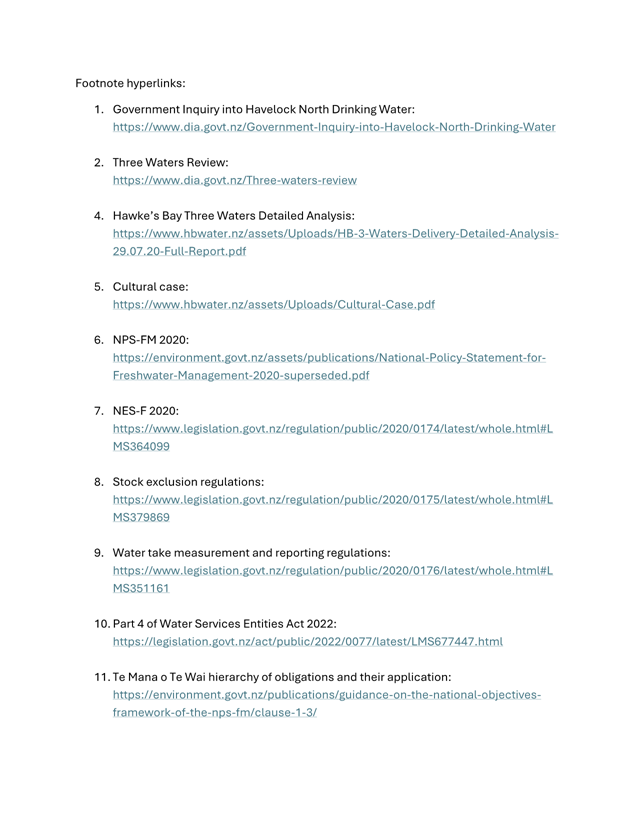
3.1 In September 2016, following the August Havelock North drinking water contamination incident, central government established the Government Inquiry into Havelock North Drinking Water[1] (the Inquiry). The Inquiry focused on how the contamination incident transpired, subsequent responses, and future options to prevent or minimise future incidents.
3.2 In mid-2017 central government also began the Three Waters Review[2] (the Review) which ran in parallel to the latter stages of the Inquiry and looked at how to improve the regulation and supply arrangements of drinking water, wastewater and stormwater (three waters) to better support Aotearoa New Zealand’s prosperity, health, safety and environment.
3.3 The Review was a cross-government initiative led by the Minister of Local Government and involved other agencies and portfolios such as: Health, Environment, Finance, Business Innovation and Employment, Commerce and Consumer Affairs, Primary Industries, Climate Change, Infrastructure, Civil Defence and Emergency Management, Housing and Urban Development, Transport, Conservation, and Rural Communities.
3.4 In response to the Review and to prepare for imminent reform, the five councils of Hawke’s Bay[3] commissioned a report in 2018 (Hawke’s Bay Three Waters Detailed Analysis) [4] to assess the challenges and opportunities of developing a region-wide solution to three waters service delivery, and to prepare for likely new central government regulations.
3.5 The report included a cultural case[5], underpinned by the Treaty of Waitangi, which identified that Māori cultural values and traditions associated with water have been well documented within council processes, however the operational implementation of cultural values was a gap. The role of the cultural case was to highlight that within the regulatory framework relating to water, te ao Māori, through its language, genealogy, stories and traditions, requires a greater level of competency than usual.
3.6 The engagement strategy for the cultural case consisted of meeting with the existing Māori committees of Hastings District, Napier City, and Wairoa District Councils, as well as the Regional Council’s Regional Planning Committee and Māori Committee. Noting that Central Hawke’s Bay did not have a formal Māori committee, a meeting was held with Te Taiwhenua o Tamatea.
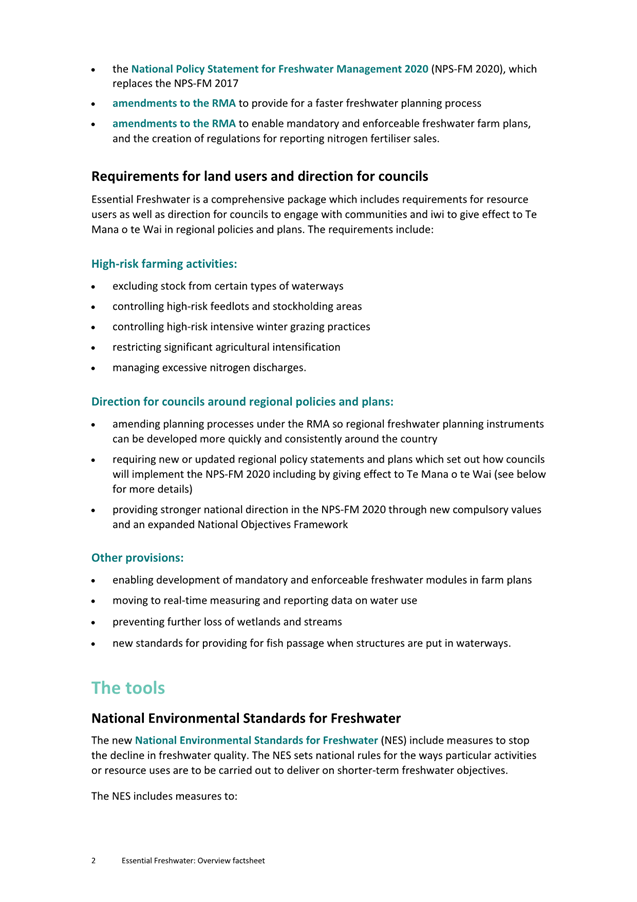
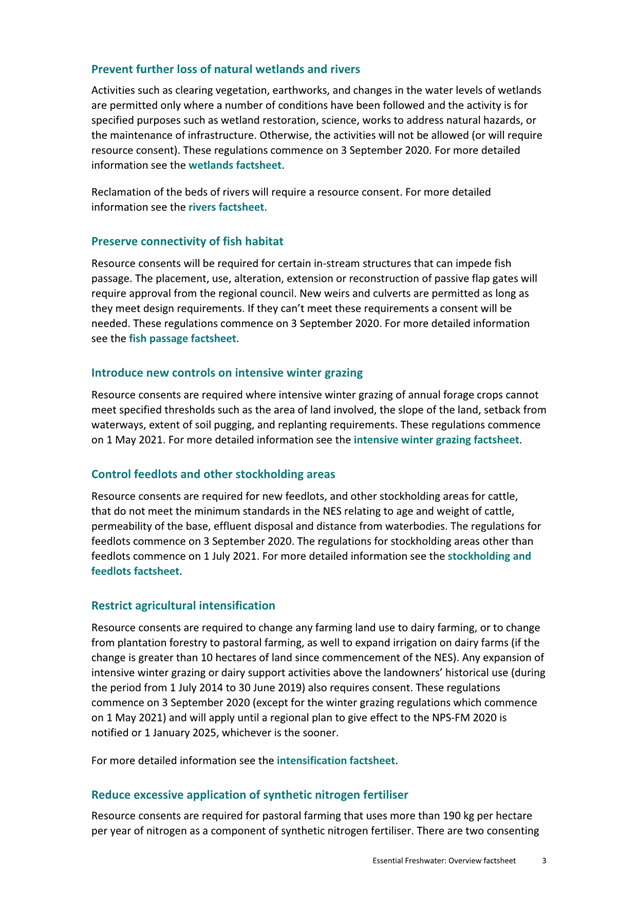
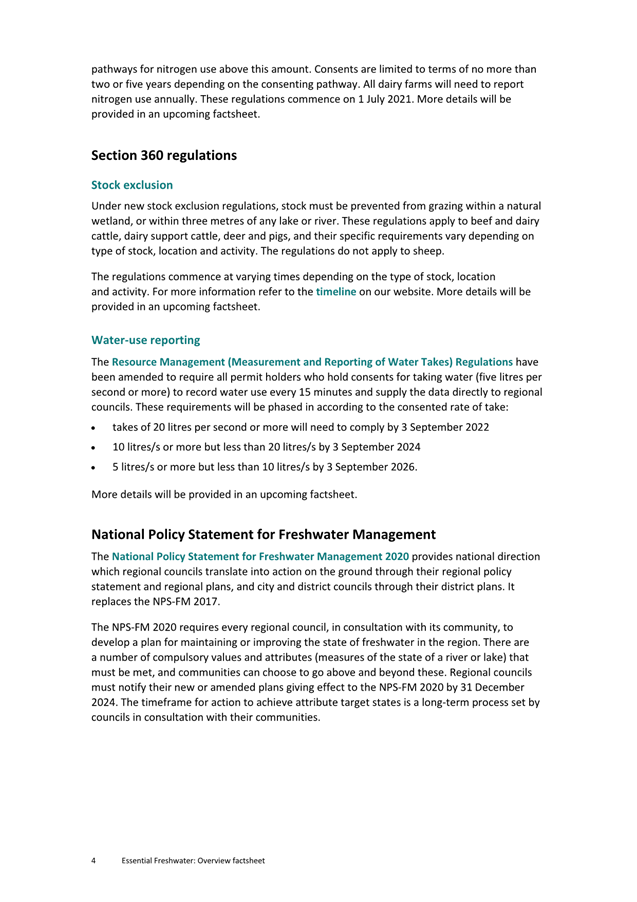
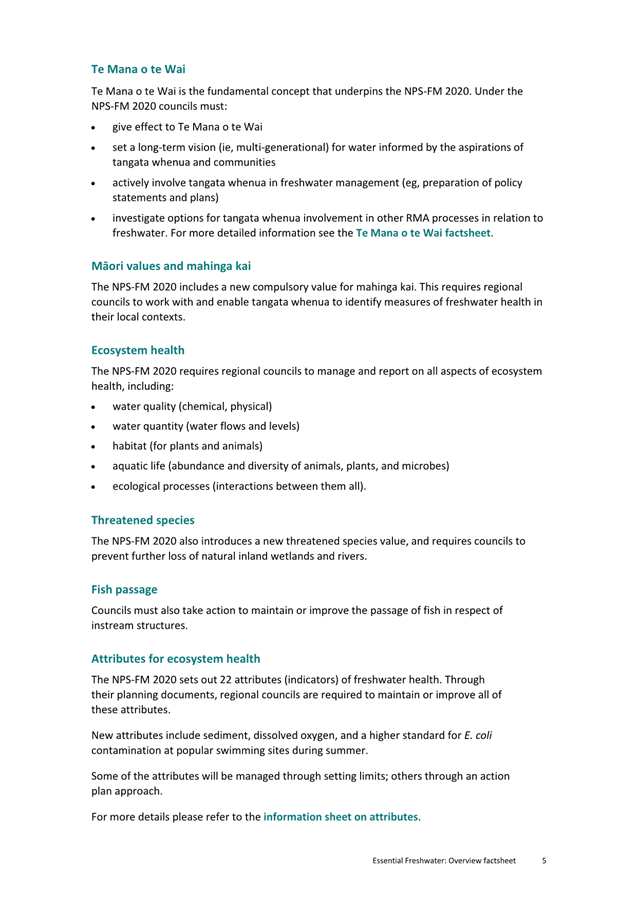
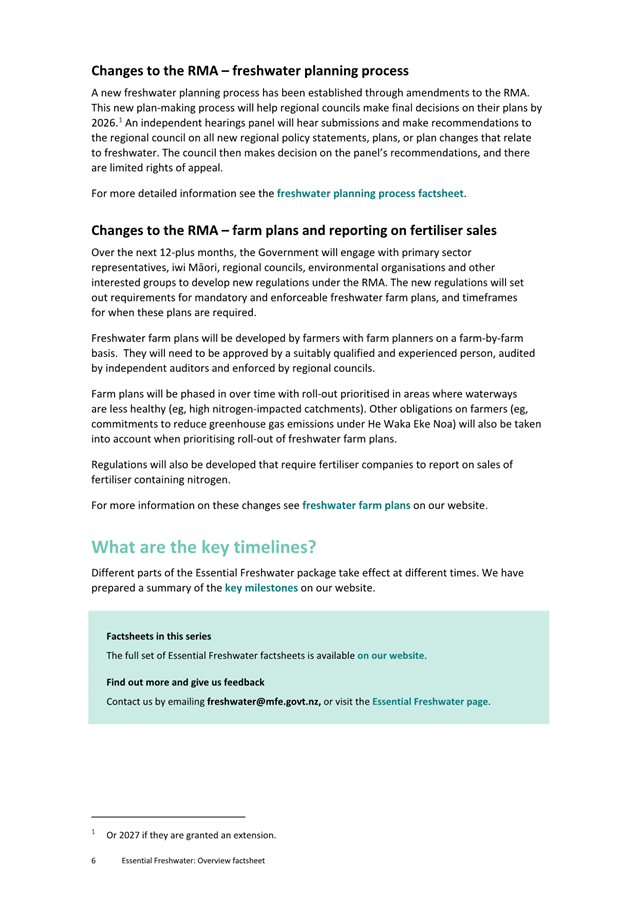
3.7 Back at a national level, in 2020 the Ministry for the Environment released the Essential Freshwater package (attachment 1); a collection of regulations and policies that included the National Policy Statement for Freshwater Management 2020 (NPS-FM 2020)[6], National Environmental Standards for Freshwater (NES-F)[7], stock exclusion regulations[8] and updates to water take measurement and reporting regulations[9].
3.8 Though separate, the Three Waters Review was related to and informed by the Essential Freshwater package;
· Essential Freshwater is focused ensuring all discharges and water users are contributing to agreed catchment and regional-level freshwater outcomes.
· Three waters issues relate to public safety and environmental outcomes in relation largely, but not exclusively, to council-controlled drinking water, wastewater and stormwater services.
3.9 From the Three Waters Review, the resulting three waters regulatory proposals were designed to be consistent with Essential Freshwater policies and regulations, with the Water Services Entities Act 2022 requiring all persons performing or exercising duties, functions, or powers under the Act to give effect to the principles of Te Tiriti o Waitangi and Te Mana o Te Wai[10].
3.10 In late 2022, following the Hastings District Council’s (HDC) triennial elections, issues surfaced with Council's demand management and conservation activities (associated with drinking water). These issues related to the lack of cultural values within the multi-criteria analysis (MCA) associated with decision-making for drinking water. Alongside the findings of the Inquiry, the Review and Hawke’s Bay Three Waters Detailed Analysis, as well as the new and imminent regulations from central government, the MCA gap was the catalyst for the Te Hā o Waiaroha policy concept.
3.11 What began as a project to establish cultural values within the MCA for demand management and conservation, soon resulted in a proposal that HDC develop an internally facing policy that umbrellas all three water services. Though the genesis of the policy concept was catalysed by the lack of cultural values in the MCA and informed by the various new or imminent water-related legislation and regulation from central government, the proposed policy’s major intent was to establish a values-based foundation to guide the improvement and future delivery of water services, that has greater resilience in a changeable legislative environment. The proposed policy would be inward-facing and result in improved water services policy and practice.
Approach of partnership
3.12 Wai is of paramount importance for Māori and in recent history, relationships between mana whenua and council for wai-related activities have been positive. This context meant the project team had an early understanding and expectation that the proposed policy should be developed in partnership with mana whenua.
3.13 Given the government and public scrutiny of council-administered water services (which was particularly prevalent at the time this policy was proposed), a key challenge was identified in developing a policy that was robust enough to drive the improvement of water-related operational policy and practice but flexible enough to ensure future agility. This agility was and remains critical to the proposed policy’s relevance and longevity as the central and local government landscapes continue to seek equilibrium in this space. These factors considered, identifying principles to underpin the policy was established as a primary objective of the early phases of the project. The rationale being that principles determined in partnership with mana whenua are in keeping with the respective responsibilities of council and mana whenua as partners under Te Tiriti o Waitangi, especially when relating to the protection of taonga such as wai. Partnered principles also provide a solid foundation for future strategic policy and practice developments, without establishing stringent policy mechanisms that are difficult to work with in a changing political environment.
3.14 With an understanding of intention, there was a shift of focus to determining an approach to engaging mana whenua to partner in the development of core principles.
3.15 The concept of Te Mana o Te Wai is well known across mana whenua partners, elected members and Council officers. However, it must be acknowledged that the comprehension of Te Mana o Te Wai is unique between mana whenua and the local government system. Mana whenua possess an inherent understanding and ability to apply Te Mana o Te Wai as an ao Māori construct. Whereas the literacy possessed by elected members and council staff comes largely from a legislative and regulatory perspective; Te Mana o Te Wai was the fundamental concept of the Essential Freshwater package (attachment 1, page 1). Though it must also be noted that some officials with whakapapa Māori and or high cultural competence, regard Te Mana o Te Wai not only for its legislative and regulatory associations but for its roots in te ao Māori. All versions of knowing Te Mana o Te Wai whether as mana whenua, local government or in its duality (as a Māori framework and bureaucratic tool) are valuable and the approaches employed to engage on, develop and deliver the proposed policy attempt to equitably acknowledge these distinct values.
3.16 Significant consideration was also given to the fact that implementation of Te Mana o Te Wai as part of the Essential Freshwater package falls largely within regional councils’ remit, with territorial local authorities’ (TLA) requirements being application of the hierarchy of obligations to their three water services (as opposed to the implementation of the wider package). It is important to make this distinction between mandates and responsibilities related to Te Mana o Te Wai because though it is applicable for both regional councils and TLAs, their respective obligations are unique. This characteristic means careful navigation is required not only in reconciling understanding and mandates between regional councils and TLAs, but also in the conversations with mana whenua whose perspective of wai, and therefore Te Mana o Te Wai, is also unique in both a broader ahurea Māori context, but possibly amongst the constituents that make up the mana whenua of Heretaunga.
3.17 Despite the diverse knowledge-scape associated with Te Mana o Te Wai across the matrix of mana whenua and stakeholders, it was nominated as the framework for engagement. The basis for this was the common ground it provided as an existing and well-known construct, and ability to progress with engagement without having to invest in the development of a new engagement framework. Supporting background also included the longer-term history and working relationships between mana whenua and council for wai-related council activities, and an understanding of the mutual desire between council and mana whenua to progress improvements to policy and practice for wai.
3.18 In October and November of 2023, an engagement process commenced with the Heretaunga Takoto Noa Māori Standing Committee, Tangata Whenua Wastewater Joint Committee, and representatives from mana whenua and local kaupapa Māori organisations. This early engagement process was carried out to understand:
· What Te Mana o Te Wai means to the mana whenua of Heretaunga.
· The mana whenua expectations of Council in implementing Te Mana o Te Wai from an ao Māori perspective, not a legislative one.
3.19 The intention was to gain understanding of the mana whenua perspective of Te Mana o Te Wai and its applicability as a foundation for an overarching policy for HDC’s three water services. Again, it must be reiterated that its application in this context was and is for its true nature as an ao Māori knowledge system and practice, not its portrayal as part of the NPS-FM 2020; though this latter interpretation had and continues to have value when reconciling the distinct world views between tangata whenua and the bureaucratic governing system of Aotearoa.
3.20 Both sessions took an interactive approach which sought to inform the kaupapa:
· Development of an internally facing policy to improve delivery of water services.
· Gain feedback, input and guidance from mana whenua and local kaupapa organisations.
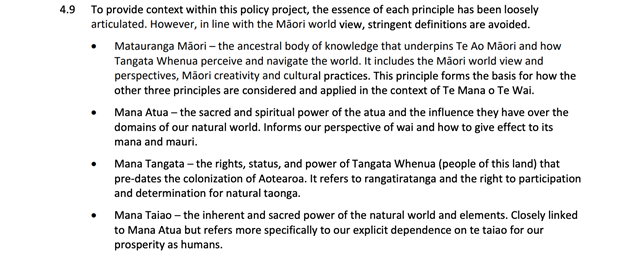
3.21 The information gained in these sessions formed the base material for identifying principles that the policy would be developed around. Alongside this, a stock take and evaluation of other principles determined by mana whenua and local Māori which have been adopted by council was also carried out. Mike Paku, chair of Heretaunga Takoto Noa, summarised the analysis with the following principles:
· Mātauranga Māori
· Mana Atua
· Mana Tangata
· Mana Taiao
3.23 In these meetings, a further resolution was passed by Heretaunga Takoto Noa and Council directing officers to socialise the four principles with the Maori Committees of all Hawke’s Bay TLAs. The intention of this resolution was to enable alignment of future water policies across all parties involved in the coalition government’s proposed Local Water Done Well. The engagement was targeted at the Māori committees of the other TLAs given they are kaupapa Māori principles and therefore the respective Māori representatives of each council were identified as the appropriate first stage of discussion. This resolution was not intended to inhibit progression of the Te Hā o Waiaroha policy project and is being delivered as a parallel workstream.
3.24 Following on from the adoption of principles, the project shifted to identifying possible policy instruments. The proposed instruments were identified through analysis of discovery material (gained through the early stages of the policy cycle) and analysis of engagements. Key sources of input for their identification include:
· the initial mana whenua engagement process
· guidance from the Heretaunga Takoto Noa chair and wider kōmiti
· internal feedback from water services officers.
3.25 Two of the policy instruments have been identified as significant and of particular relevance to this committee, the Heretaunga Takoto Noa Māori Standing Committee and mana whenua partners. These two instruments have not been defined beyond their identification because both items relate directly to the practicalities of securing and enhancing a successful partnership model between mana whenua and Council; meaning the mechanisms themselves should be determined in partnership (not prescribed by Council).
3.26 To begin this process, these critical instruments are being socialised and tested with this committee and Heretaunga Takoto Noa to seek guidance on an ideal approach to co-designing these instruments with mana whenua.
4.0 Discussion – Te Matapakitanga
4.1 It must be acknowledged that the sequencing for socialising these instruments with this committee and Heretaunga Takoto Noa has been imperfect. The intended order was to introduce and discuss their relevance and implications with Tangata Whenua Wastewater then with Heretaunga Takoto Noa. This sequencing was deemed important because of Tangata Whenua Wastewater’s role as a joint governance entity in council’s water services space. Meaning this committee and its members have a unique perspective and intimate knowledge of partnered decision-making for wastewater; both of which would be hugely beneficial to the development of the Te Hā o Waiaroha policy. Additionally, there is an appropriateness to having these conversations first with Tangata Whenua Wastewater given there is potential for the committee to be affected by the proposed policy and its instruments.
4.2 Unfortunately attempts to schedule the required workshops and meetings in the desired order were unsuccessful, resulting in the instruments being presented to Heretaunga Takoto Noa in September 2024 and a workshop and meeting with Tangata Whenua Wastewater remaining outstanding. The project team sincerely hopes this won’t be perceived as a slight on this committee’s position in the process and won’t negatively impact their willingness and ability to provide feedback and guidance moving forward.
4.3 To that end, the project team eagerly await the opportunity to schedule the appropriate workshop and meeting with Tangata Whenua Wastewater early in 2025 to introduce the relevant proposed instruments, and gain feedback on ideal approaches to progressing the policy’s development.
4.4 A review of the feedback provided by this committee and Heretaunga Takoto Noa will determine the progressive steps for design of the instruments in partnership with mana whenua.
4.5 Upon completion of instrument development, the major instruments will need to be endorsed by Tangata Whenua Wastewater and Heretaunga Takoto Noa and adopted by Council. Adoption will allow for the draft policy to be finalised for consideration and eventual adoption.
5.0 Options – Ngā Kōwhiringa
Option One - Recommended Option - Te Kōwhiringa Tuatahi – Te Kōwhiringa Tūtohunga
5.1 Proceed with workshop and subsequent meeting to introduce and discuss the relevant proposed policy instruments in early 2025.
Advantages
· Provides opportunity to appropriately introduce and discuss the relevant proposed instruments in a constructive setting.
Disadvantages
· No perceived disadvantages beyond further delaying the already disrupted timeline.
Option Two – Status Quo - Te Kōwhiringa Tuarua – Te Āhuatanga o nāianei
· There is the potential for significant disadvantages if the relevant proposed policy instruments are not introduced and discussed with this committee.
6.0 Next steps – Te Anga Whakamua
6.1 Schedule required workshop and meeting with the HDC: Tangata Whenua Wastewater Committee.
|
1⇩ |
Attachment 1 - Essential Freshwater Package overview factsheet (1) - Waiaroha update |
CG-17-18-00032 |
|
|
2⇩ |
Attachment 2 - Te Hā o Waiaroha principles definitions |
CG-17-18-0035 |
|
|
3⇩ |
Attachment 3 - Footnote hyperlinks |
CG-17-18-0036 |
|
|
Summary of Considerations - He Whakarāpopoto Whakaarohanga |
||||
|
Fit with purpose of Local Government - E noho hāngai pū ai ki te Rangatōpū-ā-Rohe The Council is required to give effect to the purpose of local government as set out in section 10 of the Local Government Act 2002. That purpose is to enable democratic local decision-making and action by (and on behalf of) communities, and to promote the social, economic, environmental, and cultural wellbeing of communities in the present and for the future. Link to the Council’s Community Outcomes – Ngā Hononga ki Ngā Putanga ā-Hapori This proposal promotes the cultural, social and environmental wellbeing of communities in the present and for the future. |
||||
|
Māori Impact Statement - Te Tauākī Kaupapa Māori Impacts to Māori in relation to wai are a key consideration of all work associated with the Te Hā o Waiaroha policy project. Given the paramount importance of wai for Māori, partnership with mana whenua is a foundation of this work. |
||||
|
Sustainability - Te Toitūtanga The Te Hā o Waiaroha policy has the potential to provide a meaningful foundation to improve water services policy and practice. The eventual implementation of a principles-based policy designed in partnership with mana whenua would serve our ability to improve other areas of our business into the future, particularly in the taiao space |
||||
|
Financial considerations - Ngā Whakaarohanga Ahumoni N/A - contained within existing budgets. |
||||
|
Significance and Engagement - Te Hiranga me te Tūhonotanga This decision/report has been assessed under the Council's Significance and Engagement Policy as being of minor significance.
|
||||
|
Consultation – internal and/or external - Whakawhiti Whakaaro-ā-roto / ā-waho Engagement with the Tangata Whenua Wastewater committee and Heretaunga Takoto Noa will be regular to provide updates or seek recommendations/resolutions. Engagement with mana whenua partners will take place to co-design relevant policy instruments and guide policy development and will be determined following feedback from the above-mentioned committees. |
||||
|
Risks Opportunity: To update the Tangata Whenua Wastewater committee
|
||||
|
Rural Community Board – Te Poari Tuawhenua-ā-Hapori N/A
|