Kaupapataka
Agenda
|
Te Rā Hui:
Meeting date:
|
Tuesday, 18 February
2025
|
|
Te Wā:
Time:
|
1:00
PM
|
|
Te Wāhi:
Venue:
|
Council Chamber
Ground Floor
Civic Administration
Building
Lyndon Road East
Hastings
|
|
Te Hoapā:
Contact:
|
Democracy
and Governance Services
P: 06 871 5000
| E: democracy@hdc.govt.nz
|
|
Te Āpiha Matua:
Responsible Officer:
|
Chief Executive - Nigel Bickle
|
Kaupapataka
Agenda
|
Mematanga:
Membership:
|
Tiamana
Chair: Mayor Sandra Hazlehurst
Ngā KaiKaunihera
Councillors: Ana Apatu,
Marcus Buddo, Alwyn Corban, Malcolm Dixon, Michael Fowler, Damon Harvey, Henry
Heke, Kellie Jessup, Tania Kerr (Deputy Mayor), Eileen Lawson, Hana
Montaperto-Hendry, Simon Nixon, Wendy Schollum, Heather Te Au-Skipworth and Kevin
Watkins
|
|
Tokamatua:
Quorum:
|
8 members
|
|
Apiha Matua
Officer Responsible:
|
Chief Executive – Nigel
Bickle
|
|
Te Rōpū Manapori me te Kāwanatanga
Democracy and Governance Services:
|
Louise Stettner (Extn 5543)
|
Te Rārangi Take
Order of Business
|
1.0
|
Opening
Prayer – Karakia
Whakatūwheratanga
|
|
|
2.0
|
Apologies
& Leave of Absence – Ngā Whakapāhatanga me te Wehenga ā-Hui
At the
close of the agenda no apologies had been received.
Leave of Absence
had previously been granted to Councillor Kerr
|
|
|
3.0
|
Conflict
of Interest –
He Ngākau Kōnatunatu
Members need to be vigilant to stand aside from
decision-making when a conflict arises between their role as a Member of the
Council and any private or other external interest they might have.
This note is provided as a reminder to Members to scan the agenda and assess
their own private interests and identify where they may have a pecuniary or
other conflict of interest, or where there may be perceptions of conflict of
interest.
If a Member feels they do have a conflict of
interest, they should publicly declare that at the start of the relevant item
of business and withdraw from participating in the meeting. If a Member
thinks they may have a conflict of interest, they can seek advice from
the General Counsel or the Manager: Democracy and Governance (preferably
before the meeting).
It is noted that while Members can seek advice and
discuss these matters, the final decision as to whether a conflict exists
rests with the member.
|
|
|
4.0
|
Confirmation
of Minutes –
Te Whakamana i Ngā Miniti
No minutes to
be confirmed.
|
|
|
5.0
|
Mayor's
Verbal Update
|
9
|
|
6.0
|
Petition
- Free Parking for Resident Drivers Over 65 in the Hastings Central Business
District
|
11
|
|
7.0
|
Tuia
2025
|
19
|
|
8.0
|
2025
Youth Council
|
21
|
|
9.0
|
2025/26
Annual Plan
|
23
|
|
10.0
|
Splash
Planet - Close of 2024/25 Season
|
29
|
|
11.0
|
Draft
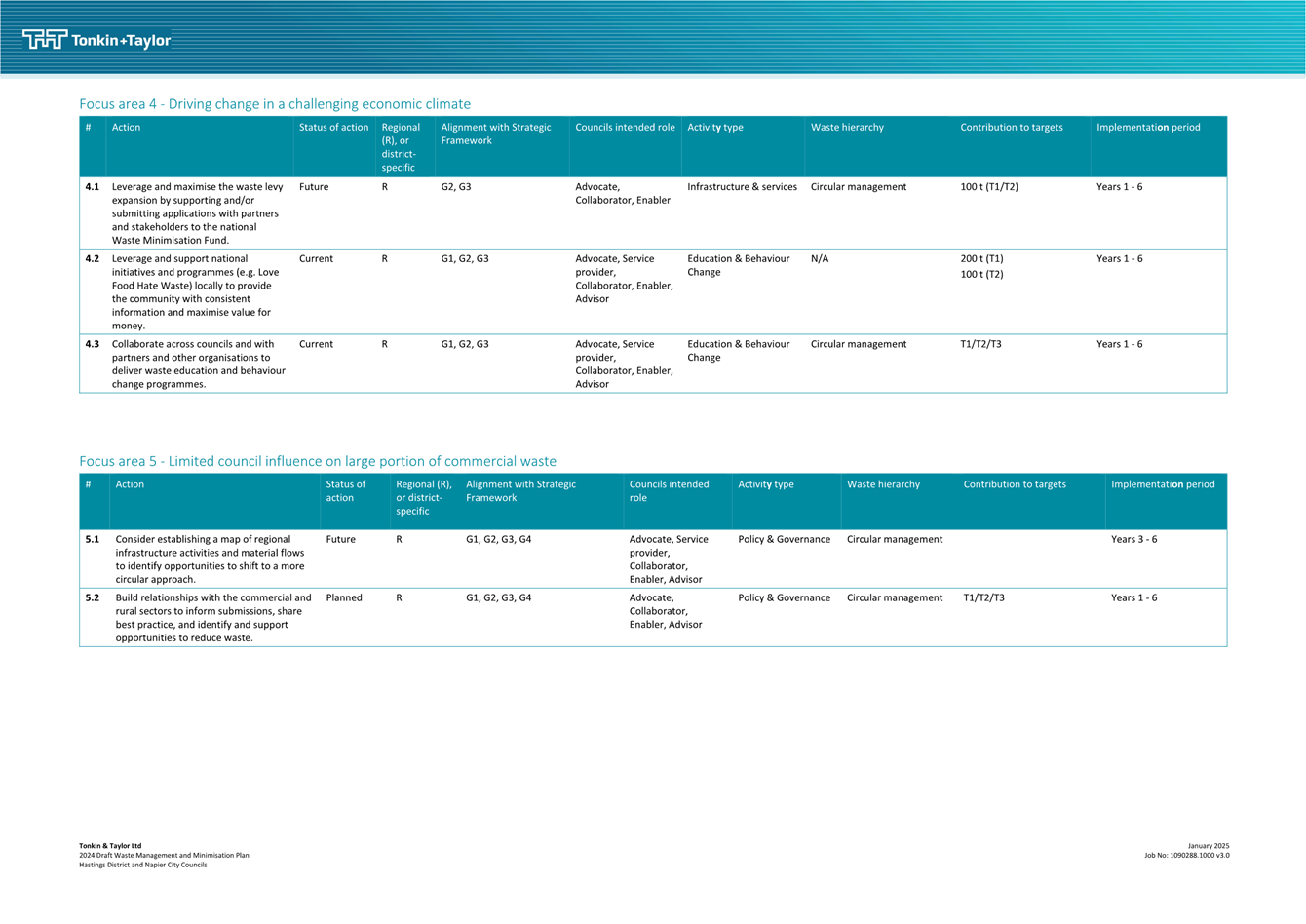
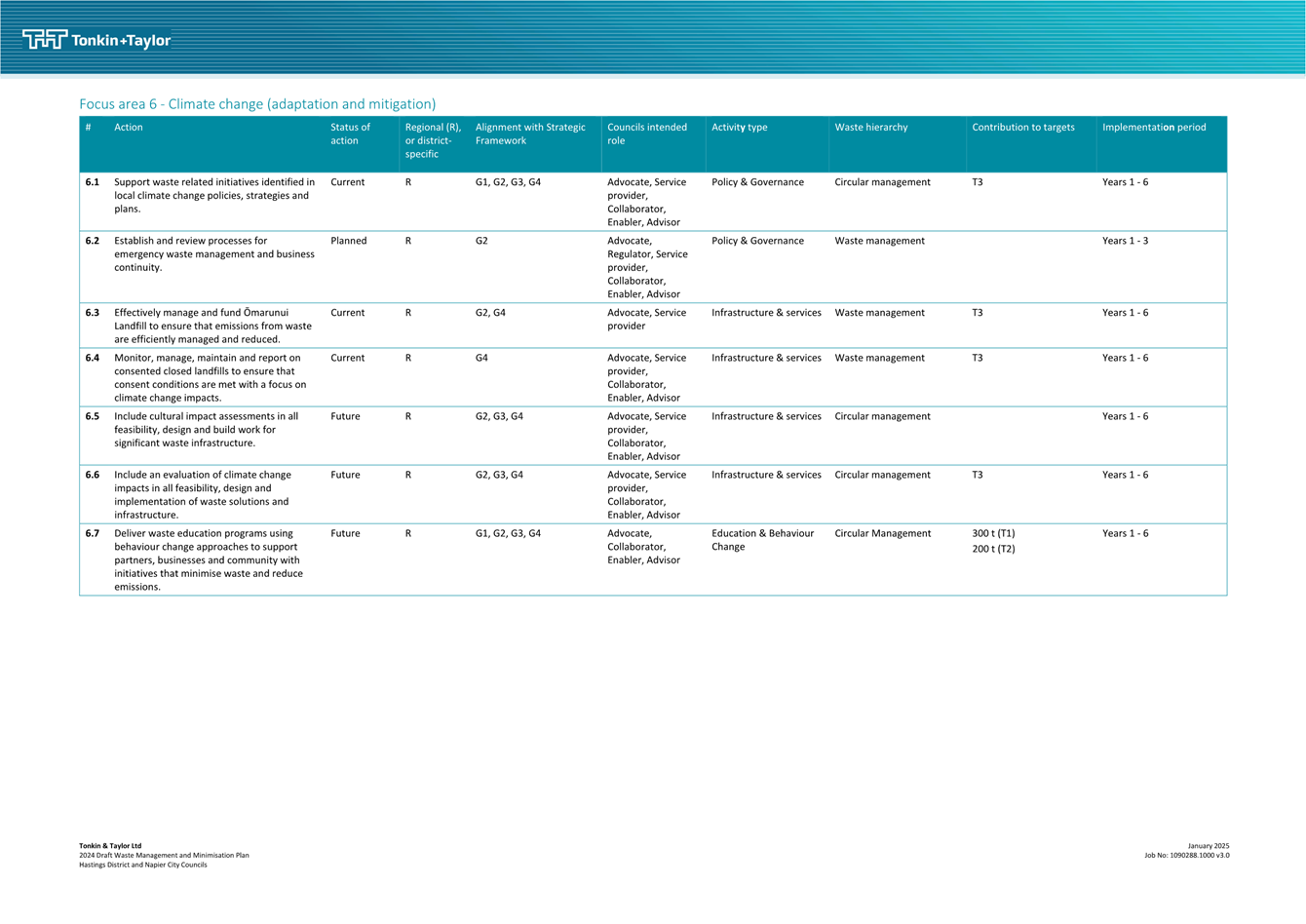
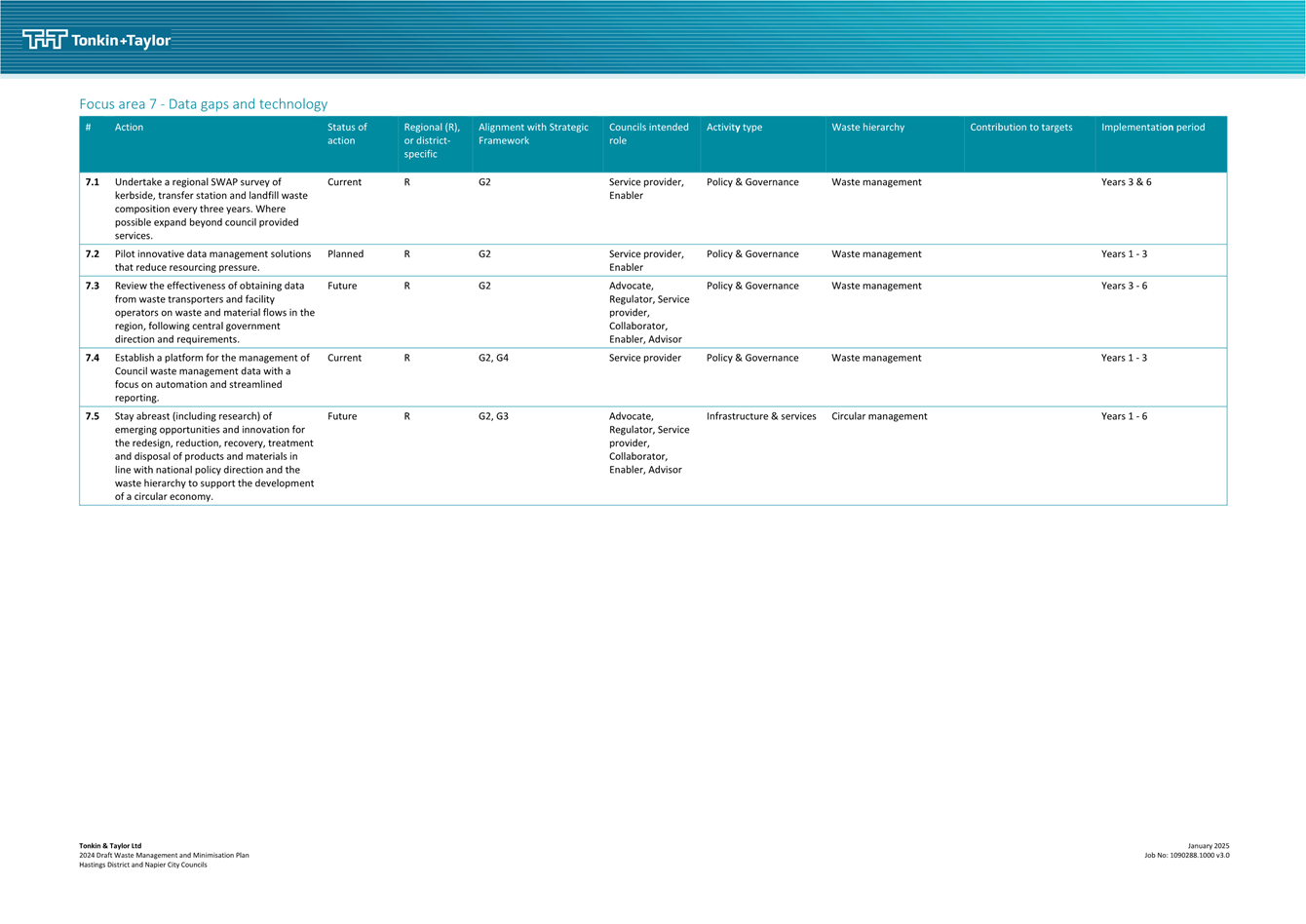
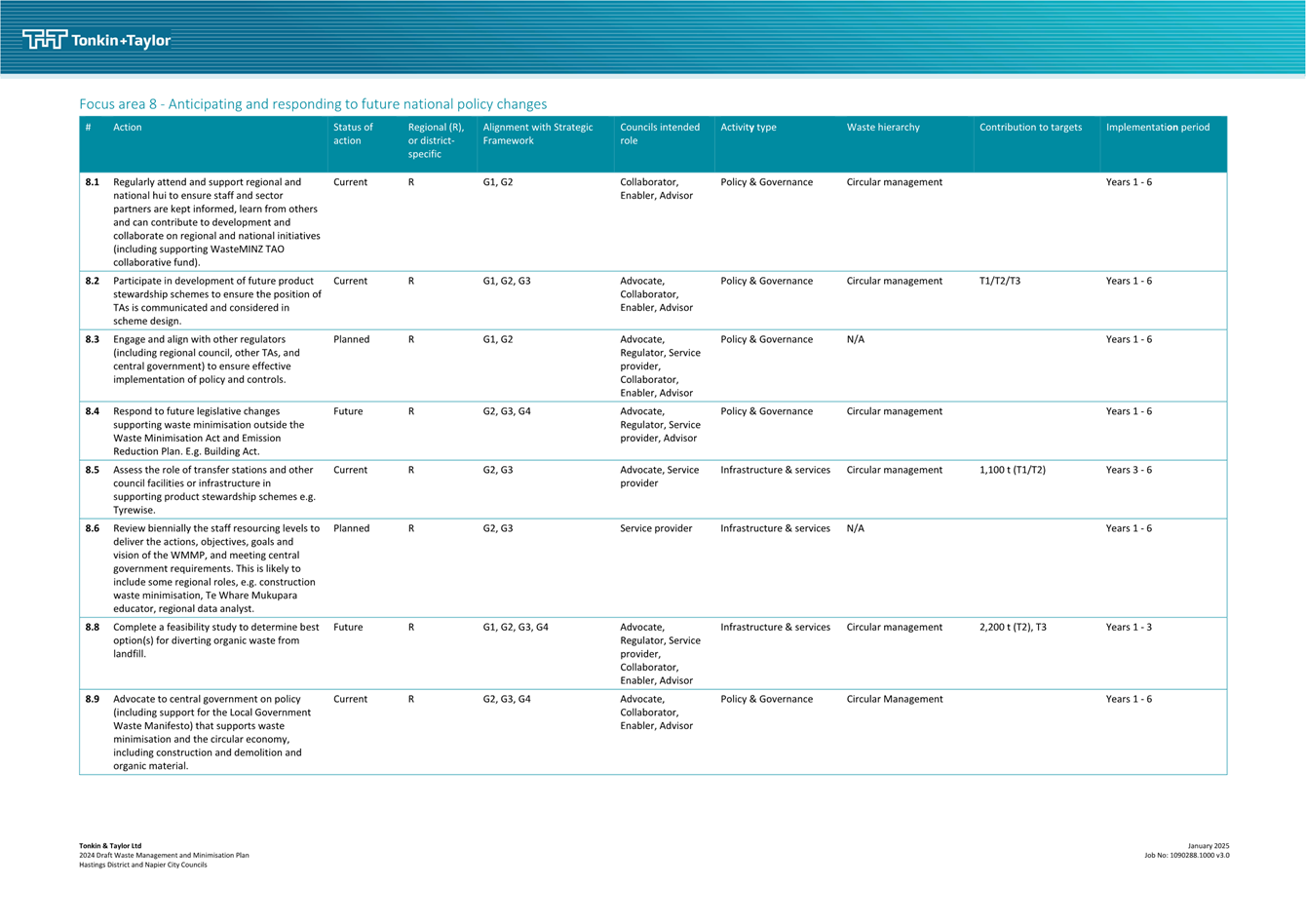
Joint Waste Management and Minimisation Plan and Statement of Proposal
|
35
|
|
12.0
|
Approval
of the first Draft Local Alcohol Policy for Special Consultative
Procedure
|
97
|
|
13.0
|
Revocation
of Part 10 Speed Limits Bylaw 2012 of the Hastings District Council
Bylaws
|
115
|
|
14.0
|
Hastings
District School Speed Limits Plan
|
119
|
|
15.0
|
River
Hazard Modelling for the Esk River and Te Ngarue Stream
|
127
|
|
16.0
|
Summary
of Recommendations of the Rural Halls Subcommittee meeting held Monday 9
December 2024
|
139
|
|
17.0
|
Summary
of Recommendations of the Civic Development Subcommittee Meeting held on 4
February 2025
|
143
|
|
18.0
|
Appointment
to the Hearings Committee
|
145
|
|
19.0
|
Requests
Received Under The Local Government Official Information and Meetings Act
1987 (LGOIMA) Update
|
147
|
|
20.0
|
Proposed
Amendments To Schedule Of Meetings
|
151
|
|
21.0
|
Minor Items
– Ngā Take
Iti
|
|
|
22.0
|
Urgent
Items –
Ngā Take Whakahihiri
|
|
|
23.0
|
Recommendation
to Exclude the Public from Item 24
|
153
|
|
24.0
|
East
Clive Waste Water Treatment Plant - 'Outfall Pump Station and Land Based
Outfall Procurement Plan' Approval
|
|

|
Tuesday, 18 February 2025
|
Hastings
District Council: Council Meeting
Te Rārangi Take
Report to Council
|
Nā:
From:
|
Sandra Hazlehurst, Mayor
|
|
Te Take:
Subject:
|
Mayor's Verbal Update
|
1.0 Purpose and summary - Te Kaupapa Me Te Whakarāpopototanga
1.1 The purpose of this report
is to provide the opportunity for a regular verbal update from the Hastings
District Council Mayor regarding current activities and events.
|
2.0 Recommendations -
Ngā Tūtohunga
That Council receive the report titled Mayor's Verbal
Update dated 18 February 2025.
|
Attachments:
There are no attachments for this report.

|
Tuesday, 18 February 2025
|
Te
Hui o Te Kaunihera ā-Rohe o Heretaunga
Hastings
District Council: Council Meeting
Te
Rārangi Take
Report to Council
|
Nā:
From:
|
John Payne, Regulatory
Solutions Manager
|
|
Te Take:
Subject:
|
Petition - Free Parking
for Resident Drivers Over 65 in the Hastings Central Business District
|
1.0 Executive Summary – Te Kaupapa Me Te
Whakarāpopototanga
1.1 This
Report is written in response to a petition from Mr Ron Wilkins, President of
Grey Power Hastings and District Association Inc (Grey Power) received by
Council at its meeting on 19 November 2024.
1.2 The
petitioner’s prayer read as follows:
“That the
Hastings District Council offer drivers over 65 free parking in the Hastings
Central Business District, Monday – Friday between 9.00am – 3.00pm.
This would require seniors to register their vehicle and pay a possible fee of
$10.00.”
1.3 There
were 68 signatures to the petition.
1.4 Mr
Wilkins, the lead petitioner has been invited to speak to the petition and has
indicated that he wishes to do so.
1.5 This
Report traverse’s Council decision elements including revenue loss,
equity and fairness, retail spend assumptions, and administration/operational
efficiency and cost.
1.6 This
Report examines the feasibility of providing free parking for drivers over the
age of 65 that reside in the Hastings district.
|
2.0 Recommendations - Ngā Tūtohunga
A) That Council receive the
report titled Petition - Free Parking for Resident Drivers Over 65 in the
Hastings Central Business District dated 18 February 2025.
B) That Council resolves to
either:
I. Not
made free parking in the Hastings Central Business District available to any
group with eligibility based on age. OR
II. Make free parking in the Hastings Central
Business District available to anyone that is aged 65 and over, lives in the
Hastings district, has a current driver’s licence, and on application
and payment of $10 registration fee per annum.
|
3.0 Background – Te Horopaki
3.1 At
the Council meeting held on the 19th of November 2024; Council
resolved the following:
‘A) That
Council receives the report titled Older Persons Free Parking Petition dated 19
November 2024.
B) That the
tabled petition “Older Persons Free Parking Petition” be received.
C) That officers
prepare a report to a future Council meeting on the Petition “Older
Persons Free Parking Petition”
D) That the lead
petitioner Ron Wilkins, President of Grey Power Hastings and District
Association Inc be invited to speak to the petition, at the future meeting
referred to in recommendation C) above.’
3.2 The
petition asks that Council consider an initiative offering drivers over 65,
free parking in the Hastings Central Business District, Monday – Friday
between 9.00am – 3.00pm. This would require seniors to register
their vehicle and pay a possible fee of $10.00.
3.3 There
were 68 signatures to the petition.
3.4 The
lead petitioner stated the following reasons for free parking for drivers over
65:
· It would encourage
older people out of their homes and into the Hastings CBD.
· It would support
local shops.
· It would
facilitate more frequent visits from older people into the CBD without stress
or challenge.
4.0 Discussion – Te Matapakitanga
4.1 The
purpose of paid parking is to provide an equitable supply of parking for the
community and encourage vehicle turnover.
4.2 There
is no such thing as free parking as effectively someone must pay for the
parking resource.
4.3 Officers
have not found any evidence that free parking for over 65-year-olds will
encourage more people into the CBD. The reasons for free parking stated
by the lead petitioner could be applied across all age groups.
4.4 The
revenue generated from parking, supports Councils parking operations, and
maintains parking facilities for locals and visitors of all ages to the
CBD. Senior citizens registering for free parking may significantly
impact parking revenue.
4.5 Council
would use an electronic permit process to manage free parking for senior
citizens. There is likely to be logistical barriers including;
· Administration:
Collecting proof of residency, evidence of age, verification of a valid New
Zealand driver’s licence and proof of vehicle ownership. Logging
and maintaining a register would require unbudgeted resources. $10 would
equate to about 5 minutes administration costs at an hourly rate of $120.
There would be considerably more than 5 minutes administration work per
application.
· Someone other than
the permit holder could use the nominated vehicle. Council systems would
not detect this.
· Regardless of age
the permit holder may sell the vehicle and forget to notify Council, leaving
the vehicle exempt, with an unauthorised owner until the annual expiry.
· The permit holder
may purchase another vehicle and forget to de-register and re-register the new
vehicle for a parking exemption. This may result in an infringement which
may be contested, investigated, and waived creating additional administration.
Regardless of age, people typically forgot to update NZTA records when they buy
or sell a vehicle.
· The permit holder
may forget to re-register annually. This may result in an infringement
which may be contested, investigated, and waived creating additional
administration.
4.6 Officers
have identified the following Councils with age related free parking.
· Whanganui have a
manual system which registers the person rather than the vehicle. This
may not work for Hastings District Council as we use a pay by plate
system. Parking is free from 8:00am to 11:00am and for the time
restriction specified.
· Palmerston North
uses a digital system and registers the vehicle number plate. Parking is
free in metered carparks from 9:00am to 3:00pm Monday to Friday.
Applicants must produce a valid driver’s license and proof of residency.
· Invercargill has
free parking for over 80’s which is limited to Zone 1 on-street parking
(excludes carparks).
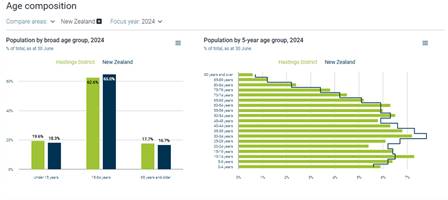
4.7 The
following data shows the 65 years and older demographic is higher in the
Hastings District than
the New Zealand
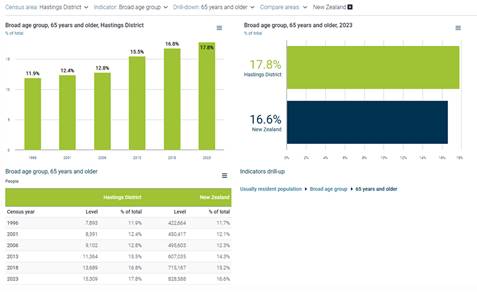
average with 15,309 as at 2023 census and is increasing.
4.8 New
Zealand Bill of Rights Act and Human Rights Act
A legal opinion was obtained from Elvidges
(lawyers) on possible implications of ageism.
Elvidges concluded ageism is discrimination of a person by virtue of their age.
Discrimination is when a person or group is
treated unfairly or unfavourably compared to others because of a protected
characteristic, for example their age.
4.9 Protection
from ageism in New Zealand is enshrined in the following statues:
· The
Human Rights Act 1993; and
· The
Bill of Rights Act 1990.
The Human
Rights Act does not explicitly prohibit differential treatment based on age in
all contexts but does prohibit age-based discrimination in some areas (i.e.
employment and housing).
The Bill of
Rights Act includes the right to be free from discrimination (section 19) which
includes the right to freedom from discrimination on the grounds of age.
4.10 Free
parking is a benefit rather than an example of unfair treatment. Failing
to provide a benefit to
a defined group of people (in this
case people over the age of 65) is not unfair discrimination and is therefore
not ageism.
4.11 Elvidges
caution that there is a floodgates argument to consider, namely, that by
providing free parking to those over 65 on the basis set out in 3.4, you would
also have to ensure that those who also face similar challenges are also
provided with the same benefit otherwise the policy could be seen as
unjustifiably discriminatory.
4.12 It
would be harder to defend free parking for those aged over 65 if the
Council did not also extend that benefit to others who face similar
challenges. Not all persons over the age of 65 have mobility or financial
pressure and, to that end, a blanket “free parking for those aged over
65” could be seen as being based purely on age rather than any specific
challenge. This in Elvidges view, may be problematic.
4.13 An
unintended consequence of granting the petition could be that there was a
shortage of parking spaces in the CBD/other in demand areas making it harder
for other challenged groups to find parking. It could act to
disproportionately disadvantage or discriminate against other vulnerable
groups.
4.14 Elvidges
do not consider that Bill of Rights or Human Rights considerations form a determining
factor in deciding whether or not to grant the petition in this case.
The petition is not inherently contrary to the Human
Rights Act 1993 or the Bill of Rights Act 1990. However, if
Council were to entertain free parking to those aged over 65 it would
have to also consider providing free parking to those who face the same or
similar challenges. If it did not extend the privilege to other
marginalised groups, it could well be argued that the policy was a form of
discriminatory treatment.
4.15 Council
would need to justify the policy as a reasonable measure to support older
people, while balancing equity for other vulnerable
groups.
4.16 Elvidges
concluded - It seems to us that any specific policy grounds underlying the
petition is best achieved in a more tailored way (for
example by reference to financial means and mobility) rather than granting it
solely on the basis of age which is, in our view, problematic.
4.17 Previous
Free Parking Trials
4.18 Council
at its May 2020 meeting considered the issue of providing free parking within
the CBD. It consulted through its Annual Plan process both on free
parking and methods of payments (annual charge vs cash in a meter). As
part of the analysis done to reach a decision of this matter, ‘Market
View’ a retail consultancy, was engaged and their conclusion was:
MARKET VIEW REPORT, RETAIL
SPEND STATISTICS
Summary
The Retail
Spend Report came to this conclusion:
“The
review of the free parking trial (time limited) points to achieving mixed
results. On the basis of data analytics there is no evidence to support
the conclusion that the trial has produced significant greater retail activity
or vibrancy in the City Centre. The positive indicators from increased
retail spend cannot be directly linked to free parking and it could be equally
argued that other macro-economic factors such as lower interest rates, high
levels of employment and Hawke’s Bay being a non-dairy region, have had a
greater influence”.
Source: Market
View report
4.19 Council
had a loss of revenue over the 19-month trial of approximately $942,000, which
is about $50,000 per month. Since 2020, Council’s fees and charges
have increased.
4.20 The
parking fees have funded the new parking meter technology and pedestrian
laneway linkages from its carparks directly to Heretaunga Street.
5.0 Options – Ngā Kōwhiringa
6.1 Option One - Status
Quo - Te Kōwhiringa Tuatahi – Te Āhuatanga o nāianei
Do not provide free parking for
resident drivers over 65 in the Hasting Central Business District.
Advantage
· Everyone
equally pays for the parking resource.
· No
loss in revenue.
· No
unbudgeted administration costs.
6.2 Option Two – Te
Kōwhiringa Tuarua – Te Kōwhiringa
Tūtohunga
Provide free parking for resident
drivers aged 65 and over in the Hasting Central Business District.
Advantages
· May
assist seniors with less stressful visits to the CBD by reducing the
frustration of having to use parking Apps, smart phones, and associated
technology.
Disadvantages
· It
will have an impact on parking revenue and expenditure. Although the
impact is unknown, the Parking budget would need to be amended to reflect the
potential loss in revenue and increase in expenditure.
· There
will be unbudgeted administration costs to register, maintain and manage the
process.
· Some
people may consider free parking for a specific age as age discrimination.
· Someone
other than the permit holder could use the nominated vehicle.
· The
permit holder may sell the vehicle and forget to notify Council, leaving it
exempt until the annual expiry.
· The
permit holder may purchase another vehicle and forget to register it for a
parking exemption.
· The
permit holder may forget to re-register annually.
6.0 Next steps – Te Anga Whakamua
6.1 If
Council adopts a parking exemption for resident drivers aged 65 and over, a
communication plan will be put in place to make people aware of the scheme.
6.2 Administration
and resourcing will need be sourced to accommodate the process.
Attachments:
There are no attachments for this report.
|
Summary of
Considerations - He Whakarāpopoto Whakaarohanga
|
|
Fit
with purpose of Local Government - E noho hāngai pū ai ki te
Rangatōpū-ā-Rohe
Council is required to give
effect to the purpose of local government as set out in section 10 of the
Local Government Act 2002. That purpose is to enable democratic local
decision-making and action by (and on behalf of) communities, and to promote
the social, economic, environmental, and cultural wellbeing of communities in
the present and for the future.
Link to the
Council’s Community Outcomes –
Ngā Hononga ki Ngā Putanga ā-Hapori
This proposal relates to the health,
safety and wellbeing of communities in the present and for the future.
|
|
Māori
Impact Statement -
Te Tauākī Kaupapa Māori
No known impacts on mana whenua / iwi /
tangata whenua above and beyond the general community population.
|
|
Sustainability
- Te
Toitūtanga
N/A
|
|
Financial
considerations -
Ngā Whakaarohanga Ahumoni
It is difficult to determine how this
would impact on meter revenue as Council has no data on parking revenue from
age groups.
|
|
Significance
and Engagement -
Te Hiranga me te Tūhonotanga
This decision/report does not trigger the threshold of
Council's Significance and Engagement Policy.
|
|
Rural
Community Board –
Te Poari Tuawhenua-ā-Hapori
N/A
|

|
Tuesday, 18 February 2025
|
Hastings
District Council: Council Meeting
Te Rārangi Take
Report to Council
|
Nā:
From:
|
Emma James, Youth Lead
|
|
Te Take:
Subject:
|
Tuia 2025
|
1.0 Purpose and summary - Te Kaupapa Me Te Whakarāpopototanga
1.1 Teina Kihirini is this
year’s ‘Tuia’. Teina Kihirini will be introducing herself to
Council.
1.2 Tuia is a national
programme that involves Mayors selecting young rangatahi (young person)
Māori from their rohe to mentor on a one-to-one basis, to encourage and
enhance leadership skills. The rangatahi is mentored monthly through informal
meetings and attends formal occasions that will assist the rangatahi’s
development as a leader.
1.3 The relationship
provides both partners with the opportunity to gain a deeper insight into
inter-generational issues, cultural values and experiences.
1.4 Rangatahi have the
opportunity to build peer networks with graduates of the programmes, obtain
support, and receive leadership training by attending leadership development
wānanga over the course of the year.
1.5 Tuia focuses on
rangatahi Māori aged 18-25 years old from Heretaunga who are actively
contributing to the wellbeing of their community and who have the potential to
be a leader in their community.
|
2.0 Recommendations -
Ngā Tūtohunga
That Council receive the report titled Tuia 2025 dated 18
February 2025.
|
Attachments:
There are no attachments for this report.

|
Tuesday, 18 February 2025
|
Hastings
District Council: Council Meeting
Te Rārangi Take
Report to Council
|
Nā:
From:
|
Emma James, Youth Lead
|
|
Te Take:
Subject:
|
2025 Youth Council
|
1.0 Purpose and summary - Te Kaupapa Me Te Whakarāpopototanga
1.1 The Youth Council is made
up of 16-19 rangatahi who live, work, and/or attend school or alternative
education in the Hastings District. Members are aged between 15 – 21
years of age.
1.2 This year 39
applications were received.
1.3 Applicants applied
online and were encouraged to send in a short two-minute video briefly
introducing themselves, why they would like to be a Youth Councillor and what
they hope to get out of this opportunity.
1.4 Those applicants on a
short list were asked to attend an interview in person. Nineteen
interviews were held over two days with twelve being appointed from the
interviews. There are 7 returning Youth Councillors. There is a
total of 19 Youth Councillors that make up the 2025 Youth Council.
1.5 List of 2025 Youth
Councillors:
|
Phaizon Parkes
(returning 2nd Year)
|
Hastings Boys High
|
|
Kingston Reid
|
Hastings Boys High
|
|
Carter Ah Kiong
|
Hastings Boys High
|
|
Hossana Peni
|
Hastings Girls High
|
|
Mennat Quazi
|
Hastings Girls High
|
|
Swarleen Kaur (returning 3rd
year)
|
Iona College
|
|
Bella Bridson (returning 2nd
Year)
|
Karamū High
|
|
Taylor Bevan (returning 2nd
Year)
|
Karamū High
|
|
Ariel Sajan (returning 2nd
year)
|
Karamū High
|
|
Zander Peterson
|
Karamū High
|
|
Maia Matchitt
|
Te Kura Kaupapa Māori
o te Wānanga Whare Tapere o Takitimu
|
|
Ihaia Wainohu
|
Te Kura Kaupapa Māori
o te Wānanga Whare Tapere o Takitimu
|
|
Kaiariki Hewett
|
Hukarere Girls College
|
|
Savannah Ogborn (returning
2nd year)
|
Havelock North High School
|
|
Emma Ellis
|
Havelock North High School
|
|
Remy te Aho Taong
|
Lindisfarne College
|
|
Astyn Nelson
|
Flaxmere College
|
|
Scarlet Flanders
|
Woodford House
|
|
Milly Petrie (returning 3rd
year)
|
Gap year
|
|
2.0 Recommendations -
Ngā Tūtohunga
That Council receive the report titled 2025 Youth Council
dated 18 February 2025.
|
Attachments:
There are no attachments for this report.
|
Tuesday, 18 February 2025
|
Hastings
District Council: Council Meeting
Te Rārangi Take
Report to Council
|
Nā:
From:
|
Lex Verhoeven, Strategy
Manager
|
|
Te Take:
Subject:
|
2025/26 Annual Plan
|
1.0 Purpose and summary - Te Kaupapa Me Te Whakarāpopototanga
1.1 The purpose of this
report is to ratify the Council’s approach to the 2025/26 Annual Plan,
given the Financial Strategy put in place because of Cyclone
Gabrielle. The report also outlines a bespoke matter in
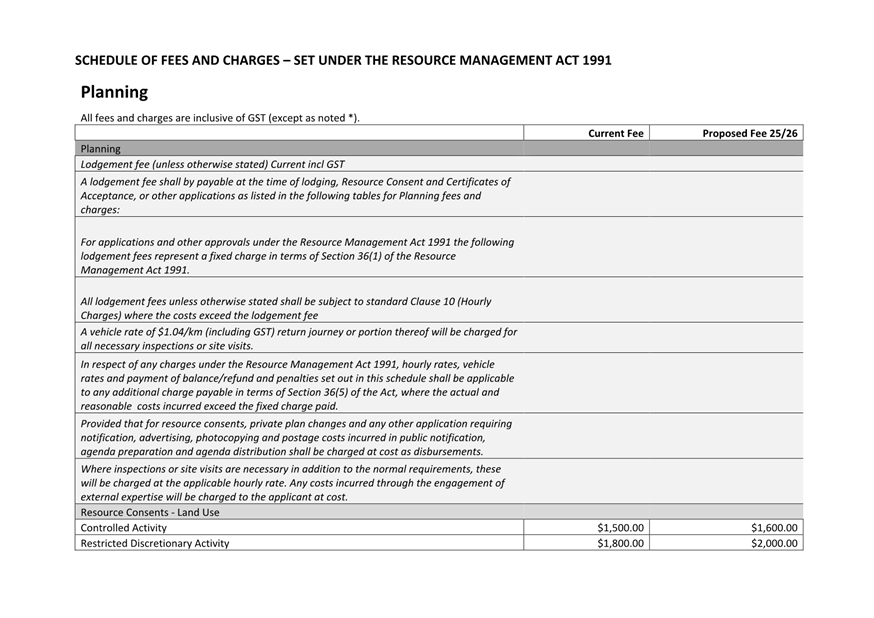
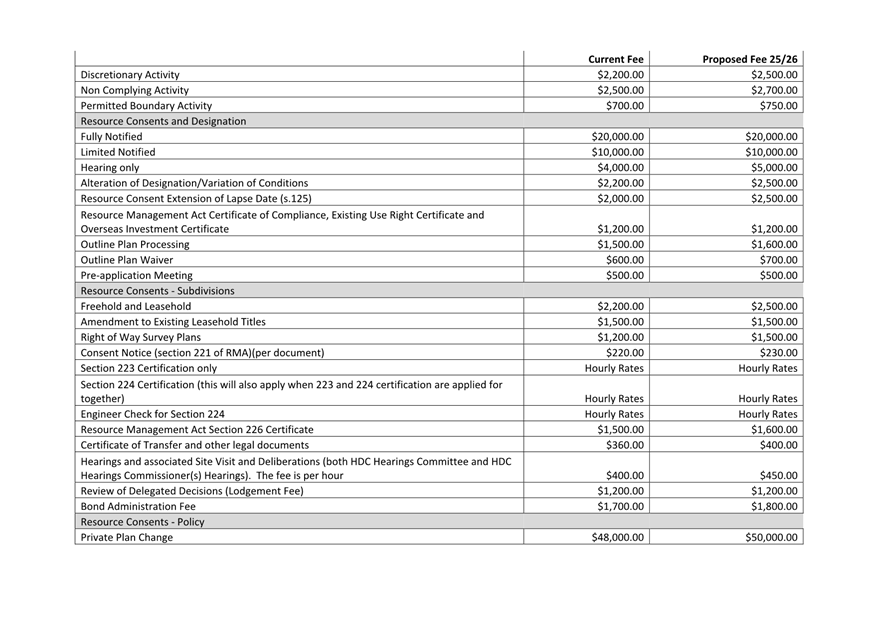
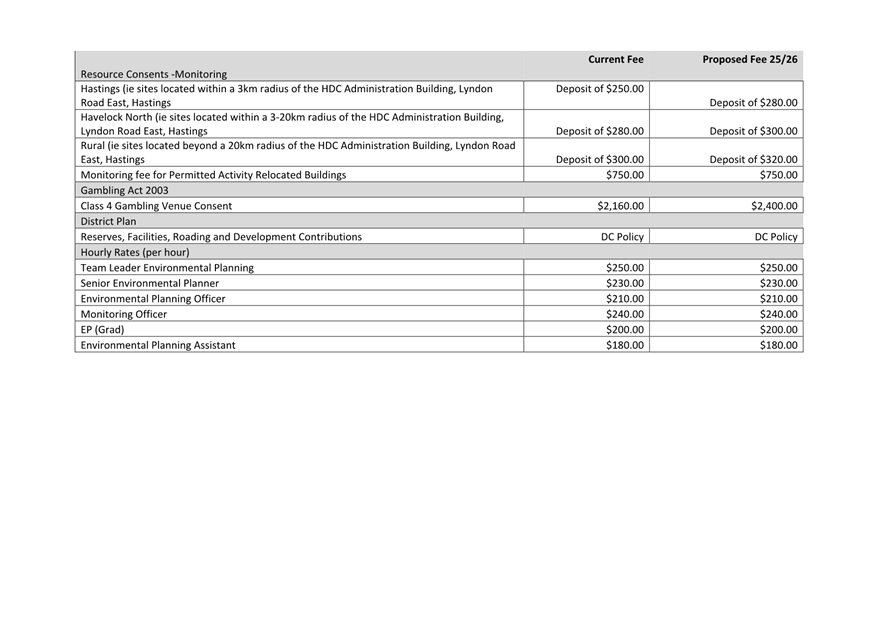
respect of the adoption of Resource Management Act charges for the 2025/26
year.
1.2 The recommendations in
this report give effect to prior Council consideration of:
§ The content of the 2025/26 Annual
Plan and that no significant or material differences exist from the content set
out in the 2024/34 Long Term Plan.
§ Technical compliance with the
setting of charges under the Resource Management Act 1991.
Approach to 2025/26 Annual Plan
1.3 The impacts of Cyclone
Gabrielle have had a profound impact on Council finances, and the 2024 Long
Term Plan put in place an expenditure approach and Financial Strategy to get
the community through this challenge over a 4-year period. That plan was
the subject of extensive public consultation and refinement in response to that
consultation process.
1.4 The mantra of the
2025/26 Annual Plan is to stick to the plan. Therefore, no material or
significant changes are proposed to that set out in Year Two of the Long-Term
Plan. Some new expenditure challenges in the form of an upgrade of
Council’s main IT system and enhanced focused on growth planning have
been managed to be offset with savings (particularly in insurance, training and
staff management). Year Two provides for the second and last step
in the introduction of a specific targeted rate to fund Cyclone related
costs. The total Council share (after Central Government assistance) is
$230m.
1.5 The total increase in
rating revenue is forecast to be 15% across the district – made-up by 6%
for cyclone recovery costs and 9% to meet the rising cost of delivering core
services, particularly in the Transport and Three Waters areas. This is
in line with the Council’s adopted 2024 Long-Term Plan.
1.6 The Council is
signalling its continued focus on the delivery of work programmes within the
2024 Long-Term Plan, and its intention to utilise the Local Government Act 2002
provisions which provide for an Annual Plan to be adopted without consultation.
This is a provision that many Councils across New Zealand use in the
appropriate circumstances.
1.7 The reasons for taking
this approach are:
§ The budget is in line with the
Long-Term Plan budget for the 2025/26 year;
§ No new matters of significance have
arisen that trigger legislative consultation requirements;
§ The Council has limited means to
approve new initiatives or expenditure via a consultation process;
§ The importance of keeping to the
Council’s Financial Strategy within the LTP and to protect Council’s
credit rating so the cost of borrowing does not go up.
1.8 Officers are working
on an information newsletter for distribution to the community. This will
come back to Council for approval prior to being produced and
distributed. It will focus on the key drivers within the plan, the fiscal
context and importantly the substantial work programme to be delivered, focused
primarily on cyclone recovery and maintaining and developing the
communities’ key infrastructural assets. It is intended to
distribute the newsletter during April 2025.
Fees and Charges
1.9 Ordinarily fees and
charges set under the Resource Management Act 1991 would be included in a draft
Annual Plan. For the coming year, to meet technical compliance these
would be made available on the Council website and be signalled in the Annual Plan
update newsletter referred to previously in this report. The updated schedule
reflects allowances for the standard BERL (Business and Economic Research LTD)
inflation adjustments as provided for within the Council’s 2024 Long-Term
Plan and other necessary adjustments to some particular fees.
|
2.0 Recommendations -
Ngā Tūtohunga
A) That Council
receive the report titled 2025/26 Annual Plan dated 18 February 2025.
B) That Council
utilise the provisions of section 95 (2A) of the Local Government Act 2002
(which remove the requirement to consult in accordance with the requirements
of section (82) before adopting an Annual Plan), and formally resolve not to
consult on the 2025/26 Annual Plan.
C) That Council
adopt the attached updated fees and charges schedule for the 2025/26
financial year in accordance with the requirements of the Resource Management
Act 1991.
D) Council
notes that an information newsletter on the 2025/26 year ahead is being
developed for community distribution and will be brought back to Council for
approval.
|
Attachments:
|
1⇩
|
RMA Charges 2025/26
|
cp-01-01-25-76
|
|
|
Item 9 2025/26
Annual Plan
|
|
RMA
Charges 2025/26
|
Attachment 1
|

|
Tuesday, 18 February 2025
|
Te
Hui o Te Kaunihera ā-Rohe o Heretaunga
Hastings
District Council: Council Meeting
Te
Rārangi Take
Report to Council
|
Nā:
From:
|
Rebekah Dinwoodie, Group
Manager: Community Wellbeing & Services
Rudi Britz, Management Accountant
|
|
Te Take:
Subject:
|
Splash Planet - Close of
2024/25 Season
|
1.0 Executive Summary – Te Kaupapa Me Te
Whakarāpopototanga
1.1 This
report updates Councillors on the current operational position of Splash Planet
for the 2024/25 season.
1.2 Inclement
summer weather conditions have impacted visitation numbers (over 15,000 less
than the 2023/24 season) and resultant revenues ($558,000 less than budget) as
at the end of January 2025.
1.3 Responsive
and effective operations management of Splash Planet have reduced costs by
$232,000 and constrained the operational financial deficit to $326,000.
1.4 The
Chief Executive recommends Splash Planet closes earlier than planned for the
2024/25 season with Sunday 22 February 2025 being the last day of public
operation.
1.5 The
advertised closing date of Splash Planet is Sunday 30 March 2025.
1.6 Management
of Splash Planet operations for this closure date will mitigate business
operational financial loss.
|
2.0 Recommendations - Ngā Tūtohunga
A) That
Council receive the report titled Splash Planet - Close of 2024/25 Season
dated 18 February 2025.
B) That
the Council approve closure of Splash Planet Park with Sunday 22 February
2025 being the last day of public operation.
C) Council
notes the Chief Executive will manage the closure process to optimise
outcomes for Council:
· Business
operational financial loss.
· Provision
of a quality visitor experience for the remaining opening days.
· Council
being a responsible employer.
· Responsive
risk management in accord with Council’s adopted and applicable Risk
Policies.
|
3.0 Background – Te Horopaki
3.1 Poor
weather has impacted expected visitor levels at Splash Planet and all aquatic
facilities this season.
3.2 To
date during the 2024/25 season visitor numbers of over 1500 occurred on only 10
days. During the 2023/25 season visitor numbers of over 1500 were reached
on 31 days.
3.3 In
2023/24 from 15 Dec there were no weeks when the temperature dropped below
24°C for more than 2 days a week.
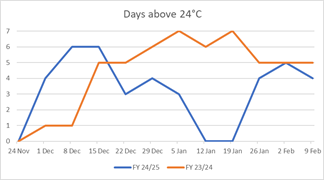
3.4 In
2024/25 from 15 Dec there was only one week where the temperature was above
24°C for 2 days, and in contrast there were two weeks with zero days above
24°C.
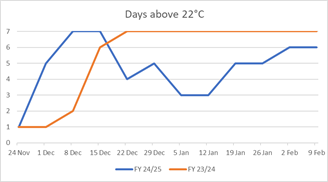
3.5 As
well as poor weather many in the community are being impacted by increasing
costs of living and this too could be affecting visitor numbers to Splash
Planet.
3.6 The
Marketview Overview Report for Hastings October – December 2024 showed a
negative ‘spend growth’ for Hastings, Napier and Central Hawkes
Bay. Hastings District a negative -2.8% spend growth in cafes,
restaurants, bars and takeaways and a negative -3.7% spend growth in
accommodation District. This could indicate a reduction in the number of
visitors to the district and a smaller discretionary spend.
Current
Position: As at the end of January 2025
3.7 There
was over 15,000 visitors fewer than the prior year.
3.8 Revenue
is $558,000 unfavourable to budget.
3.9 Costs
are being managed and operational expenditure has an overall saving of
$232,000.
3.10 This
leaves the overall position of Splash Planet at approximately $326,000
unfavourable to budget.
3.11 The
budgeted rating requirement for Splash Planet for the 2024/25 season is $1.42
million.
Revenue
3.12 The
budgeted 2024/25 full year revenue for Splash Planet is $3.37m with the
budgeted end of Jan position being $2.76m.
3.13 The
actual end of January revenue position is $2.2m, leaving over $1.1m of revenue
to make up by the end of the season.
3.14 With
14 operational days of the season left (7 weekends) that equates to $78,500 per
day of revenue required to meet budget.
3.15 That
is over 2450 people per day (based on the average person bringing in $32 of
revenue).
3.16 There
have only been 3 days with over 2200 people in Splash Planet this summer season
and therefore the likelihood of meeting revenue targets now is extremely low.
3.17 Revenue
targets not being met results in the ratepayer contribution increasing over and
above the $1.42m budgeted. As at end of January the ratepayer
contribution required is approximately $1.7m.
Meeting budgeted revenue for the
remainder of season
3.18 To
prevent the financial position deteriorating further the ongoing entry and
revenue targets need to be met.

3.19 With
14 days of operations remaining, budgeted entries of 12353 equates to 882
visitors per day. There have been 50 days (60%) with less than 882 people
in the park.
3.20 The
likelihood of meeting revenue targets for the weekend only period is low given
visitor number trends and long-range weather forecasts.
4.0 Discussion – Te Matapakitanga
Remainder of the 2024/25 season
4.1 Splash
Planet could be closed early to limit the amount of additional ratepayer
funding required for its continued operation. Revenue would be lost and
expenses (cost of business) would be saved.
4.2 The
closure could occur immediately or anytime before 30 March 2025. There
are 7 operational weekends remaining this season.
4.3 The
financial end position will be dependent on the number of visitors to Splash
Planet which are negatively affected by inclement weather.
4.4 In
2023/24 the average daily visitor numbers for the last 7 weekends of the season
was 990, however, the average temperature was 25.5⁰C with 3 days at 30⁰C
and 3 days at 27⁰C.
4.5 If
Splash Planet was closed to the public after close of business Sunday 22
February the additional cost that will be incurred could be offset by an
increase in revenue. If there were 450 visitors per day the end position
will be approximately $49,000 more positive than the end of January position
(3.17).
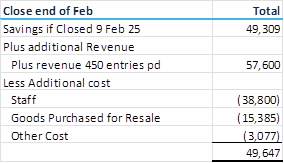
* All savings are based on reduced
budgeted revenue and costs.
This would result
in a required ratepayer contribution of approximately $1.65m.
4.6 Based
on the same numbers, of 450 visitors per day, if Splash Planet remains open for
the remaining 7 weekends of the season the end position will be an additional
loss of approximately $38,000 over the end of January position (3.17).
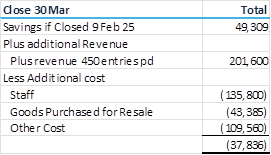
The final ratepayer
contribution required would be approximately $1.74m.
4.7 The
difference between the 2 options (4.5 and 4.6) is approximately $88,000.
4.8 This
position could be considerably worse if numbers do not average 450 per
day. It could also be better if visitor numbers are higher.
4.9 In
the shoulder season post summer holidays in 2023/24, when the temperatures were
22-23⁰C, visitor numbers were 978 for the weekend. Therefore 450
per day seems a reasonable assumption for daily visitor numbers for the rest of
the season, although economic conditions have shifted from last year.
5.0 Options – Ngā Kōwhiringa
Option One -
Recommended Option - Te Kōwhiringa Tuatahi – Te Kōwhiringa
Tūtohunga
5.1 That
Splash Planet closes to the public after close of business Sunday 22 February.
Advantages
· Mitigates
the financial risk of continuing operations.
Disadvantages
· Possible
adverse publicity and the associated reputational risk. Inconsistent
opening dates may result in less engagement/bookings in future years.
· Some
sunk costs with the Splash Planet marketing campaign already in the public
domain and paid for. This includes discount codes/offers that will no
longer be valid (e.g. discounts offered to Horse of the Year competitors).
· No
work for weekend casual staff and fixed-term staff relocation/redundancy.
· Tickets
pre-purchased for the 5 weekends in March will need to be reallocated to an
earlier weekend or refunded (84 tickets with a value of $3160). This
value is not currently accounted for in the revenue as they have not yet been
redeemed. There are no group bookings in March.
· Refund
of memberships bought within the last 4 weeks that have not been yet used
– 286 with a value of $7,461 ($8,580 incl. GST).
Option Two – Status Quo - Te Kōwhiringa Tuarua – Te
Āhuatanga o nāianei
5.2 Continue
to operate Splash Planet until the end of the season with the last date of
operation being 30 March 2025.
Advantages
· Continue
to operate as advertised.
· Staff
kept employed until the end of the season.
Disadvantages
· The
financial position is likely to get worse given weather and visitor trends.
· Possible
adverse publicity and the associated reputational risk due to the highly likely
increased ratepayer contribution required to operate until the end of the
season.
6.0 Next steps – Te Anga Whakamua
6.1 If
Council resolves the recommendations:
· Delivery
of a comprehensive communications plan to advise the public of the change in
final operational weekend.
· Contact
will be made with all ticket holders to rearrange their visit day or refund
ticket.
· Consideration
of the final weekend being a ‘community weekend’ with discounted
prices to be determined. The number of entries to be determined by
available staffing.
Attachments:
There are no attachments for this report.
|
Summary of
Considerations - He Whakarāpopoto Whakaarohanga
|
|
Fit
with purpose of Local Government - E noho hāngai pū ai ki te
Rangatōpū-ā-Rohe
The Council is required to give effect to the purpose of
local government as set out in section 10 of the Local Government Act 2002.
That purpose is to enable democratic local decision-making and action by (and
on behalf of) communities, and to promote the social, economic,
environmental, and cultural wellbeing of communities in the present and for
the future.
Link to the
Council’s Community Outcomes –
Ngā Hononga ki Ngā Putanga ā-Hapori
This proposal promotes the social and
economic wellbeing of communities in the present and for the future.
|
|
Māori
Impact Statement -
Te Tauākī Kaupapa Māori
Splash Planet and Windsor Park are of
significance to mana whenua being the true course of the former
Mākirikiri River before it entered the Awahou wetland. Although there
are no current relationship agreements with mana whenua re Splash Planet and
its presence in the cultural landscape of the Mākirikiri River, this is
an area to strengthen for the facility moving forward.
|
|
Sustainability
- Te
Toitūtanga
Recent renewals and replacements of
key assets at Splash Planet are applying a more environmentally sustainable
approach to the operation.
|
|
Financial
considerations -
Ngā Whakaarohanga Ahumoni
Financial considerations are
discussed in the body of the Council paper.
|
|
Significance
and Engagement -
Te Hiranga me te Tūhonotanga
|
|
Consultation
– internal and/or external - Whakawhiti Whakaaro-ā-roto / ā-waho
Internal consultation has occurred with
Splash Planet staff, finance and marketing and communications teams.
|
|
Risks
Opportunity: To mitigate the financial risk of continuing
operations.
|
REWARD – Te Utu
|
RISK – Te Tūraru
|
|
To limit the amount of additional (over budget)
ratepayer funding required to operate Splash Planet for the remainder of
the 2024/25 season.
|
Potential adverse publicity and reputation affect. The
communications plan will focus on positively communicating the need for the
Council decision.
|
|
|
Rural
Community Board –
Te Poari Tuawhenua-ā-Hapori
The Rural Community Board have not been
consulted with on this matter.
|

|
Tuesday, 18 February 2025
|
Te
Hui o Te Kaunihera ā-Rohe o Heretaunga
Hastings
District Council: Council Meeting
Te
Rārangi Take
Report to Council
|
Nā:
From:
|
Angela Atkins, Waste
Planning Manager
|
|
Te Take:
Subject:
|
Draft Joint Waste
Management and Minimisation Plan and Statement of Proposal
|
1.0 Executive Summary – Te Kaupapa Me Te
Whakarāpopototanga
1.1 In
November 2024, the Hastings District Council and Napier City Council resolved
to develop a replacement Waste Management and Minimisation Plan (WMMP). This
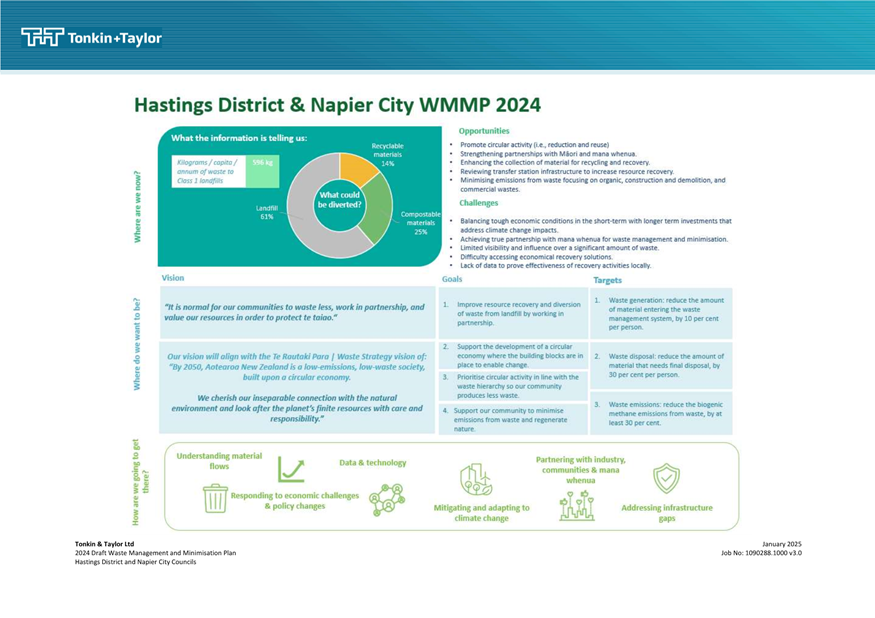
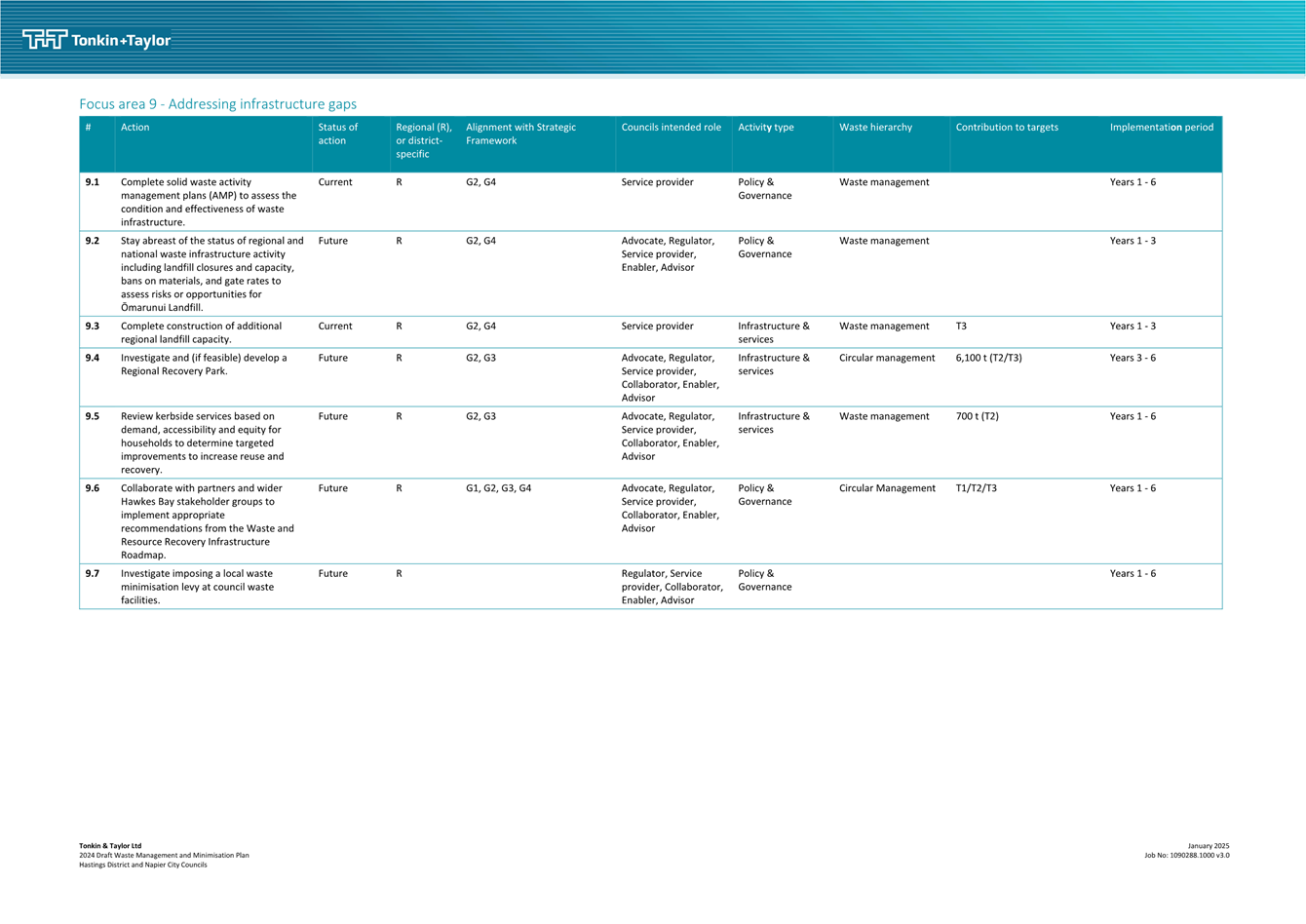
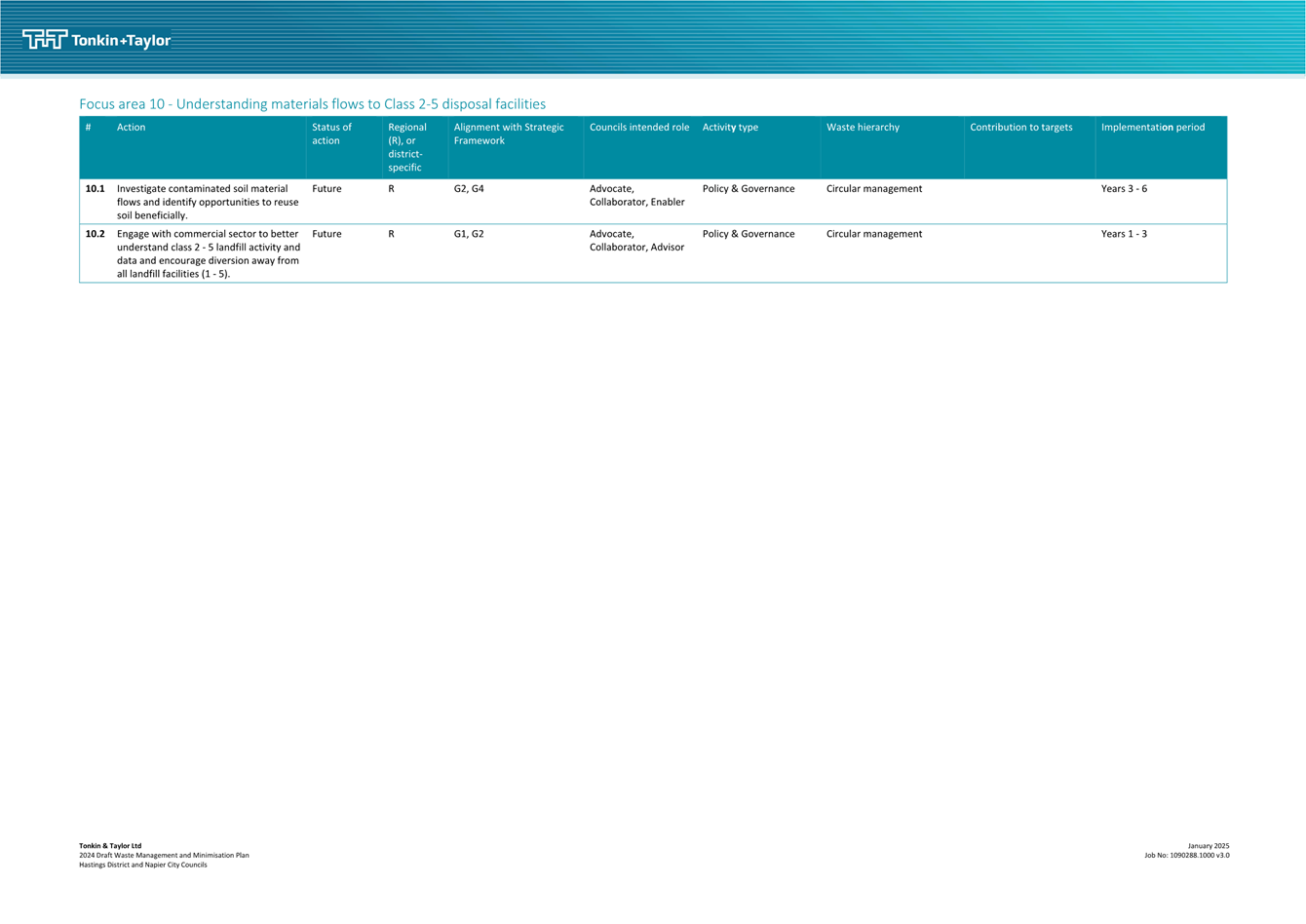
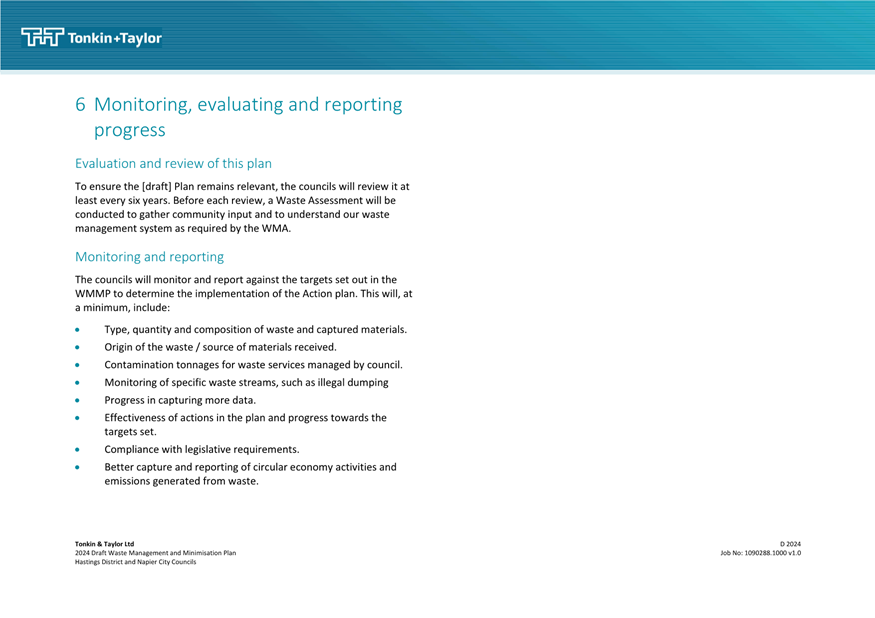
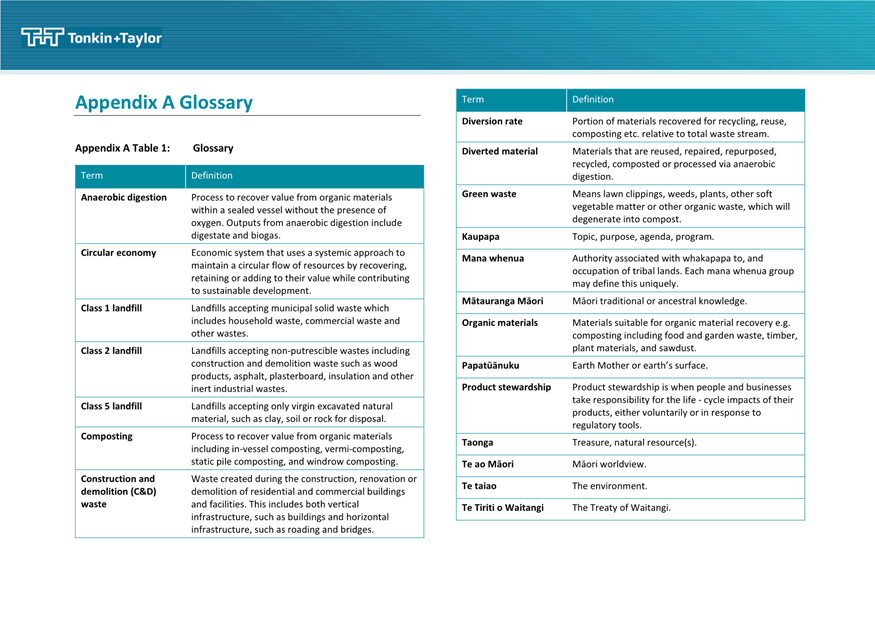
report presents the draft WMMP (Attachment 1) and accompanying Statement
of Proposal for approval (Attachment 2) for public consultation.
1.2 The
Councils are required to review their Waste Management and Minimisation Plan
every six years giving regard to Te Rautaki Para | Waste Strategy and the
council’s most recent waste assessment. This process must be completed by
15 September 2025.
1.3 Hastings
District Council and Napier City Council develop a WMMP together because of our
close proximity and similarity in services. Both Councils also jointly
own Ōmarunui Landfill.
1.4 This
draft WMMP has been written based on the technical findings of the Waste
Assessment (received by Council on 7 November 2024) and the input provided by
the early engagement sessions undertaken in 2024. The vision, goals and
objectives were developed through workshops with the Joint Waste Futures
Project Steering Committee in July and August 2024.
1.5 The
Joint Waste Futures Project Steering Committee met on Friday 31 January 2025
and endorsed the draft documents for adoption. Reports are now being presented
to Hastings District Council and Napier City Council recommending that the
draft Joint Waste Management and Minimisation Plan 2025 – 2031 and State
of Proposal documents are adopted for consultation.
1.6 The
Hastings District Council and Napier City Council have delegated authority to
the Joint Waste Futures Project Steering Committee to hear submissions arising
from the consultation, make changes (as required) and adopt the final Joint
WMMP on behalf of both Councils.
1.7 The
recommendation of this report, is for Council to receive and adopt the draft
WMMP and statement of proposal (based on the work undertaken, detailed in the
report) to enable the project to progress to the consultation stage.
Progressing to the consultation will keep the project on track to meet the
deadline of 15 September 2025.
1.8 A
similar Report and Recommendations is being presented to Napier City Council at
their Council meeting scheduled for 20 February 2025.
1.9 This
report concludes by recommending Hastings District Council adopt the draft
Joint Waste Management and Minimisation Plan and accompanying Statement of
Proposal for consultation in accordance with the relevant provisions of the
Waste Minimisation Act (WMA) 2008 and the Local Government Act 2002.
|
2.0 Recommendations - Ngā Tūtohunga
A) That
Council receive the report titled Draft Joint Waste Management and
Minimisation Plan and Statement of Proposal dated 18 February 2025.
B) That
Council adopt the draft Joint Waste Management and Minimisation Plan 2025
-2031 (Attachment 1) and Statement of Proposal (Attachment 2) documents, for
consultation in accordance with Section 83 of the Local Government Act 2002.
|
3.0 Background – Te Horopaki
3.1 This
process arises from The Waste Minimisation Act 2008 (WMA) giving councils the
responsibility to promote effective and efficient waste management and
minimisation within their territory. The WMA requires councils to complete a
Waste Assessment and review their Waste Management & Minimisation Plan
(WMMP) every six years and decide whether it should be amended or revoked, and
a new plan substituted. Both Hastings District Council (HDC) and Napier
City Council (NCC), based on the recommendation of the Joint Waste Futures Project
Steering Committee, passed resolutions to revoke the current WMMP and create a
new plan. These meetings were held on 31 October 2024 (NCC) and 7 November 2024
(HDC).
3.2 The
original review deadline was 30 August 2024. The Ministry for the Environment
accepted the joint application for a review extension under section 33A of the
Waste Minimisation Act 2008 (as amended by clause 12 of the Severe Weather
Emergency Recovery (Waste Minimisation) Order 2023). This means that the new
WMMP would need to be adopted by 15 September 2025 by both Hastings District
and Napier City Councils.
3.3 The
Waste Assessment phase has been completed and was adopted by the Joint Waste
Futures Project Steering Committee, Hastings District Council and Napier City
Council in October and November 2024.
3.4 This
draft joint WMMP has been written incorporating the findings of the waste
assessment, the Medical Officer of Health’s feedback and ideas received
from the sector engagement sessions held over the past year.
3.5 The
Joint Waste Futures Project Steering Committee meet on Friday 31 January and
endorsed the draft documents for adoption. Reports are now being presented to
Hastings District Council and Napier City Council recommending that the draft
Joint Waste Management and Minimisation Plan 2025 -2031 and Statement of
Proposal documents are adopted for consultation.
3.6 Both
Hastings District Council and Napier City Council have delegated authority to
the Joint Waste Futures Project Steering Committee to hear submissions arising
from the consultation, make changes (as required) and adopt the final Joint
WMMP on behalf of both Councils.
4.0 Discussion – Te Matapakitanga
4.1 The
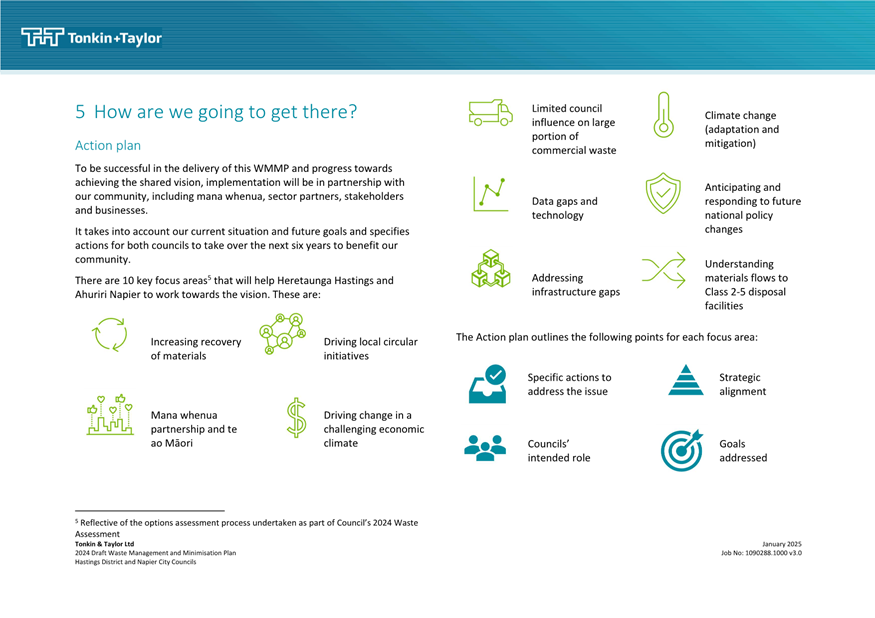
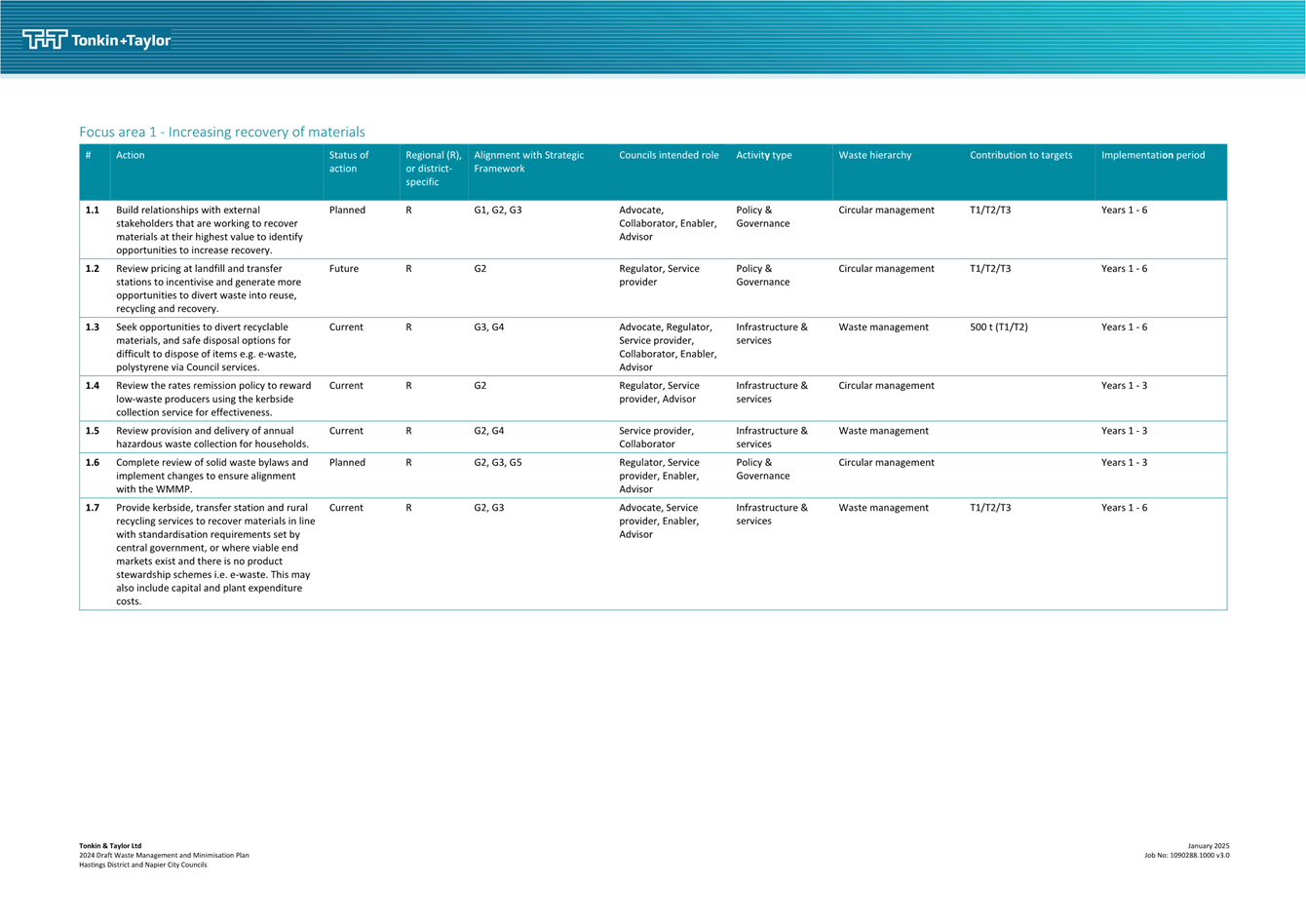
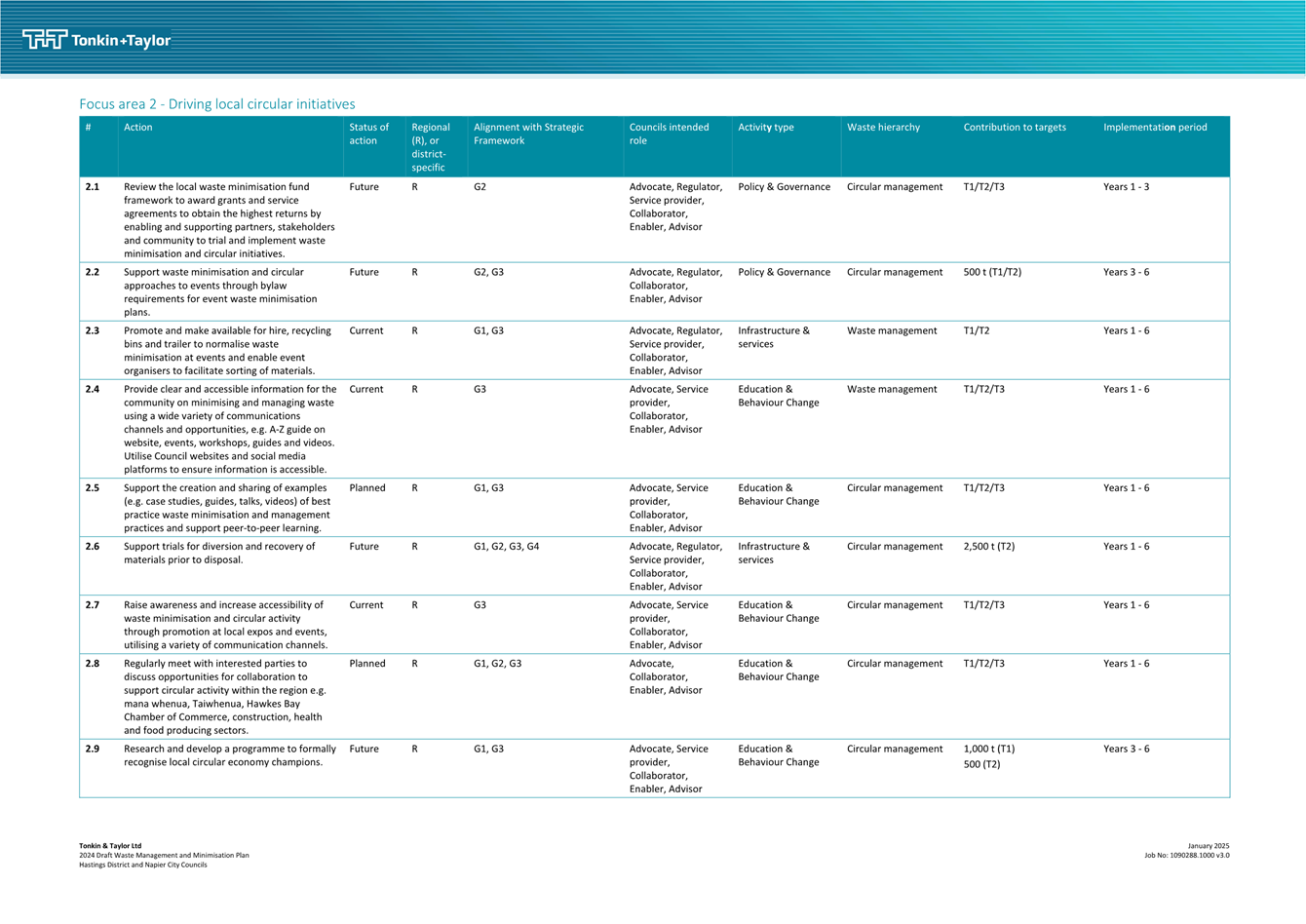
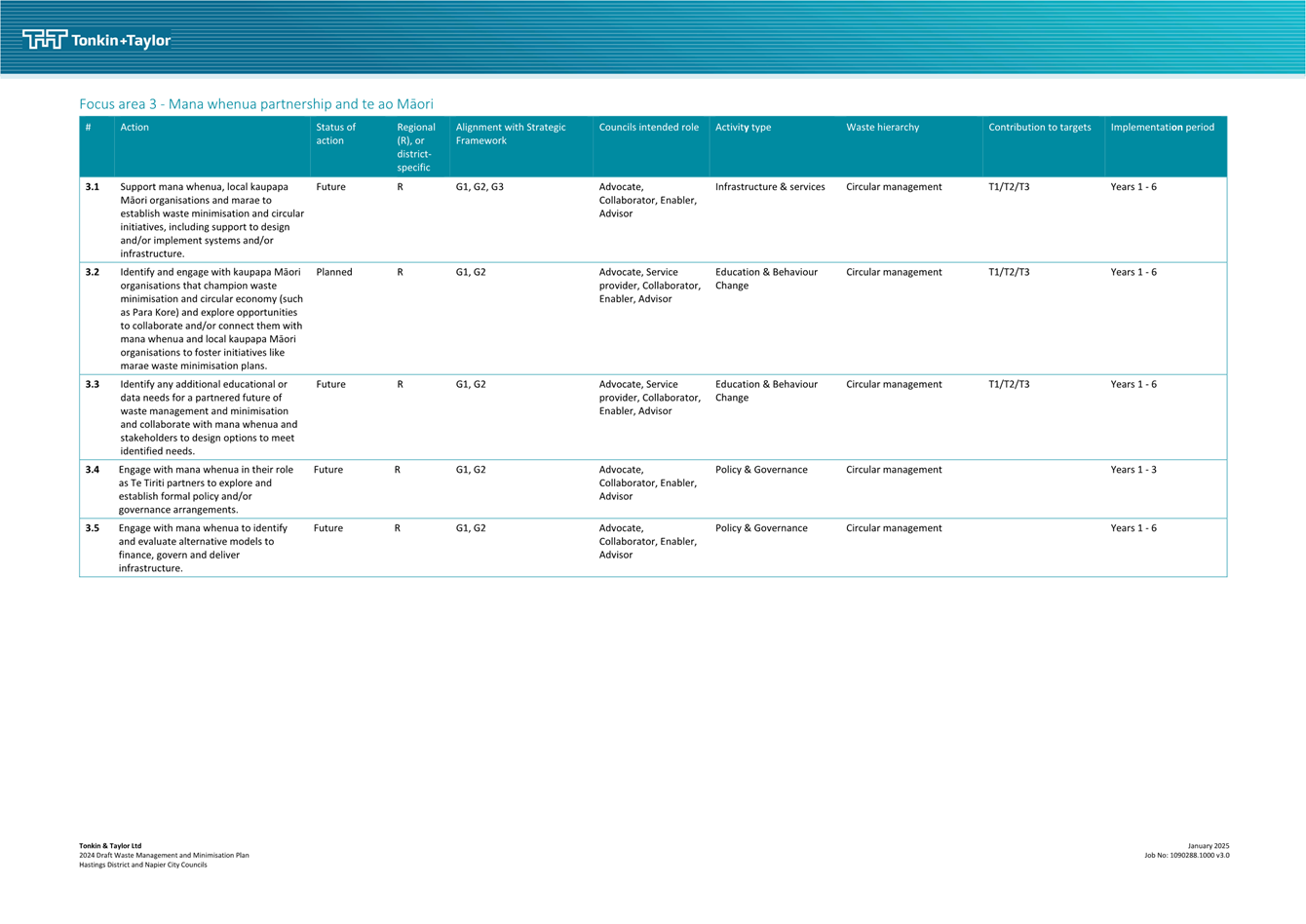
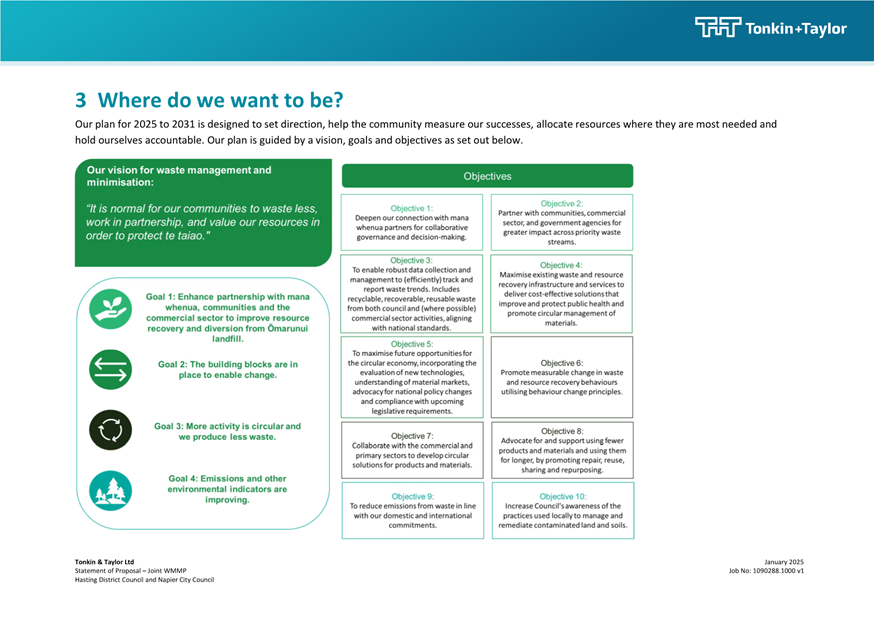
draft joint WMMP contains the vision, objectives, targets, policies and actions
that have been derived from the Waste Assessment during the Joint Council Waste
Futures Project Steering Committee workshops and meetings held on 23 July, 19
August, 6 December 2024.
4.2 Officers
are continuing with the approach to partnering with mana whenua to achieve the
committee’s aspiration of enhancing partnerships with Māori and mana
whenua for a partnered future in waste minimisation. This process has been
guided by the Māori Partnerships teams of both councils. It cannot
yet be stated what the aspirations or expectations of mana whenua are for this
WMMP or longer-term waste management and minimisation journey. The hope is that
through partnership, the councils’ ability not only to comply with their
governing legislation and regulation, but deliver strong waste minimisation
practices, is enhanced by genuinely and seamlessly incorporating the knowledge
and guidance that mana whenua deem appropriate.
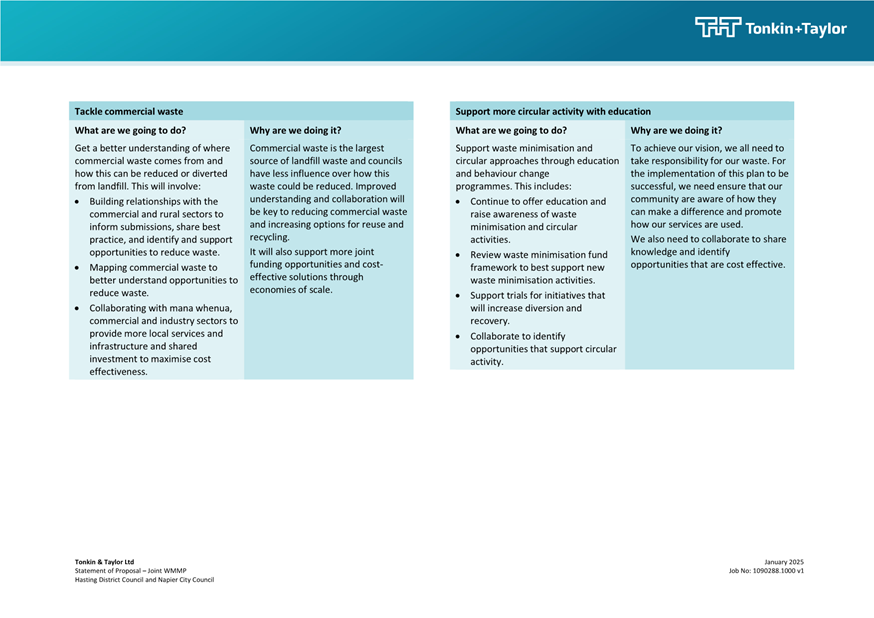
4.3 A
series of seven workshops on the Joint Waste Management and Minimisation Plan
(WMMP) review were organised for the commercial and rural sector during
November and December 2024. This provided the opportunity for these
sectors to understand the current situation with waste in Heretaunga Hastings
and Ahuriri Napier and contribute their thoughts and ideas as the WMMP actions
were drafted. The workshops also provided a chance to explore challenges
and opportunities and build relationships for potential collaboration.
4.4 The
WMMP (along with the supplementary Waste Assessment documents attached (Attachments
3, 4 and 5)) will be released for public consultation in April 2025 (exact
dates still to be confirmed).
4.5 The
draft Joint Waste Management and Minimisation Plan has met all legislative
criteria and is ready for community consultation. A Statement of Proposal
(summary document) (Attachment 2) has been prepared for adoption as per
section 83 of the Local Government Act (LGA) 2002.
4.6 The
consultation approach is being finalised with the communications and marketing
teams from both Councils.
4.7 Submissions
on the draft joint Waste Management and Minimisation Plan will be heard and
considered by the Joint Council Waste Futures Project Steering Committee in
late May 2025.
5.0 Options – Ngā Kōwhiringa
Option One - Recommended Option -
Te Kōwhiringa Tuatahi – Te Kōwhiringa Tūtohunga
5.1 Receive
and adopt the draft WMMP and accompanying Statement of Proposal is adopted for
consultation using the Special Consultative Procedure of LGA 2002, with any
editing updates to be approved by the Chief Executive.
5.2 A
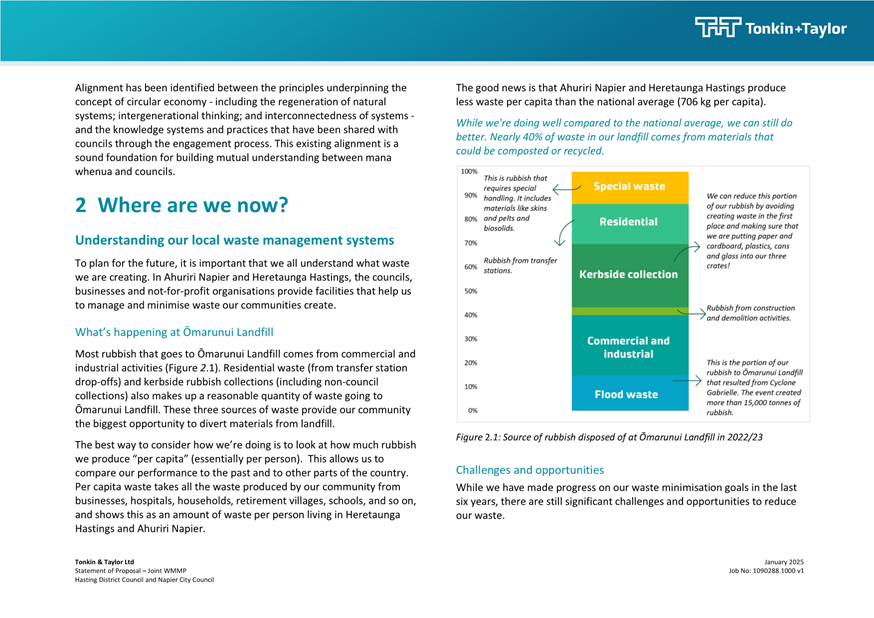
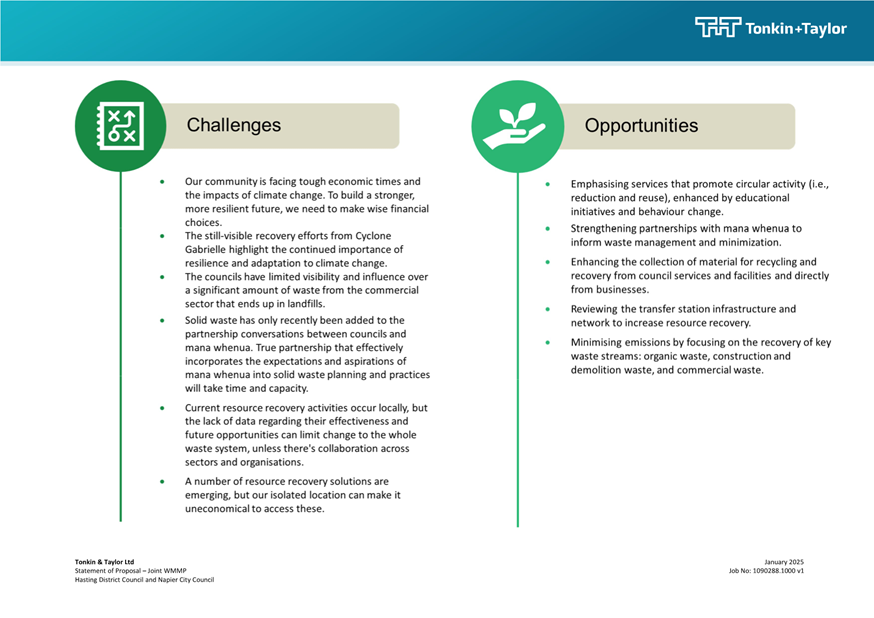
replacement WMMP is the appropriate response to the findings of the 2024 Waste
Assessment. It provides the Councils with the opportunity to revise and improve
the actions in the current WMMP and sets out a course of action for the next
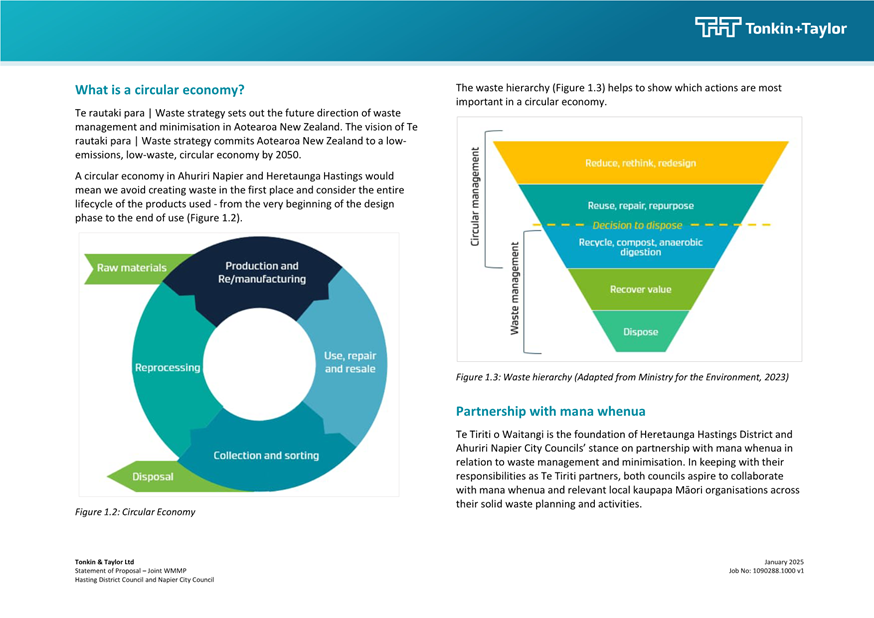
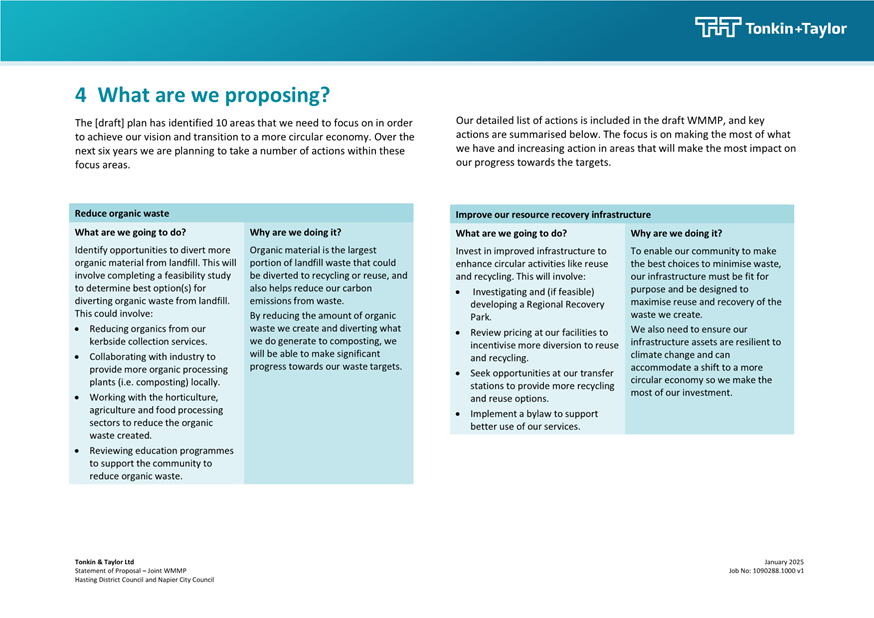
six years to improve waste minimisation outcomes and move to a circular economy
for our region and cities.
5.3 The
actions of the draft WMMP can be funded by Council’s existing and planned
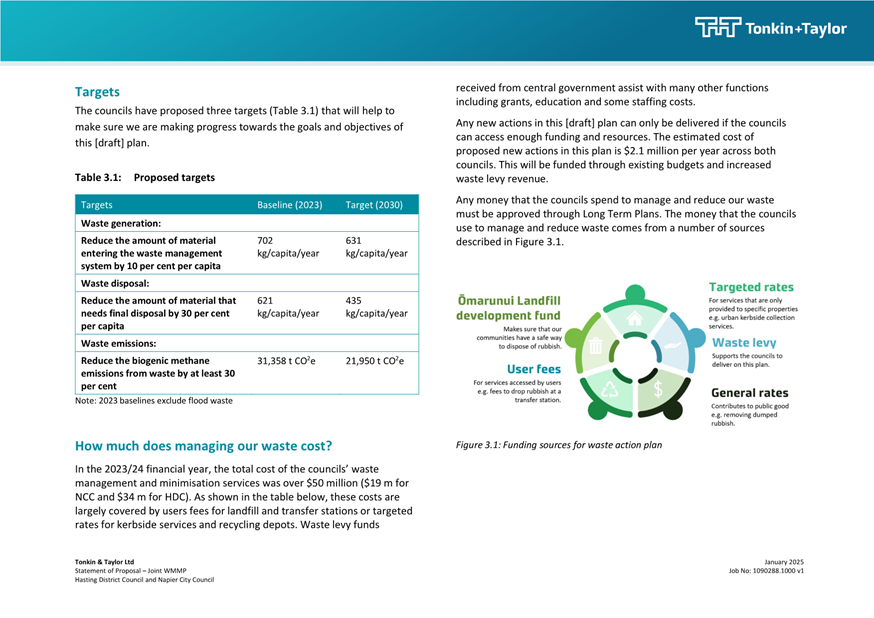
waste management budgets which are funded by the waste levy funds, targeted
rates, general rates and user pays fees.
Advantages
· Supports
planning for the Te Rautaki Para | Waste Strategy targets in relation to waste
and emissions reduction that need to be met by the councils over the next six
years.
· Meet
the councils’ responsibilities under the Waste Minimisation Act 2008 to
minimise waste in the region and ensure each council can still receive their
allocated waste disposal levy funds to carry out projects, initiatives and
actions documented in the WMMP. Combined the waste disposal levy payments are
estimated to be approximately $2.4 million for this financial year and this is
still increasing.
· Will
enable the Councils to meet drivers of increasing emphasis on diversion of
waste from landfill and recovery of material value.
· Gives
the community and key stakeholders an opportunity to provide feedback to the
Council and have input into the proposals.
· It
also focuses further on waste-related climate emissions, as also required by
the National Emissions Reduction Plan.
Disadvantages
· There
are no known disadvantages to this option.
Option Two – Status Quo - Te Kōwhiringa Tuarua – Te
Āhuatanga o nāianei
5.4 Not
reject the draft WMMP and accompanying Statement of Proposal and refer the
draft Joint WMMP back to Council officers for further drafting.
5.5 Council
officers have not considered the option of not approving a draft joint WMMP for
consultation as this would contravene Council’s statutory obligation to
review the current joint WMMP and adopt a new Plan. Failure to adopt a WMMP
could also result in central government retaining the waste levy revenue
payable to a territorial authority in accordance with section 33 of the WMA.
· Does
not align to the priorities and targets set by Te Rautaki Para | Waste Strategy
· Does
not fully meet the Councils responsibilities under the Waste Minimisation Act
2008 to minimise waste in the region
· Could
jeopardise the Councils receipt of their proportion of the waste disposal levy
to fund activities and initiatives in the plan. It is estimated that HDC
will received $1.6 million this financial year of waste disposal levy funds.
6.0 Next steps – Te Anga Whakamua
6.1 Subject
to adoption of the draft WMMP by both Hastings District and Napier City
Council, next steps (including indicative timeframes) will be:
· Draft
WMMP 2025 made publicly available for consultation, likely to occur April 2025.
Public able to provide feedback (and request to be heard by the committee).
· Collation
and analysis of submissions in May 2025
· Hearings
and deliberations from late May 2025
· Final
draft waste plan 2025 presented to Joint Waste Futures Project Steering
Committee for formal adoption in July/August 2025.
6.2 Once
approved, the Waste Management and Minimisation Plan 2025-2031 will form the
basis of Hastings District Council and Napier City Council’s work on
waste for the next six years. Monitoring and reporting frameworks will be
developed to ensure transparency.
Attachments:
|
1⇩
|
Draft Waste Management and Minimisation Plan (WMMP) 2025 -
2031
|
SW-29-2-25-141
|
|
|
2⇩
|
Draft Statement of Proposal Joint WMMP 2025 - 2031
|
SW-29-2-25-142
|
|
|
3⇨
|
2024 Waste Assessment Report
|
SW-29-2-24-133
|
Vol 1
|
|
4⇨
|
2024 Waste Assessment WMMP Medical Officer of Health
Letter of Support - September 2024
|
SW-29-2-24-132
|
Vol 1
|
|
5⇨
|
2024 Hawke’s Bay Solid Waste Analysis Protocol
(SWAP) Survey Report
|
SW-29-2-24-125
|
Vol 1
|
|
Summary of
Considerations - He Whakarāpopoto Whakaarohanga
|
|
Fit
with purpose of Local Government - E noho hāngai pū ai ki te Rangatōpū-ā-Rohe
The Council is required to give effect to the purpose of
local government as set out in section 10 of the Local Government Act 2002.
That purpose is to enable democratic local decision-making and action by (and
on behalf of) communities, and to promote the social, economic,
environmental, and cultural wellbeing of communities in the present and for
the future.
Link to the
Council’s Community Outcomes –
Ngā Hononga ki Ngā Putanga ā-Hapori
This proposal promotes all the wellbeings
of communities in the present and for the future.
|
|
Māori
Impact Statement -
Te Tauākī Kaupapa Māori
The vision captures the aspiration of the
committee for a partnered future and further alignment with the broader and
more holistic values of te ao Māori. Working with mana whenua to embed
te ao Māori into our way of working, to operationalise waste management
and minimisation, not only responds to council’s legislative
requirements including recognition of te Tiriti o Waitangi, but it also
strengthens environmental, social and cultural outcomes that benefit the
whole community.
|
|
Sustainability
- Te
Toitūtanga
The Waste Assessment and Joint Waste
Management and Minimisation Plan aligns with many sustainability objectives
across the Councils and communities; including the Emission Reduction Plan,
associated budgets and the HDC Eco District Strategy.
|
|
Financial
considerations -
Ngā Whakaarohanga Ahumoni
Funding for
Council’s waste services comes from a mixture of:
•
commercial revenue (i.e. transfer station and landfill charges)
• targeted
and general rates
• revenue from the waste
disposal levy (this is currently $60 per tonne, rising $5 each year to $75
per tonne by 1 July 2027). This levy is administered by the Ministry for the
Environment, with 50 per cent distributed to territorial authorities. It
is estimated that HDC will received $1.6 million this financial year of waste
disposal levy funds
|
|
Significance
and Engagement -
Te Hiranga me te Tūhonotanga
This decision/report has been assessed under the Council's
Significance and Engagement Policy as being of moderate significance.
All WMMPs are subject to the requirements of the Local
Government Act’s (LGA) special consultative procedure, a requirement
also set out in the WMA Part 4, section 44 and section 50(3) which outlines
consultation requirements for preparing new plans. Section 83 of the LGA sets
out the requirements for the Statement of Proposal document.
Significant changes arising from the WMMP review will need
to be considered as part of each Council’s future LTP(s) or Annual Plan
depending on timeframes.
The public consultation methodology and program will be
co-developed by Hastings District and Napier City Councils marketing and
communication teams.
|
|
Consultation
– internal and/or external - Whakawhiti Whakaaro-ā-roto / ā-waho
Sector engagement sessions were held
in November 2024 with the following sectors: food manufacturers (via the
Sustainable is Attainable programme), rural, waste operators, construction
and retail & not-for-profit.
Full community
consultation will be undertaken in early 2025 using the Special Consultative
Process.
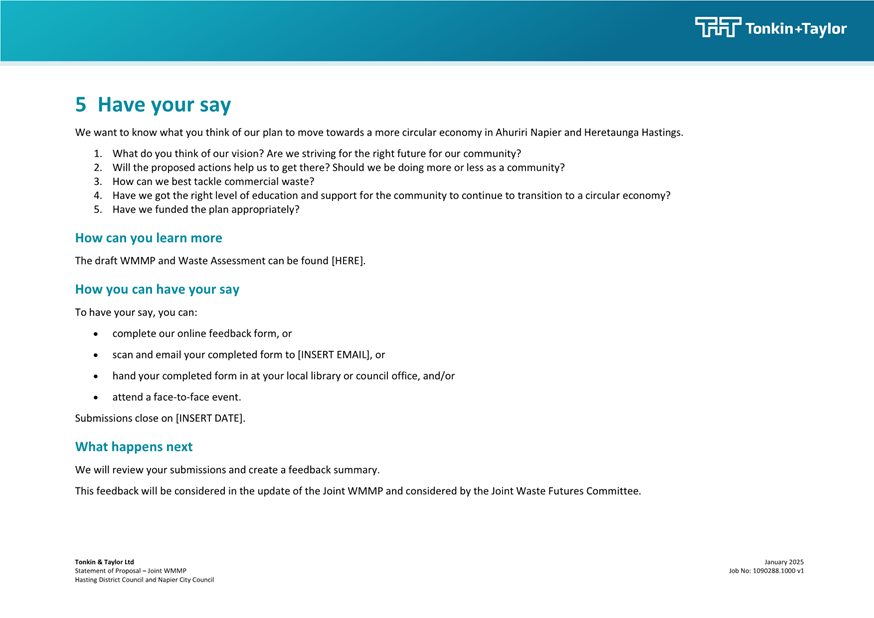
A summary of proposal is attached to the
report and will be the main basis for community engagement. This will
meet our obligations under section 83.1.a.II of the Local Government Act.
|
|
Risks
The overall risk appetite for this
project (based on the risk register) is conservative.
The risk register is reviewed regularly
at the project team meetings.
Opportunity: Update the Joint Waste
Management and Minimisation Plan to meet legislative obligations and drive
community behaviour.
|
REWARD – Te Utu
|
RISK – Te Tūraru
|
|
The expected benefits from the project include; mana
whenua partnership, greater commercial waste diversion and better outcomes
from updated bylaws.
|
The high project risks are:
Failure to meet government targets - this risk is rated
high based on the waste assessment finding that not meeting government
targets for kerbside collections could lead to a loss of waste levy
funding.
- Project
team is actively monitoring development of the plan and changes in
Government policy to ensure the required targets are met.
Lack of engagement in consultation on WMMP could affect
relevance of the plan.
- A
communications and engagement plan has been developed in consultation with
the Marketing, Engagement & Communications team.
Treasury review of waste levy – There is a medium
risk that the review could result in changes to the allocation of waste
levy funding affecting delivery of the WMMP goals.
- Project
team is awaiting guidance form the Ministry.
|
|
|
Rural
Community Board –
Te Poari Tuawhenua-ā-Hapori
No direct impact at this stage. The
Rural Community Board members were invited to the rural sector engagement
session.
|
|
Item 11 Draft Joint
Waste Management and Minimisation Plan and Statement of Proposal
|
|
Draft
Waste Management and Minimisation Plan (WMMP) 2025 - 2031
|
Attachment 1
|
|
Item 11 Draft
Joint Waste Management and Minimisation Plan and Statement of Proposal
|
|
Draft
Statement of Proposal Joint WMMP 2025 - 2031
|
Attachment 2
|

|
Tuesday, 18 February 2025
|
Hastings
District Council: Council Meeting
Te Rārangi Take
Report to Council
|
Nā:
From:
|
Janine Green, Licensing
Inspector
|
|
Te Take:
Subject:
|
Approval of the first
Draft Local Alcohol Policy for Special Consultative Procedure
|
1.0 Executive
Summary – Te Kaupapa Me Te
Whakarāpopototanga
1.1 This
report recommends Council adopts the First Draft Hastings District Local
Alcohol Policy (LAP) for public consultation. This is in accordance with the
Special Consultative Procedure (SCP) outlined in Section 83 and Section 87 of
the Local Government Act 2002 (LGA 2002), and Section 79(1) of the Sale and
Supply of Alcohol Act 2012 (SSAA 2012).
1.2 Additionally,
this report recommends delegation of up to five Councillors to hear and
consider submissions on the Draft LAP.
1.3 The
hearings are tentatively scheduled to take place on 23 and 24 April 2025.
1.4 The
Statement of Proposal for the Draft Hastings District Local Alcohol Policy,
along with the supporting documentation, is planned to be publicly notified
around the 14 March 2025. This will initiate the submission process under the
Special Consultative Procedure. Following this, the hearings process will be
conducted in late April 2025. During the hearings, all submissions will be
reviewed and considered, a preferred position will be formed. The Final Draft
LAP will be developed for Council approval.
1.5 The
draft LAP attached as attachment 1 has undergone a legal review, and
amendments have been made as necessary.
1.6 This
report presents Council with an evidence-based draft policy for consultation
and to seek public feedback on the draft LAP. While some policy divergence with
Napier City Council may arise at this stage, it is acceptable and does not
present a significant obstacle to the overall development of the draft LAP. Any
divergences can be addressed and resolved during the final draft stage, once
the Special Consultative Procedure is completed and the Council has considered
feedback from the public and stakeholders. The adoption of the first draft LAP
for consultation is an important step in gathering feedback from the community and
stakeholders, ensuring that the final policy considers a wide range of
perspectives.
|
2.0 Recommendations
- Ngā Tūtohunga
A) That
Council receive the report titled Approval of the first Draft Local Alcohol
Policy for Special Consultative Procedure dated 18 February 2025.
B) That Council
adopt:
i. The
First Draft of the Hastings District Local Alcohol Policy 2025,
ii. The
Statement of Proposal and Summary of Information (and associated documents)
for public consultation
in accordance with the Special Consultative Procedure required by the Local
Government Act 2002 and Sale and Supply of Alcohol Act 2012.
C) That Council
delegate up to five Councillors to hear public submissions on the First Draft
of the Hastings District Local Alcohol Policy 2025 in late-April 2025.
D) Council notes
a preferred position paper and final Local Alcohol Policy will be bought back
to Council for approval in mid-2025.
|
3.0 Background – Te Horopaki
3.1 This
report updates Council on the Hastings District Local Alcohol Policy (LAP)
review detailing the proposed changes to the current LAP and provides a copy of
the first draft of the revised Local Alcohol Policy (LAP) to go out for Special
Consultative Procedure (SCP) under the Sale and Supply of Alcohol Act 2012
(SSAA 2012) and the Local Government Act 2002 (LGA 2002).
3.2 Section 75 of the SSAA 2012 specifies that a Territorial Authority
(TA) may have a LAP relating to the sale, supply, or consumption of alcohol
within its district.
3.3 Under Section 77 of the Act, a LAP may include policies on any or
all of the following matters relating to licensing (and no others):
· Location of licensed premises by reference to broad areas;
· Location of licensed premises by reference to proximity to premises
or facilities of particular kinds;
· Whether further licences (or licences of a particular kind or kinds)
should be issued for premises in the district concerned, or any stated part of
the district;
· Restriction or extension of the default maximum licenced hours
· The issue of licences, or licences of a particular kind or kinds,
subject to discretionary conditions;
· One-way door restrictions.
3.4 The LAP cannot include policies on matters unrelated to licensing
such as the price of alcohol, age limits for drinking or alcohol advertising
and sponsorship.
3.5 At a Council Meeting on 16 July 2019, Council approved the final LAP
with an enforcement date of 21 August 2019, and 21 November 2019, for the hours
provisions as required under the Act.
3.6 Section 97 of the Act specifies that “a territorial
authority that has a LAP must review it utilising the Special Consultative Procedure
(under the Local Government Act 2002) no later than 6 years after it came into
force.”
3.7 At
its Meeting on 13 July 2021 Council resolved to review the policy in six years
rather than three.
“That the Council approve a review of the
Hastings District Council and Napier City Council Local Alcohol Policy in six
years (commencing October 2024) or sooner if required, as per Section 97 of the
Sale and Supply of Alcohol Act 2012.”
3.8 On the 24th October 2024 Council resolved;
A) That
Council receive the report titled Local Alcohol Policy Review dated 24 October
2024.
B) That
Council resolves to continue to have a Local Alcohol Policy (LAP) under Section
75 of The Sale and Supply of Alcohol Act 2012 (The Act).
C) That
the Chief Executive Reviews Councils LAP under Section 97 of The Act with the
goal of contributing to the reduction of alcohol related harm in our community.
D) That
Council resolves to have an individual LAP for the Review process in
Recommendation C.
E) That
Council establishes a suitable joint governance structure with Napier City
Council to oversee the LAP Review for consistency as appropriate.
F) Council
notes a Draft LAP and Statement of Proposal will be bought back to Council for
approval prior to commencement of the Special Consultative Procedure under The
Local Government Act 2002, which is a requirement under the Act when reviewing
an LAP under Section 97 of The Act.
3.9 Section 78 (2) of the Act requires that if a Territorial Authority
decides to develop a LAP it must have regard to:
· The objectives and policies of its district plan;
· The number of licences of each kind held for premises in its
district, and the location and opening hours of each of the premises;
· The number of licences of each kind held for premises in its
district, and the location and opening hours of each of the premises;
· Any areas in which bylaws prohibit alcohol in public places are in
force;
· The demography of the district’s residents;
· The demography of people who visit the district as tourists or
holiday makers;
· The overall health indicators of the district’s residents;
· The nature and severity of the alcohol-related problems arising in
the district.
3.10 Officers have completed the following since the last Council meeting
in October 2024:
· As per The Council resolution E above, a suitable governance
structure was developed with the delegation of three councillors from both Hastings
District Council (HDC) and Napier City Council (NCC) and a Terms of Reference
signed by both Councils.
· The LAP working group has received one LAP update memo and has met
once.
· A Communications Plan was developed in coordination with NCC.
· A Research Report, meeting the requirements under Section 78 (2) of
the SSAA 2012 has been developed (Attachment 2)
· Stakeholder engagement was completed with the Medical Officer of
Health, NZ Police and Licensing Inspectors as required under Section 78 (4) of
the SSAA 2012.
· An Issues and options paper which informs the changes to the LAP was
developed (Attachment 3)
· A draft LAP developed in coordination with NCC (Attachment 1)
· A Statement of Proposal and Summary of Information was developed (Attachment
4) to meet the requirements under Section 83 and 87 of the LGA 2002.
· Changes to the Draft LAP, encompassing previous Council input has
been completed ready for the SCP process.
· The first draft LAP has had its first legal review and necessary
amendments made.
4.0 Discussion – Te Matapakitanga
4.1 The
below tables detail the proposed changes and short commentary on why the
proposed changes were suggested. The table below also incorporates previous
direction from The Council.
4.2 The
proposal takes into consideration that the implementation of the 2019 Local
Alcohol Policy (LAP) may have contributed to some positive changes,
particularly minor shifts in alcohol-related harm following the reduction of
default licensing hours for all licence types. However, harm reduction is best
achieved through the continued strengthening and tailoring of policy provisions
over time.
4.3 Proposed
Provisions
Trading
Hours
4.4 It
should be noted that the following hours are Maximum trading hours, and it is
not anticipated that the District Licensing Committee (DLC) or the Alcohol
Regulatory and Licensing Authority (ARLA) will approve maximum trading hours
for every licensee. The hours will reflect the nature and purpose of the
individual premises and adhere to the restrictions under the District Plan.
4.5 Secondly,
that the below are licensed maximum trading hours and not all premises utilise
their full licensed hours.
4.6 Thirdly,
all applications through the licensing process are enquired into by the NZ
Police, Inspector and Medical Officer of Health prior to going to the District
Licensing Committee for consideration. If an applicant requested hours that was
subsequently ‘opposed’ by NZ Police, Inspector or Medical Officer
of Health, the applicant would be required to attend a hearing for
deliberation.
4.7 Lastly,
it is advisable that the closing hours for on licences align with Napier City
Council LAP in the final stages of the policy development process, to ensure
there are no unintended consequences, as supported by literature. By way of
example, patrons travelling from one district to another due to differing hours
causing alcohol related harm. In addition to this the Medical Officer of
Health and NZ Police have all commented on the importance of consistency in
hours.
|
Licence type
|
Current LAP Hours
|
Proposed LAP Hours
|
Commentary
|
|
On licence; Taverns / Bars Pubs/ Night-clubs
Add categories: breweries, cideries, distilleries,
Endorsed caterer
|
8.00 am to 3.00 am the following day Monday to
Sunday
One way door restriction: mandatory at 2.00 am
|
Taverns, bars, pubs, Nightclubs, breweries,
cideries, distilleries, Endorsed caterer
8.00 am to 2.00 am the following day Monday to
Sunday
One way door restriction: mandatory at 1.00 am
|
There is alcohol related harm data showing alcohol
related harm increases from 9.00 pm each day of the week.
An on-licence offers a regulated, safer environment
for alcohol consumption. For this specific type of licence, hours until 2:00
am strikes an appropriate balance between harm reduction and supporting the
nighttime economy. All statutory stakeholders, including NZ Police, the
Medical Officer of Health, and Inspectors, are in favour of reducing the
hours, in line with the availability theory and case studies showing
reductions in harm due to reductions in hours.
The addition of categories to ensure all licence
types are included in the LAP.
All stakeholders support the one-way door policy, as
it allows for gradual egress of patrons, reducing issues outside premises and
preventing patrons from hopping between venues later in the evening.
This proposal would affect 6 of 120 premises, or 6
of 24 premises within this category of licences (taverns, bars, pubs,
night-clubs)
(Noting that this is licensed hours and not all
premises utilise their full licensed hours).
There is some evidence to support that patrons are
likely to alter their behaviour by going out earlier and returning home
earlier.
Officers note that there may be the potential for
policy divergence on this matter.
|
|
On licence: café/ Restaurant / winery / winery restaurant
Add categories: Hotels (accommodation)
|
8.00 am to 2.00 am the following day Monday to
Sunday
|
Cafes/restaurants/wineries/winery
restaurants / Hotels (accommodation)
8.00 am to 1.00 am Monday to Sunday
|
There is alcohol related harm data showing alcohol
related harm increases from 9.00 pm each day of the week.
An on-licence offers a regulated, safer environment
for alcohol consumption. For this specific type of licence, where food is
often the main purpose, hours until 1:00 am strikes an appropriate balance
between harm reduction and supporting the nighttime economy. All statutory
stakeholders, including NZ Police, the Medical Officer of Health, and
Inspectors, are in favour of reducing the hours, in line with the
availability theory.
The addition of categories to ensure all license
types are included in the LAP.
This would affect 2 premises of 120 premises or 2 of
70 premises within this category.
(Noting that this is licenced hours and not all
premises utilise their full licensed hours).
There is some evidence to support that patrons are
likely to alter their behaviour by going out earlier and returning home
earlier.
Officers note that there may be the potential for
policy divergence on this matter.
|
|
On licence – Entertainment facilities /
Add category: Function centres / all other
non-specified on licences
|
Licensing hours are to be consistent with the nature
and activities of the premises and in general shall range from:
8.00 am to 2.00 am the following day Monday to
Sunday
|
Entertainment facilities / Function centres / all
other non-specified on licences
Licensing hours are to be consistent with the nature
and activities of the premises and in general shall range from:
8.00am
to 1.00am the following day Monday to Sunday
|
There is alcohol related harm data showing alcohol
related harm increases from 9.00 pm each day of the week.
An on-licence offers a regulated, safer environment
for alcohol consumption. For this specific type of licence, where
entertainment is the main purpose, hours until 1:00 am strikes an appropriate
balance between harm reduction and supporting the nighttime economy. All
statutory stakeholders, including NZ Police, the Medical Officer of Health,
and Inspectors, are in favour of reducing the hours, in line with the
availability theory.
The
addition of categories to ensure all license types are included in the LAP.
This
change would affect 2 of 120 premises or 2 of 26 premises in this category.
(Noting that this is licenced hours and not all
premises utilise their full licensed hours).
There is some evidence to support that patrons are
likely to alter their behaviour by going out earlier and returning home
earlier.
Officers note that there may be the potential for
policy divergence on this matter.
|
|
Off licence – Grocery Stores and Supermarkets
|
7.00 am to 10.00 pm Monday to Sunday
|
Grocery Stores and Supermarkets
7.00 am to 9.00 pm – Monday to Sunday
|
There is alcohol related harm data showing alcohol
related harm increases from 9.00pm each day of the week.
All statutory stakeholders support a general
reduction in hours based on the availability theory. (NZ Police, Medical
Officer of Health & Inspectors).
There is support for restricting remote sales
delivery hours to match all other off licences, with the intention on
reducing access to alcohol later in the evening when harm is at its highest.
However legal advice is that remote sales delivery times cannot be included
within the LAP.
The Medical Officer of Health was particularly
strong in her recommendation for consistent hours for all license types,
including supermarkets and grocery stores. This was considered; however, the
proposal acknowledges the market demand and the importance of convenience in
allowing supermarkets and grocery stores to open earlier.
The reduction to 9.00 pm closing would affect 43 of
111 premises. (Noting that this is licenced hours and not all premises
utilise their full licensed hours).
There is some evidence to support that patrons are
likely to alter their behaviour by shopping earlier.
Officers note that there may be the potential for
policy divergence on the opening hours.
|
|
Off licence – All other off licences
|
9.00 am to 10.00 pm Monday to Sunday
|
All other off licences
9.00 am to 9.00 pm – Monday to Sunday
|
|
Off licence – remote sales (online sales)
|
Sales: Any day at Any time
Delivery: 6.00am to 11.00 pm
|
Remote Sales (online sales only)
Sale can take place – Any day at Any time
Delivery of alcohol - 6.00am to 11.00pm –
Monday to Sunday
|
|
Club licence
|
Licensing hours are to be consistent with the nature
and activities of the club and in general shall range from:
8.00 am to 1.00 am the following day Monday to
Sunday
|
|
Only 6 of the 28 clubs close after midnight, and few
extend to 1.00 am. This proposal splits the club licence category by club
size, in line with fee regulation definitions of clubs, to regulate closing
hours based on size and better align with current trading hours.
|
|
Club Licences – Class one: (as per the definition in the Sale and Supply of
Alcohol (fees) Regulations 2013 - a club licence that has at least 1000
members of the purchase age and in the opinion of the TA, operates any part
of the premises in the nature of a tavern at any time.)
|
|
8.00 am to 1.00 am – Monday to Sunday
|
Only 6 of the 28 clubs close after midnight, and few
extend to 1am. Officers propose splitting the club license category by club
size, in line with fee regulations, to regulate closing hours based on size
of the club and better align with current trading hours.
There is alcohol related harm data showing alcohol
related harm increases from 9pm each day of the week.
|
|
Class Two and Three Clubs (as per the definition in
the Sale and Supply of Alcohol (fees) Regulations 2013). All those not a
class one club
|
|
8.00 am to 12.00 am midnight – Monday to
Sunday
|
There is alcohol related harm data showing alcohol
related harm increases from 9.00 pm each day of the week.
Only 6 of the 28 clubs close at 12am midnight and 6
extend to 1am. Officers propose splitting the club license category by club
size, in line with fee regulations, to regulate closing hours based on size
and better align with current trading hours.
This would affect 3 of the 28 Club premises or 3 of
the 26 clubs in this category (class 2 and 3).
|
|
Special Licence
|
Any day at any time
|
8:00 am to 2:00 am the following day, unless the
event is deemed suitable by the District Licensing Committee (DLC) to extend
beyond these hours, and the applicant can provide justification for the need
for extended hours. A waiver will need to be applied for to extend these
licensed hours.
All applications must comply with the District Plan
and any applicable Resource Consent.
|
There is alcohol related harm data showing alcohol
related harm increases from 9.00 pm each day of the week.
Events can significantly contribute to
alcohol-related harm if not properly regulated and managed. Most special
licences in the district align with the proposed hours. This provision also
allows the DLC and ARLA to grant extended hours based on the type of event.
It is important to note, it is expected the policy position is to ensure the
hours are appropriate and reasonable for each individual event. The proposed
hours are not intended to set an expectation that the DLC and ARLA will
always issue licences for the full duration.
|
4.8 Location
and Density provisions
4.8.1 Council
requested further information regarding density provisions for additional
suburbs as recommended by the Medical Officer of Health. (See Attachment 5
for Location maps) A memo was sent to Councillors with further information
to inform decision making.
|
Policy Provision
|
Current LAP
|
Proposed LAP
|
Commentary
|
|
Proximity provisions
|
None
|
None
|
Practicality issues
Unintended consequences
|
|
Location of licensed premises by reference to broad
areas
|
None
|
None
|
Practicality issues
Unintended consequences
|
|
Density provisions - Whether further licenses (or licenses of a particular kind or kinds)
should be issued for premises in the district concerned, or any stated part
of the district
|
No further off licences being a bottle store on land
located in –
Flaxmere Commercial Service or
Suburban Commercial zone or
Flaxmere Village Centre Zone
Camberley - suburban commercial zone
identified in Map 2.
|
No further off licenses being a bottle store on land
located in –
Flaxmere Commercial Service or
Suburban Commercial zone or
Flaxmere Village Centre Zone or residential area.
Camberley – suburban commercial
zone identified in Map 2.
|
No further changes are recommended, as there is
strong support for the current provisions.
An analysis was conducted to assess potential new
areas for inclusion, but the evidence gathered was insufficient to justify
adding any additional locations to the list.
This is particularly relevant given that many areas
are already restricted from granting licences under the district plan
(residential zones) or without a Resource Consent for some licence
types. Additionally, the areas
identified by the MoH all straddle the town centre, or are a part of the main
centre, which could cause unintended consequences such as clustering of
licences just inside or outside of the exclusion zone.
The additional area maps are appended in Attachment
5 if there is preference to add additional suburbs to the Draft LAP.
|
4.9 Discretionary
Conditions
|
Policy Provision
|
Current LAP
|
Proposed LAP
|
Commentary
|
|
On licences / club licences
|
· CCTV cameras (location and number)
•
Provision of effective exterior lighting
• No
serving in glass containers at specified times
•
Number of door-staff and provision of additional security staff after
specified times
•
Management of patrons queuing to enter the licensed premise
• Limit
on the number of drinks per customer at specified times
• No
shots or types of drinks to be served after specified times
• Limit
on drink sizes after specified times
•
Conditions relating to management: such as certificated staff required if the
maximum occupancy exceeds a prescribed number or if recommended by Police or
the Inspector, requirement for multiple managers etc
• One
way door restrictions
•
Provision of transport for patrons
• Restriction on the use of
outdoor areas after a specified time
· Club specific - Conditions relating to management: such as
certificated staff required at all clubs unless the bar is staffed
voluntarily, and membership is below a prescribed number.
|
· CCTV cameras (location and number – keeping
recordings for at least 28 days)
•
Provision of effective exterior lighting
• No
serving in glass containers at specified times
•
Number of door-staff and provision of additional security staff after
specified times
•
Management of patrons queuing to enter the licensed premise
• Limit
on the number of drinks per customer at specified times
• No
shots or types of drinks to be served after specified times
• Limit
on drink sizes after specified times
• Conditions
relating to management: such as certificated staff required if the maximum
occupancy exceeds a prescribed number or if recommended by Police or the
Inspector, requirement for multiple managers etc
• One
way door restrictions
•
Provision of transport for patrons
• Restriction on the use of outdoor
areas after a specified time
· Club specific - Conditions relating to
management: such as certificated staff required at all clubs unless the bar
is staffed voluntarily, and membership is below a prescribed number.
In addition to the above:
· Utilise the principals of Crime
Prevention through Environmental Design. (CPTED)
· Require impact assessments by an
applicant if a premises is in a particularly low socio-economic area or an
area known to have ARH issues. This impact assessment should detail how the
applicant will mitigate any issues with amenity and good order and may result
in conditions imposed on the licence to ensure the minimisation of alcohol
related harm on the surrounding community.
· Maintain and provide as a part of the application
process an incident register of alcohol related incidents and mandatory
reporting of violent incidents to NZ Police.
· Maintain and provide upon request a duty
manager register.
|
Additional elements will further provide DLC’s
with options for the licensing process to help alleviate issues with amenity
and good order and assist in the reduction of alcohol related harm.
|
|
Off licences
|
Display of safe drinking
messages/material
|
· Display of safe drinking
messages/material
· In addition to the above:
· CCTV cameras (location and number)
· Provision
of effective exterior lighting
· Limit on alcohol related exterior signage or advertising to 30%
of the building or glass exterior.
· No single sale of Ready to Drink (RTD)
or mainstream beer under 500ml.
· Utilise the principals of Crime
Prevention through Environmental Design. (CPTED)
· Require impact assessments by an
applicant if a premises is in a particularly low socio-economic area or an
area known to have ARH issues. This impact assessment should detail how the
applicant will mitigate any issues with amenity and good order and may result
in conditions imposed on the licence to ensure the minimisation of alcohol
related harm on the surrounding community.
· Maintain
and provide as a part of the application process an incident register of
alcohol related incidents, and mandatory reporting of violent incidents to NZ
Police.
· Maintain
and provide upon request a duty manager register.
· Low
alcoholic drinks and 0% alcohol beer to be available for sale.
· No
end of isle sales of alcohol for supermarkets and grocery stores.
|
Additional elements will further provide DLC’s
with options for the licensing process to help alleviate issues with amenity
and good order and assist in the reduction of alcohol related harm.
|
|
Special licences
|
· Restriction on the type of drinks sold,
the alcohol percentage of the drinks and the type of containers the drinks
are served in
· One way door restrictions
|
· Restriction on the type of drinks sold,
the alcohol percentage of the drinks and the type of containers the drinks
are served in
· One way door restrictions
· Requirement of a separate line or
service area for non-alcoholic beverages where the special licence is likely
to have patrons that are under the legal drinking age.
· For class one events
- Security Staff, porta loos and
rubbish bins provided in the surrounding areas to assist with issues with
amenity and good order.
- No full bottle wine sales for onsite
consumption
- Serve reduction systems in place to
manage intoxication levels – maximum serves of 2 per sale reducing to
1.
- Prescribed ratio of security staff to
patrons
- High visibility clothing to be worn by
security staff and be visible to others.
- Means of egress for emergency services
- Submission of Applications at least 25
working days prior to the event to allow for processing and potential
stakeholder meetings
- A sufficiently detailed Alcohol
Management Plan as per Section 143 of the SSAA 2012
|
Additional elements will further provide DLC’s
with options for the licensing process to help alleviate issues with amenity
and good order, reduce issues at larger events and assist in the reduction of
alcohol related harm.
|
4.10 Other
proposed changes
4.10.1 The
current LAP outcomes are as follows:
· Creating a safe and healthy community free from alcohol related harm
· Fostering safe and responsible drinking environments
· Reflecting community views on the sale and supply of alcohol within
the district.
4.10.2 The
current outcomes remain appropriate, with one recommended amendment to the
first outcome: "Creating a safe and healthy community free from
alcohol-related harm." Given that the alcohol industry is a legal and
legitimate sector, which inherently carries risks—even for moderate
drinkers—it is unrealistic to aim for an outcome that seeks to eliminate
all harm.
4.10.3 Therefore,
it is proposed that the outcome be revised to: "Fostering a safe and
healthy community by reducing alcohol-related harm". This revised outcome
is more action-oriented, realistic, and achievable, aligning better with the
practical goal of harm reduction.
4.11 Final
conclusions
4.11.1 The research and the issues and options paper present evidence
confirming that alcohol-related issues remain prevalent in the Hastings
District, including patterns of heavy consumption, health problems, traffic and
crime offenses, and harm during weekends, particularly late nights and summer
months. The data suggests that alcohol-related harm begins to rise after 9pm.
It is recognised that alcohol misuse affects both individuals and the
wider community, with significant associated costs.
4.11.2 Research
and literature acknowledge that Māori and youth are overrepresented in
alcohol related harm statistics and therefore further strengthening the LAP
provisions may assist in reducing alcohol related harm for these
populations.
4.11.3 Implementation
of the 2019 Local Alcohol Policy (LAP) may have contributed to some positive
changes, particularly minor shifts in alcohol-related harm following
adjustments to licensing hours. However, harm reduction is best achieved
through the continued strengthening and tailoring of policy provisions over
time.
4.11.4 Overall,
the proposed changes to the LAP are designed to build on the existing policy
framework, focusing on further reducing alcohol-related harm while recognizing
the alcohol industry as a legal and regulated sector. These revisions aim to
support a vibrant and safe night-time economy in the community, while ensuring
that public health and safety are prioritized. The ongoing support from
stakeholders, including health professionals, law enforcement, and alcohol
licensing inspectors, underscores the effectiveness and continued importance of
the policy in reducing harm in the Hastings District.
4.12 Consultation
(Special Consultative Procedure)
4.12.1 Consultation
will be completed through the SCP between approximately the 14 March – 14
April 2025 with hearings occurring mid to late April 2025.
4.12.2 Specific
consultation will occur with Māori and youth as they are overrepresented
in statistics. Licensees will also have additional consultation via the Alcohol
Accord meeting.
4.12.3 All
SCP documents will be legally checked, and then designed by the communications
department of council prior to being publicly available on the Council website
and our voice our choice platform.
4.12.4 Consultation will
include:
· Social
media campaigns
· Public
meetings / stakeholder meetings
· Media
releases
· Flyers
and posters
· Email
outreach.
5.0 Options
– Ngā Kōwhiringa
5.1 The
officers have evaluated three potential options.
5.1.1 Option One: The
Council adopts the Statement of Proposal (and its associated attachments),
approving the Draft Local Alcohol Policy as proposed (or amended during the
meeting), and proceeds with its notification on or around 14 March 2025, in
accordance with the Special Consultative Procedure.
5.1.2 Selecting
Option One would initiate the Special Consultative Procedure (SCP) for the
Draft Local Alcohol Policy, allowing the Council to maintain an active LAP and
meet its review deadline of August 2025.
5.2 Option
Two: The Council does not approve the draft policy for notification under the
Special Consultative Procedure.
5.2.1 If
Option Two is selected, the provisions in the current LAP would be rescinded,
and the regulations would default to the more permissive provisions of the Sale
and Supply of Alcohol Act 2012 (SSAA 2012). A SCP would then need to occur to
revoke the LAP under Section 96 of the Act.
5.3 Option
Three: The Council provides alternative provisions or requests further work to
finalize a different set of provisions for the Proposed Draft LAP.
5.3.1 Should
Option Three be chosen, the Council would either propose alternative provisions
during the meeting or request further analysis to be completed and defer the
decision to a later date, with a view to finalizing provisions different from
those in the proposed Draft LAP.
5.4 Advantages
and Disadvantages of each option
5.4.1 Option
One: Adopt the Draft LAP and Statement of Proposal and associated documents for
the SCP
Advantages:
· The
proposed policy changes will continue to contribute to the reduction in alcohol
related harm in our community.
· The
changes support the views of the key stakeholders (NZ Police, MoH, Inspectors)
· The
proposed changes align with the evidence of harm provided in the research
report and issues and options paper, and largely reflects stakeholder feedback.
· The
proposed changes still allow for a vibrant nighttime economy while contributing
to the reduction in harm.
· The
LAP project will meet the LAP review deadline of August 2025 as required by the
SSAA 2012.
5.4.2 Disadvantages
· Certain
licensees may oppose a reduction in operating hours.
· There
may be resistance from the public.
· Possible
misalignment of provisions with NCC (This can be remedied, if necessary, at the
final draft stage once the SCP has been completed).
5.5 Option
Two: That Council does not approve the draft policy for notification as per the
Special Consultative Procedure.
5.5.1 Advantages:
· None
5.5.2 Disadvantages:
· HDC
would relinquish the current provisions in the existing LAP, reverting to the
more permissive SSAA 2012 provisions, which could result in an increase in
alcohol-related harm.
· There
is still a requirement under Section 96 of the Act to complete a SCP to revoke
a LAP.
· Potential
negative feedback from stakeholders and the public.
· Potential
misalignment of provisions with NCC, resulting in unintended consequences.
5.6 Option
Three: The Council provides alternative provisions or requests further work to
finalize a different set of provisions for the Draft LAP.
5.6.1 Advantages
· Politically
there may be more support for alternative provisions.
5.6.2 Disadvantages
· Possible
misalignment of provisions with NCC (This can be remedied, if necessary, at the
final draft stage once the SCP has been completed
· Risk
of not meeting the LAP review deadline of August 2025.
5.7 Option
one is the preferred choice, as it incorporates stakeholder input and research
on alcohol-related harm. This option aims to further reduce alcohol-related
harm while supporting a vibrant night-time economy, recognizing Hastings as a
wine district, and acknowledging the importance of the hospitality industry.
6.0 Next
steps – Te Anga Whakamua
6.1 If the Statement of Proposal (and associated documents) and first draft
of the LAP are approved by the Council today, the documents will be made
available for public consultation and will be notified for submissions on or around
14 March 2025.
6.2 The Council must adhere to the Special Consultative Procedure as
outlined in Section 83 of the Local Government Act 2002.
6.3 Following the closure of the submission period (approximately 14
April 2025), a Council Hearing Committee, consisting of up to five councillors
(as determined by the Council today), will hear the submissions.
6.4 A preferred position paper will be developed providing the
submission analysis and detailing any proposed changes to the Draft LAP. If
necessary, the Joint Working Reference Group may reconvene to assist with
policy alignment.
6.5 It is important to note that there is no appeal process within this
review. The LAP will come into force 30 days after the public notification of
its adoption by The Council, with hours provisions coming into force 3 months
after the notification date.
6.6 NCC will follow the similar procedure in parallel with HDC.
Attachments:
|
1⇨
|
Regulatory Operations - Liquor Licensing - Policy - First
Draft LAP 2024 - non tracked (FINAL 12.2.25 - legally checked) PDF
|
REG-14-3-25-322
|
Vol 2
|
|
2⇨
|
Regulatory Operations - Liquor Licensing - Policy - FINAL
LAP Research Report 2024 PDF - (FINAL 4.2.25)
|
REG-14-3-24-317
|
Vol 2
|
|
3⇨
|
Regulatory Operations - Liquor Licensing - Policy - FINAL
LAP Issue and Options paper 2024 (FINAL 12.2.25)
|
REG-14-3-25-323
|
Vol 2
|
|
4⇨
|
Regulatory Operations - Liquor Licensing - Policy -
Submission pack for consultation 2025 for council meeting (FINAL PDF 12.2.25)
|
REG-14-3-25-324
|
Vol 2
|
|
5⇨
|
Regulatory Operations - Liquor Licensing - Policy - Binder
of maps for LAP 2025
|
REG-14-3-25-328
|
Vol 2
|
|
Summary of
Considerations - He Whakarāpopoto Whakaarohanga
|
|
Fit
with purpose of Local Government - E noho hāngai pū ai ki te
Rangatōpū-ā-Rohe
The Council is required to give effect to the purpose of
local government as set out in section 10 of the Local Government Act 2002.
That purpose is to enable democratic local decision-making and action by (and
on behalf of) communities, and to promote the social, economic, environmental,
and cultural wellbeing of communities in the present and for the future.
Link to the
Council’s Community Outcomes –
Ngā Hononga ki Ngā Putanga ā-Hapori
This proposal promotes the performance of
regulatory functions for the purpose of preventing harm and creating safe and
healthy environments for people. The proposal also contributes towards
reducing public nuisance and threats to public health and safety through
appropriate policy controls for the wellbeing of communities in the present
and for the future.
|
|
Māori
Impact Statement -
Te Tauākī Kaupapa Māori
Maori and pacific people are
overrepresented in alcohol related harm statistics, however no known impacts
for mana whenua / iwi / tangata whenua above and or beyond the general
community population specifically in relation to this policy review. Maori
will have targeted consultation through the SCP.
|
|
Sustainability
- Te
Toitūtanga
The policy is required under
the Act to be reviewed every six years.
|
|
Financial
considerations -
Ngā Whakaarohanga Ahumoni
The policy process will incur fees associated with a
legal review and costs for Special Consultative Procedure and administration /officer time. These will
be covered from existing Planning and Regulatory
budgets in the 2024-2025 years.
|
|
Significance
and Engagement - Te
Hiranga me te Tūhonotanga
Section 79 of
the Act requires the use of the SCP under The LGA 2002, for the LAP Review.
Preliminary stakeholder consultation has been done.
|
|
Consultation
– internal and/or external - Whakawhiti Whakaaro-ā-roto / ā-waho
The LAP Review
must use the SCP under the LGA 2002. Specific consultation will be completed
with Maori, Youth and Licensees.
|
|
Risks
|
REWARD – Te Utu
|
RISK – Te Tūraru
|
|
Public health benefits of
having a LAP –
reducing alcohol related
harm.
Providing tools for the
District Licensing Committee to regulate where and when alcohol is sold and
supplied in the region.
Supporting stakeholder
groups wish for the continuation of the LAP to protect and promote public
health and safety.
|
Provisions contained within the LAP may be too
restrictive or not restrictive enough.
Possible policy divergence with NCC
|
|
|
Rural
Community Board –
Te Poari Tuawhenua-ā-Hapori
NA
|
|
Tuesday, 18 February 2025
|
Hastings
District Council: Council Meeting
Te Rārangi Take
Report to Council
|
Nā:
From:
|
Bruce Conaghan,
Transportation Policy and Planning Manager
|
|
Te Take:
Subject:
|
Revocation of Part 10
Speed Limits Bylaw 2012 of the Hastings District Council Bylaws
|
1.0 Executive Summary
– Te Kaupapa Me Te
Whakarāpopototanga
1.1 This report recommends
that the Council revoke Part 10 Speed Limits Bylaw 2012 of the Hastings
District Council Bylaws in response to legislative changes.
1.2 The Land Transport
Rule: Setting of Speed Limits 2022 changed the way that speed limits are
set. Councils no longer need to set speed limits through a bylaw, but
through a process associated with the new National Speed Limit Register.
1.3 This means that the
speed limits bylaw is redundant and can be revoked. The Land Transport
Act 1988 enables this to be done by resolution, without the need for public
consultation under section 168AAA(2) of that Act.
1.4 Revoking the
bylaw that sets speed limits can only be considered once the speed limits have
been entered into the National Speed Limit Register. This is set out in
Part 4 of the Land Transport (Register of Land Transport Records – Speed
Limits) Regulations 2022.
1.5 Given that
Council’s speed limit data has been migrated to the National Speed Limit
Register, Part 10 Speed Limits Bylaw 2012 of the Hastings District Council
Bylaws can therefore be revoked effective immediately.
|
2.0 Recommendations -
Ngā Tūtohunga
A) That Council
receive the report titled Revocation of Part 10 Speed Limits Bylaw 2012 of
the Hastings District Council Bylaws dated 18 February 2025.
B) That Council
revoke Part 10 Speed Limits Bylaw 2012 of the Hastings District Council
Bylaws effective immediately, noting that the speed limits contained in the
Speed Limits Bylaw have been entered into the National Speed Limit Register.
|
3.0 Background – Te Horopaki
3.1 The Council sets speed
limits on the roads it controls through Part 10 Speed Limits Bylaw 2012 of the
Hastings District Council Bylaws (“Speed Limits Bylaw 2012”). The
Speed Limits Bylaw 2012 was made pursuant to section 684(13) of the Local Government
Act 1974, the Local Government Act 2002, and the Land Transport Rule : Setting
of Speed Limits 2003. Note that the Speed Limits Bylaw does not include
those roads in the District where other road controlling authorities are
responsible e.g. NZTA for the State Highways and the Department of Conservation
for their roads.
3.2 The Land Transport
Rule : Setting of Speed Limits 2022 (“2022 Rule”) revoked and
replaced the Land Transport Rule : Setting of Speed Limits 2017 (“2017
Rule”) which required speed limits to be set by bylaw under section
2.7(1) of the 2017 Rule. The 2022 Rule requires speed limits to be set by
creating land transport records and entering those records into the National
Speed Limit Register (“NSLR”). The NSLR becomes the legal
instrument meaning that the Speed Limits Bylaw can be revoked.
3.3 Section 168AAA of the
Land Transport Act 1998 (“Act 1998”) enables regulations to be made
relating to land transport records (a speed limit is a land transport
record). The regulations made to accommodate this change are the Land
Transport (Register of Land Transport Records – Speed Limits) Regulations
2022 (“Regulations 2022”). Section 13 of Part 4 of the Regulations
2022 enables a road controlling authority to revoke the bylaw that sets speed
limits after the speed limits have been entered into the NSLR as a land
transport record, thus setting them as legal speed limits under the new system.
3.4 Section 168AAA(2) of
the Act 1998 removes the consultation requirements when amending, replacing, or
revoking a bylaw in accordance with the regulations made under that
system. The regulations pertinent here are the Land Transport Register of
Land Transport Records – Speed Limits) Regulations 2022.
3.5 Where a Speed Limits
Bylaw is revoked, there is still the legal requirement for the road controlling
authority to retain copies of the bylaw including the obligation in clause
2.8(7) of the Setting of Speed Limits Rule 2017 to keep speed limit information
for seven years. This would include all information associated with the
process to change speed limits in the bylaw.
4.0 Discussion – Te Matapakitanga
4.1 The Land Transport
Rule : Setting of Speed Limits 2022 changed the way that speed limits are
set. Road controlling authorities no longer need to set speed limits
through a bylaw, but through a process associated with the new National Speed
Limit Register. This means that the Speed Limits Bylaw is redundant and
can be revoked. The Land Transport Act 1988 enables this to be done by
resolution, without the need for public consultation under section 168AAA(2) of
that Act.
4.2 Revoking the
bylaw that sets speed limits can only be considered once the existing speed
limits have been migrated to the NSLR as required by Section 13 of Part 4 of
the Land Transport (Register of Land Transport Records – Speed Limits)
Regulations 2022.
4.3 With Council’s
speed limit data having been migrated to the NSLR, Part 10 Speed Limits Bylaw
2012 of the Hastings District Council Bylaws can therefore be revoked effective
immediately.
4.4 While the Speed Limits
Bylaw is revoked, there is still the legal requirement for road controlling
authorities to retain copies of the bylaw including the obligation in clause
2.8(7) of the Setting of Speed Limits Rule 2017 to keep speed limit information
for seven years up to the date of revocation. This would also include all
information associated with the process to effect amendments to the speed
limits bylaw for the same period.
5.0 Options – Ngā Kōwhiringa
Option One - Recommended Option -
Te Kōwhiringa Tuatahi – Te Kōwhiringa Tūtohunga
5.1 Revoke the Speed
Limits Bylaw 2012 effective immediately.
Advantages
· Complies
with guidance from NZTA to revoke the Bylaw
· Avoids
any confusion for the community as to what legal instrument is regulating speed
limits
Disadvantages
· There
are no known disadvantages with this option
Option Two – Status Quo - Te Kōwhiringa Tuarua
– Te Āhuatanga o nāianei
5.2 Do not revoke the
Speed Limits Bylaw 2012.
Advantages
· There
are no known advantages with this option
Disadvantages
· Does
not comply with guidance from NZTA to revoke the Bylaw as soon as practicable
· Would
duplicate the regulations leading to potential inconsistency and confusion as
to which legal instrument is regulating speed limits on roads controlled by
Hastings District Council
6.0 Next steps – Te Anga Whakamua
6.1 Once the decision has
been made to revoke the Part 10 Speed Limits Bylaw 2012 of the Hastings
District Council Bylaws, officers will update the Hastings District Council
Bylaws to show that the Speed Limits Bylaw 2012 has been revoked. An
explanatory note directing readers to the National Speed Limit Register for the
Hastings District Council speed limits will be included on the Council website.
6.2 As required, Council
will retain copies of the previous Speed Limits Bylaw for seven years.
Recognising the obligation in clause 2.8(7) of the Setting of Speed Limits Rule
2017, all speed limit information associated with the process to change speed
limits in the bylaw will also be kept for the same period.
Attachments:
There are no attachments for this report.
|
Summary of
Considerations - He Whakarāpopoto Whakaarohanga
|
|
Fit
with purpose of Local Government - E noho hāngai pū ai ki te
Rangatōpū-ā-Rohe
The Council is required to give effect to the purpose of
local government as set out in section 10 of the Local Government Act 2002.
That purpose is to enable democratic local decision-making and action by (and
on behalf of) communities, and to promote the social, economic,
environmental, and cultural wellbeing of communities in the present and for
the future.
Link to the
Council’s Community Outcomes –
Ngā Hononga ki Ngā Putanga ā-Hapori
There is no contribution to Council’s Community
Outcomes or Long term Plan Strategic Objectives given that the revocation is
in response to legislative changes.
|
|
Māori
Impact Statement -
Te Tauākī Kaupapa Māori
N/A as the decisions in this report are
administrative to comply with legislative changes.
|
|
Sustainability
- Te
Toitūtanga
N/A as the decisions in this report are
administrative to comply with legislative changes.
|
|
Financial
considerations -
Ngā Whakaarohanga Ahumoni
There are no financial implications
as the decisions in this report are administrative only to comply with
legislative changes.
|
|
Significance
and Engagement - Te
Hiranga me te Tūhonotanga
This decision/report has been assessed under the Council's
Significance and Engagement Policy as being of minor significance.
|
|
Consultation
– internal and/or external - Whakawhiti Whakaaro-ā-roto / ā-waho
N/A as the decisions in this report are
administrative to comply with legislative changes.
|
|
Risks
There are no risks as the revocation of
the existing Speed Limits Bylaw to comply with legislative requirements has
no impact on the Council being able to perform its role as a road controlling
authority.
|
|
Rural
Community Board –
Te Poari Tuawhenua-ā-Hapori
N/A as the decisions in this report are
administrative and to comply with legislative changes.
|
|
Tuesday, 18 February 2025
|
Hastings
District Council: Council Meeting
Te Rārangi Take
Report to Council
|
Nā:
From:
|
Bruce Conaghan,
Transportation Policy and Planning Manager
|
|
Te Take:
Subject:
|
Hastings District School
Speed Limits Plan
|
1.0 Executive Summary
– Te Kaupapa Me Te
Whakarāpopototanga
1.1 The purpose of this
report is to seek approval to adopt the Hastings District School Speed Limits
Plan as required by the Land Transport Rule: Setting of Speed Limits 2024.
1.2 Land Transport Rule:
Setting of Speed Limits 2024 (“the Rule”) came into force on 28
September 2024. The Rule requires road controlling authorities (RCAs) to
use reasonable efforts to comply with Section 5 of the Rule by 1 July 2026 in setting
speed limits outside all schools.
1.3 Council officers
identified the specific Category (1 or 2) of each school in the context of the
Rule definition such that all schools having a current posted speed limit of 50
km/h would have a 30 km/h school speed limit while those with a posted speed limit
of 60 km/h or above would have a school speed limit of 60 km/h or no change
where the existing speed limit was already 60 km/h.
1.4 Discussions
are underway with each school to detail the proposed speed limit changes and to
confirm the times that the school speed limit would operate at the time of
writing this report. An update of that progress will be provided to
Council at the meeting.
1.5 All electronic signs
have been purchased previously with subsidy from NZTA so the only cost involved
moving forward will be the supply of the static school speed limit signs and
the installation of all signs. The estimated cost for to deliver this $300,000
compromised of $180,000 for the urban area and $120,000 for the rural
area. The only two schools that have electronic signs in place are
Puketapu School and Maraekākaho School and Council officers would be
looking to confirm that these can become operational as soon as possible after
the Hastings District School Speed Limits Plan is certified in accordance with
the Rule. A potential date for the school speed limits speed limits to
come into effect at those two schools would be within a month of certification
of the school speed plan.
1.6 While all school speed
limits are to be in place by 1 July 2026, Council officers would be working to
achieve this by 1 July 2025 and are seeking subsidy from NZTA to assist with
this delivery within approved LTP budgets. If funding is approved and
budget is available within the LTP, all school speed signs would be installed
by the end of this financial year to enable the school speed limits once
certified in accordance with the Rule to come into effect on 1 July 2025.
If funding is only approved in the 2025/26 financial year, Council officers
would look to have all school speed limits come into effect on 1 January
2026. Given that Puketapu School and Maraekākaho School have
electronic signs in place, and Council officers would be looking to confirm
that these can become operational as soon as possible after the Hastings
District School Speed Limits Plan is certified in accordance with the Rule.
|
2.0 Recommendations -
Ngā Tūtohunga
A) That Council
receive the report titled Hastings District School Speed Limits Plan dated 18
February 2025.
B) That Council
adopt the proposed school speed limits in Attachment 2: Hastings District
School Speed Limits Plan.
|
3.0 Background – Te Horopaki
3.1 Land Transport Rule:
Setting of Speed Limits 2024 (“the Rule”) came into force on 28
September 2024. The objective of the Rule is to contribute to an effective,
efficient, and safe land transport system by:
· providing
for an approach to speed management that considers speed limits alongside
safety infrastructure and safety camera enforcement, and
· empowering
or requiring road controlling authorities to set speed limits for roads under
their control, generally after considering safety, economic impacts, and the
views of road users and the community, and
· setting
out requirements road controlling authorities must comply with when setting
speed limits.
3.2 The Rule requires road
controlling authorities (RCAs) to use reasonable efforts to comply with Section
5 of the Rule by 1 July 2026 in setting speed limits outside all schools.
3.3 In the Rule, all
schools are classed as either Category 1 or Category 2 schools. Schools
are Category 1 unless RCAs designate them Category 2.
Category 1 schools are more likely to
be in areas with:
· existing
speed limits of 50 km/h or less
· higher
risk to vulnerable road users e.g. more nearby housing so pupils may walk or
cycle to school
· other
vulnerable road users in the vicinity e.g. pedestrians, cyclists,
micro-mobility users
Category 2 schools are more likely to
be in rural areas with:
· higher
existing speed limits
· comparatively
less risk to vulnerable road users e.g. pupils are usually driven or take a bus
to school as distance makes active transport modes less practical, and
there’s off-road parking and/or pick up/drop off spaces
· other
mitigating features for higher speed limits e.g. safety infrastructure such as
dedicated cycle lanes
3.4 The Rule sets speed
limit requirements for roads “outside the school gate” which is
defines as “the section of road immediately adjacent to a gate or other
access used by students to enter or leave the school, usually measuring (with
any reasonably practicable modifications):
· 300
metres for a category 1 school, or
· 600
metres for a category 2 school
Schools may have many different gates
or access points. RCAs would work with schools to identify the relevant
ones, i.e. gates and access points next to a road and used by students entering
and leaving school. RCAs then are required to apply the specified lengths
for roads outside a school gate wherever possible, ideally with a school gate
in the middle, i.e.:
• 300m
total road length, 150m either side of a school gate for a category 1 school
• 600m
total road length, 300m either side of a school gate for a category 2 school
3.5 In deciding a sensible
and reasonable approach for each relevant school gate or access point, RCAs need
to consider the road environment and resulting sign placement needs. Reasonably
practicable modifications to suit a school’s individual circumstances
include extending the length of road treated as outside a school gate to:
· cover
a long drop off / pick up zone
· meet
another school gate along the same road or around a corner
· include
a cluster of schools, to avoid having a short section of road with no variable
speed limit
· meet
a nearby intersection or other feature showing a more reasonable point of
change
3.6 RCAs setting variable
speed limits for roads outside a school gate under Section 5 of the Rule must
set school travel periods for a school at the same time. School travel
periods are the periods of time when variable speed limits apply and only on
days when the school is operating. RCAs must set one school travel period at
the start and one at the end of each school day for up to 45 minutes either
side of the bell.
Depending on
the circumstances, it may be helpful to reduce the amount of information road
users have to process by:
· making morning and afternoon school travel periods the same
length of time, for example, both 40 minutes long
· using round numbers, for example,
‘8.20–9.00am’ instead of ‘8.15–8.55am’
· if possible, setting consistent school travel periods for
schools in the same area.
3.7 RCAs must set speed
limits for roads outside a school gate during school travel periods as:
· 30km/h
variable speed limits for Category 1 schools
· 60km/h
or less variable speed limits for Category 2 schools.
3.8 Additionally, RCAs may
set a permanent speed limit for a road outside a school gate as 30km/h (Category
1 schools) or 60km/h or less (Category 2 schools) if:
· this
speed limit is permitted under Schedule 3 of the Rule for the road outside a
school gate and an adjoining section of road, and
· they
set this permanent speed limit for the adjoining section of road at the same
time
3.9 RCAs will need to work
together with each school to plan changes and provide detailed information to
communities about the speed limit changes and when they are to come into force.
4.0 Discussion – Te Matapakitanga
4.1 From a Council
perspective, setting safe speed limits around all schools works to improve
safety for all users, and especially for encouraging and enabling more active
transport to and from school is fully supported.
4.2 Council officers
identified the specific Category (1 or 2) of each school in the context of the
Rule definition such that all schools having a current posted speed limit of 50
km/h would have a 30 km/h school speed limit while those with a posted speed limit
of 60 km/h or above would have a school speed limit of 60 km/h or no change
where the existing speed limit was already 60 km/h. Attachment 1
identifies all of the schools in Hastings District, the school category, and
the proposed school speed limit in terms of the Rule requirements.
4.3 Maps showing the
minimum requirements of the Rule for each school were developed. These
then enabled Council officers to identify the extent of any overlaps of the
school speed zones to see which schools could be treated as part of a cluster
and the wider area signed accordingly. Attachment 1 notes which schools are to
be treated individually or as part of a cluster. By virtue of that approach, it
provided a simple process to ascertain what would be suitable school speed
limits in terms of the Rule while considering the adjacent environment and to
ascertain where modifications in accordance with the Rule would be suitable in
terms of the Rule to achieve a safer environment. Attachment 2 shows the
extent of the school speed zone for each school that is to be signed and forms
the basis of the school speed limit plan that Council would seek to have
certified as a Land Transport Record in accordance with the Rule.
4.4 The approach to the
implementation of the speed limit signage is that electronic speed signs will
be installed for Category 1 schools where that school fronts a road defined as
an Urban Connector (Arterial or Primary Collector Road) and for Category 2 schools
where that school fronts a road defined as a Rural Connector. All other
school speed limit signage will be static signs.
4.5 It can be noted that
there are a small number of schools in rural areas that have a current speed
limit of 50 km/h so that a 30 km/h school speed limit would be appropriate e.g.
Puketapu School, Bridge Pa School, and Ōmāhu School. There are
also a few schools e.g. Puketapu School and Parkvale School where the school
speed zone would extend beyond the extent of the current legal 50 km/h speed
limit so the underlying 50 km/h speed limit would be extended
accordingly. With those isolated rural schools being in cul-de-sacs e.g.
Te Pohue School and Waimārama School, it would be appropriate that the
speed limit on those roads be lowered to a permanent lower speed limit as is
the case for Pakowhai School on Chesterhope Road.
4.6 Discussions
are underway with each school to detail the proposed speed limit changes and to
confirm the times that the school speed limit would operate at the time of
writing this report. An update of that progress will be provided to
Council at the meeting.
4.7 All electronic signs
have been purchased previously with subsidy from NZTA so the only cost involved
moving forward will be the supply of the static school speed limit signs and
the installation of all signs. The estimated cost for to deliver this $300,000
compromised of $180,000 for the urban area and $120,000 for the rural
area. The only two schools that have electronic signs in place are
Puketapu School and Maraekākaho School and Council officers would be
looking to confirm that these can become operational as soon as possible after
the Hastings District School Speed Limits Plan is certified in accordance with
the Rule. A potential date for the school speed limits speed limits to
come into effect at those two schools would be within a month of certification
of the school speed plan.
4.8 While all school speed
limits are to be in place by 1 July 2026, Council officers would be working to
achieve this by 1 July 2025 and are seeking subsidy from NZTA to assist with
this delivery. If funding is approved, all school speed signs would be
installed by the end of this financial year to enable the school speed limits
once certified to come into effect on 1 July 2025. If funding is only
approved in the 2025/26 financial year, Council officers would look to have all
school speed limits come into effect on 1 January 2026.
4.9 The school speed limit
changes are mandated by the Rule and with Part 10 Speed Limits Bylaw 2012 of
the Hastings District Council Bylaws being revoked, these changes can be
effected without the need for wider consultation as would be required under an
amendment to a Bylaw.
5.0 Options – Ngā Kōwhiringa
Option One - Recommended Option -
Te Kōwhiringa Tuatahi – Te Kōwhiringa Tūtohunga
5.1 Implement the school
speed limits as proposed to meet the legal requirements of Land Transport Rule:
Setting of Speed Limits 2024:
Advantages
· Compliance
with the Rule
· Setting
safe speed limits around all schools improves safety for road users including
encouraging and enabling more active travel to and from schools
· Appropriate
speed limits operate at the times of greatest risk to vulnerable road users
Disadvantages
· There
are no known disadvantages with this option
Option Two – Status Quo - Te Kōwhiringa Tuarua
– Te Āhuatanga o nāianei
5.2 Do not implement the
requirements of the Rule for school speed limits:
Advantages
· There
are no known advantages with this option
Disadvantages
· Does
not comply with the requirements of the Rule to have school speed limits
implemented
6.0 Next steps – Te Anga Whakamua
6.1 All electronic signs
have been purchased previously with subsidy from NZTA so the only cost involved
moving forward will be the supply of the static school speed limit signs and
the installation of all signs. The estimated cost for to deliver this $300,000
compromised of $180,000 for the urban area and $120,000 for the rural area.
6.2 Council officers are
seeking subsidy from NZTA to assist with this delivery within approved LTP
budgets as this will determine when the speed limits could become
operational. If funding is approved and budget is available within the
LTP, all school speed signs would be installed by the end of this financial
year to enable the school speed limits once certified in accordance with the
Rule to come into effect on 1 July 2025. If funding is only approved in
the 2025/26 financial year, Council officers would look to have all school
speed limits come into effect on 1 January 2026.Council officers will then be
able to submit the School Speed Limits Plan to NZTA for certification.
Attachments:
|
1⇨
|
Proposed School Speed Limits
|
CG-17-1-01392
|
Vol 2
|
|
2⇨
|
School Speed Limits Plan
|
CG-17-1-01397
|
Vol 2
|
|
Summary of
Considerations - He Whakarāpopoto Whakaarohanga
|
|
Fit
with purpose of Local Government - E noho hāngai pū ai ki te
Rangatōpū-ā-Rohe
The Council is required to give effect to the purpose of
local government as set out in section 10 of the Local Government Act 2002.
That purpose is to enable democratic local decision-making and action by (and
on behalf of) communities, and to promote the social, economic, environmental,
and cultural wellbeing of communities in the present and for the future.
Link to the
Council’s Community Outcomes –
Ngā Hononga ki Ngā Putanga ā-Hapori
This proposal promotes the safety wellbeing
of communities in the present and for the future. It will provide for
safety at those times when there is the greatest cycling and walking activity
around schools.
|
|
Māori
Impact Statement -
Te Tauākī Kaupapa Māori
N/A as the decisions in this report are
to comply with legislative changes.
|
|
Sustainability
- Te
Toitūtanga
N/A.
|
|
Financial
considerations -
Ngā Whakaarohanga Ahumoni
It is estimated that the cost of
implementation for the school speed limits would be $300,000 for the supply
of the static signs and implementation of all speed limit signage. Note
that all electronic speed limit signs have been purchased.
|
|
Significance
and Engagement - Te
Hiranga me te Tūhonotanga
This decision/report has been assessed under the Council's
Significance and Engagement Policy as being of minor significance.
|
|
Consultation
– internal and/or external - Whakawhiti Whakaaro-ā-roto / ā-waho
Discussions are underway with each school
to detail the proposed changes at the time of writing this report and an
update of that progress will be provided to Council at the meeting.
|
|
Risks
|
REWARD – Te Utu
|
RISK – Te Tūraru
|
|
While implementing the school speed limits will meet the
requirements of the Rule, the implementation will work to decrease the
likelihood and severity of crashes around schools.
|
The only noted risk is timing for the
overall delivery of the school speed limits where the cost of
implementation is not subsidised by NZTA especially noting that the school
speed limit changes are required to meet the requirements of the Rule.
While the cost required to implement the school speed limits is not
significant per se, the lack of subsidy does create an additional financial
and budgetary impact on Council.
|
|
|
Rural
Community Board –
Te Poari Tuawhenua-ā-Hapori
Given that a number of schools are in the
rural area of Hastings District, Rural Community Board members have been
consulted with and support the intent of the Rule.
|
|
Tuesday, 18 February 2025
|
Hastings
District Council: Council Meeting
Te Rārangi Take
Report to Council
|
Nā:
From:
|
Rebecca Hill, Senior
Environmental Planner - Policy
|
|
Te Take:
Subject:
|
River Hazard Modelling
for the Esk River and Te Ngarue Stream
|
1.0 Executive Summary
– Te Kaupapa Me Te
Whakarāpopototanga
1.1 This report updates
Council on the Hawke’s Bay Regional Council’s River Hazard
Modelling for the Esk River and Te Ngarue Stream.
1.2 The Resource Management Act (the Act) requires territorial
councils to control any actual or potential effects of the use, development, or
protection of land for the purpose of the avoidance or mitigation of natural hazards (s 31(1)(b)(i)).
1.3 The Act also sets out the functions of regional councils
which includes the control of the use of land for the purpose of the avoidance
or mitigation of natural hazards (s 30(1)(c)(iv)).
1.4 The Councils in exercising their functions and powers under
the Act shall recognise and provide for the management of significant risks
from natural hazards as a matter of national
importance.
1.5 The Hawke’s Bay Regional Council in exercising its
function under the Act, and triggered by the devastating floods of Cyclone
Gabrielle, are conducting river hazard modelling for the Esk River and Te
Ngarue Stream and will be sharing this with the Council to inform any changes
to the Hastings District Plan. This information can also be used to
inform decisions on resource consents, building consents and supplied with any
Land Information Memorandum (LIM).
1.6 This modelling work is well underway with sensitivity
testing and review to be completed. Council Officers will continue to
work with the Regional Council and report back to Council once the modelling
has been finalised. In this next report Council Officers will present
options for a planning response to the updated river hazard modelling and
advise on the legislative framework in place at that time.
|
2.0 Recommendations -
Ngā Tūtohunga
That Council receive
the report titled River Hazard Modelling for the Esk River and Te Ngarue
Stream dated 18 February 2025.
|
3.0 Background – Te Horopaki
3.1 The District Plan
contains Natural Hazard provisions that aim to identify and avoid or mitigate
risks associated with natural hazards. Both the Esk River and Te Ngarue
Stream have a River Hazard Overlay identified and associated rules limiting
development. Maps showing the current extent of the River Hazard Overlays
in the District Plan for Esk and Tangoio are included as Attachments 1 and 2.
3.2 The current District Plan provisions require any
permanent buildings, structures and habitable buildings within the River Hazard
Overlay in the Esk Valley and Tangoio to obtain resource consent as a
Non-complying Activity thus promoting the avoidance of this hazard. These
rules however do not apply to the land zoned Coastal Settlement Zone at
Tangoio. Site specific investigations were undertaken in 2008 as part of
a Private Plan Change that recommended a minimum floor level (reference level of
RL 15.7). The Commissioners’ decision at the time was that
this would provide protection from a 1 in 100-year flood level plus 500mm
freeboard.
3.3 Esk Valley and Tangoio
have been impacted by flood events in the past, the most recent being Cyclone
Gabrielle in February 2023. This event resulted in extensive
property and infrastructure damage and destruction. This event also
caused loss of life.
3.4 Following Cyclone
Gabrielle, the Hawke’s Bay Regional Council categorised land in the Esk
Valley and Tangoio as Category Three (see Attachment 3) in accordance with the
Government’s land categorisation framework. Category Three is defined
as land where “future severe
weather event risk cannot be sufficiently mitigated. In some cases, some
current land uses may remain acceptable, while for others there is intolerable
risk of injury or death”.
3.5 As part of Council’s response to
the Category 3 classification, it put in place the Voluntary Buy-Out Programme
and acknowledged that options to amend Regional and District Plans to limit or
preclude future residential development in Category 3 areas needed to be
explored.
3.6 The Whenua Māori and Marae Pathway
provided by the Crown aims to support communities on whenua Māori in
Category 3 areas to relocate to safer places whilst retaining ownership.
This recognises that the voluntary buy-out scheme is likely not appropriate for
this land as it could alienate Māori from their land. The Cyclone Recovery Unit of the
Department of the Prime Minister and Cabinet have advised that recipients of
the support packages will commit to relocating and no longer using the whenua
for residential purposes, and consent to relevant buildings and structure being
removed and services capped. The agreement will be binding on successors.
Council Officers will be advised of the conditions in the ‘residential relocation
agreements’ once agreements are signed. These agreements are not
regulations or rules. Their administration and implementation will be
between the parties to the respective agreement.
3.7 For the properties that went through the
voluntary buy-out process, covenants have been put in place to prevent future
residential development on these sites shown in Attachment 3. There does
remain many sites in Category 3 where residential activities remain as
permitted activities as per the current District Plan rules as they are outside
the current River Hazard Overlay and do not have covenants.
3.8 Recommendation L of
Item 5 of the Council meeting held on 14 September 2023 states: That
Council notes that a further report will be presented that considers options to
amend Regional and District Plans to limit or preclude future residential
development in Category 3 areas, and explores options to enable displaced
property owners to relocate to nearby locations.
3.9 Plan Change 6 has provided Category 3
landowners who have reached a voluntary buy-out agreement with an easier
pathway for the creation of a lifestyle site within the Rural and Rural
Residential zones. This helps them relocate to a new dwelling site near
their existing community. Plan Change 6 became operative 28 September
2024.
3.10 Steps to address future residential use of the Category 3 land
have not advanced as quickly. It relies on a robust assessment of future
flood vulnerability. The Regional Council has commissioned and
prioritised flood modelling for the Esk River and Te Ngarue Stream over other
areas given the recognised significance of the hazard. Discussions have
been taking place with government agencies and adjoining authorities to ensure
that a consistent approach is adopted. The expectation is that future
activities that would have a high probability of placing people in risk to life
situations will be prevented.
3.11 The Regional Council is in the process
of reviewing the Regional Policy Statement (RPS). A RPS is a key planning
document under the Act that can state policies directing who and how risk from
natural hazards can be managed, including directing the use of the district
plan rules to control of land use to avoid and mitigate flood hazard
risk. The District Plan must give effect to the RPS and national policy
statements prepared under the Act.
3.12 The Hawke’s Bay Independent Flood
Review (HBIFR) July 2024 contained recommendations relating to planning
controls that are likely to influence the RPS. The relevant
recommendations include;
22. HBRC should urgently
review the Regional Policy Statement so that it includes clear and directive
objectives and policies regarding land use management in flood hazard areas.
23. HBRC should update and
include the 2023 flood event as well as other notable historic floods in the
assessment of flood frequency for use in identifying flood hazard areas. The
underestimation of flood risk in the Esk Valley and Pōrangahau are
examples of significant historic floods not being accounted for.
24. HBRC should ensure that
Regional Policy Statement provisions:
a. Identify and map areas
subject to flood hazard risks, including scenarios that exceed the levels of
service provided by flood management assets;
b. Direct how the effects
of climate change are to be taken into consideration when identifying flood
hazard areas and assessing subdivision and land use applications;
c. Define unacceptable
flood hazard risk;
d. Direct that district
plans avoid unacceptable flood hazard risks, including, for example, through
the use of prohibited activity rules;
e. Define when mitigation
measures to manage flood hazard risks are appropriate and the types of
mitigation that are appropriate;
f. Identify areas of high
flood hazard risk where managed retreat is required.
25. The review of the
Regional Policy Statement should ensure that new and intensified residential
development and subdivision is prohibited in areas subject to unacceptable
flood hazard.
3.13 The Regional Council has commissioned
updated flood modelling in several key catchments in the region. This
modelling work incorporates data from Cyclone Gabrielle along with several
other key factors, notably climate change scenarios. This updated
modelling will identify areas of river hazard risk, which could properly be
managed through the Hastings District Plan. Furthermore, this modelling
information can also be used in other contexts, such as assessing resource
consents, building consents and LIMs.
3.14 Parallel with the Council’s
identification of the need to better reflect natural hazard risk through the
District Plan, the Government has also been considering and promoting changes
to the current planning regime to address those risks. The Resource
Management (Consenting and Other System Changes) Amendment Bill proposes new regulation-making powers to
support emergency responses and recovery efforts. It also seeks to
introduce a new ability to decline land use consents or impose conditions when
significant natural hazard risks are present, regardless of their activity
status. Plan changes that introduce new natural hazards rules are also
proposed to have immediate legal effect from the date of public notification.
This Bill will go through the parliamentary process from early to mid-2025.
3.15 The Government has signalled its
intention to release a draft National Policy Statement on Natural Hazards
Decision-making (NPS-NHD) in early 2025 for public comment. Officers
expect that this will set out the modelling parameters and the scale of the
flood event that Council is required to avoid or mitigate against.
The timeframe for Ministerial approval of a new NPS-NHD is currently unknown.
4.0 Discussion – Te Matapakitanga
4.1 The Regional
Council’s updated modelling information will provide a more up-to-date
reflection of the river hazard risk in the Esk and Tangoio Valleys. The
Regional Council have prioritised modelling in these areas as it is where flood mitigation is not
possible and there is the greatest level of risk to life.
While there may be some alignment with the River Hazard Overlay currently in
the District Plan, the extent of the area identified as being affected by the
river hazard will likely increase. By the time this meeting is held, the
Regional Council will have advised a likely timeframe for the review of
modelling results.
4.2 The HBIFR highlights
that the Regional Council have provided advice around this increased flood
extent before. In 2013 the Regional Council presented a flood hazard map
as a worst-case scenario showing flooding beyond the 100-yr return period.
It largely matched what was experienced in Cyclone Gabrielle. This flood
extent at the time was not included in this Council’s nor the Napier
Council’s District Plans as applying restrictive rules on an area based
on worst case scenario or extreme events “may not sit so easily with
those landowners”.
4.3 The HBIFR observed
that the 1938 flood was not used in the modelling analysis for 1 in 100-year
events and that this significantly affected the assigned frequency of such
events. Considering such historic events, Cyclone Gabrielle and climate
change impacts the updated modelling for this area may show this wider area to
be affected by events with a return period of 1 in 100 years, which is
typically considered appropriate for land use planning controls.
4.4 Once the Regional
Council has completed the updated modelling, the Council will need to consider
what steps it takes in response to that new information. It is proposed
that once the modelling is finalised, a further report will be brought to Council
with options for Council to consider. The following paragraphs set out
some of the matters that will be considered as part of that next report.
4.5 Council will need to
consider the content of any Plan Change to reflect the updated hazard
information. As a minimum, Council could undertake a Plan Change to
update the extent of the River Hazard Overlay in accordance with the new
modelling. However, it is also considered appropriate to consider
what activities are enabled within areas identified as subject to river hazard
risk. Currently the District Plan requires buildings to be assessed as
non-complying activities but does not specifically refer to types of activities
(for instance, residential activities which may be carried out with an existing
building). Council may look to review the rule settings for the River Hazard
Overlay to determine whether they adequately reflect the impact and significance
of the hazards in these areas. As noted above, the HBIFR recommended that
unacceptable flood risk should be avoided using prohibited activity rules for
new and intensified residential activities.
4.6 Prior to the
development of a Plan Change, Council will need to undertake consultation as
required by Schedule 1 of the Act. This consultation will be to inform on
the mapping extent of the hazard and consult on the associated District Plan
rule settings. A consultation plan for the next phase of this
project will include consultation with landowners, mana whenua, iwi
authorities, the Esk Valley and Tangoio communities and the wider Hastings
District community. Council Officers will also continue to consult with
their counterparts at the Hawke’s Bay Regional Council and Napier City
Council with the aim being consistency across planning documents.
Stakeholders will be consulted including; HB Recovery Agency, HB Emergency
Management, NZTA, Kiwi Rail, Transpower, Genesis Energy, Contact Energy,
Unison Networks, Pan Pac, Rural Community Board, the insurance sector, Natural
Hazard Commission and relevant Government Ministries.
4.7 A further matter to
consider will be the timing of any plan change. Given the requirement for
a district plan to give effect to a regional policy statement and national
policy statement, ideally any changes to the RPS and a new NPS in relation to
natural hazard planning would be made first and the District Plan could give
effect to those. Indications from the Regional Council are that a draft
RPS may be released for public comment around August 2025 with public
notification unlikely until 2026. The timing of a NPS-NHD is
uncertain. It may not be appropriate to delay a plan change for these
instruments to be in place given the risks involved.
5.0 Next steps – Te Anga Whakamua
5.1 Moving forward Council
Officers will;
· Continue
to work with the Regional Council to get updated river hazard modelling for the
Esk River and Te Ngarue Stream.
· Liaise
with Napier City Council in relation to the Esk River with the aim being
consistency of approach in this area.
· Report
back to Council once the finalised river hazard modelling information
commissioned by the Regional Council is received.
· Present
options to the Council as to the content of any planning response.
· Assess
the legislative and national guidance framework in place at that time.
· Advise
on any updated indications as to the timing of an amended RPS and a new
NPS-NHD.
Attachments:
|
1⇩
|
Environmental Policy - 2nd Generation District Plan Review
- District Wide Activities - Natural Hazards - Current Extent of River Hazard
Overlay at Esk - Hastings District Plan
|
ENV-9-11-5-25-14
|
|
|
2⇩
|
Environmental Policy - 2nd Generation District Plan Review
- District Wide Activities - Natural Hazards - Current Extent of River Hazard
Overlay at Tangoio - Hastings District Plan
|
ENV-9-11-5-25-15
|
|
|
3⇩
|
Environmental Policy - 2nd Generation District Plan Review
- District Wide Activities - Natural Hazards - Esk and Tangoio River Hazard
Land Classifications
|
ENV-9-11-5-25-17
|
|
|
Summary of
Considerations - He Whakarāpopoto Whakaarohanga
|
|
Fit
with purpose of Local Government - E noho hāngai pū ai ki te
Rangatōpū-ā-Rohe
The Council is required to give effect to the purpose of
local government as set out in section 10 of the Local Government Act 2002.
That purpose is to enable democratic local decision-making and action by (and
on behalf of) communities, and to promote the social, economic,
environmental, and cultural wellbeing of communities in the present and for
the future.
Link to the
Council’s Community Outcomes –
Ngā Hononga ki Ngā Putanga ā-Hapori
Planning controls that seek to avoid areas prone to
natural hazards promotes the health and wellbeing of
communities in the present and for the future.
|
|
Māori
Impact Statement -
Te Tauākī Kaupapa Māori
Māori land and communities including
marae and papakainga are located within the Esk and Tangoio
Valleys. Consultation on any changes to the District Plan will
include mana whenua and iwi authorities.
|
|
Sustainability
- Te
Toitūtanga
Avoidance of significant risks
from natural hazards protects people and property.
|
|
Financial
considerations -
Ngā Whakaarohanga Ahumoni
Consultation and any District Plan
Changes will be carried out using existing staff resources. Controlling
land use and development in flood prone areas reduces financial risk by
reducing the likelihood of needing to repeat the buyout of flood damaged
homes.
|
|
Significance
and Engagement - Te
Hiranga me te Tūhonotanga
This decision/report has been assessed under the Council's
Significance and Engagement Policy as being of medium/high significance.
|
|
Consultation
– internal and/or external - Whakawhiti Whakaaro-ā-roto / ā-waho
A consultation plan for the next phase of
this project includes consultation with landowners, mana whenua, iwi
authorities, Esk Valley and Tangoio communities and the wider Hastings
District community. Council Officers will continue to consult with
their counterparts at the Hawke’s Bay Regional Council and Napier City
Council. Stakeholders will be consulted including; HB Recovery Agency,
HB Emergency Management, NZTA, Kiwi Rail, Transpower, Genesis Energy,
Contact Energy, Unison Networks, Pan Pac, Rural Community Board, insurance
sector, Natural Hazard Commission and relevant Government Ministries.
Internally Roading, Parks & Reserves, Three Waters, Community, Consents
and Building will be consulted.
|
|
Risks
Opportunity:
|
REWARD – Te Utu
|
RISK – Te Tūraru
|
|
|
|
|
|
Rural
Community Board –
Te Poari Tuawhenua-ā-Hapori
The Rural Community Board will be
included in the consultation plan.
|
|
Item 15 River
Hazard Modelling for the Esk River and Te Ngarue Stream
|
|
Environmental
Policy - 2nd Generation District Plan Review - District Wide Activities -
Natural Hazards - Current Extent of River Hazard Overlay at Esk - Hastings
District Plan
|
Attachment 1
|
|
Item 15 River
Hazard Modelling for the Esk River and Te Ngarue Stream
|
|
Environmental
Policy - 2nd Generation District Plan Review - District Wide Activities -
Natural Hazards - Current Extent of River Hazard Overlay at Tangoio -
Hastings District Plan
|
Attachment 2
|
|
Item 15 River
Hazard Modelling for the Esk River and Te Ngarue Stream
|
|
Environmental
Policy - 2nd Generation District Plan Review - District Wide Activities - Natural
Hazards - Esk and Tangoio River Hazard Land Classifications
|
Attachment 3
|
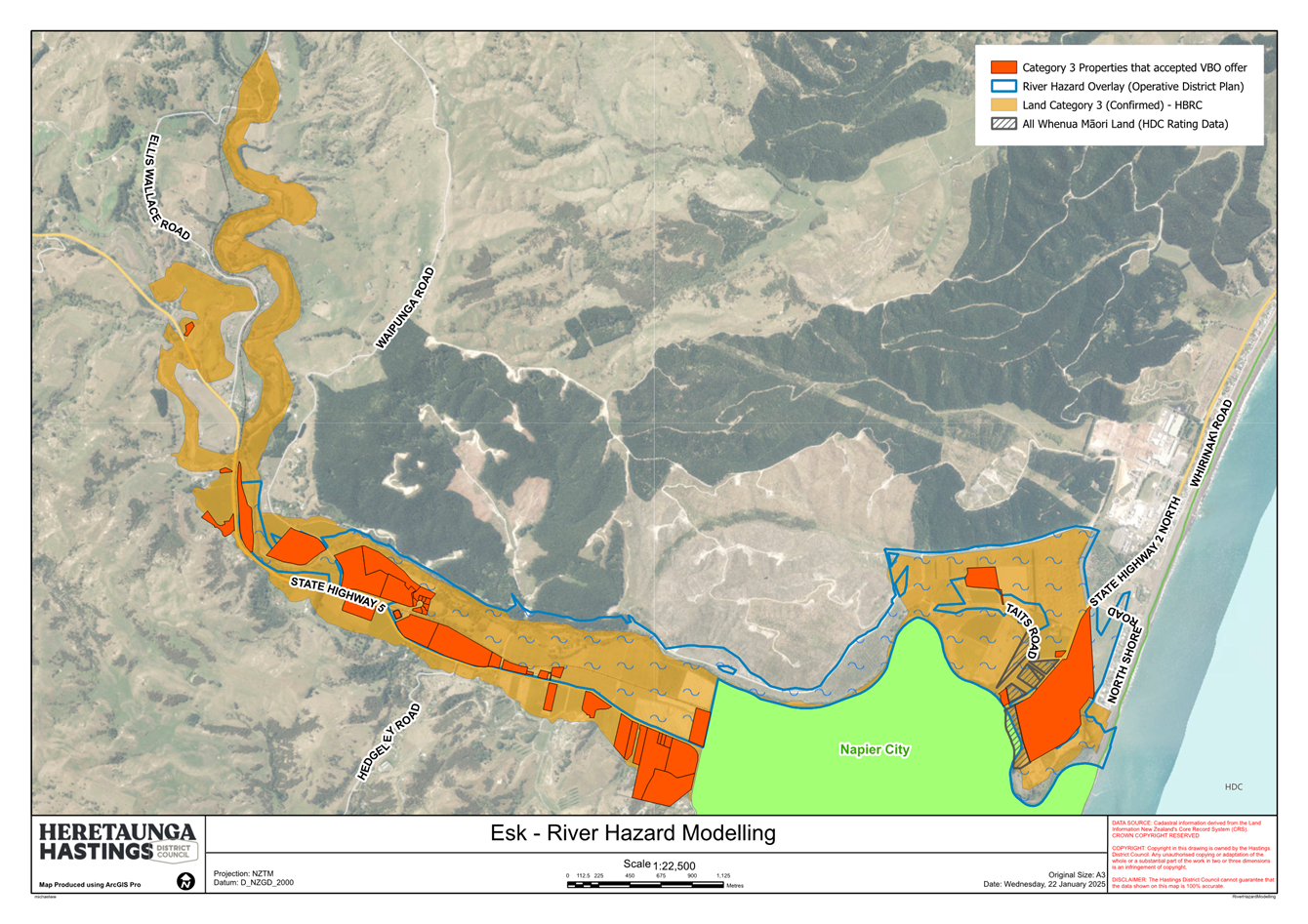
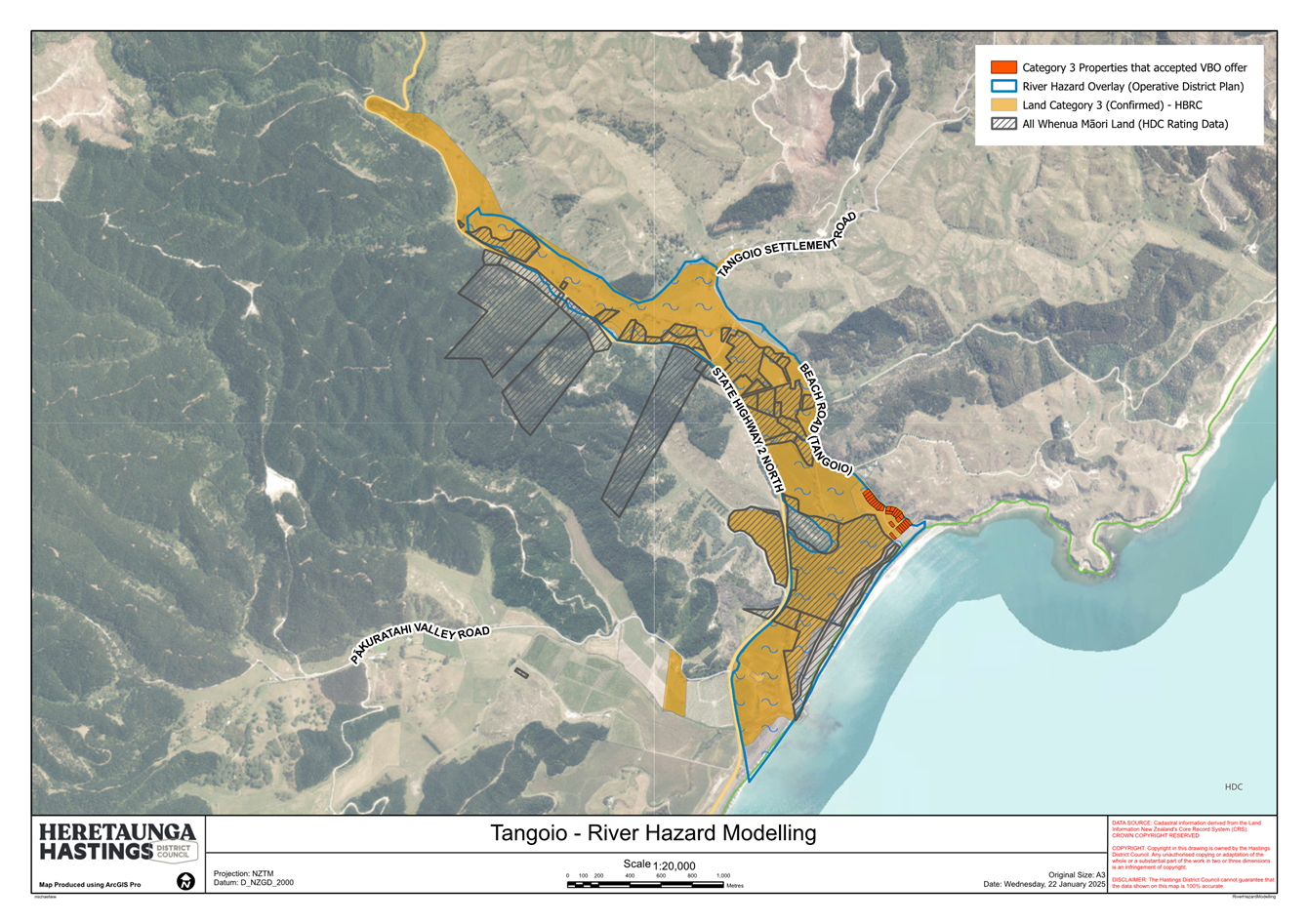
|
Tuesday, 18 February 2025
|
Hastings
District Council: Council Meeting
Te Rārangi Take
Report to Council
|
Nā:
From:
|
Emma Morgan, Community
Strategies Manager
Kevin Carter, Community
Grants and Partnerships Advisor
|
|
Te Take:
Subject:
|
Summary of
Recommendations of the Rural Halls Subcommittee meeting held Monday 9
December 2024
|
1.0 Summary
1.1 The purpose of this
report is to advise that the recommendations from the Rural Halls Subcommittee
held on Monday 9 December 2024 require ratification by Council.
1.2 The relevant Rural
Halls Subcommittee recommendations to be ratified are set out below.
|
2.0 Recommendation– Ngā Tūtohunga
A) That
Council receive the report titled “Summary of Recommendations of the
Rural Halls Subcommittee meeting held Monday 9 December 2024”.
B) The
following recommendations of the Rural Halls Subcommittee meeting held 09
December 2024 be ratified:
B) That the Rural
Halls Subcommittee notes Council’s request for cost-saving and
efficiency options to be identified.
C) That the Rural
Halls Subcommittee recommends that the full Rural Hall Maintenance Fund be
retained for 2024/2025 and that $2,000 be allocated to each of the 23 halls
subject to required information, with the remaining $4,000 ring fenced for
training and capacity building, as per Council’s adoption of the Rural
Halls Maintenance Fund Policy on 14 March 2024.
D) That the Rural
Halls Subcommittee notes further information on halls agreements and asset
maintenance plans is required to inform 2025 – 2027 cost-saving
considerations.
|
3.0 Background – Te Horopaki
3.1 The purpose of the
report to the Rural Halls Subcommittee was to seek a recommendation for Council
on the Rural Halls Maintenance Fund budget for 2024/2025.
3.2 Following the adoption
of the Financial Strategy as part of the Long-Term Plan, officers were directed
to identify cost-saving and efficiency options for 2024 – 2027. One of
the options was to reduce the Rural Halls Maintenance Fund.
3.3 There are 23 halls
recognised in the Hastings District rural hall network (Attachment 1). Through
various other external recovery funding, 17 of these halls have recently
received capital funding to contribute to community resilience.
3.4 Although many halls
have benefited from recent capital investment, most are experiencing increased
operational costs. In response to this, the Rural Halls Maintenance Fund Policy
was reviewed to enable a $2,000 annual payment to each of the 23 halls per annum
for operational or capital costs. The reviewed policy was adopted by Council on
14 March 2024.
3.5 In line with the 14
March 2024 Council resolution, the 2024/2025 Rural Halls Maintenance Fund has
been committed to the 23 halls, at $2,000 each, but has not yet been paid. The
remaining $4,000 is ringfenced for training and support for the Rural Halls. This
is all within the current budget.
3.6 Various options for
retaining, reducing and removing the 2024 - 2027 Rural Halls Maintenance Fund were
reported to the Rural Community Board on 16 September 2024, for feedback. A
report was then taken to the Rural Halls Subcommittee on 9 December, with the
recommendation that the 2024/2025 fund be retained and distributed as per the
14 March 2024 Council resolution.
3.7 Officers will readdress
cost-saving options for the 2025/2026 and 2026/2027 budgets once further
information on rural halls is gathered.
Attachments:
|
1⇩
|
Rural Halls Map 2024
|
COP-01-9-7-24-10
|
|
|
Item 16 Summary
of Recommendations of the Rural Halls Subcommittee meeting held Monday 9
December 2024
|
|
Rural
Halls Map 2024
|
Attachment 1
|
|
Tuesday, 18 February 2025
|
Hastings
District Council: Council Meeting
Te Rārangi Take
Report to Council
|
Nā:
From:
|
Louise Stettner,
Manager, Democracy & Governance Services
|
|
Te Take:
Subject:
|
Summary of
Recommendations of the Civic Development Subcommittee Meeting held on 4
February 2025
|
1.0 Summary
1.1 The purpose of this
report is to advise that the recommendations from the Civic Development
Subcommittee meeting held on 4 February 2025 relating to the upcoming
appointments process for Te Mata Park Trustee vacancies require ratification by
Council.
1.2 To provide context,
the following information is provided as set out below.
1.3 The Te Mata Park Trust
Board will have two vacant trustee positions from 30 June 2025 arising from the
terms of Michael Bate and Michael (Mike) Devonshire expiring. There will
also be a vacancy for the Trust Board’s ‘Aspiring Trustee’
role.
1.4 Council is responsible
for appointing 6 trustees (2 of these must be councillors) to the Te Mata Park
Trust. Council appointed trustees are allowed to serve three (3 year)
terms (maximum of 9 years). The two Councillors on the Trust are appointed
for the duration of each triennium. These roles are unpaid.
1.5 While the Aspiring
Trustee role does not have the legal responsibilities of being a trustee, he or
she can participate fully in Trust discussions. Appointment of the
Aspiring Trustee role does not need to be made via a Council resolution and can
be confirmed by the Te Mata Park Trust Board.
1.6 Considering the
pending vacancies on the Te Mata Park Trust Board it is timely for an
appointments process to now commence.
1.7 The first decision for
the Council to make before the appointments process can begin is whether the
vacant positions should be advertised. The Civic Development Subcommittee
recommends to Council that the positions be advertised providing an open and
transparent process for those in the community who may wish to apply.
1.8 The Civic Development
Subcommittee will oversee the appointments process and will recommend to the
Council (at a later date) in regard to the names of the proposed appointees to
fill the vacancies on the Te Mata Park Trust Board.
1.9 The relevant Civic
Development Subcommittee recommendations to be ratified are set out below.
|
2.0 Recommendation– Ngā Tūtohunga
A) That
Council receive the report titled “Summary of Recommendations of the
Civic Development Subcommittee Meeting held on 4 February 2025”.
B) The
following recommendations of the Civic Development Subcommittee meeting held on
4 February 2025 be ratified:
“Item
6 – Appointments to the Te Mata Park Trust Board”
C) That the Civic Development
Subcommittee recommend to Council, at the 18 February 2025 Council meeting,
that the two upcoming vacant trustee positions and the Aspiring Trustee
position on the Te Mata Park Trust be advertised.
|
Attachments:
There are no attachments for this report.
|
Tuesday, 18 February 2025
|
Hastings
District Council: Council Meeting
Te Rārangi Take
Report to Council
|
Nā:
From:
|
Louise Stettner,
Manager, Democracy & Governance Services
|
|
Te Take:
Subject:
|
Appointment to the
Hearings Committee
|
1.0 Purpose and summary - Te Kaupapa Me Te Whakarāpopototanga
1.1 This report recommends
the appointment of Councillor Te Au-Skipworth to the Hearings Committee for the
remainder of the 2022-2025 triennium.
1.2 At the 12 December
2024 Council meeting the Mayor presented the Making Good Decisions Foundation
Programme certificate to Cr Te Au-Skipworth. The certificate was awarded
on the 22nd of November 2024 and is valid until the 31st
of December 2027.
1.3 The completion of the
Making Good Decisions Foundation is a pre-requisite for Hearings Committee
membership.
1.4 The membership of the
Hearings Committee is currently made up of Mr George Lyons (Chair –
external Appointee), Cr Kerr (Deputy Chair), Cr Lawson, Cr Schollum, Cr Corban
and Cr Buddo. Currently there are 4 vacancies on the Hearings Committee –
with up to 2 being elected members and 2 being external members.
1.5 The Schedule of
Appointments to Committees and Subcommittees will be updated in line with
Council’s decision.
|
2.0 Recommendations -
Ngā Tūtohunga
A) That Council receive the report titled Appointment to the
Hearings Committee dated 18 February 2025.
B) That Council
appoint Councillor Heather Te Au-Skipworth to the Hearings Committee for the
remainder of the 2022-2025 triennium.
|
Attachments:
There are no attachments for this report.
|
Tuesday, 18 February 2025
|
Hastings
District Council: Council Meeting
Te Rārangi Take
Report to Council
|
Nā:
From:
|
Louise Stettner,
Manager, Democracy & Governance Services
|
|
Te Take:
Subject:
|
Requests Received Under
The Local Government Official Information and Meetings Act 1987 (LGOIMA)
Update
|
1.0 Purpose and
summary - Te Kaupapa Me Te Whakarāpopototanga
1.1 The
purpose of this Report is to inform the Council of the number of requests under
the Local Government Official Information and Meetings Act 1987 (LGOIMA)
received from 21 November 2024 to 21 January 2025 and the status of those
requests as at the 31 January 2025.
1.2 This
issue arises from the provision of accurate reporting of information to enable
effective governance.
1.3 This
is an administrative report to ensure that Council is aware of the number and
types of information requests received and to provide assurance the Council is
meeting its legislative obligations in relation to the LGOIMA.
1.4 This
Report concludes by recommending that the LGOIMA requests (as in Attachment
1) be noted.
|
2.0 Recommendations -
Ngā Tūtohunga
A) That
Council receive the report titled Requests Received Under The Local
Government Official Information and Meetings Act 1987 (LGOIMA) Update dated 18
February 2025.
B) That
the LGOIMA requests received from 21 November 2024 to 21 January 2025, as set
out in Attachment 1 of the Report be noted.
|
Attachments:
|
1⇩
|
LGOIMA Report for 18 February 2025 Council Meeting
|
IRB-2-6-10-25-0037
|
|
|
Item 19 Requests
Received Under The Local Government Official Information and Meetings Act
1987 (LGOIMA) Update
|
|
LGOIMA
Report for 18 February 2025 Council Meeting
|
Attachment 1
|
|
Tuesday, 18 February 2025
|
Hastings
District Council: Council Meeting
Te Rārangi Take
Report to Council
|
Nā:
From:
|
Louise Stettner,
Manager, Democracy & Governance Services
|
|
Te Take:
Subject:
|
Proposed Amendments To
Schedule Of Meetings
|
1.0 Purpose and summary - Te Kaupapa Me Te Whakarāpopototanga
1.1 The
purpose of this report is to consider amendments to the schedule of Council and
Committee Meetings for the 2024 Meetings Calendar which was adopted by Council on
7 November 2024.
1.2 The
Local Government Act 2002, Schedule 7, Clause 19 states:
“A
local authority must hold meetings at the times and places that it
appoints”.
If a local authority adopts a schedule of meetings-
a) The schedule-
i) may cover
any future period that the local authority considers appropriate, and
ii) may be amended.
Although a local authority must hold the ordinary meetings
appointed, it is competent for the authority at a meeting to amend the schedule
of dates, times and number of meetings to enable the business of the Council to
be managed in an effective way.
1.3 It is
proposed that the meeting schedule be amended as outlined in the
recommendations of this report.
|
2.0 Recommendations -
Ngā Tūtohunga
A) That Council
receive the report titled Proposed Amendments To Schedule Of Meetings dated 18
February 2025.
B) That Council
adopt changes to the 2025 Schedule of Meetings as follows:
|
From Thursday 27
February 2025, 9am to
Tuesday 11 March
2025, 9am
Council Chamber
|
Postpone
|
Strategy and
Recovery Committee
|
|
From Tuesday the
25 February 2025, 10am to
Tuesday 25 March
2025, 10am
Landmarks Room
|
Postpone
|
Risk and Assurance
Committee
|
|
From Friday 21
March, 1pm to
Friday 28 March, 1pm
Landmarks Room
|
Postpone
|
Ōmarunui Refuse
Landfill Joint Committee
|
|
From Friday 21
March, 10am to
Friday 28 March,
10am
Landmarks Room
|
Postpone
|
Joint Waste
Futures Project Steering Committee
|
|
Attachments:
There are no attachments for this report.
HASTINGS DISTRICT COUNCIL
Council MEETING
Tuesday, 18 February 2025
RECOMMENDATION TO EXCLUDE THE PUBLIC
SECTION 48, LOCAL GOVERNMENT OFFICIAL INFORMATION AND
MEETINGS ACT 1987
THAT the public now be excluded from the following part of
the meeting, namely:
24 East
Clive Waste Water Treatment Plant - 'Outfall Pump Station and Land Based
Outfall Procurement Plan' Approval
The general subject of the matter to be considered while the
public is excluded, the reason for passing this Resolution in relation to the
matter and the specific grounds under Section 48 (1) of the Local Government
Official Information and Meetings Act 1987 for the passing of this Resolution
is as follows:
|
GENERAL SUBJECT OF
EACH MATTER TO BE CONSIDERED
|
REASON FOR PASSING
THIS RESOLUTION IN RELATION TO EACH MATTER, AND
PARTICULAR INTERESTS
PROTECTED
|
GROUND(S) UNDER
SECTION 48(1) FOR THE PASSING OF EACH RESOLUTION
|
|
|
|
|
|
24 East
Clive Waste Water Treatment Plant - 'Outfall Pump Station and Land Based
Outfall Procurement Plan' Approval
|
Section 7 (2) (i)
The withholding of the
information is necessary to enable the local authority to carry on, without
prejudice or disadvantage, negotiations (including commercial and industrial
negotiations).
Tender is yet to be
advertised and therefore commercial negotiations still need to take place.
|
Section 48(1)(a)(i)
Where the Local Authority is
named or specified in the First Schedule to this Act under Section 6 or 7
(except Section 7(2)(f)(i)) of this Act.
|