Kaupapataka
Agenda
|
Te Rā Hui:
Meeting date:
|
Wednesday, 19 March 2025
|
|
Te Wā:
Time:
|
1:00
PM
|
|
Te Wāhi:
Venue:
|
Council Chamber
Ground Floor
Civic Administration
Building
Lyndon Road East
Hastings
|
|
Te Hoapā:
Contact:
|
Democracy
and Governance Services
P: 06 871 5000
| E: democracy@hdc.govt.nz
|
|
Te Āpiha Matua:
Responsible Officer:
|
|
Heretaunga Takoto Noa Māori Standing Committee –
Terms of Reference
This is established between the Hastings District Council
and the Māori community.
Context
The Heretaunga Takoto Noa Māori
Standing Committee has been established by Council to continue the development
of strategic and sustainable relationships with Māori. Council also wishes
to empower Māori as much as possible to make decisions over their and the
wider community’s future. Council shall meet the intent and spirit of the
Council’s obligations set out in the legislation, more particularly the
obligations of the Local Government Act 2002;
·
Towards establishing and maintaining processes
that provide opportunities for Māori to contribute to the decision
processes of Council.
·
Fostering the development of Māori capacity
to contribute to these processes.
·
The provision of information to assist
Māori contribution to Council’s activities.
The Council wishes the Committee to reflect
a spirit of partnership between the Council and the community and to contribute
effectively to the Council’s activities. To enable this to occur the
Fields of Activity and Delegated Powers are framed with the widest scope
possible.
The Council wishes the Committee to assist
with the development of an integrated policy framework (based on Te Tiriti o
Waitangi Principles) for the Council aimed at delivering effective governance,
engagement and service delivery for Council’s Māori Communities.
Meetings of the Heretaunga Takoto Noa Māori
Standing Committee are supported by Council Kaumātua.
Fields of Activity
·
To provide policy advice with respect to the
District Plan, regarding provisions for Wāhi Tapu, Papakainga, and where
relevant to Māori, any other amendments to the Plan.
·
To provide input to the Long Term Plan and
Annual Plan with particular reference to those issues of importance to
Māori from within the District.
·
To support Council to embrace the principles of
Te Tiriti o Waitangi.
·
To provide insight into Māori and other
strategic community issues with particular reference to the Long Term Plan, the
effectiveness of the District Plan and the delivery of the Annual Plan.
·
To make decisions and provide advice on matters
of mana whenua wellbeing.
·
To approve and provide advice on Māori
economic wellbeing initiatives.
·
To assist Council as appropriate in conducting
and maintaining effective, good faith working relationships with Māori
communities across the district including advice on governance arrangements.
·
To make decisions as to the allocation of Marae
Development Fund grants within the allocated budget.
·
To make decision on matters relating to
Māori community development and Māori community plans.
·
To make recommendations to Council on projects
requiring Māori input.
·
To assist Council with the development of an
integrated policy framework and work programme to enable effective governance,
engagement and service delivery for Council’s Māori Communities.
Membership (15
Members)
·
Chair – to be elected at the first meeting
of the Committee at the beginning of each triennium; and from among the
appointed mana whenua members of the committee.
·
Deputy Chair – to be elected at the first
meeting of the Committee at the beginning of each triennium from among the
elected members of the committee.
·
The Mayor.
·
6 Councillors including the 3 Takitimu Ward
Councillors.
·
Up to 8 members from Mana Whenua to be appointed
by the Council, taking into account the “post
settlement environment” and Mataawaka.
Quorum – at
least 8 members (one of whom must be a Councillor).
|
DELEGATED POWERS
1)
Authority to exercise all Council powers,
functions, and authorities in relation to the matters detailed in the Fields
of Activity such as to enable recommendations to the Council on those
matters.
2)
Authority to make decisions on the allocation
of Marae Development Fund grants within the allocated budget.
3)
Authority to develop procedures and protocols
that assist the Committee in its operation provided that such procedures and
protocols meet the statutory requirements of the Local Government Act 2002,
the Local Government Official Information and Meetings Act 1987 and
Council’s Standing Orders.
4)
Authority to approve Māori Community
Plans.
5)
Authority to approve projects or programs
relating to Māori Community Wellbeing within existing budgets.
6)
Authority to approve projects or programs
relating to Mana Whenua Wellbeing within existing budgets.
7)
Authority to approve projects or programs
relating to Māori Economic Wellbeing within existing budgets.
8)
To recommend to Council on projects that
require Māori input or oversight.
9)
To recommend to Council on planning and
regulatory matters that require Māori input or oversight.
The Chair shall not have a casting vote.
Note:
The Terms of Reference for the Heretaunga Takoto Noa Māori Standing
Committee are subject to review by the Committee at its first meeting in the
2022 Triennium.
|
Kaupapataka
Agenda
|
Mematanga:
Membership:
|
Koromatua
Chair: Mike Paku
Deputy Chair: Councillor Henry Heke
Ngā KaiKaunihera
Councillor members:
Mayor Sandra Hazlehurst
Councillors Ana Apatu, Alwyn Corban, Kellie Jessup,
Heather Te Au-Skipworth and Hana Montaperto-Hendry
Mana Whenua members: (up to 8 members)
Tipene Cottrell; Ngaio Tiuka; Tom Keefe; Elizabeth Waiwiri-Hunt,
Charmaine Butler, Pōhatu Paku and Api Robin
Kaumātua: Jerry Hapuku
|
|
Tokamatua:
Quorum:
|
At least 8 members (one of whom
must be a Councillor)
|
|
Apiha Matua
Officer Responsible:
|
Petera Hakiwai – POU AHUREA
MĀTUA: Principal Advisor Relationships, Responsiveness & Heritage
Office of the Chief Executive
|
|
Te Rōpū Manapori me te Kāwanatanga
Democracy & Governance Services:
|
Lynne Cox (Ext 5632)
|
Te Rārangi Take
Order of Business
|
1.0
|
Prayer
- Karakia
|
|
|
2.0
|
Apologies
& Leave of Absence – Ngā Whakapāhatanga me te Wehenga ā-Hui
At the
close of the agenda no apologies had been received.
At the
close of the agenda no requests for leave of absence had been received.
|
|
|
3.0
|
Conflict
of Interest –
Mahi Kai Huanga
|
|
|
4.0
|
Confirmation
of Minutes –
Te Whakamana i Ngā Miniti
Minutes of the
Heretaunga Takoto Noa Māori Standing Committee Meeting held Wednesday 20
November 2024.
(Previously circulated)
|
|
|
5.0
|
Te
Huinga Kauheke
|
9
|
|
6.0
|
Update
on the Transport Recovery Programme: Mana Whenua Engagement
|
11
|
|
7.0
|
Mātaitai/Rāhui
Application for Artificial Reef east of Pania Reef
|
17
|
|
8.0
|
Te
Hā o Waiaroha Policy Project Update
|
21
|
|
9.0
|
Waste
Management and Minimisation Plan Update
|
33
|
|
10.0
|
Flaxmere
Development Areas - Reserve Names and Design
|
39
|
|
11.0
|
Information
report on the Draft Local Alcohol Policy
|
53
|
|
12.0
|
Minor Items
– Ngā Take
Iti
|
|
|
13.0
|
Urgent
Items –
Ngā Take Whakahihiri
|
|
Hastings
District Council: Heretaunga Takoto Noa Māori Standing Committee Meeting
Te Rārangi Take
Report to Heretaunga Takoto Noa Māori Standing Committee
|
Nā:
From:
|
Charles Ropitini,
Principal Advisor: Relationships, Responsiveness & Heritage
|
|
Te Take:
Subject:
|
Te Huinga Kauheke
|
1.0 Purpose and summary - Te Kaupapa Me Te Whakarāpopototanga
1.1 The purpose of this
report is to introduce the Heretaunga Takoto Noa Kōmiti to Te Huinga
Kauheke and to inform the Kōmiti of their activities and aspirations for
2025.
1.2 Te Huinga Kauheke are
a growing group of more than 30 Māori kauheke aged 55 years+, who are
actively involved in their marae kaenga and whānau. The kauheke
gather from across the Heretaunga and Tamatea Districts.
1.3 Te Huinga Kauheke is a
dream envisioned by Mahinārangi Barlow-Bartlett of Wāimārama,
who wished for an opportunity for Kaumātua Māori to gather and
empower each other through the use of te reo Māori me ōna tikanga.
The dream was for a weekly class for kauheke to practice karakia, mihimihi, and
basic conversational skills with an outlook to communicate in te reo Māori
with their mokopuna.
1.4 Through kauheke
interviews Mrs Barlow-Bartlett identified that the need of the wiser generation
extended to revitalising te reo Māori me ōna tikanga across their
generation. The need for revitalising te reo Māori me ōna
tikanga sits alongside the needs of social interaction, health, upskilling, and
sharing natural gifts.
1.5 The goals of Te Huinga
Kauheke are:
· To
strengthen and revitalise our prestigious language of te reo Māori and its
traditions by empowering kauheke with karanga, whaikōrero, waiata, karakia
me ngā hītori.
· To
ensure our kauheke are healthy and spiritually enlightened.
· To
acknowledge and address any social, health and physical needs of kauheke.
· To
practise old and new learning of te reo Māori.
1.6 The name ‘Te
Huinga Kauheke’ was gifted to the group by Dr Jeremy Tatere MacLeod
through Ngāti Kahungunu Iwi Inc.
1.7 Te Huinga Kauheke is
currently supported by Te Puni Kōkiri who provide their boardroom as a
venue with use of their kitchen and provision of tea and coffee.
1.8 The CBD based Te Puni
Kōkiri offices have accessibility challenges for Te Huinga Kauheke
specifically with parking availability and accumulation of fines. The
popularity of the group is seeing their numbers grow and the boardroom of Te
Puni Kōkiri will not be sustainable should the group continue to grow.
1.9 Te Huinga Kauheke
thank the Heretaunga Takoto Noa Kōmiti for the opportunity to present the
success and current challenges of their group.
2.0 Heretaunga Ararau Te Reo Māori
Policy and Action Plan
2.1 The Pou Ahurea
Principal Advisor: Relationships, Responsiveness and Heritage notes that the
Heretaunga Ararau Te Reo Māori Policy Action Plan does not currently cater
for the language aspirations of kauheke.
2.2 The Heretaunga Ararau
Te Reo Māori Policy and Action Plan is at its natural review cycle
2020-2024 with an opportunity to engage Te Huinga Kauheke with intent to
develop a set of actions specific to kauheke.
3.0 Next steps – Te Ara Whaihua
3.1 The Pou Ahurea will
work with Te Huinga Kauheke and the Te Puni Kōkiri office to understand
current parking and accessibility challenges with the outlook to explore short
term parking solutions for ease of access to Te Puni Kōkiri for their Te Reo
Māori lessons.
3.2 The Pou Ahurea will
work with the Kaiwhakahaere for Community Centres for an appropriate venue for
Te Huinga Kauheke to relocate to that has parking and ease of access for Friday
Te Reo Māori lessons.
3.3 The Pou Ahurea will
engage Te Huinga Kauheke as a part of the review for the Heretaunga Ararau Te
Reo Māori Policy to capture actions specific to the needs and requirements
of Heretaunga kauheke.
|
4.0 Recommendations -
Ngā Tūtohunga
That the Heretaunga
Takoto Noa Māori Standing Committee receive the report titled Te Huinga
Kauheke dated 19 March 2025.
|
Attachments:
There are no attachments for this report.
Hastings
District Council: Heretaunga Takoto Noa Māori Standing Committee Meeting
Te Rārangi Take
Report to Heretaunga Takoto Noa Māori Standing Committee
|
Nā:
From:
|
Robert Whaitiri, Pou
Hononga - Mana Whenua Co-ordinator: Transportation Recovery
|
|
Te Take:
Subject:
|
Update on the Transport
Recovery Programme: Mana Whenua Engagement
|
1.0 Executive Summary
– Te Kaupapa Me Te Whakarāpopototanga
1.1 The purpose of this
report is to update the committee on the progress with the Hastings District
Council (HDC) Transport Recovery Programme in relation to engagement with Mana
Whenua, delivery of the programme and social outcomes from November 2024 to March
2025.
1.2 At the last September
2024 meeting of this committee, we informed the committee that an offer of
service for establishing the scope of engagement work required for repair sites
had been requested from each Mana Whenua group with cyclone repair work within
their area of interest. The application for an area-wide consent for the repair
of bridges and culverts was tabled. The Committee also approved that:
· Mana
Whenua would still be informed of all recovery work in their area of interest,
regardless of whether it requires resource consent
· Those
unique sites (bridge rebuilds, sites close to wāhi tapu) would still
require an in-depth approach additionally to the area-wide work
· That
engagement is ongoing about the transport recovery work after the area wide
approach has been agreed, and that the area-wide approach relates only to
transport cyclone recovery work
· Council
seeks expert advice to establish clear guidelines based on national best
practice for procurement of cultural advice in relation to infrastructure
recovery in the wake of national disaster.
· That
Council progress a proposal for additional training of contractors on resource
consent conditions by Mana Whenua groups as a mechanism to provide additional
protection for sites considering the volume of work required and the limited
resources available.
1.3 In the November
meeting of this Committee, a presentation summarising actions taken after this
approval was delivered, which outlined the development and delivery of the
first pilot contractor training and progress on establishing the scope of the
area wide engagement. Since that point:
· The
application for an area-wide resource consent for the repair of culverts and
bridges was approved by Hawke’s Bay Regional Council (HBRC) in December
2024.
· The
scope of engagement required is near completion, and a process for procuring
the work required is following the same process as procuring work HDC’s
panel of consultants.
· Three
more contractor trainings have been delivered. A debrief of these pilot
sessions is scheduled for 21 March. The intent of this is to identify strengths
and areas for improvement from feedback received to date to improve training
going forward. Hawke’s Bay Regional Council (HBRC) is now organising
their own training in a similar way.
· Construction
is underway on many major slip sites across Heretaunga and work on bridge sites
is underway.
· The
third Supplier Panel Hui has been held and was well attended. Contractors
reported on the social procurement outcomes to date and that information is
included in this report.
· Regular
hui have been established with the three mana whenua groups where the largest
volume of repair work is underway to improve collaboration and communication
about the large amount of work in progress.
1.4 The purpose of this
report is to provide an update on that scope, on the contractor training and on
the social outcomes of procurement through the Supplier Panel to date.
|
2.0 Recommendations -
Ngā Tūtohunga
That the Heretaunga
Takoto Noa Māori Standing Committee receive
the report titled Update on the Transport Recovery Programme: Mana Whenua
Engagement dated 19 March 2025.
|
3.0 Background – Te Horopaki
3.1 Overall, the scale of
the damage to the roading network is such that neither HDC nor our mana whenua
partners have the resource to treat each site individually in a
business-as-usual approach. Our shared goal is to restore the transport network
as quickly as possible for the benefit of our communities. Therefore, we
aimed to develop a transport recovery engagement approach which enables this
while ensuring all resource consent and statutory obligations HDC have to mana whenua
are met, and that Māori cultural concepts, values and practices are
safeguarded.
3.2 A draft proposed
structure (‘Strawman’) to support a specific Mana Whenua Engagement
Strategy was presented at the wānanga on 20 June. It was intended to
propose a general direction of travel and outline how mana whenua engagement
over the recovery programme might be resourced and function. It was also
intended to meet the request for one point of contact in relation to the
programme. Had it been agreed, it would have been put forward to the July
meeting of Heretaunga Takoto Noa Māori Standing Committee for agreement
and a transitional roadmap to set it up would have been developed.
However, while the governance role, and internal HDC Mana Whenua Coordinator
role proposed were accepted, the approach of Mana Whenua Taio roles in each
Mana Whenua Group, proportionate to the volume and scale of transport recovery
work was not accepted. An individual approach has been adopted instead, with
the engagement required for transport repairs required in each area of interest
being scoped by the appropriate PSGE or hapū.
3.3 Due to the volume and
scale of recovery work needed, with 224 major slips across the Hastings
district, a package approach is being taken to resource consent and to tender
the work. Area-wide consents were sought and granted for repair of 113 major
slips and 120 damaged bridges and culverts. A Suppliers Panel was established
in July 2024 comprised of: TW Civil & Infrastructure, Downer Group NZ, Hick
Bros Civil Construction Ltd and Tūpore Infrastructure. Three supplier
panel hui with PSGE have been held in August and November 2024 and March 2025.
The purpose of these is enable direct relationships to be established between
PSGE/hapū trusts and the Suppliers Panel.
3.4 Pōwhiri for the
panel contractors have been held at Omahu Marae (5 August 2024) and Wharerangi
Marae (17 October) as they began the first packages of repair work on Taihape
Rd (August), Dartmoor Rd, Puketitiri Rd and Glengarry Rd.
3.5 Figures on the social
outcomes of procurement from these panel contractors are included in the
presentation. Across 9 contracts to date and all 4 panel contracts:
· 218
people working on these contracts, living locally (incl. Tūpore
management)
· 6
cadets/graduates
· 114
identify as Māori or Pasifika
· 26
identify as wāhine
· 21
aged 15-24
· 26
engagements of local subcontractors through Panel contracts
3.6 In September 2024, in
recognition of the volume of work, it was approved that training of contractors
by mana whenua groups be developed and delivered to provide additional
protection for sites and enable cultural monitors to be focussed to the most
sensitive sites. The pilot round of training has now been completed, with
four sessions delivered, attended by each of the panel contractors and United
Civil (awarded the repair of Olrig Bridge). These have been delivered by
Te Piringa Hapū o Omahu, Maungaharuru-Tangitū Trust and Mana Ahuriri
Trust. A debrief of the pilot training is scheduled for 21 March with the
intention of reviewing and strengthening the sessions together.
3.7 From September 2024 to
December 2025, the scope of engagement required across 273 repair sites in the
Area of Interest of Tamatea Pokai Whenua, Mana Ahuriri,
Maungaharuru-Tangitū Trust and Piringa Hapū was established via a
desktop analysis of the GIS map followed by a site visit, if required. From
these sites, 43 (15%) were identified as requiring engagement prior to work
starting in addition to the area-wide consent conditions. There remain 31 sites
still to be confirmed as to the engagement needed. Most of these are in the
area in between the area of interest for Hineuru Iwi Trust and
Maungaharuru-Tangitū Trust.
3.8 Unique sites requiring
individual engagement: Cultural Impact Assessments (CIAs). To date, thirty-two
sites have been identified as requiring CIAs – nineteen bridge/culvert
rebuild sites and thirteen repair sites.

3.9 Engagement is ongoing
on sites where the CIA has been completed or is underway. These are significant
projects last 12-18 months in general, and the ongoing engagement requirements
on hapū are significant.
4.0 Discussion – Te Matapakitanga
4.1 The area-wide approach
has been time and cost effective and HDC are grateful to our mana whenua
partners for supporting it. It has saved the $3k/resource consent
application and reduced the number of CIAs required. Without this approach, the
burden of consenting would have delayed the programme and repair of the
network.
4.2 Even with the
area-wide approach, the volume and pace of work is stretching the capacity of
both Hastings District Council and mana whenua partners. New team members and
new contractors are working on a very large programme spread across the
district. We appreciate the support of all the stakeholders and have aimed to
establish channels of communication so that, where issues or concerns arise,
these can be addressed early.
4.3 The funding pressure
is to deliver the bulk of this repairs work by June 2025 to meet funding
constraints. This is placing pressure on the team and relationships, and the
volume of work, particularly within the areas of Mana Ahuriri Trust,
Maungaharuru-Tangitū Trust and Piringa Hapū, is significant. Officers
appreciate the mahi they have been doing in addition to the regular workload
and welcome any suggestions to further reduce any burden of administration.
5.0 Next steps – Te Anga Whakamua
5.1 Officers will provide
an update report to the Committee at their next scheduled meeting on the 28th
of May.
Attachments:
There are no attachments for this report.
|
Summary of
Considerations - He Whakarāpopoto Whakaarohanga
|
|
Fit
with purpose of Local Government - E noho hāngai pū ai ki te
Rangatōpū-ā-Rohe
The Council is required to give effect to the purpose of
local government as set out in section 10 of the Local Government Act 2002.
That purpose is to enable democratic local decision-making and action by (and
on behalf of) communities, and to promote the social, economic,
environmental, and cultural wellbeing of communities in the present and for
the future.
Link to the
Council’s Community Outcomes –
Ngā Hononga ki Ngā Putanga ā-Hapori
This proposal promotes the social
wellbeing of communities in the present and for the future.
|
|
Māori
Impact Statement -
Te Tauākī Kaupapa Māori
To enable participation and partnership
of mana whenua in work related to Cyclone Gabrielle Transportation Recovery
|
|
Sustainability
- Te
Toitūtanga
To support the consideration of Te Taio
and Te Mana o Te Wai in the Cyclone Gabrielle Transportation Recovery.
|
|
Financial
considerations -
Ngā Whakaarohanga Ahumoni
Cultural advice is being
procured following the same process used for the Panel of Consultants and
Contractors. This means HDC are issuing a Project Description Sheet (PDS)
requesting an Offer of Service for work. Once agreed, a purchase order is
issued. This process ensures consistent treatment of treaty partners, clarity
on the scope of work required and also ensure both parties are clear in
advance on the volume of work required, timeframe and cost. There is a cost
of the contractor training and other work, but it is proportionate to the
amount of work required to meet legislative requirements and support
engagement.
Capacity of Treaty Partners due to
the volume of work in combination with funding pressures to deliver by June
may become a factor for the programme.:
|
|
Significance
and Engagement - Te
Hiranga me te Tūhonotanga
N/A
|
|
Consultation
– internal and/or external - Whakawhiti Whakaaro-ā-roto / ā-waho
Consultation has been undertaken with :
o Mana
Ahuriri Trust
o Tamatea
Pōkai Whenua Trust
o Maungaharuru
-Tangitū Trust
o Ngāti
Hineuru Iwi Trust
o Te Piringa Hapū o
Ōmāhu
o WSP
|
|
Risks
Risks: volume and pace of work is placing
a strain on HDC and Treaty Partners and making effective communication more
challenging. This is a risk to relationships.
For example, need to assign bridge repair
work to specialised contractors and open tender/tight timeframes can make it
difficult to give appropriate timeframes for contractor training.
Opportunity: Opportunity to build
capability and capacity both with local contractors, 70 staff have attended
cultural training to date, and with HDC and PSGE.
|
|
Rural
Community Board –
Te Poari Tuawhenua-ā-Hapori
N/A:
|
Hastings
District Council: Heretaunga Takoto Noa Māori Standing Committee Meeting
Te Rārangi Take
Report to Heretaunga Takoto Noa Māori Standing Committee
|
Nā:
From:
|
Charles Ropitini,
Principal Advisor: Relationships, Responsiveness & Heritage
|
|
Te Take:
Subject:
|
Mātaitai/Rāhui
Application for Artificial Reef east of Pania Reef
|
1.0 Purpose and summary - Te Kaupapa Me Te Whakarāpopototanga
1.1 The purpose of this report
is for Mr Cameron Ormsby to present on behalf of the Napier Port’s Mana
Whenua Steering Kōmiti, an application under the Fisheries (Kaimoana
Customary Fishing) Regulations 1998.
1.2 The Napier
Port’s Mana Whenua Steering Kōmiti (The Kōmiti) are
representatives of Ahuriri marae, customary fisheries representatives, and
Ngāti Kahungunu Iwi Incorporated. The Kōmiti meets bi-monthly and
provides advice and direction to the Napier Port on Māori cultural matters
particularly regarding the management of the marine environment.
1.3 With the creation of
the new 6 wharf at the Napier Port and its opening in July 2022, an initiative
was put forward by recreational fisheries advocacy group Legasea, supported by
The Komiti, was to make use of the removed seawall’s limestone rocks for
the purpose of creating a new reef located approximately 1.5km to the east of
Pania Reef.
1.4 This reef currently
known as the ‘artificial reef’ has since been established and
measures approximately 9 hectares in area. The Committee is seeking a new name
for the reef with guidance provided by Ahuriri kaumātua.
1.5 In June 2023 an
application to establish a rāhui over the ‘artificial reef’
was put forward by Te Kaha Hawaikirangi on behalf of Ngāti Pārau
Hapū and Waiohiki Marae. The rāhui was granted for a period of
2-years by the Minister of Fisheries at the time. The current rāhui
established under the Fisheries Act 1996 (The Regulations) is due to expire in
June 2025. A rāhui prohibits any fishing occurring over a designated area.
1.6 Currently the
artificial reef is showing promising environmental signs where it is holding
good numbers of juvenile kōura/crayfish and has established kuku/mussels
on it. Fish including kahawai, kingfish, and blue cod are also making the reef
their home.
1.7 The intent of The
Kōmiti is that a second rāhui for a further 2-years be placed over
the ‘artificial reef’. The reason for this is that The Kōmiti
is wanting the mauri of the reef to grow, for mahinga kai to be abundant, and
for the ecosystem to be protected from fishing pressure and physical damage to
the reef while it is establishing. If a rāhui is granted, the intent of
the ‘The Kōmiti’ is to then apply for the area to be changed
from a rāhui area to a Mātaitai Fishing Area once the mauri of the
ecosystem has been shown to be healthy and able to sustain a limited amount of
customary and recreational fish take.
1.8 As part of the process
to apply for an extension of the rāhui under ‘The Regulations’
and a future Mātaitai, The Kōmiti is required to consult with
interested parties including tangata whenua, commercial and recreational fishery
interests, community groups, the Department of Conservation, Regional
Council’s, and Territorial Local Authorities.
1.9 Following the
pre-consultation process an application will be made to the Ministry for
Primary Industries for the 2-year extension of the rāhui, and then for the
establishment of a Mātaitai. This application process will involve a
publicly notified consultation process led by the Minister of Fisheries.
2.0 Outcomes sought – Te Whakataunga
2.1 The outcomes sought by
Napier Port’s Mana Whenua Steering Committee are:
· Written
support for the establishment of a 2-year rāhui over the artificial reef,
located approximately 1.5km east of the Pania Reef.
· Written
support for the establishment of a Mātaitai in the near future over the
artificial reef, located approximately 1.5km east of the Pania Reef.
· Written
support for the establishment of fisheries bylaws that manages the
Mātaitai area if established. These recreational fishing rules include:
- Potting
for fish/crayfish are prohibited from being used in the area of the
‘artificial reef’.
- Diving
for fish/crayfish using compressed air is prohibited from being used in the
area of the ‘artificial reef’.
- Set
nets and long lines are prohibited from being used in the area of the
‘artificial reef’.
3.0 Next steps
– Te Ara Whaihua
3.1 If the Heretaunga
Takoto Noa Māori Standing Committee support the outcomes sought by the
Napier Port’s Mana Whenua Steering Committee as outlined in section 2.1
Council Officers will prepare letters of support accordingly.
|
4.0 Recommendations -
Ngā Tūtohunga
A) That the Heretaunga
Takoto Noa Māori Standing Committee receive the report titled Mātaitai/Rāhui
Application for Artificial Reef east of Pania Reef dated 19 March 2025.
B) That the Heretaunga
Takoto Noa Māori Standing Committee support the following requests of
Napier Port’s Mana Whenua Steering Committee:
i. The
establishment of a 2-year rāhui over the artificial reef.
ii. The
establishment o a Mātaitai over the artificial reef.
iii. The
establishment of fisheries bylaws that manage the Mātaitai area if
established.
C) That the
Heretaunga Takoto Noa Māori Standing Committee do not support the requests
of Napier Port’s Mana Whenua Steering Committee.
|
Attachments:
There are no attachments for this report.
Te
Hui o Te Kaunihera ā-Rohe o Heretaunga
Hastings
District Council: Heretaunga Takoto Noa Māori Standing Committee Meeting
Te
Rārangi Take
Report to Heretaunga Takoto Noa Māori Standing Committee
|
Nā:
From:
|
Steve Cave, 3 Waters
Manager
|
|
Te Take:
Subject:
|
Te Hā o Waiaroha
Policy Project Update
|
1.0 Executive Summary – Te Kaupapa Me Te
Whakarāpopototanga
1.1 The
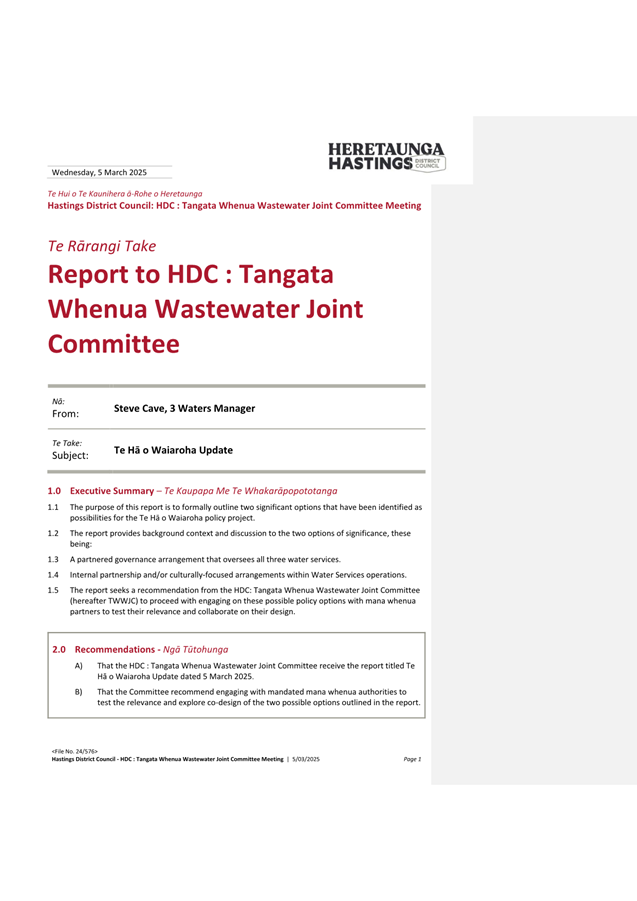
purpose of this cover report is to table with the Heretaunga Takoto Noa
Māori Standing Committee (hereafter Heretaunga Takoto Noa) the report
titled Te Hā o Waiaroha – Possible Policy Options (attachment
1) that was presented to the HDC: Tangata Whenua Wastewater Joint Committee
(hereafter TWWJC) on 5 March 2025.
This cover report also seeks direction
from those kōmiti members that represent mana whenua partners of Hastings
District Council (HDC) to confirm who to engage with from their organisations.
|
2.0 Recommendations - Ngā Tūtohunga
That the Heretaunga Takoto Noa
Māori Standing Committee receive the report titled Te Hā o Waiaroha
Policy Project Update dated 19 March 2025.
|
3.0 Background – Te Horopaki
3.1 The
rationale for tabling attachment 1 is to provide Heretaunga Takoto Noa with the
opportunity to review the progress made in the Te Hā o Waiaroha policy
project since officers last presented an address (on 11 September 2024).
3.2 The
attached report outlines the two significant instruments that have been
identified as possibilities for the Te Hā o Waiaroha policy. The subject
matter of the attached report is the same as the report presented to Heretaunga
Takoto Noa on 11 September 2024.
3.3 Since
September last year, a language change was adopted and in the attached report instruments
are referred to as options. Reasoning for this change was largely
based on the word instrument (in the context of this project) causing
confusion. Henceforth, for the purposes of the project, the words instrument
and option may be used interchangeably and efforts to minimise
confusion will be made.
3.4 In
addition to the language change, the attached report provides a more
comprehensive context and discussion than the report introducing the same
instruments/options to Heretaunga Takoto Noa in September last year. The
increased level of detail in the attached report was possible because analysis
of the instruments/options was further progressed between September 2024 and
February 2025. The original intention was for the two reports introducing the
significant instruments/options to Heretaunga Takoto Noa and TWWJC, to happen
in quick succession. This however wasn’t possible due to committee
schedules. The project team utilised the delay between addressing Heretaunga
Takoto Noa and TWWJC to progress with analysis which ultimately resulted in a
more comprehensive report to TWWJC. The intention was never for one kōmiti
to receive more information than the other.
3.5 Tabling
the attached report with Heretaunga Takoto Noa ensures that all members of both
kōmiti have access to the same information and the opportunity to formally
discuss that information.
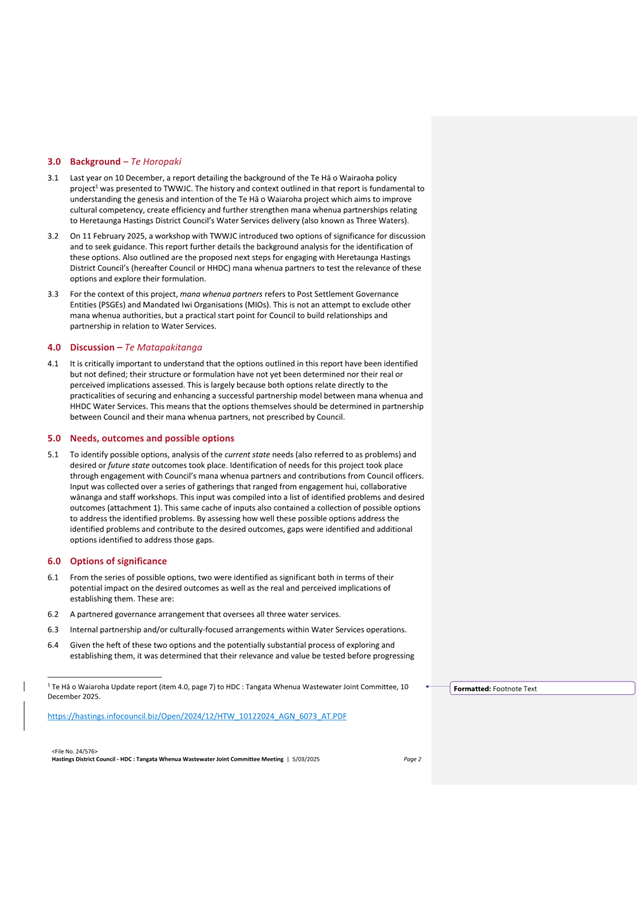
3.6 During
the 5 March address to TWWJC, a clarifying discussion took place regarding
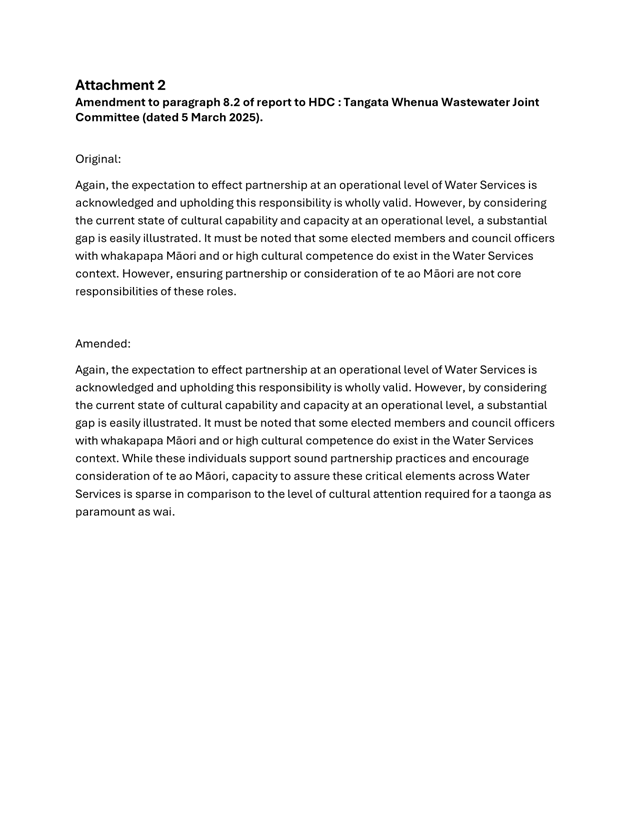
paragraph 8.2 of the report. To conclude that discussion, officers received an
action to amend 8.2 to more accurately articulate the point. Please refer to
attachment 2 to see the amendment.
4.0 Discussion –
Te Matapakitanga
4.1 The
two possible instruments/options have now been endorsed by Heretaunga Takoto
Noa and TWWJC as concepts to be explored in partnership with mana whenua. It
has been recommended by both kōmiti that engagement with mana whenua
partners should begin.
4.2 The
intention of the planned engagement process is to test the relevance and value
of these instruments and proceed with co-design.
4.3 Given
that many of Hastings District Council’s mana whenua partners are
represented on the Heretaunga Takoto Noa kōmiti, this meeting presents an
ideal opportunity to initiate the planned engagement. This is outlined in
section 5.0 below and will be led by Mike Paku, Chair of Heretaunga Takoto Noa,
with support from the engaged contractor (and the wider project team where
required).
5.0 Options –
Ngā Kōwhiringa
Option One -
Recommended Option - Te Kōwhiringa Tuatahi – Te Kōwhiringa
Tūtohunga
· Mana
whenua members support initiation of engagement by each:
· arranging
a time to engage on the instruments/options outlined in the attached report,
OR;
· identifying
another, appropriate representative of their organisation to engage on the
instruments/options outlined in the attached report.<Enter text>
Advantages
· Recommended
engagement with mana whenua partners is initiated.
· Potential
to alleviate some engagement fatigue by utilising existing meeting to initiate
engagement
Disadvantages
· No
disadvantages identified.
Option Two –
Status Quo - Te Kōwhiringa Tuarua – Te Āhuatanga o nāianei
Advantages
· No
advantages identified with the status quo.
Disadvantages
· Initiation
of engagement will be delayed.
· By
not utilising an existing meeting to initiate engagement there is potential for
increased engagement fatigue
6.0 Next steps –
Te Anga Whakamua
Begin engaging mana whenua to explore the conceptual
instruments/options outlined in the attached report.
Attachments:
|
1⇩
|
HDC : Tangata Whenua Wastewater Report 5 March 2025
|
CG-17-5-00083
|
|
|
2⇩
|
Amendment to paragraph 8.2 of the Te Hā o Waiaroha
Update report to the HC : Tangata Whenua Wastewater Committee
|
CG-17-5-00087
|
|
|
Item 8 Te
Hā o Waiaroha Policy Project Update
|
|
HDC :
Tangata Whenua Wastewater Report 5 March 2025
|
Attachment 1
|
|
Item 8 Te
Hā o Waiaroha Policy Project Update
|
|
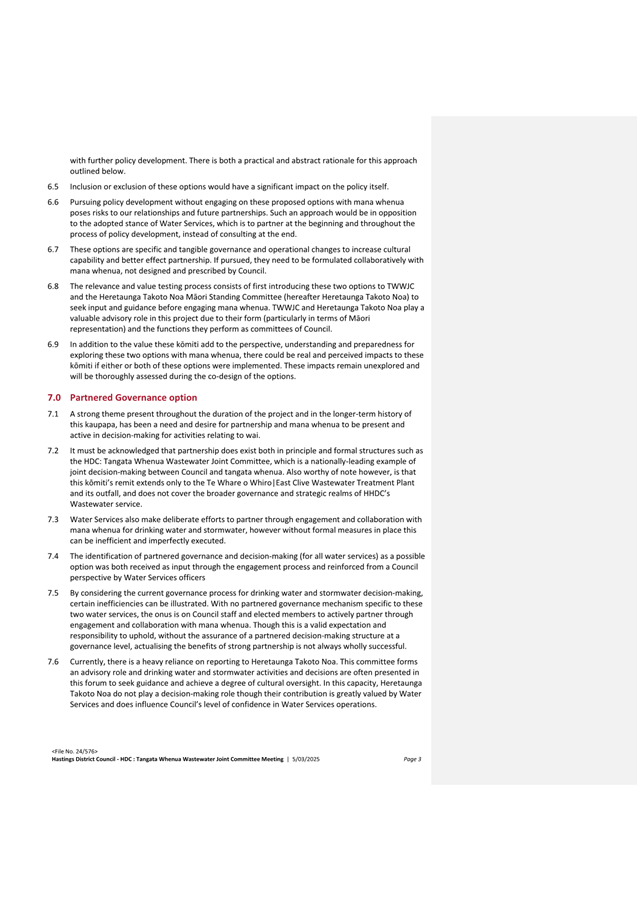
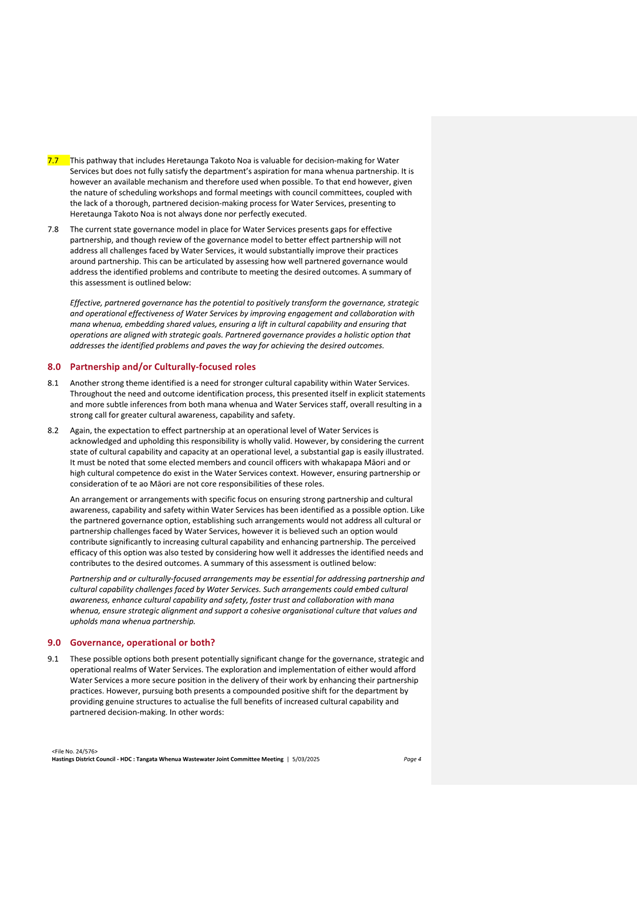
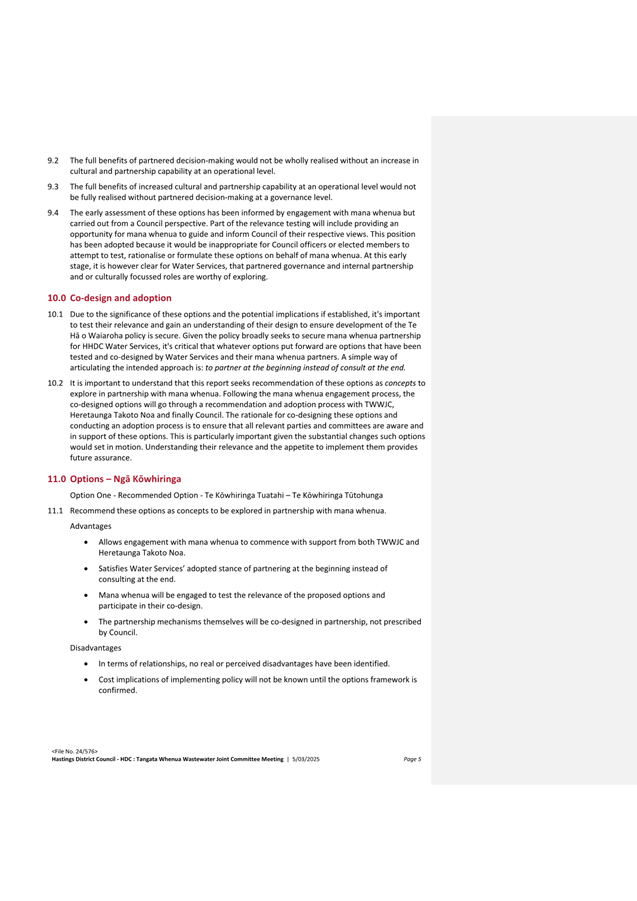
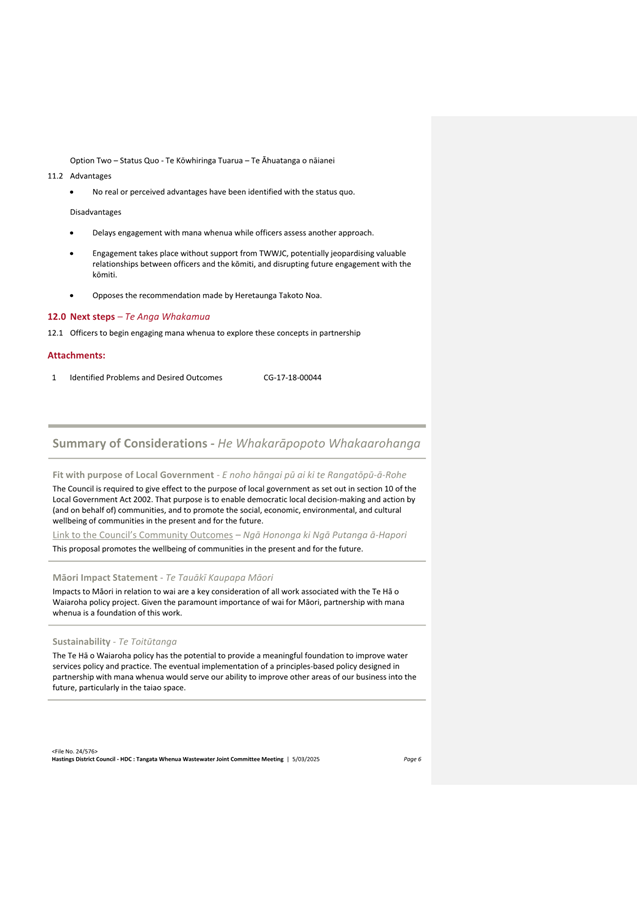
Amendment
to paragraph 8.2 of the Te Hā o Waiaroha Update report to the HC :
Tangata Whenua Wastewater Committee
|
Attachment 2
|
Hastings
District Council: Heretaunga Takoto Noa Māori Standing Committee Meeting
Te Rārangi Take
Report to Heretaunga Takoto Noa Māori Standing Committee
|
Nā:
From:
|
Jordarne Wiggins, Waste
Minimisation Specialist
|
|
Te Take:
Subject:
|
Waste Management and
Minimisation Plan Update
|
1.0 Executive Summary
– Te Kaupapa Me Te
Whakarāpopototanga
The purpose of this report is to
update the Heretaunga Takoto Noa Māori Standing Committee (Heretaunga
Takoto Noa) on progress with the Hastings District Council (HDC) and Napier
City Council (NCC) Joint Waste Management and Minimisation Plan (WMMP).
1.1 The report also
outlines the planned approaches for engaging mana whenua that are additional to
the legislated requirements of the Special Consultative Procedure (SCP). Where
possible, it is hoped that those kōmiti members who represent mana whenua partners
will either:
· provide
immediate feedback on the draft Joint WMMP
· wish
to connect at another time outside of this formal meeting of Heretaunga Takoto
Noa
· support
and direct officers to connect with other representatives of their organisation.
|
2.0 Recommendations -
Ngā Tūtohunga
A) That the Heretaunga
Takoto Noa Māori Standing Committee receive the report titled Waste
Management and Minimisation Plan Update dated 19 March 2025.
B) That any
members that represent mana whenua partners either:
i. Provide
immediate feedback on the draft joint WMMP
ii. Indicate
an intention to meet with officers and/or provide feedback on the draft Joint
WMMP outside of this formal meeting of Heretaunga Takoto Noa
iii. Support
and direct officers to connect with other representatives of their
organisation.
|
3.0 Background – Te Horopaki
3.1 On 11 September last
year, a report introducing the Joint WMMP review process was presented to
Heretaunga Takoto Noa. Then on 20 November 2024 another formal address was made
to the kōmiti, providing further updates on progress with the WMMP and detailed
some of the challenges faced as well as steps toward establishing and enhancing
partnership with mana whenua. Both reports provide important background and
context to the Joint WMMP process and outline the adopted approaches of the
Joint Waste Futures Project Steering Committee (hereafter JWFPSC) and Solid
Waste team for enhancing partnership with mana whenua.
3.2 Following the adoption
of the Joint Waste Assessment (attachment 1) on Monday 7th of October
2024 by JWFPSC, drafting of the Joint WMMP commenced. This draft Joint WMMP (attachment
2) has now been adopted by HDC (on 18 February 2025) and NCC (on 20
February 2025) respectively.
3.3 The draft Joint WMMP
provides a comprehensive but provisional plan for the next 6 years of waste
management and minimisation for Ahuriri Napier City and the Heretaunga Hastings
District, and now requires consultation with the Ahuriri Napier and Heretaunga
Hastings communities.
3.4 Consultation will take
place through the required SCP as prescribed by the Local Government Act 2002.
However, it has been identified by Solid Waste officers that these prescribed
expectations do not quite meet the partnership ethos adopted by JWFPSC or the
Solid Waste team; which is to genuinely approach engagement to better reflect
the rights of mana whenua as Council partners according to Te Tiriti o
Waitangi.
3.5 Additionally (as
referenced in last year’s workshop and formal meetings with Heretaunga
Takoto Noa), the process of engaging mana whenua for the Joint WMMP process has
been imperfect. This is attributable to:
· The time
constraints dictated by the Waste Management Act 2008 and cyclone-induced
delays.
· There being no
established process for engaging and partnering with mana whenua for the
development of a WMMP; this is the first Joint WMMP where councils have
actively prioritised partnership.
· Limited internal
capability and capacity to ensure engagement and partnership are being carried
out appropriately.
· Disparities in the
capacity of mana whenua to engage due to their significant commitments and
contributions across other kaupapa.
· Though the
approach to enhancing partnership with mana whenua for the Joint WMMP has been
earnest, the above factors mean that the ability of mana whenua to contribute
to the review and development process has been patchy. Consequently, the JWFPSC
and Solid Waste officers are motivated to establish engagement processes that
complements the SCP and emphasises the opportunity for mana whenua to influence
the Joint WMMP before its final adoption in August 2025.
4.0 Discussion – Te Matapakitanga
4.1 Both councils are
currently preparing to undertake the required SCP. The purpose of the SCP is to
provide the community with relevant, accessible information and allow any
person the opportunity to present their views on the subject matter, to
Council. The proposed SCP period begins 7 April to 11 May. The steps
of the SCP include:
· preparation
of a Statement of Proposal and a Summary
· public
consultation including consideration of written and oral submissions
· deliberation
in an open meeting of the Council.
4.2 These prescriptions of
the SCP do not satisfy JWFPSC or the Solid Waste team’s perspective of
appropriate engagement with mana whenua as Council partners. Though there is a
thorough appreciation for the purpose and value of the SCP from both governors
and officers in terms of consulting with the community, it is also acknowledged
that a deeper level of engagement is needed with mana whenua to genuinely
effect the partnership commitments made in the draft Joint WMMP.
4.3 For this reason, Solid
Waste officers will be reaching out directly to the Post Settlement Governance
Entities (PSGEs) and Mandated Iwi Organisations (MIOs) to ensure they are aware
of the draft Joint WMMP and supported (where required) in providing feedback.
This process will be fluid, and officers accept that not all partners will have
capacity to engage. Despite this, it's important to model the adopted stance of
JWFPSC and Solid Waste officers that has been laid out in the draft Joint WMMP.
There are also benefits for officers in building their practice for the ongoing
engagement and partnership with mana whenua.
4.4 The purpose of
bringing this report to Heretaunga Takoto Noa is to keep the kōmiti
informed of progress with the Joint WMMP process. It is also a good opportunity
to connect with those kōmiti members that represent mana whenua partners
who may:
· wish
to provide immediate feedback on the draft Joint WMMP
· wish
to connect at another time outside of this formal meeting of Heretaunga Takoto
Noa
· support
and direct officers to connect with other representatives of their
organisation.
5.0 Options – Ngā Kōwhiringa
Option One - Recommended Option - Te
Kōwhiringa Tuatahi – Te Kōwhiringa Tūtohunga
5.1 Mana whenua members:
· Provide immediate
feedback on the draft Joint WMMP.
· Connect with
officers at another time outside of this formal meeting of Heretaunga Takoto
Noa.
· Support and direct
officers to connect with other representatives of their organisation.
Advantages
· Feedback will be
adopted to enhance approaches for engagement.
· Increases
confidence and comfort in the intended approaches for engagement.
· Potential to
alleviate some engagement fatigue by utilising existing meeting to initiate
engagement.
Disadvantages
5.2 No disadvantages
identified.
Option Two – Status Quo - Te
Kōwhiringa Tuarua – Te Āhuatanga o nāianei
Advantages
· No advantages
identified with the status quo although lack of feedback on this report will
not be disruptive to the planned engagement approach.
Disadvantages
· Lack of feedback
on this report means officers are not aware of positive or negative components
of the planned approach and are not able to adjust if needed.
· By not utilising
an existing meeting to initiate engagement there is potential for increased
engagement fatigue.
6.0 Next steps – Te Anga Whakamua
6.1 Engage directly with
mana whenua partners about the draft WMMP.
Attachments:
|
1⇨
|
2024 Waste Assessment Report
|
SW-29-2-24-133
|
Under Separate Cover
|
|
2⇨
|
Draft Waste Management and Minimisation Plan (WMMP) 2025 -
2031
|
SW-29-2-25-141
|
Under Separate Cover
|
|
Summary of
Considerations - He Whakarāpopoto Whakaarohanga
|
|
Fit
with purpose of Local Government - E noho hāngai pū ai ki te
Rangatōpū-ā-Rohe
The Council is required to give effect to the purpose of
local government as set out in section 10 of the Local Government Act 2002.
That purpose is to enable democratic local decision-making and action by (and
on behalf of) communities, and to promote the social, economic,
environmental, and cultural wellbeing of communities in the present and for
the future.
Link to the
Council’s Community Outcomes –
Ngā Hononga ki Ngā Putanga ā-Hapori
This proposal promotes the all the
wellbeing’s of communities in the present and for the future.
|
|
Māori
Impact Statement -
Te Tauākī Kaupapa Māori
Given the significant impact waste has on te taiao, and
the importance of te taiao for tangata whenua, all mahi in this space
provides inference for impacts to Māori. It is the existing and future
impacts to Māori that form the basis of these engagement and partnership
approaches which are intended to enhance progress toward true partnership.
|
|
Sustainability
- Te
Toitūtanga
The Waste Assessment and Joint Waste
Management and Minimisation Plan aligns with many sustainability objectives
across the Councils and communities; including the Emissions Reduction Plan,
associated budgets and the HDC Eco District Strategy.
|
|
Financial
considerations -
Ngā Whakaarohanga Ahumoni
Funding for Council’s waste
services come from a mixture of:
· commercial
revenue (i.e. transfer station and landfill charges
· targeted
and general rates
· revenue
from the waste levy (this is a $60 per tonne waste levy, rising $5 each year
to $75 per tonne from 1 July 2027, administered by the Ministry for the
Environment, 50 per cent of which is distributed to territorial authorities,
amounting to $1,382,133 for Hastings District Council and $1,055,526 to
Napier City Council in 2023/24).
|
|
Significance
and Engagement - Te
Hiranga me te Tūhonotanga
This decision/report has been assessed under the Council's
Significance and Engagement Policy as being of moderate significance.
All WMMPs are subject to the requirements of the Local
Government Act’s (LGA) special consultative procedure, a requirement
also set out in the WMA Part 4, section 44 and section 50(3) which outlines
consultation requirements for preparing new plans.
Significant changes arising from the WMMP review will need
to be considered as part of each Council’s future LTP(s) or Annual Plan
depending on timeframes.
The public consultation methodology and programme will be
co-developed by Hastings District and Napier City Councils marketing and
communication teams. It is the intention of Council officers to provide
engaging face-to-face consultation alongside the more traditional digital
media and mail submissions.
|
|
Consultation
– internal and/or external - Whakawhiti Whakaaro-ā-roto / ā-waho
Sector engagement sessions were held in
November 2024 with the following sectors: food manufacturers (via the
Sustainable is Attainable programme) rural, waste operators, construction and
retail & not for profit.
Full community consultation will be
undertaken in early 2025 using the Special Consultative Process. A summary of
proposal will be the ain basis of community engagement.
This will meet our obligations under
section 83;1.a.ll of the Local Government Act.
|
|
Risks
The overall risk appetite for this
project (based on the risk register) is conservative.
The risk register is reviewed regularly
at the project team meetings.
Opportunity: Update the Joint Waste
Management and Minimisation Plan to meet legislative obligations and drive
community behaviour.
|
REWARD – Te Utu
|
RISK – Te Tūraru
|
|
The expected benefits from the project include; mana
whenua partnership, increased waste levy funding and greater commercial
waste diversion.
|
The high project risks are:
Limited staff capacity – concerns over staff
capacity to meet deadlines and deliver engagement opportunities.
Failure to meet government targets – this risk is
rated high based on the waste assessment find that not meeting government
targets for kerbside collections could lead to a loss of waste levy
funding.
|
|
|
Rural
Community Board –
Te Poari Tuawhenua-ā-Hapori
No direct impact at this stage. The Rural
Community Board members were invited to the rural sector engagement session.
|
Hastings
District Council: Heretaunga Takoto Noa Māori Standing Committee Meeting
Te Rārangi Take
Report to Heretaunga Takoto Noa Māori Standing Committee
|
Nā:
From:
|
Alex Mabin, Public
Spaces Policy Planner
|
|
Te Take:
Subject:
|
Flaxmere Development
Areas - Reserve Names and Design
|
1.0 Executive
Summary – Te Kaupapa Me Te
Whakarāpopototanga
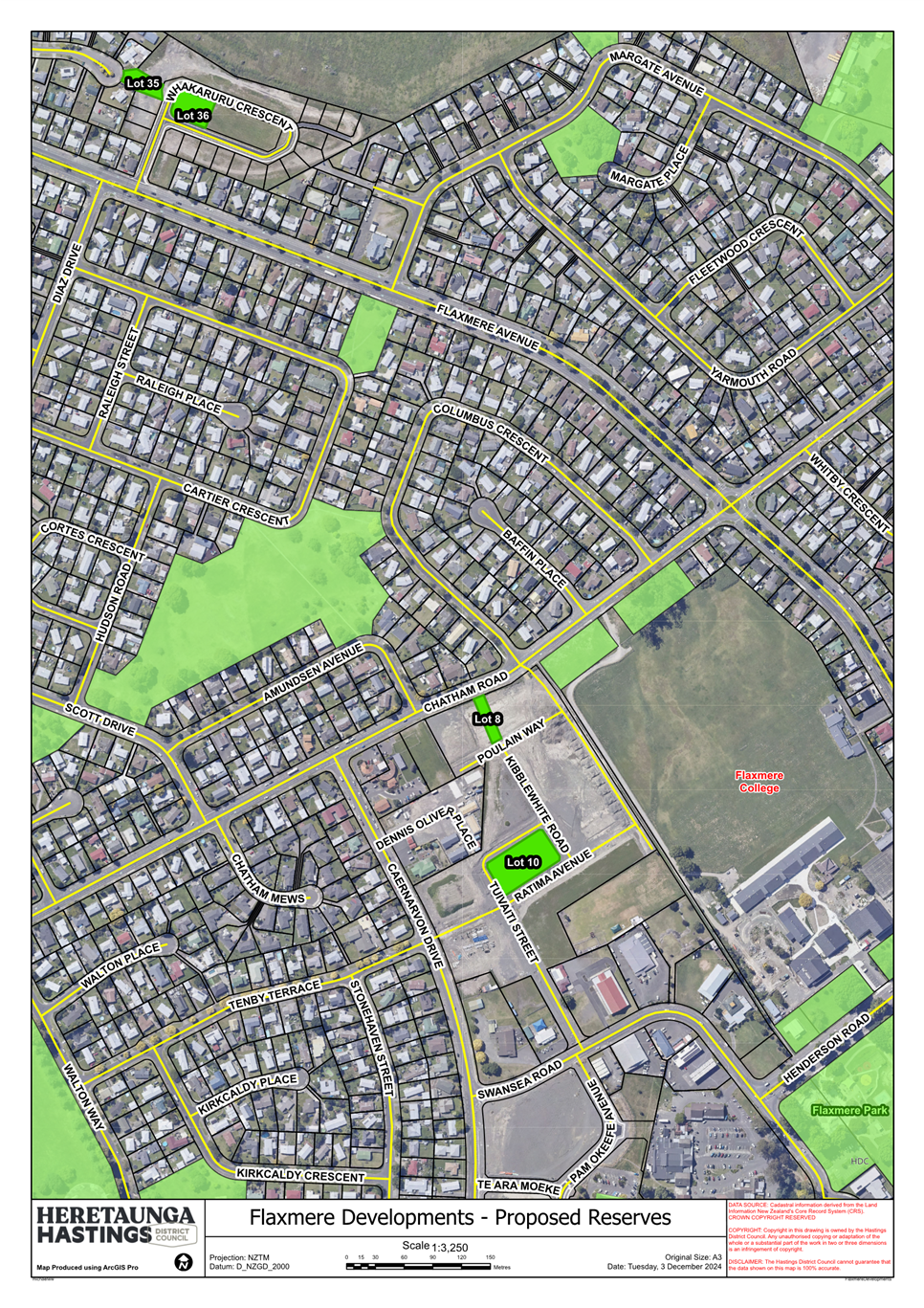
1.1 This
report seeks endorsement from the Committee on two issues relating to the
Flaxmere development areas at Whakaruru Crescent and Caernarvon Drive:
· The naming of four
reserves created in Flaxmere as part of Council’s development programme.
· The design of the
new reserves in the Whakaruru Crescent development area, following the
discovery during civil works of three pou whenua located approximately 5m
underground.
1.2 Following these
endorsements, this would allow the reserve names to be finalised and officers
to advance discussions with the Flaxmere Planning Committee, seek any
archaeological approvals required from Heritage New Zealand Pouhere Taonga for
Lots 35 and 36 and then proceed with the development of these reserves.
|
2.0 Recommendations - Ngā Tūtohunga
A) That
the Heretaunga Takoto Noa Māori Standing Committee receive the report
titled Flaxmere Development Areas - Reserve Names and Design dated 19 March
2025.
B) That the
Committee endorse the names listed below:
Whakaruru
Reserve (Lot 36)
Northlee
Reserve (Lot 35)
Tuivaiti
Reserve (Lot 10)
Poulain
Reserve (Lot 8)
C) That the
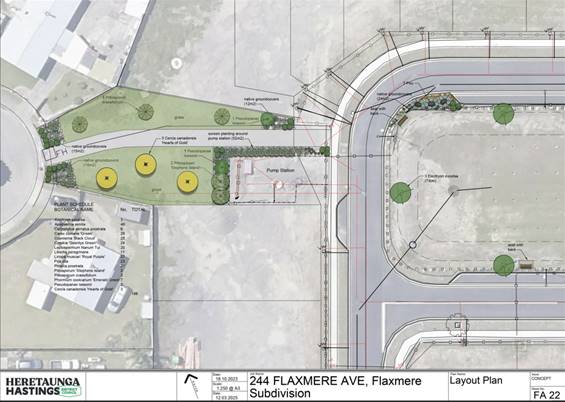
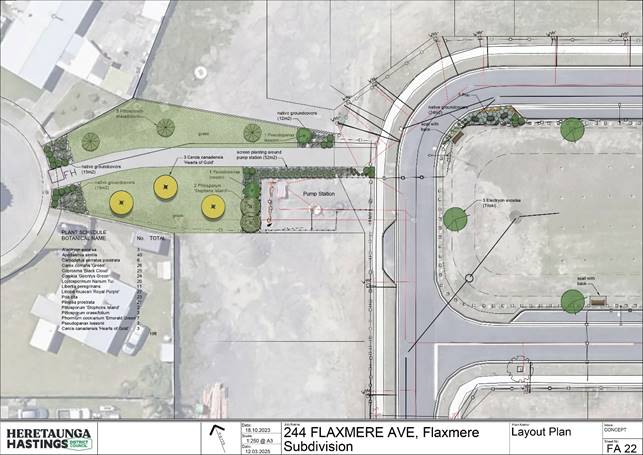
Committee endorse the design of Lots 35 and 36 as shown below and in
Attachment 3.
|
2.0 Background – Te Horopaki
2.1 In
recent years Council has been undertaking a development programme within
Flaxmere over three areas: Whakaruru Crescent (previously 244 Flaxmere Avenue);
72 Caernarvon Drive and 30 Swansea Road behind the Flaxmere town
centre. The development has encompassed primarily residential properties,
a commercial property, new roads, Three Waters infrastructure and new reserve
areas. All new roads within these developments have received road names
via Council’s Road Naming Policy.
2.2 Two new reserves have
been created at the Whakaruru Crescent development area (see Attachment
1):
· A detention basin
which can also be used as an informal recreation space (Lot 36)
· A link reserve
between Whakaruru Crescent and Northlee Place (Lot 35). A wastewater pump
station is also located on this reserve.
2.3 Two new reserves have
also been created within the Caernarvon Drive development area:
· A neighbourhood
reserve (Lot 10). A wastewater pump station is also located on this
reserve.
· A link reserve
connecting Poulain Way to Chatham Road (Lot 8).
2.4 Lot 36 and Lot 10 are
intended to each have three pou placed within them, together with shrubs, trees
and seating. The link reserves are intended to each have a path, shrubs
and trees.
2.5 There are no reserves
provided as part of the Flaxmere town centre development.
2.6 During civil works for
construction of the wastewater pump station in the Whakaruru Crescent area,
three pou whenua were discovered 5 metres underground: see Location Plan
below.
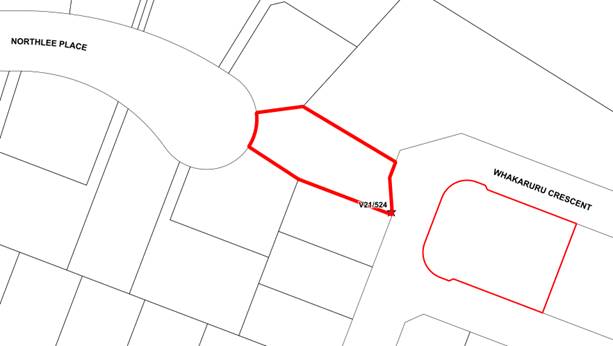
Location plan: Archaeological site
V21/524 in the linkage reserve, opposite the drainage reserve
2.7 Following discovery of
the pou whenua Elizabeth Pishief, Principal Heritage Specialist, on behalf of
Council obtained an archaeological authority for work on the site from Heritage
New Zealand Pouhere Taonga (2023/227, PRJ20-87-0234), following which the civil
works were completed. The site is now a registered
archaeological site (V21/254). Images of the pou taken at the time of
their discovery are set out below.
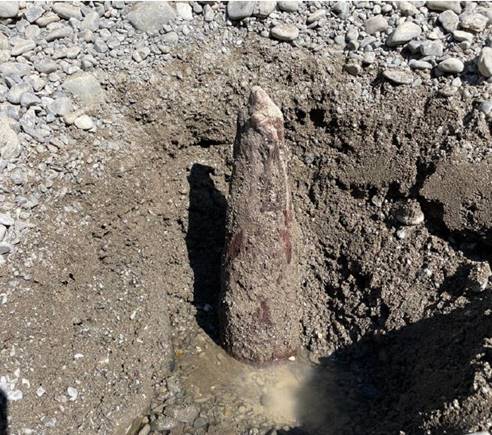
Image A: Pou uncovered during
excavation for wastewater treatment plant, August 2022
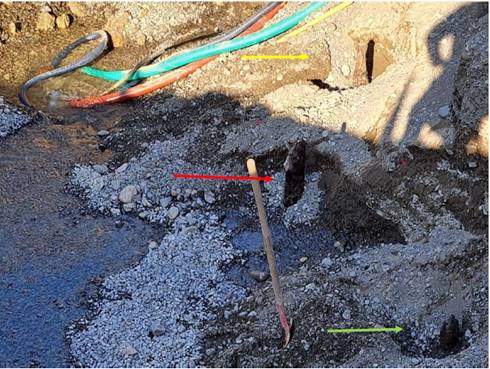
Image B: Three pou, August 2022
3.0 Discussion – Te Matapakitanga
Reserve Naming
3.1 The naming of new
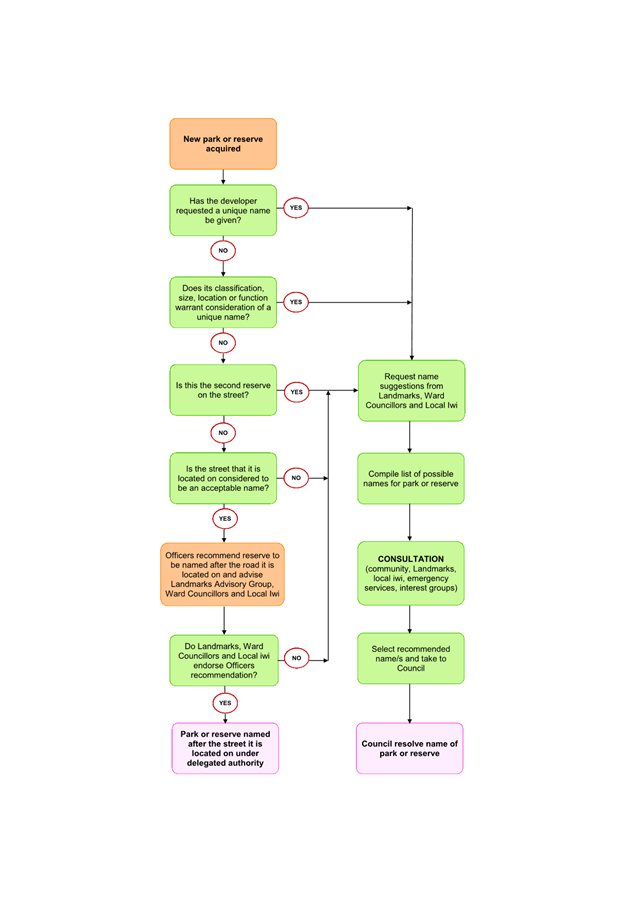
reserves is set out in Council’s Reserve Naming Policy (Attachment
2). This provides two alternative processes to be used, either
naming the reserve after the street it is located upon, or selection of a
unique name if the classification, larger size, location or function warrant
this.
3.2 In this instance,
given the small size of these four reserves and function either as access,
drainage or neighbourhood reserve, it is proposed to name them after the
streets they are located on.
· Lot 36 is located
on Whakaruru Crescent and is proposed to be named ‘Whakaruru
Reserve’. During the road naming process, Whakaruru Crescent was
put forward by Councillors O’Keefe and Oli to be named after Steve
Whakaruru, due to his life-long advocacy for the people of Flaxmere and for his
involvement in the creation and completion of Te Aranga Marae (per Road Naming
Report (24910#0072)).
· Lot 35 connects
Northlee Place with Whakaruru Crescent. Given the proposal to name
Lot 36 ‘Whakaruru Reserve’ and two reserves on the same street
cannot have the same name, it is proposed to name the link reserve
‘Northlee Reserve’.
· Lot 8 connects
Poulain Way with Chatham Road. There are already reserves named
‘Chatham Road Reserve’ therefore it is proposed to name this link
reserve ‘Poulain Reserve’.
· Lot 10, the
neighbourhood reserve in the Caernarvon Drive development area, has
four frontages, to three streets: Tuivaiti, Ratima and Kibblewhite.
During the road naming process Tuivaiti Street was put forward by Councillors
O’Keefe and Oli to be named after Tuivaiti Fetaiaimauso Tuivaiti, with an
extensive citation. The citation sets out Mr Tuivaiti’s
long-standing leadership in the community, including organisation of annual
kilikiti and volleyball tournaments. Tuivaiti is proposed as the reserve
name:
o Given Mr Tuivaiti’s extensive
leadership in community sports, it is considered appropriate to reflect this in
the naming of reserve space.
o Tuivaiti Street is the only street
which crosses two reserve frontages.
o Tuivaiti Street is a key linkage,
connecting the 72 Caernarvon development area to the Flaxmere town centre via
Swansea Road and Pam O’Keefe Ave.
3.3 The pathway for naming
the reserve after the street it is located on requires recommendation be made
to Landmarks Advisory Group, Ward Councillors and local iwi. The proposed
names:
· Were provided to
Councillor Heke, Flaxmere Ward Councillor (on 21 November 2024),
and Councillors Apatu, Jessup and Te Au-Skipworth, Takitimu Māori
Ward Councillors (on 11 December 2024). To date no feedback has
been received.
· Were presented to
the Flaxmere Planning Committee on 11 December 2024. The committee
endorsed the names pending completion of the consultation required under the
policy.
· Are being
presented to the Committee today, on the advice of Charles Ropitini,
Council’s Pou Ahurea. This, together with the presentation to the
Flaxmere Planning Committee, is to assist meeting the iwi consultation
requirement.
It is noted that the Landmarks
Advisory Group no longer exists and, as such, cannot be advised.
3.4 Given
the reasoning outlined above, the names recommended to the Committee are (see Attachment
1):
· Whakaruru
Reserve (Lot 36)
· Northlee
Reserve (Lot 35)
· Tuivaiti Reserve
(Lot 10)
· Poulain Reserve
(Lot 8)
Reserve Design
3.5 Given that there is
subsurface archaeology located underneath Lot 35 and with close proximity to
Lot 36, Officers are seeking feedback from the Committee. This area has
been highly modified through the civil works to create the residential lots, detention
basin and wastewater pump station, as well as road. The proposed
landscape plan shows the development of these reserves which is consistent with
development of reserves of this purpose and scale (see Attachment 3):
· Lot 35 currently
contains a wastewater pump station, footpath and bollards. It is proposed
to add trees, shrub planting at the gateway at Northlee Place and screen
planting with shrubs around the pump station.
· Lot 36 is a
detention basin contains bollards and grass. It is proposed to place the
pou whenua on the north-eastern corner surrounded by indigenous planting with
seating and several specimen trees. The pou whenua are being carved by Pitiera
Frank Wainohu which has been arranged by Charles Ropitini, Council’s Pou
Ahurea. The development of this site is constrained given the subsurface
crate installed for stormwater purposes located in the base of the reserve,
however this provides space for informal recreation i.e. to kick a ball, picnic
etc.
3.6 Officers have
discussed the proposed design with Piringa Hapu of Omahu Marae and are awaiting
feedback. Officers also intend to present the design to the
Flaxmere Planning Committee following this meeting.
3.7 Officers have
discussed the design with Elizabeth Pishief who has advised that the proposed
furniture, shrub planting and paths will not impact the subsurface
archaeology. Following her advice regarding the potential impact of tree
roots damaging the archaeological material, medium size shallow rooted trees
suitable for shade and amenity are proposed in both reserves.
4.0 Options – Ngā Kōwhiringa
Option One - Recommended Option -
Te Kōwhiringa Tuatahi – Te Kōwhiringa Tūtohunga
4.1 The Committee endorse
the names recommended in paragraph 4.5 above. The Committee also endorse
the reserve design as shown in Attachment 3.
Advantages
· The
reserves are named after the streets they are located on, which is appropriate
for the size and purpose of the reserves.
· Lots
35 and 36 as shown in Attachment 1 are developed in accordance with the
proposed landscape plan, avoiding impacts on subsurface archaeology.
Disadvantages
· Nil.
5.0 Next steps – Te Anga Whakamua
5.1 Reserve Naming: Guided
by the decision of the Standing Committee, if the proposed names are endorsed
today the reserve names will be presented back to the Flaxmere Planning
Committee then confirmed by the Public Spaces and Buildings Asset Manager under
delegated authority, with name signs then installed in the reserves.
5.2 Reserve Development:
Officers will confirm with Heritage New Zealand Pouhere Taonga whether an
archaeological authority is required to undertake development of both Lots 35
and 36. It is proposed that the reserves to be developed during the
winter 2025 planting season.
Attachments:
|
1⇩
|
Flaxmere Developments- Proposed Reserves
|
CG-17-5-00089
|
|
|
2⇩
|
Reserve Naming Policy
|
CG-17-5-00090
|
|
|
3⇩
|
Flaxmere Ave Planting Plan 1
|
CG-17-5-00088
|
|
|
Summary of
Considerations - He Whakarāpopoto Whakaarohanga
|
|
Fit
with purpose of Local Government - E noho hāngai pū ai ki te
Rangatōpū-ā-Rohe
The Council is required to give effect to the purpose of
local government as set out in section 10 of the Local Government Act 2002.
That purpose is to enable democratic local decision-making and action by (and
on behalf of) communities, and to promote the social, economic,
environmental, and cultural wellbeing of communities in the present and for
the future.
Link to the
Council’s Community Outcomes –
Ngā Hononga ki Ngā Putanga ā-Hapori
This proposal promotes the social,
environmental and cultural wellbeing of communities in the present and for
the future by providing recreation space with good quality amenity and
appropriate recognition of cultural features.
|
|
Māori
Impact Statement -
Te Tauākī Kaupapa Māori
Consultation as required under the
Reserve Naming Policy has been undertaken as described in this report and
through presentation to this Committee. The proposed reserve design has
been presented to Piringa Hapu of Omahu Marae for feedback.
Whakaruru Crescent is named after Steve Whakaruru, who
played a significant role in the development of Te Aranga Marae. The
naming of the larger reserve on Whakaruru Crescent is a chance to further
recognise Mr Whakaruru’s community involvement.
|
|
Sustainability
- Te
Toitūtanga
The proposed design of the reserves is
consistent with design of reserves of similar size and purpose within
Hastings District. The design provides for numerous trees providing
ecosystem services, together with indigenous shrub planting with biodiversity
benefits.
|
|
Financial
considerations -
Ngā Whakaarohanga Ahumoni
The development of these reserves is
provided for within the Flaxmere development area project budgets.
Operational expenses would be consistent with similar reserves across the
District and have been provided for in forward budgeting.
|
|
Significance
and Engagement - Te
Hiranga me te Tūhonotanga
This decision/report has been assessed under the Council's
Significance and Engagement Policy as being of low significance.
|
|
Consultation
– internal and/or external - Whakawhiti Whakaaro-ā-roto / ā-waho
Councillors Heke, Apatu, Jessup and Te Au-Skipworth have
been advised of the recommended reserve names. Flaxmere Planning
Committee have endorsed the recommended names, dependent on any comments
received from the Ward Councillors and completion of consultation.
Officers have discussed the reserve design with representatives of Omahu
Marae.
|
|
Risks
While the area is already highly
modified, the risk to the archaeology through the reserve design would be
mitigated by careful choice of tree species with smaller root zones. If
required, an archaeological authority will be obtained prior to commencement
of works.
|
|
Rural
Community Board –
Te Poari Tuawhenua-ā-Hapori
N/A.
|
|
Item 10 Flaxmere
Development Areas - Reserve Names and Design
|
|
Flaxmere Developments-
Proposed Reserves
|
Attachment 1
|
|
Item 10 Flaxmere
Development Areas - Reserve Names and Design
|
|
Reserve
Naming Policy
|
Attachment 2
|
|
Item 10 Flaxmere Development Areas -
Reserve Names and Design
|
|
Flaxmere
Ave Planting Plan 1
|
Attachment 3
|

Hastings
District Council: Heretaunga Takoto Noa Māori Standing Committee Meeting
Te Rārangi Take
Report to Heretaunga Takoto Noa Māori Standing Committee
|
Nā:
From:
|
Janine Green, Licensing
Inspector
|
|
Te Take:
Subject:
|
Information report on
the Draft Local Alcohol Policy
|
1.0 Executive Summary
– Te Kaupapa Me Te
Whakarāpopototanga
1.1 This report provides
information on the Hastings District Local Alcohol Policy (LAP) review and
provides a copy of the first draft Local Alcohol Policy (LAP) that will go out
for Special Consultative Procedure (SCP) under the Sale and Supply of Alcohol
Act 2012 (SSAA 2012) and the Local Government Act 2002 (LGA 2002).
1.2 The policy will be publicly
notified on the 14 March 2025. This will initiate the submission process under
the Special Consultative Procedure. Following this, the hearings process will
be conducted in late April 2025. During the hearings, all submissions will be
reviewed and considered, a preferred position will be formed. The Final Draft
LAP will be developed for Council approval.
1.3 Section 75 of the SSAA 2012 specifies that a Territorial Authority
(TA) may have a LAP relating to the sale, supply, or consumption of alcohol
within its district.
1.4 Under Section 77 of the Act, a LAP may include policies on location
of alcohol licences, density, maximum trading hours, one way door policies and
discretionary conditions.
1.5 The LAP cannot
include policies on matters unrelated to licensing such as the price of
alcohol, age limits for drinking or alcohol advertising and sponsorship.
1.6 The draft LAP attached as attachment
1 and has undergone a legal review.
1.7 The adoption of the first draft
LAP by council for consultation is an important step in gathering feedback from
the community and stakeholders, ensuring that the final policy considers a wide
range of perspectives.
1.8 The public consultation for
this policy is particularly important for this committee as research conducted
showed that Māori, Youth and Males were overrepresented in harm
statistics.
|
2.0 Recommendations -
Ngā Tūtohunga
A) That the Heretaunga
Takoto Noa Māori Standing Committee receive the report titled Information
report on the Draft Local Alcohol Policy dated 19 March 2025.
B) That the
Committee note:
The First Draft
of the Hastings District Local Alcohol Policy 2025, The Statement of Proposal
and Summary of Information (and associated documents) will go out for public
consultation in accordance with the Special Consultative Procedure required
by the Local Government Act 2002 and Sale and Supply of Alcohol Act 2012 on
the 14 March 2025.
|
3.0 Background – Te Horopaki
3.1 This report provides
information on the Hastings District Local Alcohol Policy (LAP) review
detailing the proposed changes to the current LAP and provides a copy of the
first draft of the revised Local Alcohol Policy (LAP) to go out for Special
Consultative Procedure (SCP) under the Sale and Supply of Alcohol Act 2012
(SSAA 2012) and the Local Government Act 2002 (LGA 2002).
3.2 Section 75 of the SSAA
2012 specifies that a Territorial Authority (TA) may have a LAP relating to the
sale, supply, or consumption of alcohol within its district.
3.3 Under Section 77 of
the Act, a LAP may include policies on any or all of the following matters
relating to licensing (and no others):
· Location of licensed premises by reference to broad areas;
· Location of licensed premises by reference to proximity to premises
or facilities of particular kinds;
· Whether further licences (or licences of a particular kind or kinds)
should be issued for premises in the district concerned, or any stated part of
the district;
· Restriction or extension of the default maximum licenced hours
· The issue of licences, or licences of a particular kind or kinds,
subject to discretionary conditions;
· One-way door restrictions.
3.4 The LAP cannot include
policies on matters unrelated to licensing such as the price of alcohol, age
limits for drinking or alcohol advertising and sponsorship.
3.5 On the 24th October
2024 Council resolved to continue to have a LAP, move to an individual LAP for
efficiency and create a joint working group with Napier City Council to assist
in consistency between the two policies where required.
3.6 Officers have
completed the following in the development of the first draft LAP:
· A Research Report, meeting the requirements under Section 78 (2) of
the SSAA 2012 has been developed (Attachment 2)
· Legislatively required stakeholder engagement was completed with the
Medical Officer of Health, NZ Police and Licensing Inspectors.
· An Issues and options paper which informs the changes to the LAP was
developed (Attachment 3)
· A draft LAP developed in coordination with Napier City Council (Attachment
1) and had its first legal review and necessary
amendments made.
· A suitable governance structure was developed with the delegation of
three councillors from both Hastings District Council (HDC) and Napier City
Council (NCC) and a Terms of Reference signed by both Councils.
· A Communications Plan was developed in coordination with NCC.
3.7 On the 18 February
2025, Council approved the first draft LAP to go out for consultation.
3.8 The Draft LAP includes
the following changes:
· A reduction of
trading hours for all licence types
· A one way door
from 1.00am for bars and taverns
· Continue the
restriction of no further bottle stores for Flaxmere and Camberley
· A new suite of
discretionary conditions
4.0 Discussion – Te Matapakitanga
4.1 As a part of the
review process literature analysis and data analysis from the Hawkes Bay
Hospital and NZ Police was completed. Below is a short summary of that
evidence, the full research is appended to this report. (Attachment 2 and 3)
4.2 Summary of
Evidence
4.3 Tourism
4.3.1 Hawke’s Bay is renowned for its art
deco architecture, festivals, and as a prominent wine and food production
region. It is the second largest wine region in New Zealand and a leader in red
wine production, gaining international recognition for its award-winning wines.
4.3.2 In 2023, total tourism expenditure in
Hawke’s Bay reached $696 million, a rise from $640 million in 2020 and
the tourism sector employed approximately 9,468 individuals, constituting 4.3%
of total employment in Hastings District.
4.3.3 According to Service IQ (2019) 2808 jobs
were filled specifically in bars and restaurants in Hawkes Bay in 2019.
4.3.4 Tourism contributed $106.6 million to
Hastings District's GDP in 2023.
4.4 Alcohol Licences
4.4.1 Hastings District
has a total of 259 alcohol licences as of January 2024. The breakdown is as
follows:
Ø Off
Licences: 111 (down from 118 in 2021)
Ø On
Licences: 120 (increase from 118 in 2021)
Ø Club
Licences: 28 (increase from 27 in 2021)
Ø Additionally,
there have been 119 special licences approved for events in Hastings District
between 1 June 2022 and 1 June 2023, up from 113 in the previous period
(2020-2021).
4.5 Hazardous Drinking
and harms
4.5.1 NZ Regional
Health Survey (2017-2020) indicated that 27.1% of residents in Hawke's Bay were
classified as hazardous drinkers and 12.2% of the population reported drinking
heavily at least weekly. This is slightly higher than the national figures
of 25.7% and 12% respectively.
4.5.2 While there has
been a national and regional decrease in hazardous drinking, Hawke's Bay
continues to experience higher-than-average rates.
4.5.3 According to the
2019/2020 New Zealand Health Survey, Māori adults were more likely to
engage in hazardous drinking compared to the general population. Around 24% of
Māori adults reported drinking at hazardous levels, which is higher than
the national average.
4.5.4 Māori have a
higher prevalence of binge drinking, defined as consuming large quantities of
alcohol in a short period, which is linked to a range of negative health and
social outcomes. Data from the New Zealand Health Survey showed that Māori
were more likely to report binge drinking episodes than other ethnic groups.
4.5.5 Hazardous
drinking is particularly concerning among younger Māori adults. Studies
show that Māori youth, especially those aged 18-24, have higher rates of
hazardous drinking compared to their non-Māori peers. This age group is at
an increased risk of alcohol-related harm, including accidents, injuries, and
alcohol dependence.
4.5.6 It has been
well-documented, including by the World Health Organization (2023), excessive
consumption of alcohol contributes to a range of serious individual, family and
community harms, including:
Ø criminal
offences
Ø diseases,
including alcohol-related cancers, cardiovascular disease, mental health
disorders including dementia, dependence, sexually transmitted infections,
etc., as well as alcohol poisoning and other health impacts such as increased
risk of stroke
Ø Foetal
alcohol spectrum disorder (FASD)
Ø accidental
injury due to intoxication, sometimes causing death (including many incidents
occurring in the home and on the roads)
Ø domestic
violence and child abuse or neglect
Ø harmful
effects on educational outcomes, workplace productivity, friendships, social
life, home life and the financial position of households
Ø the
public nuisance of litter, glass, noise, the damage and destruction of
property.
4.5.7 In addition, a
recent New Zealand study found that 26 percent of suicide deaths in New Zealand
involve acute alcohol use (higher than the World Health Organization's global
estimate of 19 percent)
And younger people
and Māori, have a higher proportion of suicide deaths involving alcohol. (NZIER. 2024. Costs of alcohol harms
in New Zealand: Updating the evidence with recent research. A report for the
Ministry of Health.)
4.6 Health data
4.6.1 In the calendar
year May 2023 – April 2024 there were approximately 54,089 presentation
to ED and of those 618 were alcohol related admissions (1.19%) and Maori, Males
and youth are over represented in this data.
4.6.2 As seen below, generally
Māori are over-represented in alcohol related harm statistics, other than
in two months of the year where ‘other’ had higher presentations.
Ethnicity rates of
presentations May 23 – February 24
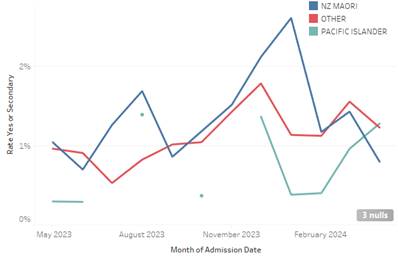
Hawkes Bay District Health
Board Business Performance & Intelligence, 2024
4.6.3 Of the admissions
into ED 27 were Resus and 422 were classed as an emergency or of urgent nature
in the year 2023-2024 which illustrates the severity of the harm occurring at
the community level.
4.7 NZ Police data
4.7.1 Alcohol
contributes to a significant number of committed offences both nationally and
within Hawke’s Bay. A significant proportion of police work involves
responding to alcohol-related incidents including violent offending, homicides,
drink-driving, family violence and ensuring the safety of intoxicated people or
those around them.
4.7.2 In the 2022-2023
period, there were 2,969
alcohol-related incidents recorded in the Hastings District. This number
decreased to 2,797
in 2023-2024, indicating a decrease
of 172 incidents or about a 5.8% reduction. There were a total
of 1263 family harm incidence in 2022-23 and 1058 in 2023-24, this represents
approximately 40% of all alcohol related incidence.
4.8 Literature
4.8.1 Alcohol causes significant
harms to individuals, whānau and communities, costing NZ an estimated $9.1
billion each year (NZIER, 2024).
4.8.2 Alcohol related harms are
not fairly distributed and health burden from alcohol is disproportionately
borne by Māori and male. Māori are twice as likely to die from
alcohol-related causes compared to non-Māori (Chambers, et al., 2024).
4.8.3 Māori
experience higher rates of alcohol-related harm, such as accidents, injuries,
and health conditions related to alcohol abuse (like liver disease). This harm
is often more severe, leading to greater numbers of Māori being
hospitalized for alcohol-related issues.
4.8.4 Māori are
more frequently involved in alcohol-related offenses, such as drink-driving or
violent behaviour. This can be linked to both higher alcohol consumption and
social factors, including socioeconomic disadvantage, which can increase the
likelihood of engaging in behaviours that result in legal consequences.
4.8.5 Māori are
disproportionately affected by poverty and other social determinants of health,
which can contribute to higher alcohol consumption and alcohol-related harm.
Financial stress, limited access to support services, and other factors can
exacerbate these issues.
4.9 Final conclusions
4.10 The research and the
issues and options paper present evidence confirming that alcohol-related
issues remain prevalent in the Hastings District, including patterns of heavy
consumption, health problems, traffic and crime offenses, and harm during
weekends, particularly late nights and summer months. The data suggests that
alcohol-related harm begins to rise after 9pm. It is recognised that
alcohol misuse affects both individuals and the wider community, with
significant associated costs.
4.11 Research and literature acknowledge
that Māori and youth are overrepresented in alcohol related harm
statistics and therefore further strengthening the LAP provisions may assist in
reducing alcohol related harm for these populations.
4.12 Implementation of the 2019 Local
Alcohol Policy (LAP) may have contributed to some positive changes,
particularly minor shifts in alcohol-related harm following adjustments to
licensing hours. However, harm reduction is best achieved through the continued
strengthening and tailoring of policy provisions over time.
4.13 Overall, the proposed changes to the
LAP are designed to build on the existing policy framework, focusing on further
reducing alcohol-related harm while recognizing the alcohol industry as a legal
and regulated sector. These revisions aim to support a vibrant and safe
night-time economy in the community, while ensuring that public health and
safety are prioritized.
4.14 Consultation (Special Consultative
Procedure)
4.15 Consultation will be completed through
the SCP between approximately the 14 March – 14 April 2025 with hearings
occurring mid to late April 2025.
4.16 Specific consultation will occur with
Māori and youth as they are overrepresented in statistics. Licensees will
also have additional consultation via the Alcohol Accord meeting.
4.17 Consultation will include:
· Social
media campaigns
· Public
meetings / stakeholder meetings
· Media
releases
· Flyers
and posters
· Email
outreach.
5.0 Next steps – Te Anga Whakamua
5.1 The consultation
documents and Draft LAP will be made publicly available and will be notified
for submissions on the 14 March 2025.
5.2 Information
will be available on the council website.
5.3 Following
the closure of the submission period (approximately 14 April 2025), a Council
Hearing Committee, consisting of up to four councillors will hear the
submissions.
5.4 A
preferred position paper will be developed providing the submission analysis
and detailing any proposed changes to the Draft LAP.
5.5 It is
important to note that there is no appeal process within this review. The LAP
will come into force 30 days after the public notification of its adoption by
The Council, with hours provisions coming into force 3 months after the
notification date.
5.6 NCC
will follow the similar procedure in parallel with HDC.
Attachments:
|
1⇨
|
FINAL First Draft LAP 2024 - non tracked (FINAL 20.2.25 -
legally checked) PDF
|
REG-14-3-25-322
|
Document 3
|
|
2⇨
|
FINAL LAP Research Report 2024 PDF - (FINAL 20.2.25)
|
REG-14-3-24-317
|
Document 3
|
|
3⇨
|
FINAL LAP Issue and Options paper 2024 (FINAL 20.2.25)
with FC
|
REG-14-3-25-323
|
Document 3
|
|
Summary of
Considerations - He Whakarāpopoto Whakaarohanga
|
|
Fit
with purpose of Local Government - E noho hāngai pū ai ki te
Rangatōpū-ā-Rohe
The Council is required to give effect to the purpose of
local government as set out in section 10 of the Local Government Act 2002.
That purpose is to enable democratic local decision-making and action by (and
on behalf of) communities, and to promote the social, economic,
environmental, and cultural wellbeing of communities in the present and for
the future.
Link to the
Council’s Community Outcomes –
Ngā Hononga ki Ngā Putanga ā-Hapori
This proposal promotes the performance of
regulatory functions for the purpose of preventing harm and creating safe and
healthy environments for people. The proposal also contributes towards
reducing public nuisance and threats to public health and safety through
appropriate policy controls for the wellbeing of communities in the present
and for the future.
|
|
Māori
Impact Statement -
Te Tauākī Kaupapa Māori
Māori and youth are overrepresented
in alcohol related harm statistics, however no known impacts for mana whenua
/ tāngata whenua outside the general community population specifically
in relation to this policy review.
To better understand the impact of
alcohol related harm to Māori there will be targeted consultation
through the SCP outlined below in the consultation section.
|
|
Sustainability
- Te
Toitūtanga
The policy is required under
the Act to be reviewed every six years.
|
|
Financial
considerations -
Ngā Whakaarohanga Ahumoni
The policy process will incur fees associated with a
legal review and costs for Special Consultative Procedure and administration /officer time. These will
be covered from existing Planning and Regulatory
budgets in the 2024-2025 years.:
|
|
Significance
and Engagement - Te
Hiranga me te Tūhonotanga
Section 79 of
the Act requires the use of the SCP under The LGA 2002, for the LAP Review.
|
|
Consultation
– internal and/or external - Whakawhiti Whakaaro-ā-roto / ā-waho
The LAP Review
must use the SCP under the LGA 2002. Specific consultation will be completed
with Māori, Youth and Licensees.
Specifically
for consultation to understand alcohol related impacts to Māori,
external engagement is proposed to take place with, but not limited to:
- Te Taiwhenua o Heretaunga
- Te Oranga o Te Matau-a-Māui Health Hawke’s Bay
Māori Partnerships Team
- Kahungunu Health Services (Choices) Māori Midwives
Alongside
consultation with Māori it is proposed to engage Kainga Pasifika
Services to understand the impact of alcohol related harm to Pasifika
communities.
|
|
Risks
|
REWARD – Te Utu
|
RISK – Te Tūraru
|
|
Public health benefits of
having a LAP –
reducing alcohol related
harm.
Providing tools for the
District Licensing Committee to regulate where and when alcohol is sold and
supplied in the region.
Supporting stakeholder
groups wish for the continuation of the LAP to protect and promote public
health and safety.
|
Provisions contained within the LAP may be too
restrictive or not restrictive enough.
|
|
|
Rural
Community Board –
Te Poari Tuawhenua-ā-Hapori
<Enter text> :
|