Kaupapataka
Agenda
|
Te Rā Hui:
Meeting date:
|
Thursday, 26 June 2025
|
|
Te Wā:
Time:
|
1.00pm
|
|
Te Wāhi:
Venue:
|
Council Chamber
Ground Floor
Civic Administration
Building
Lyndon Road East
Hastings
|
|
Te Hoapā:
Contact:
|
Democracy
and Governance Services
P: 06 871 5000
| E: democracy@hdc.govt.nz
|
|
Te Āpiha Matua:
Responsible Officer:
|
Chief Executive - Nigel Bickle
|
Kaupapataka
Agenda
|
Mematanga:
Membership:
|
Tiamana
Chair: Mayor Sandra Hazlehurst
Ngā KaiKaunihera
Councillors: Ana Apatu,
Marcus Buddo, Alwyn Corban, Malcolm Dixon, Michael Fowler, Damon Harvey, Henry
Heke, Kellie Jessup, Tania Kerr (Deputy Mayor), Hana Montaperto-Hendry, Simon
Nixon, Wendy Schollum, Heather Te Au-Skipworth and Kevin Watkins and one
councillor vacancy
|
|
Tokamatua:
Quorum:
|
8 members
|
|
Apiha Matua
Officer Responsible:
|
Chief Executive – Nigel
Bickle
|
|
Te Rōpū Manapori me te Kāwanatanga
Democracy and Governance Services:
|
Louise Stettner (Extn 5543)
|
Te Rārangi Take
Order of Business
|
1.0
|
Opening
Prayer – Karakia
Whakatūwheratanga
|
|
|
2.0
|
Apologies
& Leave of Absence – Ngā Whakapāhatanga me te Wehenga ā-Hui
At the
close of the agenda no apologies had been received.
Leave of Absence
had previously been granted to Councillor Kerr
|
|
|
3.0
|
Conflict
of Interest –
He Ngākau Kōnatunatu
Members need to be vigilant to stand aside from
decision-making when a conflict arises between their role as a Member of the
Council and any private or other external interest they might have.
This note is provided as a reminder to Members to scan the agenda and assess
their own private interests and identify where they may have a pecuniary or
other conflict of interest, or where there may be perceptions of conflict of
interest.
If a Member feels they do have a conflict of
interest, they should publicly declare that at the start of the relevant item
of business and withdraw from participating in the meeting. If a Member
thinks they may have a conflict of interest, they can seek advice from
the General Counsel or the Manager: Democracy and Governance (preferably
before the meeting).
It is noted that while Members can seek advice and
discuss these matters, the final decision as to whether a conflict exists
rests with the member.
|
|
|
4.0
|
Confirmation
of Minutes –
Te Whakamana i Ngā Miniti
Minutes of the
Council Meeting held Tuesday 10 June 2025.
(Previously circulated)
|
|
|
5.0
|
Mayor's
Verbal Update
|
7
|
|
6.0
|
Adoption
of 2025/26 Annual Plan
|
9
|
|
7.0
|
Resolution
to Set the Rates for the 2025/26 Financial Year
|
11
|
|
8.0
|
Adoption
of the Napier/Hastings Future Development Strategy
|
21
|
|
9.0
|
Adoption
of the Final Hastings District Local Alcohol Policy 2025
|
33
|
|
10.0
|
Splash
Planet - Options for Improvements and Operational Changes for 2025/26
Season
|
49
|
|
11.0
|
Requests
Received Under The Local Government Official Information and Meetings Act
1987 (LGOIMA) Update
|
63
|
|
12.0
|
Minor Items
– Ngā Take
Iti
|
|
|
13.0
|
Urgent
Items –
Ngā Take Whakahihiri
|
|
|
14.0
|
Recommendation
to Exclude the Public from Item 15
|
67
|
|
15.0
|
Ōhiti
Land Transfer to Hawkes's Bay Regional Council
|
|

Hastings
District Council: Council Meeting
Te Rārangi Take
Report to Council
|
Nā:
From:
|
Sandra Hazlehurst, Mayor
|
|
Te Take:
Subject:
|
Mayor's Verbal Update
|
1.0 Purpose and summary - Te Kaupapa Me Te Whakarāpopototanga
1.1 The purpose of this
report is to provide the opportunity for a regular verbal update from the
Hastings District Council Mayor regarding current activities and events.
|
2.0 Recommendations
- Ngā Tūtohunga
That Council receive the report titled Mayor's Verbal
Update dated 26 June 2025.
|
Attachments:
There are no attachments for this report.

Hastings
District Council: Council Meeting
Te Rārangi Take
Report to Council
|
Nā:
From:
|
Lex Verhoeven, Strategy
Manager
|
|
Te Take:
Subject:
|
Adoption of 2025/26
Annual Plan
|
1.0 Purpose and summary - Te Kaupapa Me Te Whakarāpopototanga
1.1 The
purpose of this report is to obtain a decision from Council on adoption of the
2025/26 Annual Plan, now that all Local Government Act 2002 compliance matters
have been completed.
1.2 The
Annual Plan has been prepared in accordance with the Council’s Financial
Strategy and meets all the financial benchmark measures within it.
1.3 The
Council had previously at its meeting dated 18 February resolved to set the
increase in rating requirement at 15% in accordance with Year Two of the
Long-Term Plan, and not to consult on the plan. An Annual Plan update
newsletter on the year ahead was distributed to residents across the district.
1.4 The
Plan gives effect to the Council resolutions passed at its 10 June and 17 June
meetings in relation to the adoption of the schedule of Fees and Charges
(Resource Management Act 1991 and Food Act 2014), and the direction to defer a
final decision on the Whakatu West Stormwater scheme.
1.5 This
report also gives effect to Council direction having considered a petition from
Grey Power Hastings in respect of free parking for over 65 residents and other
parking accessibility issues in the Hastings Central Business District. The
Council undertook to report back on findings for addressing the
petitioner’s concerns.
1.6 The
matters raised in the petition along with subsequent work completed by officers
on potential options and impacts were considered during Council’s Annual
Plan workshop. The Council provided direction that given the Council’s
fiscal position no financial provision could be made for free parking
initiatives and that the Parking Account could not be put into deficit.
For these reasons the 2025/26 Annual Plan for adoption does not contain any
financial provision for free parking initiatives. The Council may revisit
the issue or alternative options in the future.
1.7 The
final step in the process is one of technical compliance with the provisions of
the Local Government Act 2002 and therefore an administrative matter. No
audit approval is required.
1.8 Before
the Council can resolve to set the rates for the 2025/26 financial year, the
Council must first adopt the Annual Plan (to be circulated separately), which
confirms the budget for the year.
|
2.0 Recommendations -
Ngā Tūtohunga
A) That Council
receive the report titled Adoption of 2025/26 Annual Plan dated 26 June 2025.
B) That
Council adopts the 2025/26 Annual Plan in accordance with section 95 (1) of
the Local Government Act 2002.
|
Attachments:
There are no attachments for this report.

Hastings
District Council: Council Meeting
Te Rārangi Take
Report to Council
|
Nā:
From:
|
Richard Elgie,
Management Accountant - Development Contributions
|
|
Te Take:
Subject:
|
Resolution to Set the
Rates for the 2025/26 Financial Year
|
1.0 Executive Summary
– Te Kaupapa Me Te
Whakarāpopototanga
1.1 The purpose of this
report is to obtain a decision from the Council to adopt the Resolution to set
Rates for the 2025/26 Financial Year commencing 1 July 2025.
1.2 Council will adopt its
2025/26 Annual Plan at its meeting on 26 June 2025. Council now needs to set
and assess the Rates described in its Rating Policy and Funding Impact
Statement in order to collect the revenue needed for the 2025/26 Financial Year
commencing 1 July 2025.
1.3 This report concludes
by recommending that the Council set the Rates as detailed, as well as the
payment due and penalty dates set out in the recommendations. All Rates are
shown as inclusive of Goods and Services Tax of 15%.
|
2.0 Recommendations -
Ngā Tūtohunga
A) That Council
receive the report titled Resolution to Set the Rates for the 2025/26
Financial Year dated 26 June 2025.
B) That
pursuant to Sections 23, 24 and 57 of the Local Government (Rating) Act 2002
the Hastings District Council sets the rates on rating units in the District
for the financial year commencing on 01 July 2025 and ending on 30 June 2026
and sets the due dates and penalty dates for the 2025/26 financial year, as
follows:
INTRODUCTION
Hastings District Council
has adopted its 2025/26 Annual Plan. This has identified the
Council’s budget requirement, and set out the rating policy and funding
impact statement. The Council hereby sets the rates described below to
collect its identified revenue needs for 2025/26 commencing 01 July 2025.
All rates are inclusive of Goods and Services Tax.
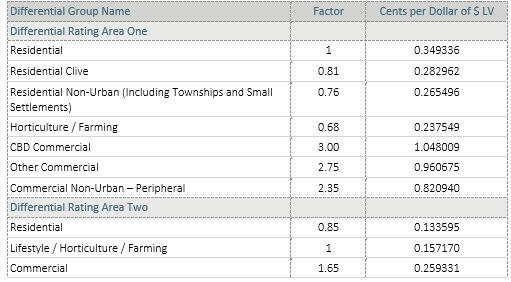
GENERAL RATES
A
general rate set and assessed in accordance with Section 13 of the Local
Government (Rating) Act 2002, on the land value of all rateable land within
the district on a differential basis as set out below:
UNIFORM ANNUAL GENERAL CHARGE
A
uniform annual general charge set and assessed in accordance with Section 15
of the Local Government (Rating) Act 2002, of $246 on each separately used or
inhabited part of a rating unit within the district.
TARGETED RATES
All
differential categories of targeted rates areas are as defined in the Funding
Impact Statement for 2025/26. For the purposes of the Havelock North
Promotion, Hastings City Marketing, Hastings CBD Targeted Rate, Havelock
North Parking, Havelock North CBD Targeted Rate, and Security
Patrols (Hastings and Havelock North), a commercial rating unit is one
that fits the description as set out under DRA1 CBD Commercial and DRA1 Other
Commercial in Part B of the Funding Impact Statement for 2025/26.
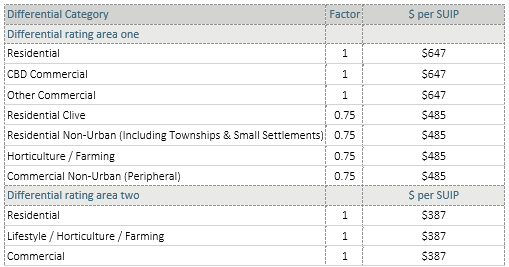
COMMUNITY SERVICES & RESOURCE MANAGEMENT RATE
A
targeted rate set and assessed in accordance with Section 16 of the Local
Government (Rating) Act 2002, on a differential basis, on each separately
used or inhabited part of a rating unit in the district as follows:
CYCLONE RECOVERY TARGETED RATES
Two targeted rates set and assessed for the purposes
of funding the costs of Cyclone Gabrielle recovery. The first as a rate in
the dollar of land value and the second as a fixed amount.
All land in the Hastings District will be allocated
to either Differential Rating Area One or Differential Rating Area Two. These
areas are defined on Council map ‘Differential Rating Areas’ and
are based on broad areas of benefit from the Council’s services and
facilities. The costs of cyclone recovery have been allocated into the two
rating groups with 67% of costs assigned to Differential Rating Area One and
33% of costs allocated to Differential Rating Area Two.
A differential targeted rate set and assessed in
accordance with Section 16, Schedule 2 Clause 6, and Schedule 3 Clause 3 of
the Local Government (Rating) Act 2002, on the land value of all rateable
land within the district. The rate is set on a differential basis, based on
the location of the land within the district. This is applied to the
same two differential rating areas as defined and used for the general rate:

A differential targeted rate set and assessed in
accordance with Section 16, Section 18 (2) and Schedule 2 Clause 6 of the
Local Government (Rating) Act 2002, as a fixed amount per rating unit in the
district. The rate is set on a differential basis, based on the location of
the land within the district: This is applied to the same two differential
rating areas as defined and used for the general rate:

HAVELOCK NORTH PROMOTION
A
targeted rate set and assessed in accordance with Section 16 of the Local
Government (Rating) Act 2002, on the land value of any commercial rating unit
located within Havelock North as defined on Council Map “Havelock North
Promotion Rate”, of 0.093330 cents per dollar of land value.
SWIMMING POOL SAFETY
A
targeted rate set and assessed in accordance with Section 16 of the Local
Government (Rating) Act 2002, as a fixed amount on every rating unit where a
swimming pool (within the meaning of the Fencing of Swimming Pools Act 1987)
is located, of $88 per rating unit.
HAVELOCK NORTH PARKING
A
targeted rate set and assessed in accordance with Section 16 of the Local
Government (Rating) Act 2002, on a differential basis, on each separately
used or inhabited rating unit located within Havelock North as defined on
Council Map “Havelock North Parking Rate Map”, as follows:

HASTINGS CITY MARKETING
A
targeted rate set and assessed in accordance with Section 16 of the Local
Government (Rating) Act 2002, on the land value of any commercial rating
units located within Hastings as defined on Council Map “Hastings City
Marketing Rate Map”, of 0.207631 cents per dollar of land value.
HASTINGS CBD TARGETED RATE
A
targeted rate set and assessed in accordance with Section 16 of the Local
Government (Rating) Act 2002, on the land value of any commercial rating unit
located within Hastings as defined on the Council Map “Hastings CBD
Targeted Rate Map”, of 0.143205 cents per dollar of land value.
HAVELOCK NORTH CBD TARGETED RATE
A
targeted rate set and assessed in accordance with Section 16 of the Local
Government (Rating) Act 2002, on the land value of any commercial rating unit
located within Havelock North as defined on Council Map “Havelock North
CBD Upgrades Map”, of 0.050205 cents per dollar of land value.
SECURITY PATROLS
Targeted
rates set and assessed in accordance with Section 16 of the Local Government
(Rating) Act 2002, on the land value of any commercial rating unit located
within each respective Council Map defined “Hastings Area - Security
Patrol Map” and “Havelock North Security Patrol Area Map”,
as follows:
Hastings
Security Patrol Area - 0.088608 cents per dollar of land value.
Havelock
North Security Patrol Area - 0.042539 cents per dollar of land value.
SEWAGE DISPOSAL
A
differential targeted rate set and assessed in accordance with Section 16 of
the Local Government (Rating) Act 2002, based on the provision or
availability to the land of the service. The rate is set as an amount per
separately used or inhabited part of a rating unit.
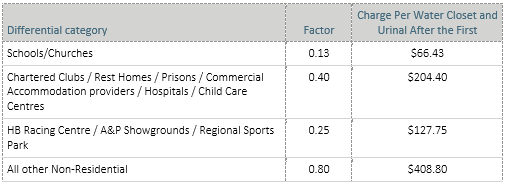
A
differential targeted rate for all non-residential rating units classified as
“connected”, based on the use to which the land is put. The rate
is an amount for each water closet or urinal after the first.
The
rates apply to connected or serviceable rating units in all areas excluding
those in the Waipatiki scheme area.
The rates for the 2025/26 year are:

Where
connected, in the case of non-residential use, the differential charge for
each water closet or urinal after the first is as follows:
WAIPATIKI SEWAGE DISPOSAL
A
differential targeted rate set and assessed in accordance with Section 16 of
the Local Government (Rating) Act 2002, based on the provision or
availability to the land of the service. The rate is set as an amount per
separately used or inhabited part of a rating unit.
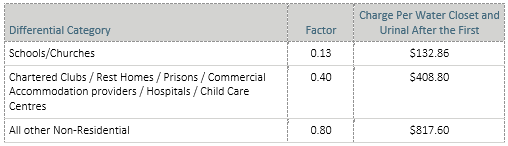
A
differential targeted rate for all non-residential rating units classified as
“connected”, based on the use to which the land is put. The rate
is an amount for each water closet or urinal after the first.
The
rates apply only to connected or serviceable rating units in the Waipatiki
scheme area.
The rates for the 2025/26 year are:

Where
connected, in the case of non-residential use, the differential charge is set
for each water closet or urinal after the first as follows:
WASTEWATER TREATMENT
A
differential targeted rate set and assessed in accordance with Section 16 of
the Local Government (Rating) Act 2002, based on the provision or
availability to the land of the service. The rate is set as an amount per
separately used or inhabited part of a rating unit.
A
differential targeted rate for non-residential rating units classified as
“connected”, based on the use to which the land is put. The rate
is an amount for each water closet or urinal after the first.
The rates apply to connected or
serviceable rating units in all areas excluding those in the Waipatiki scheme
area.
The rates for the 2025/26 year are:

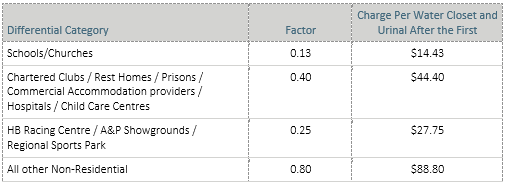
Where
connected, in the case of non-residential use, the differential charge is set
for each water closet or urinal after the first as follows:
WATER SUPPLY
Targeted
rates set and assessed in accordance with Section 16 of the Local Government
(Rating) Act 2002, on each separately used or inhabited part of a rating unit
and based on the provision or availability to the land of the service, for
each water supply service, on a differential basis as follows.
The
rates for the 2025/26 year are:

The
Council has water supply services for Hastings, Havelock North, Flaxmere,
Waipatu, Haumoana/Te Awanga, Clive, Whakatu, Omahu, Paki Paki, Waimarama,
Waipatiki, Whirinaki, Te Pohue.
WATER BY METER
A
targeted rate set and assessed in accordance with Section 19 of the Local
Government (Rating) Act 2002, on the volume of water supplied as
extraordinary water supply, as defined in Hastings District Council Water
Services Policy Manual (this includes but is not limited to residential
properties over 1,500m2 containing a single dwelling, lifestyle lots, trade
premises, industrial and horticultural properties) of $1.20 per cubic metre
of water supplied over and above the typical household consumption as defined
in the Hastings District Council Water Services Policy Manual.
RECYCLING
A
targeted rate set and assessed in accordance with Section 16 of the Local
Government (Rating) Act 2002, on each separately used or inhabited part of a
rating unit and based on the provision or availability to the land of the
service provided in the serviced area. The
service areas are set out in council maps “Recycling Map incl Clive
Whakatu”, “Recycling Map incl Hastings, Flaxmere, Havelock
North”, “Recycling Map incl Haumoana Te Awanga” and
“Recycling incl Whirinaki”.
Rating
units which Council officers determine are unable to practically receive the
Council service and have an approved alternative service will not be charged
the rate.
The
rate for 2025/26 is $119 per separately used or inhabited part of the rating
unit.
REFUSE
A
targeted rate set and assessed in accordance with Section 16 of the Local
Government (Rating) Act 2002, on each separately used or inhabited part of a
rating unit in the serviced areas, differentiated based on the use to which
the land is put and location.
Rating
units which Council officers determine are unable to practically receive the
Council service and have an approved alternative service will not be charged
the rate. The Council maps “Refuse Map Incl
Clive Whakatu”, “Refuse Map incl Hastings”, “Refuse
Map Incl Haumoana Te Awanga” and “Refuse Map Incl
Whirinaki” set out the serviced areas.
Residential
rating units currently receive a weekly collection. Commercial rating
units located within the Hastings area as defined on Council Map
“Hastings CBD Targeted Rate Map”, and located within the Havelock
North area as defined on Council Map “Havelock North CBD Upgrades
Map” currently receive a twice weekly collection.
The
rates for the 2025/26 year are:

WAIMARAMA REFUSE
A
targeted rate set and assessed in accordance with Section 16 of the Local
Government (Rating) Act 2002, on each separately used or inhabited part of a
rating unit located within Waimarama as defined on Council Map
“Waimarama Refuse Collection”, and based on the provision or
availability to the land of the service provided, of $170 per separately used
or inhabited part of the rating unit.
WAIMARAMA SEA WALL
A
targeted rate set and assessed in accordance with Section 16 of the Local
Government (Rating) Act 2002 on a differential basis, on each separately used
or inhabited part of a rating unit within each individual zone defined on
Council Map “Waimarama Sea Wall Map Zones 1-3” of the following
amounts per separately used or inhabited part of the rating unit:
Zone
1 shall pay 67% of the cost to be funded, whilst Zone 2 shall pay 23% of the
cost and Zone 3 10% of the cost, based on the extent of the provision of
service.

DUE DATES AND PENALTY DATES
Due Dates for Payment and Penalty Dates (for Rates other than Water
by Meter Rates):
The
Council sets the following due dates for payment of rates (other than Water
by Meter) and authorises the addition of penalties to rates not paid on or by
the due date, as follows:
Rates
will be assessed in quarterly instalments for an equal amount and are payable
on the due dates below:
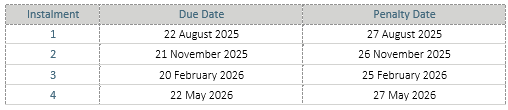
A penalty of 10% will be added to any portion of rates (except for
Water by Meter) assessed in the current year which remains unpaid after the
relevant instalment due date, on the respective penalty date above.
Arrears Penalties on Unpaid Rates from Previous Years
Any
portion of rates assessed in previous years (including previously applied
penalties) which are unpaid on 03 July 2025 will have a further 10% added, to
be added on 7 July 2025, and if still unpaid, again on 07 January 2026.
Due Dates for Payment and Penalty Dates (for Water by Meter Rates):
For
those properties that have a metered water supply, invoices will be issued
either three-monthly or six-monthly. The due dates for both options are set
out in the following table:
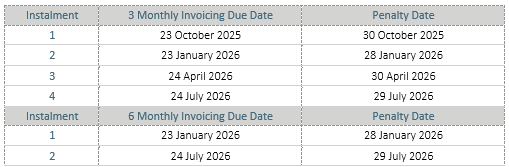
A
penalty of 10% will be added to any portion of rates for water supplied by
meter, which remains unpaid after the relevant instalment due date, on the
respective penalty date above.
With the reasons for this
decision being:
The Council
is required to collect funds from rates on properties to undertake the
functions outlined in the 2025/26 Annual Plan.
|
3.0 Background – Te Horopaki
3.1 At its meeting on 26
June 2025, Council will adopt its 2025/26 Annual Plan which identifies the
Council’s budgetary requirements for the forthcoming financial year.
3.2 It now needs to set
and assess the Rates described in its Rating Policy and Funding Impact
Statement in order to collect the revenue needed for the 2025/26 Financial Year
commencing 1 July 2025.
4.0 Discussion – Te Matapakitanga
4.1 To enable the Rates to
be levied on properties for 2025/26, the Council needs to pass the resolution
to set the Rates for the 2025/26 Financial Year in accordance with Sections 23
and 24 of the Local Government (Rating) Act 2002.
4.2 The Rates have been
calculated to ensure that the correct revenue is collected to meet the budget.
5.0 Options – Ngā Kōwhiringa
5.1 The resolution enables
the collection of Council’s rate funding requirement based on the budget
and policies adopted in the 2025/26 Annual Plan. This is the only option that
allows Council to collect rates to fund the expenditure requirements.
Attachments:
There are no attachments for this report.
|
Summary of
Considerations - He Whakarāpopoto Whakaarohanga
|
|
Fit
with purpose of Local Government - E noho hāngai pū ai ki te
Rangatōpū-ā-Rohe
The Council is required to give effect to the purpose of
local government as set out in section 10 of the Local Government Act 2002.
That purpose is to enable democratic local decision-making and action by (and
on behalf of) communities, and to promote the social, economic,
environmental, and cultural wellbeing of communities in the present and for
the future.
Link to the
Council’s Community Outcomes –
Ngā Hononga ki Ngā Putanga ā-Hapori
This proposal promotes the social, economic,
environmental, and cultural wellbeing’s of communities
in the present and for the future.
|
|
Māori
Impact Statement -
Te Tauākī Kaupapa Māori
N/A
|
|
Sustainability
- Te Toitūtanga
N/A
|
|
Financial
considerations -
Ngā Whakaarohanga Ahumoni
The outcome of this report and
recommendation will enable Council to generate the budgeted rates income.
|
|
Significance
and Engagement - Te
Hiranga me te Tūhonotanga
This decision/report has been assessed under the Council's
Significance and Engagement Policy as being of high significance.
|
|
Consultation
– internal and/or external - Whakawhiti Whakaaro-ā-roto / ā-waho
Whilst there was no formal consultation
on the 2025/26 Annual Plan , the budgets used to set Rates for the 2025/26
financial year are in line with what was consulted upon through the 2024/34
Long Term Plan process.
|
|
Risks
The rates resolution and Funding Impact Statement were
reviewed by Lizzy Wiessing, Barrister in June 2024 to ensure compliance with
the legislative requirements of the Local Government Act and Local Government
(Rating) Act. No new rate types have added in 2025/26.
|
|
Rural
Community Board –
Te Poari Tuawhenua-ā-Hapori
Due to time constraints, officers have
not been able to provide the Rural Community Board with information on the
impacts for Rating Area 2.
|

Hastings
District Council: Council Meeting
Te Rārangi Take
Report to Council
|
Nā:
From:
|
Nigel Bickle, Chief
Executive
|
|
Te Take:
Subject:
|
Adoption of the
Napier/Hastings Future Development Strategy
|
1.0 Executive Summary
– Te Kaupapa Me Te
Whakarāpopototanga
1.1 The
purpose of this report is to inform the adoption of a final joint Future
Development Strategy (FDS) for the Napier-Hastings urban environment, which
satisfies section 3.12 of the National Policy Statement on Urban Development
(NPSUD).
1.2 The
background context to the development of the FDS is set out in this report, and
other reports presented to the Future Development Strategy Joint Committee
(FDSJC) established by the Partner Councils. Of note, the FDSJC approved
the draft FDS for notification on 23 October 2024 and then appointed an
Independent Hearings Panel (IHP) to hold hearings and consider submissions on
the draft FDS. Following those hearings, the FDSJC met on 19 May 2025 to
consider the recommendations made by the IHP.
1.3 The
FDSJC adopted the IHP’s recommendations for all but one site (Riverbend
Road – NC4b), with the draft FDS recommended for approval by the IHP
attached as Attachment 1. For clarity, note that an amended version of
the draft FDS was not provided following the FDSJC recommendations.
1.4 Subject
to the consideration of this recommendation report by the Partner Councils,
Officers consider that the draft FDS will satisfy the statutory requirements
for a Future Development Strategy under the NPSUD.
1.5 This
Report fulfils the Requirement of Resolution D (Report for Partner Councils) of
the FDSJC, which required that a recommendation report be prepared to inform
decision-making by the Partner Councils. This Report sets out the
background context, statutory requirements and considerations, and makes a
recommendation on the final form of the FDS for the Napier-Hastings urban
environment.
|
2.0 Recommendations -
Ngā Tūtohunga
A) That Council receive the report titled Adoption of the
Napier/Hastings Future Development Strategy 26
June 2025.
B) That
Council notes the resolution of the Napier Hastings Future Development
Strategy Joint Committee (FDSJC) from its Committee Meeting on 19 May 2025 as
shown in the meeting minutes (Attachment 5). In particular resolution
B which recommended the endorsement of the IHP report with the exclusion of
Riverbend Road NC4b
C) That
Council notes this Agenda Report fulfils the Requirement of Resolution D
(Report for Partner Councils) of the FDSJC.
D) That Council
notes the draft final FDS (Attachment 1) does not include the FDSJC
Resolution (refer Recommendation B) to exclude NC4b Riverbend Road.
E) That
the Partner Councils in accordance with Section 3.12 of the National Policy
Statement on Urban Development 2020 which relates to requirements local
authorities to prepare and publish a Future Development Strategy (FDS),
accept in part the recommendations of the FDSJC, but with the inclusion of
Riverbend Road NC4b, and
F) That
Council adopt a final FDS that includes Riverbend Road NC4b with additional
wording below relating to that specific site. (to be added to page 59,
following the wording describing Ahuriri Station).
Riverbend (NC4b)
Riverbend (NC4b) has long been identified as a
potential location for future urban development, including through the
Heretaunga Plains Urban Development Strategy 2010 and 2017 editions. Active
planning work has been undertaken over recent years involving the landowner
and Napier City Council.
HBRC has expressed concerns about the potential for
development at Riverbend given the site’s susceptibility to flooding
risk and other natural hazards. There is well documented evidence of flooding
affecting the site (for example, recent events in November 2020 and February
2023). The low-lying topography means the site is vulnerable to runoff and
flooding, including from the existing neighbouring residential area.
Significant site-specific engineering works would be
required to manage stormwater and flooding effects arising from development
at Riverbend, including to maintain important environmental values to an
acceptable level. Additional land will be required to manage these effects
outside of the existing identified NC4b area if mitigation works cannot be
achieved onsite. This is acknowledged in a footnote to Table 3 of the FDS.
The inclusion of Riverbend NC4b in the FDS does not
predetermine the outcome of subsequent planning process, including structure
planning, plan changes, and resource consent applications.
As part of any application for consent or rezoning
proposal to develop the Riverbend NC4b site, further detailed work will need
to be undertaken to ensure the site’s suitability for development and
necessary mitigation of stormwater and flooding impacts. This should include
consideration of ‘residual risks’ (i.e. circumstances where
events may exceed design and construction capacity of stormwater mitigation
works) as has been recommended in the 2024 Hawke’s Bay Independent
Flood Review Panel’s report.
G) That
Council notes that if the adopted draft final FDS aligns with F, then
consequential amendments will be required to be made to Attachment 1
to include the additional wording.
|
3.0 Statutory
Context for FDS
3.1 The
NPSUD requires all tier 1 and tier 2 local authorities (Council is a tier 2
authority) to review every 3 years and to make publicly available an FDS for
the urban environment every 6 years and in time to inform or at the same time
as preparation of the next Long-Term Plan of each relevant local authority.
Where an urban environment involves more than one local authority, the NPSUD
requires that a FDS is prepared jointly.
3.2 The
NPS-UD states that the purpose of an FDS is to promote long term strategic
planning by setting out how the Partner Councils (Hastings District Council,
Napier City Council, Hawke’s Bay Regional Council) intend to:
· Achieve
well-functioning urban environments in existing and future urban
areas,
· Provide at least
sufficient development capacity over the next 30 years to meet expected demand,
and
· Assist with the
integration of planning decisions under the Resource Management Act with
infrastructure planning and funding decisions.
3.3 A
FDS is a strategic document that is intended to assist the Partner Councils
with integrating planning decisions under the Resource Management Act 1991
(RMA) with Council Long Term Plans, Infrastructure Strategies, and funding
decisions under the Local Government Act 2002 (LGA).
3.4 Development
of the FDS has been ongoing for several years and has included lengthy engagement
with mana whenua, elected officials, the community, interested landowners and
developers, to inform detailed technical analysis and evaluation.
3.5 The
FDS has been jointly developed in partnership with Hastings District Council,
Napier City Council, Hawke’s Bay Regional Council, and has directly
involved Maungaharuru Tangitū Trust, Mana Ahuriri Trust and Tamatea
Pōkai Whenua, all of which had members on the FDSJC.
3.6 In
addition, significant input has been received from council officers,
consultants and interested individuals, groups and stakeholders. This included:
· Barker &
Associates, which is a specialist planning consultancy
· staff from
Maungaharuru Tangitū Trust
· staff from Mana
Ahuriri Trust and
· staff from Tamatea
Pōkai Whenua.
3.7 The
draft FDS was adopted by the FDSJC for consultation and is intended (once
adopted) to satisfy the statutory requirements for Future Development
Strategies under the NPSUD.
3.8 Once
adopted, the final FDS will replace the current Heretaunga Plains Urban
Development Strategy 2017 (HPUDS).
4.0 Consultation and
Engagement
4.1 Section
3.15 of the NPSUD requires local authorities when preparing or updating an FDS
to use the special consultative procedure in Section 83 of the Local Government
Act 2002.
4.2 On October 23, the
FDSJC recommended to the partner councils, (Hastings District Council, Napier
City Council and Hawke’s Bay Regional Council,) that the Draft Napier
Hastings Future Development Strategy (FDS) be adopted for public notification
and submission. One variation to the draft was put forward by the FDSJC
Middle Rd
The
recommendation of the committee included one amendment to the strategy proposed
by the consultants and technical advisory group. This was the exclusion of
Middle Road sites Hn3a and Hn3b from the strategy. For the following reasons:
• These
areas are not required to provide sufficient development capacity to meet
demand (including the 20 per cent competitiveness margin)
• Hn3a and
Hn3b are Highly Productive land areas (including ‘Land Use
Capability’ level 1 and 2)
• These
areas are not included in the Heretaunga Plains Urban Development Strategy
(except as a reserve area in the case of Hn3a)
• It would
be contrary to the objectives of the FDS to include these areas.
The draft
recommendations were then considered by all Partner Councils in November. All
Councils agreed to accept the Joint Committee’s amendment to remove the
Middle Rd sites Hn3a and Hn3b from the draft strategy. Those two sites have
subsequently been removed from the draft.
4.3 An additional
amendment to the draft was recommended by Hawke’s Bay Regional Council
being the removal of Riverbend Road NC4b. The Hastings District Council and
Napier City Council voted to retain this area. To address this, the partner
councils agreed that the strategy be notified for public input, with this
divergence noted via this covering note, and that the divergence will be
considered by the independent panel to be appointed to hear submissions.
Riverbend Rd
The
Hawke’s Bay Regional Council additionally recommended that the Riverbend
Road site Nc4b also be excluded from the strategy, for the following reason:
•
Area Nc4b is subject to severe flooding risk.
4.4 The
FDSJC also resolved at its meeting held on 23 October 2024 to;
‘Appoint an Independent Panel to assist the Joint
Committee by hearing all persons / parties who wish to submit on the draft FDS.
The Independent Panel will prepare a summation of all submissions and provide
recommendations to the Joint Committee, for consideration by the Joint
Committee. The Joint Committee can then recommend a final FDS to the Partner
Councils’
4.5 The draft FDS was
adopted by the Partner Councils for consultation on the 19th
November 2024.
4.6 The
Independent Hearings Panel (IHP) consisted of the following members:
· Gina
Sweetman (Chair),
Field of Expertise - Resource management, local and
regional planning, policy and plan development. Resource consents. Te Ao Maori,
Freshwater and Chair of Hearing Panels.
· Shadrach
Rolleston,
Field of
Expertise - Planning and Resource Management, Spatial and Growth Management
Planning, Community and Māori Engagement, Te Ao Māori, Iwi Management
Planning, Tikanga Māori, Treaty Settlements, Local Government Policy
Planning.
· Juliane
Chetham,
Field of
Expertise - Planning, environmental science, geography, coastal and marine
ecology and management, Cultural Impact Assessment, Tikanga Māori,
Mātauranga Māori.
· Michael
Parsonson,
Field of
Expertise - District and regional consenting, plan changes, policy development.
Resource use, construction, infrastructure, general land use activities, and
associated effects. Council hearings, fast-track panels, boards of inquiry.
· Steven
(Tipene) Wilson
Field of
Expertise – Māori, Iwi
4.7 The notification
period for the draft FDS ran from 23rd November 2024 to the 23rd
December 2024. This period was chosen to avoid the summer break and much of
January when many workplaces are closed and staff are away for significant
periods of time and therefore may not have had sufficient opportunity to
prepare a submission.
4.8 A
total of 139 submissions were received on the draft FDS. These included a combination
of online survey submissions and general submissions. The submissions were
evaluated by officers from partner Councils and PSGEs. A Recommendations Report
was prepared for the IHP in advance of the hearings commencing. The officers’
Recommendations Report is attached as Attachment 3 (FDS-Hearings-Report-2025-03-17-1.pdf).
4.9 At
the invitation of the IHP, all submitters were also able to provide additional
evidence to help accompany presentations at subsequent Public Hearings.
4.10 The
process adopted by the IHP provided submitters with the opportunity to
critique, assess, support or otherwise any aspects of the draft FDS.
4.11 Submissions
were heard by the IHP during 24 – 26 March 2025. 86 of the lodged
submissions were spoken to at the hearings. Following the hearings the IHP
requested that officers provide a Reply Report to consider additional evidence
presented to the IHP during the hearings. The officers’ Reply Report is
attached as Attachment 4 (Napier-Hastings-FDS-Reply-2025-04-04.pdf).
4.12 The
IHP was not required to accept the recommendations in the reply report.
4.13 In
executing their role, the IHP was required to consider all information received
from submitters (and their representatives), all supplementary information,
officers’ reports and verbal hearing information. This information
informed the IHP Recommendations Report.
5.0 IHP Findings and
Recommendations
5.1 The
IHP provided their Recommendation Report on 9th May 2025. The IHP
Recommendation Report attached as Attachment 2 was prepared by the
IHP and is independent from either officer or submitter input, albeit that the
IHP was informed by information provided by officers, submitters and the
various experts and other persons involved in the process.
5.2 The
Executive Summary from the IHP Recommendation Report is noted below:
1. Having
considered the submissions received, the Independent Hearings Panel (IHP or
Hearings Panel) has recommended several changes to the draft FDS. Most of those
changes were recommended to us by the professional experts and advisors
representing Napier City Council, Hastings District Council and the
Hawke’s Bay Regional Council and Tamatea Pōkai Whenua (TPW), Mana
Ahuriri Trust (MAT) and Maungaharuru-Tangitū Trust (MTT) (FDS Advisors).
2. Our
more substantive recommended changes to the draft FDS include:
a. A new section 4.3 on cross-boundary
relationships
b. References to the Hawke’s Bay
Independent Flood Review Report recommendations in respect to natural hazard
data collection and Regional Policy Statement and district plan reviews
c. Amendments to Section 6 to address
redress land and papakāinga
d. Amendment to the strategic objectives to amend
objective 10 and include a new objective relating to nationally and regionally
significant infrastructure
e. Reference to latent demand and that there may
be a shortfall in wet industry in the long term in section 8
f. Amend the constraints identified in
Figure 13 to include areas for the safe operation and functional needs of
nationally and regionally significant infrastructure
g. Amend section 10 to address that growth area
boundaries shown in the FDS are indicative only and why small sites have not
been included
h. Amend table 2 in section 10 to include the
additional capacity identified for the Hastings District
i. Inclusion of Middle Road (HN3a and
HN3b), Wall Road (HN3b) and FM9 Portsmouth Road, Flaxmere as new Residential
Greenfield Development Areas in Table 3, and include the additional land at the
Mission Estate
j. Include Irongate North as a new
industrial area in section 10
k. Include reference in section 10 about a
potential shortfall in development capacity for wet industry and the approach
to be taken if this eventuates
l. Amend 10.6 to reference a
carry-over of the strategic direction for coastal and rural settlements from
HPUDS in an appendix, including maps, until such time as a Rural Residential
Strategy is promulgated
m. New paragraph in section 10.11 to reference the
importance of the operational and functional needs of nationally and regionally
significant infrastructure,
n. Amend section 10.11 to say that stormwater
solutions may occur out of identified growth areas and reference specific
Māori education demands
o. Include new sections in 10.11 on solid waste
and nationally and regionally significant infrastructure
p. Amend table 6 to reference additional
greenfield capacity and remove reference to an “overs/unders”
approach.
3. Other
than for the matters listed above, no substantial changes to any
‘spatial’ components of the FDS are recommended.
4. Our
recommendations are to be considered and decided on by the Future Development
Strategy Joint Committee.
5.3 In
terms of spatial components, the key decisions and changes recommended to the
draft FDS that was formally consulted on for submissions are as follows:
Residential
· Inclusion
of HN3a and HN3b (Middle Road) area. (Long Term Priority 11 – 30+ years)
· Inclusion
of H5b (Wall Rd) area. (Long Term Priority 11 – 30+ years)
· Inclusion
of FM9 (Portsmouth Rd) area. (Long Term Priority 11 – 30+ years)
· Inclusion
of additional land at NC6 (Mission Hills). (Medium to Long Term Priority (5
– 30 years)
Industrial
· Inclusion
of IR4 (Irongate North) area (Long Term Priority 11 – 30+ years).
· Recognition
that wet industry capacity will be needed over the long term. Recommending
short-term action to investigate policy changes aimed at protecting the
remaining capacity within the existing urban area for wet industry use at
Whakatu.
Rural Residential
· Recommendation
for councils to prioritise the development of a Rural Residential Strategy.
6.0 IHP Commentary regarding Riverbend Road
6.1 As part of their
recommendation’s report, the IHP specifically addressed a number of the
more contentious areas. Following the FDSJC recommendations with regard to
Riverbend Road NC4b, it is relevant to include extracts of the IHP’s
reasoning for their recommendations. The Riverbend Road discussion can be found
from paragraphs 54 to 66 of the IHP Recommendations Report (Attachment 2).
6.2 The IHP recognised
that there are significant constraints on the Riverbend site, acknowledging
that it currently acts as a basin for stormwater detention area for surrounding
land for the surrounding area
Riverbend is a
residential growth area in the Heretaunga Plains Urban Development Strategy
(HPUDS) and meets the definition of being “identified for urban
development.”10 The draft FDS identifies the area as a suitable specific
growth area, acknowledging that the area is subject to complex and overlapping
natural hazards constraints. While there are engineering solutions available to
address these constraints, they may impact the feasibility and timing of
development
6.3 The IHP also
recognised that the existing condition of the land in question, and the
relevant concerns of HBRC given the flooding of the site during significant
rain events in 2020 and 2023, with the site providing significant storage
adjacent to existing residential areas.
Stormwater
engineering evidence was presented on behalf of the Joint Venture by Ms Landon
of Development Nous Limited. Ms Landon acknowledged that the site currently
functions as an “unofficial” stormwater detention area for the
surrounding urban areas. She described the likely approach to flood mitigation
for development of the site, which included flood storage and pumping, and
conservatism in her assumptions. This is subject to ongoing analysis and design
and will require detailed interrogation through a resource consent process.
6.4 The IHP ultimately
acknowledged that the suitability of development should be assessed through a
more detailed plan change or resource consent process where the specific
constraints of the site and feasibility of development can be properly
understood. The IHP ultimately recommend the inclusion of the site as a long
term priority:
For the reasons
outlined above, we accept and adopt the recommendation of the FDS
Advisors’ Hearing Report to include Riverbend site NC4b in the FDS, at
the timing recommended by the FDS Advisors. Ultimately, its suitability for
development will be managed through the more granular plan change and resource
consent processes. Its planning history and the consequential investment in
development planning weighs in favour of its inclusion.
6.5 It is noted that to
address these qualifications, a footnote was added to Table 3 of the
recommended FDS (pg 65) noting ‘Additional land will be required to
manage stormwater and flooding effects arising from development of Riverbend
Road (NC4b), with the exact location to be determined through future planning
processes.’
6.6 The IHP
recommendations report also specifically addresses submitters concerns with
regards to natural hazards, with specific mention of flooding. This is
addressed from paragraphs 48 to 53 of the report. Ultimately the IHP concluded
(noting the exceptions discussed relate to Riverbend Road and Ahuriri Station):
We accept there
are site-specific opportunities to mitigate some risks but, consistent with the
FDS Advisors’ Hearing Report, we limit inclusion of sites with identified
significant (before mitigation) natural hazard risk to the sites discussed below
that are subject to other relevant factors that support their inclusion. We
agree with the FDS Advisors’ Hearing Report in its response to the
Natural Hazards Commission and the Hawke’s Bay District Health Board
submissions, that site specific risk assessments for those future growth areas
are most appropriately undertaken “at the structure planning and plan
change [and resource consent] stage, where a detailed stormwater and flood
modelling can be undertaken in the context of a specific proposal”.
6.7 The submitter
information and evidence can be viewed on the FDS website https://www.hastingsdc.govt.nz/hastingsnapierfuturedevelopment/
under the submissions documents tab, evidence and supplementary evidence tabs.
The primary submissions related to Riverbend Road were (Sub 105 – Te
Orokohanga Hou Joint Venture, Sub 74 – Natural Hazards Commission, Sub 90
– HBRC, Sub 16 – John Reid, Sub 26 – Myriam Parker, Sub 34
– Gary Curtis, Sub 47 – Andrew Lessels, Sub 52 – Simon Nash,
Sub 8 – Samantha McPherson, Sub 9 – Susan Gardner & Sub 12
Forest and Bird, Sub 94 MTT), however noting that there are also a number
of submissions that related to natural hazards and flooding in general.
7.0 FDSJC Resolutions
7.1 The
‘FDSJC Meeting Minutes’ from their Meeting on 19 May 2025 are
attached as Attachment 5 (Minutes
of Napier-Hastings Future Development Strategy Joint Committee - Monday, 19 May
2025).
7.2 Two
motions were put forward for amendments by FDSJC members.
Exclude Middle
Road (HN3a and HN3b) and Wall Road (H5b)
7.3 With
the reasons for these exclusions being the sites in i) and ii) are on highly
productive land and are not required to meet demand capacity under the Future
Development Strategy.
7.4 This
amendment was lost (3 votes for/5 votes against/3 abstained).
7.5 The
Middle Road areas (HN3a and HN3b) added 640 dwellings and the Wall Road area
(H5b) added 110 dwellings to overall development capacity.
Exclude
Riverbend Road (NC4b)
7.6 With
the reasons for this exclusion being the site presents as a significant
flooding risk and is not conducive to a well-functioning urban environment and
is not required to meet demand capacity under the Future Development Strategy.
7.7 This amendment was
carried (8 votes for/3 votes against).
7.8 The
Riverbend Road NC4b land provided an estimated 660 dwellings to the overall
development capacity.
7.9 The
FDSJC recommendations will be put to all Partner Councils to consider when
determining the final FDS with the risks associated with each option discussed in
section 8 below. Dates for the respective Partner Councils’ meetings are:
· Hawke’s Bay
Regional Council – Wednesday 25th June 2025
· Hastings
District Council - Thursday 26th June 2025
· Napier
City Council – Thursday 26th June 2025.
8.0 Options – Ngā Kōwhiringa
Option
One - Recommended Option - Te Kōwhiringa Tuatahi – Te
Kōwhiringa Tūtohunga
8.1 Adopt
the Future Development Strategy as recommend by the FDSJC, except for in
relation to the exclusion of Riverbend Road NC4b, by adopting a final FDS that
includes Riverbend Road with associated additional wording included in the FDS
relating to that land. The recommended additional wording is included in Attachment
6 to this report.
Advantages
· Allows Partner
Councils to consider specific viewpoints of FDSJC when making decisions on the
final FDS.
· Ensures that a FDS
that is consistent with IHP recommendations is adopted, with appropriate
qualifying statements where development concerns remain (as expressed by the
FDSJC minutes and in IHP’s commentary within its own report).
· Qualifying
statements can reflect many of the IHP’s observations without undermining
or being a substantive departure from the IHP’s overall findings and
recommendations.
· Satisfies NPS-UD
requirements.
· Ensures that
future plan change or resource consent processes are fully informed of the
constraints that will need to be addressed around hazard mitigations.
Disadvantages
· May lead to future
contention in relation to proposals for the development of the land for
residential growth.
· Amendments to the
recommendations that differ from the IHP’s reporting could give rise to judicial
review proceedings.
· Amendments to the
recommendations that differ from the FDSJC’s resolutions could give rise
to judicial review proceedings, albeit for different grounds than a departure
from the IHP’s reporting above.
· If heavily
qualified statements are included and/or statements that are beyond factual
ones, it may mean that Riverbend Road NC4b is out of step with other sites
subject to constraints, noting that the recommended FDS includes qualifying
language in regard to future growth areas requirements under future RMA
processes.
Option
Two
8.2 Adopt
the Future Development Strategy as recommended by the IHP.
Advantages
· Would
be consistent with the evidence-based assessment undertaken by independent
qualified experts who directly heard from submitters during the hearing process.
· Meets the
obligations of the Partner Councils under the National Policy Statement –
Urban Development 2020 which requires that a Future Development Strategy is
prepared for the Napier/Hastings urban environment.
· If adopted by the Partner
Councils, the Future Development Strategy will provide increased certainty for
the future planned growth of the Napier/Hastings urban environment and assist
to identify other opportunities for future growth in the longer-term.
Disadvantages
· Does not align
with FDSJC recommendations regarding Riverbend Road.
Option Three
8.3 Adopt
the Future Development Strategy as recommended by the FDSJC.
Advantages
· Would be
consistent with the evidence-based assessment undertaken by independent
qualified experts who directly heard from submitters during the hearing process,
with the exception of Riverbend Road.
· Meets the
obligations of the Partner Councils under the National Policy Statement –
Urban Development 2020 which requires that a Future Development Strategy is
prepared for the Napier/Hastings urban environment.
· If adopted by the Partner
Councils, the Future Development Strategy will provide increased certainty for
the future planned growth of the Napier/Hastings urban environment and assist
to identify other opportunities for future growth in the longer-term.
Disadvantages
· May lead to risk
of legal challenge, as decision would be based on recommendation from FDSJC
which did not directly hear submissions.
· Potential that
decision with regard to Riverbend Road is not as well informed as the
recommendation of the Independent Hearings Panel.
· Removal of
estimated 660 dwelling supply from FDS at Riverbend NC4b from overall capacity,
meaning significant more pressure on the ability to meet demand requirements,
including reliance on other development options in the Napier area.
9.0 Next steps – Te Anga Whakamua
9.1 Once the Partner
Councils have made their decision, the final FDS will become the adopted final
strategy and replace the HPUDS.
9.2 Following
the adoption of the final FDS it is recommended that the FDSJC meet to consider
the future implementation requirements of the FDS. Opportunities to do this
will be time-limited given local body elections in October 2025.
9.3 The FDS is required to
be reviewed at regular intervals so that it informs each long-term plan cycle
(ie. every 3 years). If a review determines that changes are required, a
public consultation process will be involved for the review of the FDS itself.
Attachments:
|
⇨1
|
Attachment 1 – Independent Hearings Panel
Recommended Future Development Strategy
|
CG-17-27-00217
|
Vol 2
|
|
⇨2
|
Attachment 2 – Independent Hearings Panel
Recommendations Report
|
CG-17-27-00218
|
Vol 2
|
|
⇨3
|
Attachment 3 – Officers Report to hearings panel on
Submissions
|
CG-17-27-00216
|
Vol 3
|
|
⇨4
|
Attachment 4 – Officers reply – Report for
hearings panel
|
CG-17-27-00219
|
Vol 3
|
|
⇨5
|
Attachment 5 - FDSJC Minutes 19 May 2025
|
CG-17-1-01625
|
Vol 3
|
|
⇨6
|
Attachment 6 - Riverbend additions to be considered for
FDS - June 2025
|
CG-17-1-01637
|
Vol 3
|
|
Summary of
Considerations - He Whakarāpopoto Whakaarohanga
|
|
Fit
with purpose of Local Government - E noho hāngai pū ai ki te
Rangatōpū-ā-Rohe
The Council is required to give effect to the purpose of
local government as set out in section 10 of the Local Government Act 2002.
That purpose is to enable democratic local decision-making and action by (and
on behalf of) communities, and to promote the social, economic,
environmental, and cultural wellbeing of communities in the present and for
the future.
Link to the
Council’s Community Outcomes –
Ngā Hononga ki Ngā Putanga ā-Hapori
This FDS seeks to control future growth in the region one of the core objectives is to provide a range of housing which
meets people’s needs in neighbourhoods that are safe and healthy. The
FDS is considered to promote wellbeing of communities in the present and for
the future.
|
|
Māori
Impact Statement -
Te Tauākī Kaupapa Māori
Maori communities have been consulted
with as part of the FDS process. Papakainga and treaty settlement land forms
a key part of the strategy. Post Treaty Settlement Group (PSGE) input has
been central to the development of the FDS. PSGE members have been part of
the joint committee and officers have inputted into the recommended FDS.
|
|
Sustainability
- Te
Toitūtanga
Intensification of existing urban areas
and protection of fertile land are key objectives of the FDS
|
|
Financial
considerations -
Ngā Whakaarohanga Ahumoni
Financial Considerations have been
previously considered for the FDS, the development of the strategy is now at
the end of its process. Failure to agree to a consistent strategy however
would result in additional costs.
|
|
Significance
and Engagement - Te
Hiranga me te Tūhonotanga
This decision/report has been assessed under the Council's
Significance and Engagement Policy as being of high significance.
|
|
Consultation
– internal and/or external - Whakawhiti Whakaaro-ā-roto / ā-waho
Significant informal consultation has
occurred through a ‘call for opportunities’ and formal
consultation was undertaken through the Special Consultative procedure which
included submissions and hearings opportunities.
|
|
Risks
Opportunity: To provide a finalised FDS
that guides the next 30 years growth across the sub-region
|
REWARD – Te Utu
|
RISK – Te Tūraru
|
|
30 year growth strategy which informs development, long
term spending and infrastructure strategies.
|
An inconsistent FDS, or one with significant departure
from Independent Hearings Panel Recommendations may lead to higher risk of
judicial proceedings.
|
|

Te
Hui o Te Kaunihera ā-Rohe o Heretaunga
Hastings
District Council: Council Meeting
Te
Rārangi Take
Report to Council
|
Nā:
From:
|
Janine Green, Licensing
Inspector
|
|
Te Take:
Subject:
|
Adoption of the Final
Hastings District Local Alcohol Policy 2025
|
1.0 Executive Summary – Te Kaupapa Me Te
Whakarāpopototanga
1.1 The
purpose of this report is twofold:
· To formally
receive submissions made through the Special Consultative Procedure, along with
the accompanying Preferred Position Paper.
· To seek a Council
decision on the adoption and enforcement date of the Final Hastings District
Local Alcohol Policy 2025 (LAP).
1.2 The
development of the LAP has complied with all statutory obligations under the Sale
and Supply of Alcohol Act 2012 (SSAA 2012). A legally sound and
evidence-informed process has been followed to ensure the policy is robust and
positioned to effectively contribute to the reduction of alcohol-related harm.
1.3 The
final LAP (Attachment 1) has undergone legal review and has been amended as
necessary to ensure statutory compliance and clarity of intent.
1.4 The
Preferred Position Paper (Attachment 2) summarises the analysis of submissions
and hearings and provides the formal evidential basis for the final LAP.
1.5 There
is clear and compelling evidence that alcohol-related harm is present in the
Hastings District, including elevated rates of alcohol-related emergency
department presentations and police incidents. The Hawke’s Bay region
records hazardous drinking rates higher than the national average, with
disproportionate impacts on Māori, youth, and individuals living in areas
of high socio-economic deprivation. National and international research
consistently demonstrates that policies targeting alcohol availability can
substantially reduce alcohol-related harm. Both NZ Police and The Medical
Officer of Health have provided strong evidence and anecdotal evidence to
support a reduction in hours for all licences and the addition of stronger
discretionary conditions and support the LAP position.
1.6 Research
shows that the most effective way to reduce alcohol-related harm is through a
coordinated, integrated suite of policy measures. The draft LAP strengthens the
existing framework by building on the current policy and enhancing its overall
effectiveness. It is underpinned by robust evidence and shaped by feedback from
the community and key stakeholders.
1.7 The
LAP also acknowledges that well-managed on-licence premises provide a safer
environment for alcohol consumption and recognises the alcohol industry as a
legitimate and regulated sector.
1.8 Submissions
received during the Special Consultative Procedure (14 March – 14 April
2025), alongside hearings held on 16 April, offered strong support for many of
the proposed provisions. Submitters provided valuable feedback, reinforcing
alignment with expert recommendations and community expectations, and
contributing practical suggestions for policy refinement.
1.9 Continued
support from statutory agencies and sector experts underscores the value of the
LAP in promoting the safe, responsible sale and consumption of alcohol across
the Hastings District, while minimising harm associated with excessive or
inappropriate use.
1.10 It
is noted that there remains a potential risk of policy divergence with Napier
City Council’s LAP. Council officers have assessed this risk and taken
steps to mitigate it, as discussed in detail in Section 4.15-4.21 of this
report.
1.11 The
report provides Council with three options, with option one being the
recommended option; to adopt the Final Local Alcohol Policy (LAP) as attached,
with an impact assessment report to be presented to the full Council after one
year (or at a timeframe to be determined) to evaluate the potential effects of
differing on-licence trading hours between Hastings District and Napier City
Council, particularly for taverns, bars, and nightclubs.
|
2.0 Recommendations - Ngā Tūtohunga
A) That
Council receive the report titled
Adoption of the Final Hastings District Local Alcohol Policy 2025 dated 26
June 2025.
B) That Council formally
receive;
i. The
62 submissions (Attachment 3) received through the Special Consultive
Procedure and the Preferred Position Paper 2025 (Attachment 2).
C) That Council approve;
i. The Final
Hastings District Local Alcohol Policy 2025, supported by evidence gathered
throughout the LAP review process. (Attachment 1)
ii. Public
notification of the Final Local Alcohol Policy on the 30 June 2025, as per
the Section 90 (1) of the Sale and Supply of Alcohol Act 2012.
iii. An enforcement date
of:
· 30
September 2025 for provisions relating to maximum trading hours
· 30
July 2025 for the remainder of the policy
D) That
Council note a follow up report will be presented in mid-2026 to assess the
initial impacts of the reduced trading hours for on-licences (Taverns, Bars,
Nightclubs) to determine whether a full impact assessment or formal review of
the LAP is required.
E) That a research
working party of the key agencies is developed to start gathering evidence to
support the review of the policy required within 6 years by the Sale and
Supply of Alcohol Act 2012.
|
3.0 Background – Te Horopaki
LAP Provisions under the Sale
and Supply of Alcohol Act 2012
3.1 Section
75 of the Sale and Supply of Alcohol Act 2012 (SSAA 2012) specifies that a
Territorial Authority (TA) may have a Local Alcohol Policy (LAP) relating to
the sale, supply, or consumption of alcohol within its district.
3.2 Under
Section 77 of the Act, a LAP may include policies on any or all of the
following matters relating to licensing (and no others):
· Location of licensed premises by reference to broad areas;
· Location of licensed premises by reference to proximity to premises
or facilities of particular kinds;
· Whether further licences (or licences of a particular kind or kinds)
should be issued for premises in the district concerned, or any stated part of
the district;
· Restriction or extension of the default maximum licenced hours
· The issue of licences, or licences of a particular kind or kinds,
subject to discretionary conditions;
· One-way door restrictions.
3.3 Section
78 (2) of the Act requires that if a Territorial Authority decides to develop a
LAP it must have regard to:
· The objectives and policies of its district plan;
· The number of licences of each kind held for premises in its
district, and the location and opening hours of each of the premises;
· The number of licences of each kind held for premises in its
district, and the location and opening hours of each of the premises;
· Any areas in which bylaws prohibit alcohol in public places are in
force;
· The demography of the district’s residents;
· The demography of people who visit the district as tourists or
holiday makers;
· The overall health indicators of the district’s residents;
3.4 The
LAP cannot include policies on matters unrelated to licensing such as the price
of alcohol, age limits for drinking or alcohol advertising and sponsorship.
Approval of
current LAP
3.5 At
a Council Meeting on 16 July 2019, Council approved the final LAP with an
enforcement date of 21 August 2019, and 21 November 2019, for the hours
provisions as required under the Act.
Review of
Current LAP
3.6 On the 24th of October 2024 Council resolved to review
the LAP with the goal of contributing to the reduction of alcohol
related harm in our community.
3.7 On
the 18th of February 2025 Council adopted the first draft LAP,
Statement of Proposal and Summary of Information (and associated documents) for
public consultation in accordance with the Special Consultative Procedure (SCP)
required by the Local Government Act 2002 and Sale and Supply of Alcohol Act
2012. The Council also delegated up to five Councillors to hear public
submissions on the First Draft of the Hastings District Local Alcohol Policy.
3.8 The
SCP ran from the 14th of March to the 14th of April 2025,
with hearings subsequently held at council on the 16 April 2025.
3.9 On
29 May 2025, the Council held a full Council workshop to deliberate on the
analysis of submissions and hearings, review the details of the Preferred
Position Paper, and receive insights from the Hearings Committee that oversaw
the hearings process.
4.0 Discussion
– Te
Matapakitanga
Evidence of
alcohol related harm
4.1 There
is clear evidence that alcohol-related harm is present in the Hastings
District, with high rates of both Alcohol related ED presentations and alcohol
related police incidence. Māori, youth, and those living in areas of high
socio-economic deprivation are disproportionately affected. There is a wealth
of academic literature and national and international studies showing that
policy measures targeting alcohol availability can significantly reduce harm.
LAP Review
4.2 In
response, the Council proposed a range of policy changes through the draft
Local Alcohol Policy (LAP), which was open for public consultation between 14
March and 14 April 2025, with hearings held on 16 April 2025. A series of
meetings with stakeholders and community representatives were held during this
period. A total of 62 submissions were received, the majority from licensees
(32 submissions received, out of approximately 259 licensees across the
district), followed by members of the public (18 submissions), stakeholder
organisations (10 submissions), and non-licensee businesses (2 submissions).
4.3 Overall,
there was support for many aspects of the proposed LAP. The LAP is seen as an
effective tool to reduce alcohol-related harm while balancing the need for a
vibrant night-time economy and recognising the alcohol industry as a
legitimate, regulated sector.
4.4 The
Preferred Position Paper has been completed (Attachment 2) and has
informed the final changes to the Local Alcohol Policy (LAP). It provides a
detailed analysis of submissions and hearing feedback, and, alongside the
Research Report, Issues and Options Paper, and related Council memos and
documents, forms the evidential basis for the final LAP. This comprehensive
approach ensures the policy is legally robust, evidence-based, and aligned with
the object and purpose of the SSAA 2012 with a clear focus on our local context
and reducing alcohol-related harm.
4.5 Officers
have met all legislative requirements under the Sale and Supply of Alcohol Act
2012 for the review of a Local Alcohol Policy.
Submission
and hearings overview
On-Licence
Trading Hours
4.6 There
was support for reducing on-licence trading hours. Nearly half of all
submitters—and around 65% of those who answered—supported earlier
closing times for nightclubs, bars, taverns, and pubs. Similar support was
shown for a reduction in hours for cafes, restaurants, wineries, and
entertainment venues.
4.7 The
proposed one-way door policy was also widely supported, with 79% in favour.
Many submitters linked late-night trading with increased alcohol-related harm,
citing health and emergency service data. Most viewed earlier closing times as
a practical harm-reduction measure. While some raised concerns about economic
impacts and personal freedom, the overall response supported a balanced and
evidence- based approach.
Off-Licence
Trading Hours
4.8 A
reduction in off-licence hours was also supported. About 69% of submitters who
answered the question supported shorter trading hours overall. For opening
hours, 86% favoured a later start (9am or 10am) for bottle stores and similar
retailers, with 59% supporting the same for supermarkets. 67% of submitters
supported consistent trading hours across all off-licence types.
4.9 Most
preferred a 9pm closing time, with over half supporting an earlier closing (8pm
or 9pm) for both supermarkets and other off-licences. Many highlighted evidence
and case law supporting reduced off-licence hours as a harm-reduction tool.
Bottle stores and supermarkets were commonly identified as key sources of cheap
alcohol and pre-loading.
4.10 Some
raised concerns about impacts on shoppers or convenience to shoppers.
Club and Special
Licences
4.11 Most
submitters (73%) supported reducing licensed hours for clubs from 1am to
midnight, noting many of these venues rarely stayed open late except for
special occasions. Concerns were similar to those raised for other on-licence
premises. Opinions on special licences were more divided. Just over half (54%)
supported including standardised hours in the LAP, while others preferred to
retain flexibility for the District Licensing Committee to assess each event
individually. Officers note within the hours provision for special licences,
there is discretion from the DLC which allows for that flexibility.
Discretionary
Conditions and Location Rules
4.12 Submitters
broadly supported the discretionary conditions if they were tailored to the
risk profile of each licence application. This became more apparent through the
hearings process.
4.13 Discretionary
conditions are seen as a valuable mechanism for addressing context-specific
risks, provided they are applied judiciously rather than in a blanket or in a
heavy-handed manner. Submitters emphasized that such conditions should not be
routinely imposed, but rather used where clearly warranted. Based on feedback
received, the wording of certain discretionary conditions has been revised and
subject to legal review.
4.14 There
was also strong support for location-based rules, particularly those
restricting new licences in areas with high levels of alcohol-related harm.
These provisions were viewed as essential for proactive risk management and for
safeguarding community wellbeing.
Consistency
with Napier City Council
4.15 Throughout
this LAP review, officers have been cognisant of the potential for policy
divergence with Napier City Council (NCC) and any unintended consequences that
could arise. To support alignment, a joint LAP working reference group was
established, comprising four councillors and one officer from each council.
This group convened once, prior to the Special Consultative Procedure, to
assist with policy consistency where required. A second meeting was requested
following Napier’s submissions and hearings process, when divergence was
apparent; however, this request was declined.
4.16 As
with the development of the 2019 LAP, some divergence between the two councils
is once again occurring at a similar stage in the process. Officers from both
councils have worked closely and remained consistent in their policy direction
throughout. At the time of writing, Napier officers—acting under the
direction of their elected members—have indicated a preference to revert
to the more permissive policy settings of the 2019 LAP.
4.17 It
is important to note that this divergence would likely have occurred regardless
of whether the policy was developed jointly or individually, as the same
situation that arose during the 2019 process has reoccurred. On that occasion,
Hastings ultimately adopted Napier’s more permissive policy provisions.
4.18 Differences
in policy, particularly in relation to trading hours for taverns, bars, and
nightclubs, carry some potential risks. These include the potential for patron
migration between areas with the possibility of increased harm, and the
creation of an uneven commercial playing field. However, several factors could
mitigate these risks: the number of licensed premises affected is small (2-4
premises), meaning a limited population is likely to be impacted; and migration
may already be occurring, driven by personal preference rather than policy
differences (please see the preferred position paper for more details).
4.19 While
these risks are important to consider, the overall impact remains uncertain. A
range of factors, issues, and mitigation options have been considered and
explored.
4.20 Officers
still believe the current provisions are suitable and recommend a 2am closing
time for bars, taverns and nightclubs accompanied by a built-in review and
impact assessment mechanism. This would involve monitoring relevant indicators
(e.g. traffic offences) at 6, 12, 18 month intervals and engaging with
licensees to assess emerging issues or commercial impacts. Should adverse
effects be identified, a full impact assessment or a review of the LAP can be
initiated based on new evidence. (Note: HDC is not legislatively bound to the
six-year review cycle; a review can occur at any time.)
4.21 While
other differences between the two policies may arise (e.g., in relation to
special licences, club licences, off-licences, or café/restaurant
hours), officers do not anticipate these discrepancies will present significant
risks.
Alcohol
related harm and effective policy mechanisms
4.22 Officers
maintain that there are high levels of alcohol-related harm within Hastings and
the wider Hawke’s Bay region, as demonstrated by the evidence provided
throughout this process—namely, emergency department (ED) presentations
and alcohol-related incidents recorded by New Zealand Police. The region also
exhibits significantly higher levels of hazardous drinking compared to other
areas in New Zealand. Recent secondary analysis of regional data from the New
Zealand Health Survey—only made available in the latter stages of this
process—confirms that Hawke’s Bay continues to have the highest
rate of hazardous drinking in the country.
4.23 The
evidence indicates that reducing alcohol-related harm is most effectively
achieved through a suite of coordinated policy provisions. The Policy
acknowledges that a well-managed on-licence premises provides a safer
environment for alcohol consumption and recognises the alcohol industry as a
legitimate and regulated sector. This final LAP presents a robust and
integrated set of measures that strengthen the existing policy framework,
incorporating both strong evidential support and community input.
4.24 Ongoing
endorsement from statutory stakeholders and subject matter experts reinforces
the importance of the LAP as a key mechanism for ensuring alcohol is sold,
supplied, and consumed in a safe and responsible manner across the Hastings
District. The LAP also plays a critical role in minimising harm from excessive
or inappropriate alcohol consumption.
4.25 A
summary of the evidential basis underpinning the Final LAP is provided in
Section 4 of the Preferred Position Paper (Attachment 2).
Final LAP
detail
The following
tables details the current LAP provisions, and the final Officer proposed LAP
provisions for adoption, based on evidence, research, the SCP and Council
direction to date. There is brief commentary for each provision, however the
Research Report, Issues and Options Paper and Preferred Position Paper should
be referred to for detailed evidence and analysis.
|
HOURS PROVISIONS
|
|
Current LAP
|
Proposed Final LAP Hours
|
Commentary
|
|
On-licence;
Taverns / Bars Pubs/ Night-clubs
8.00 am to 3.00 am the following
day
Monday to Sunday
One way door restriction:
mandatory at 2.00 am
|
ON-LICENCE
Taverns/bars/
pubs/night-clubs / breweries / cideries/ distilleries/ Endorsed Caterer.
Monday
to Sunday
8.00
am to 2.00 am the following day
One
way door restriction: mandatory at 1.00 am
|
Evidence
· There is strong local evidence to support
the move to closing hours of 8.00am to 2.00 am (1.00am one-way door).
· Hawke’s Bay has high levels of
hazardous drinking, higher than other regions within NZ.
· Recent literature, including a 2023 report by the
World Health Organization, states that there is no safe level of alcohol
consumption — “the risks of harm start from the first
drop.” This marks a shift from previous guidance that suggested
moderate consumption could be acceptable. As a result, stronger or more
restrictive policy provisions are increasingly justified, and any reduction
in trading hours can contribute meaningfully to reducing alcohol-related
harm.
· Policy considerations should include chronic,
long-term health outcomes in addition to immediate or acute harms.
· Hastings Emergency Department (ED) data
shows the highest alcohol related harm occurs after 7pm, particularly on
weekends.
· Hastings alcohol harm police incident data
highlights increases in harm from 7pm and large spikes in alcohol related
incidents between 12am – 3am (accounting for approximately 20% of the
total incidents).
· The relationship between alcohol
availability, trading hours, and alcohol-related harm is well-established.
Stakeholder and community Support
· There is statutory stakeholder support for
the reduction in on-licence hours.
· Through the submission process 65.2% of
those who answered the question, wanted reduced hours for this type of
licence.
· 79% of submitters who answered the
question on whether they agreed with the one-way door provision, supported
it.
Impacts on Hospitality
Industry
· An on-licence offers a regulated, safer
environment for alcohol consumption. For this specific type of licence, hours
until 2:00 am may strike an appropriate balance between harm reduction and
supporting the nighttime economy.
· The alcohol industry plays a significant
role in the Hawke's Bay region, contributing to the local economy through
employment and business activity.
· At the time of writing this report, a
change to 2am closing would affect 4 of 120 premises, or 4 of 24 premises
within this category of licences (taverns, bars, pubs, night-clubs) (noting
that this is licensed hours and not all premises utilise their full licence
hours.) Based on Licensing Inspector knowledge, currently only 2 venues
regularly stay open to their maximum trading hours of 3am.
Regional
Consistency and Patron
Migration
· Extended trading hours are linked to
higher levels of alcohol consumption and equate to an increased risk of harm,
including violence, injury, and impaired driving. However, this needs to be
balanced with the prospect of potentially having different closing hours with
Napier and the unknown consequences of such a difference.
· Napier’s proposed one-way door at
2am may deter very late- night migration from one area to another but will not affect those
that may want to travel earlier.
· If Hastings adopts significantly earlier
closing hours, patrons seeking a later night experience may choose to go
directly to Napier instead. This could result in Hastings losing not only
late-night trade but also early-evening patronage, as people may decide to
dine and spend the entire evening in Napier on occasion.
· Feedback from some licensees and
stakeholders during the stakeholder and licensee workshops indicated that
such patron migration already occurs, with individuals choosing venues based
on their preferences and specific situations.
· Stakeholder feedback through the SCP
showed strong support for reduced hours across the region (regional
consistency.)
· Licensees, through engagement, expressed
strong support for consistency and alignment between local policies to avoid
creating competitive advantages.
· The difference in trading hours may replicate
situations seen in areas like Auckland, whereby one area has later trading
hours than another, with similar distances and time travel as those between
Napier and Hastings. Similarly, other council areas such as Tauranga and
Western Bay of Plenty have differing on-licence hours (initially a joint
policy, then separated), also similar in distance and time between some
areas. Therefore, this scenario is occurring elsewhere.
· The overall impact of different hours to neighbouring
Napier is uncertain, and it
is difficult to determine whether the effects will be significant or minimal,
or the extent to which this is already occurring.
· Officers recommend an impact assessment is
completed at 1 year to assess the impacts on both alcohol related harm
statistics and commercial impacts on effected businesses.
Please see section 4 of the
Preferred position paper for more detail.
|
|
ON-LICENCE
Café/
restaurant / winery / winery restaurant
8.00
am to 2.00 am the following day Monday to Sunday
|
ON-LICENCE
Cafes/ restaurants
/ wineries/ winery restaurants /
Hotels (accommodation – excluding mini bars)
Monday
to Sunday
8.00 am to 1.00 am
|
Evidence
· The same evidential basis as above also
applies to on-licence hours provision for Cafes/restaurants/wineries/winery
restaurants / Hotels (accommodation).
· For this specific type of licence, where food is
often the main purpose, hours until 1:00 am
strikes an appropriate balance between harm reduction and supporting the
nighttime economy.
Stakeholder and community feedback
· All statutory stakeholders, including NZ
Police, the Medical Officer of Health, and Alcohol Licensing Inspectors, are
in favour of reducing the hours, in line with the availability theory and
local evidence.
· Through the submission process 32 of the
61 submitters wanted further reduced hours for this licence type - 52.5% of
submitters wanted reduced trading hours for restaurants, wineries and winery
restaurants. Of those who answered the question, 69.6% wanted reduced hours
for this type of licence.
Economic
and Operational considerations
· This would affect
2 premises of 120 premises or 2 of 70 premises within this
category. (noting that
this is licensed hours and not all premises utilise their full
license hours).
Regional
Consistency and Patron
Migration
· If a 1am
closure was adopted, this could be a one-hour difference in trading hours with NCC. (NCC
2am - as per deliberations / direction provided to NCC Officers at
NCC Hearings on 29.4.25)
· There is strong
evidence to support the move to closing hours
of 8.00am to 1.00
am. However, this
needs to be balanced with the prospect of potentially having different closing hours with
Napier. In this
case the risk
of people migrating from one area another
is not considered as great due to the
nature of the
operations and that generally people will just
go to one restaurant in a night
out.
Please see section 4 of the
Preferred position paper for more detail.
|
|
ON-LICENCE
Entertainment
facilities /
Add
category: Function centres / all other non-specified on-licences
Licensing
hours are to be consistent with the nature and activities of the premises and
in general shall range from:
8.00
am to 2.00 am the following day Monday to Sunday
|
ON-LICENCE
Entertainment Venues /Function
centres and ‘otherwise not specified’ (as per the Sale and Supply
of Alcohol (Fees) Regulations 2013.
Licensing
hours are to be consistent with the nature and activities of the premises and
in general shall range from:
Monday
to Sunday
8.00
am to 1.00 am
|
Evidence
· The same evidential basis as above also
applies to on-licence hours provision for Entertainment facilities / function
centres / all other non- specified on licenses.
· For this specific type of licence, where
entertainment is the main purpose, hours until 1:00 am strikes an appropriate
balance between harm reduction and supporting the nighttime economy.
· All statutory stakeholders, including NZ
Police, the Medical Officer of Health, and Alcohol Licensing Inspectors, are
in favour of reducing the hours, in line with the availability theory and
local evidence.
· This change would affect 2 of 120 premises
or 2 of 26 premises in this category. (noting that this is licensed hours and
not all premises utilise their full license hours).
· 30 submitters (49.2%, or 68.2% of those
who answered the question) wanted reduced trading hours for this category of
on-licence.
Regional Consistency and
Patron Migration
· If a 1am closure was adopted, this could
be a one-hour difference in trading hours with NCC. (NCC 2am - as per
deliberations / officers’ direction at NCC Hearings on the 29.4.25)
· There is strong evidence to support the
move to closing hours of 8.00am to 1.00 am. However, this needs to be
balanced with the prospect of potentially having different closing hours with
Napier. In this case the risk of people migrating from one area another is
not considered as great due to the nature of the operations.
Please see section 4 of the
Preferred position paper for more detail.
|
|
Off-licence – Grocery
Stores and Supermarkets
7.00
am to 10.00 pm Monday to Sunday
|
ALL OFF-LICENCES (EXCLUDING REMOTE SALES)
All
Off-licences
9.00 am to 9.00
pm Monday to Sunday
Off-licence
– remote sales
As
per SSAA2012 (Section 49 & 59)
Any
day at Any time.
|
Harm
Evidence
· Recent literature, including a 2023 report by the
World Health Organization, states that there is no safe level of alcohol
consumption — “the risks of harm start from the first
drop.” This marks a shift from previous guidance that suggested
moderate consumption could be acceptable. As a result, stronger or more
restrictive policy provisions are increasingly justified, and any reduction
in trading hours can contribute meaningfully to reducing alcohol-related
harm.
· Policy considerations should include chronic,
long-term health outcomes in addition to immediate or acute harms.
· Alcohol related ED presentations show
there is still acute harm occurring at 7am-9am in the morning, albeit at low
levels.
· Hastings ED data shows the highest alcohol
related harm occurs after 7pm, particularly on weekends.
· Hastings Police data shows there is still
alcohol related harm occurring between 7am- 9am, however at low levels.
· Police data shows that for Flaxmere, over
60% of alcohol related incidents are residential incidents (incidents
occurring in the home – therefore alcohol often purchased at an
off-licence).
· Secondary analysis of regional data from
the New Zealand Health Survey showed that Hawke’s Bay had the highest
rates of hazardous drinking of any district in the country, highlighting the
urgent need to address excessive and hazardous alcohol consumption in
Hastings.
· A reduction in trading hours may help to
support the one in four people who drink hazardously in Hawke’s Bay.
· Reducing trading hours for off-licences is
an effective strategy for mitigating alcohol-related harm, as shorter hours
limit opportunities for "pre-loading," "post-loading,"
and "side-loading" behaviours where individuals drink before,
after, or between visits to licensed venues.
· Evidence from New Zealand and
international studies suggests that restricting off-licence trading hours,
particularly following the 2012 end to 24-hour trading, resulted in a
reduction in alcohol-related incidents.
· There is substantial research and
literature to support a reduction in off-licence hours based on the
availability theory.
· A recent study has also estimated that
implementing stricter limits on off-licence trading hours and density could
decrease overall alcohol consumption in NZ by 17.9% resulting in a gain of
450,000 health adjusted life years over the lifetime of the 2018 population.
· Although difficult to prove causality,
Hastings alcohol related ED admissions have reduced since the adoption of the
2019 LAP.
Sales, Availability, and Outlet
Types
· Peer reviewed NZ analysis of the
relationship between alcohol outlets and harm shows no evidence of a
substantive difference in alcohol related harm between alcohol sales from
supermarkets when compared to other off-licence premises.
· Off-licences, including supermarkets and
grocery stores, sell over 80% of all alcohol in New Zealand. With supermarket
and grocery store market share approximately 60% and 30% of all off-licence
wine and beer sales, respectively. These outlets are easily accessible and
often operate with long trading hours, which increases the potential for
alcohol-related harm, as alcohol is consumed in unregulated environments
where supervision is minimal.
· Supermarkets and grocery stores are only
11.7% of the off licenses in Hastings, yet supermarket and grocery store
market share in NZ are approximately 60% and 30% of all off-licence wine and
beer sales respectively.
Community and Stakeholder
feedback
· A large proportion of submitters (68.9% of those who
responded) supported reducing off-licence trading hours generally.
· For supermarket opening hours, 58.7% of respondents
preferred a later start time (9am or 10am) instead of the current 7am.
Similarly, 86% supported a later opening for bottle stores and other
off-licences.
· For closing hours, 9pm was the most preferred option
across both supermarkets and other off-licences, closely followed by 10pm.
· 54.3% favoured earlier supermarket closings (8pm or
9pm), and 52.3% wanted earlier closings for other off-licences.
· There was also strong support (67.4%) for having
consistent trading hours across all off-licence types, including
supermarkets, with support having more than double the opposition.
Statutory Positions and
Legal context
· All statutory stakeholders strongly
support a general reduction in hours. (NZ Police, Medical Officer of Health
& Alcohol Licensing Inspectors).
· There is statutory stakeholder support for
consistent hours for all license types, including supermarkets and grocery
stores.
· The precautionary approach is appropriate
when developing and implementing LAP’s, allowing for restrictions based
on a reasonable likelihood of reducing alcohol-related harm. Stakeholders
also noted that the court had highlighted the importance of considering
community preferences and the broader legislative context when assessing the
reasonableness of LAP’s.
· LAPs reflect policy choices of a Council
partly based on, or at least influenced by, community preference.
· An assessment of two factors will be
required: (a) the reduction in alcohol- related harm likely to result if the
element is in place; and (b) the likely disruption to safe and responsible
drinking that it will cause.
Operational Impacts
· The reduction to 9pm closing would affect
43 of 111 premises. (noting that this is licensed hours and not all premises
utilise their full license hours), this would include one supermarket.
· The reduction to a 9am opening would
affect 13 grocery stores and supermarkets. (noting this is licensing hours
and not overall opening / trading hours).
· Feedback from Supermarket companies noted
the need for longer hours than proposed for supermarkets for convenience to
shoppers and practicality reasons. Also stating they thought there was
insufficient evidence to justify the reduction in hours, particularly the
change to morning hours.
· Supermarkets stated they also have very
high compliance and host responsibility standards, checks and balances.
· Supermarkets cite the provisions still
must be reasonable and proportionate in light of the object of the Act.
Access and Equity
· Restricting alcohol sales to shorter hours
than general supermarket trading times provides an opportunity for people to
shop for groceries without being exposed to alcohol.
· This approach can support individuals
trying to reduce their consumption, as well as those in recovery from alcohol
dependence, by reducing temptation and reinforcing a safer retail
environment. It also would cater to those who chose not to drink, or those
who do not want to be exposed to alcohol during their weekly shop.
· Similar initiatives already exist in
supermarkets through the implementation of "quiet hours" in late
2019, designed to support neurodivergent individuals such as those with
autism. According to RNZ, Autism New Zealand estimates that 80,000 people are
affected by autism. This has led major retailers like Countdown to introduce
‘quiet hours’ across most stores nationwide.
Regional Consistency and
Patron Migration
· If different hours were adopted to NCC,
(NCC- 7am – 10pm – supermarkets and grocery stores & 9am to
10 pm all others - as per deliberations / officers’ direction at NCC
Hearings on 29.4.25) this would have less risk than that of on licences, as
people are less likely to travel distance to get to a later opening
off-licence.
· Other councils including Wairoa have
reduced morning hours (10am – 9pm)
Please see section 4 of the
Preferred position paper for more detail.
|
|
Off-licence –
All
other off-licences
9.00
am to 10.00 pm Monday to Sunday
|
|
Off-licence
– remote sales
Any
day at Any time
|
|
Club licence
Licensing
hours are to be consistent with the nature and activities of the club and in
general shall range from:
8.00
am to 1.00 am the following day Monday to Sunday
|
CLUB LICENCES
Class One Clubs (as per The Sale and Supply of Alcohol (Fees)
Regulations 2013).
Monday to Sunday
8.00 am to 1.00 am
Class Two and Three Clubs (as per The Sale and Supply of Alcohol (Fees) Regulations 2013)
Monday to Sunday
8.00am to 12.00 am
midnight
|
Evidence
· Similar evidential basis as for
on-licences
· Only 6 of the 28 clubs close after
midnight, and few extend to 1am. This proposal splits the club license
category by club size, in line with fee regulation definitions of clubs, to
regulate closing hours based on size of the club and better align with
current actual trading hours.
· From the submission process, of those who
answered the question, 67.5% agreed with the reduction of hours for small
clubs from 1am to 12am midnight.
Regional Consistency and
Patron Migration
· If a 12am closure was adopted, this would
be a one-hour difference in trading hours with NCC. (NCC 1am - as per
deliberations / officers’ direction at NCC Hearings on 29.4.25)
· There is less risk with clubs than with
differing hours with taverns and late- night bars due to the need to be a
member of a club to enter or visit with a member of the club to attend.
Please see section 4 of the
Preferred Position Paper for more detail
|
|
Special Licence
Any
day at any time
|
Special Licence
Monday to Sunday
8:00 am to 2:00 am the following day
Unless the event is
deemed suitable to extend
beyond these hours, and the
applicant can
provide justification for the need for the extended hours.
All applications
must comply with the District Plan and
any applicable Resource Consent.
|
Evidence
· Events can significantly contribute to alcohol-related
harm if not properly regulated and managed.
· Similar
evidential basis as for on licenses, the effects of hours
and alcohol related harm applies to special licenses too.
· Alcohol Licensing Alcohol Licensing
Inspectors note that
alcohol is commonly consumed at events,
and patrons often continue
drinking at on-licence premises afterwards. This pattern contributes to increased overall
alcohol consumption and associated harm, both acute and chronic.
· This provision ensures that events align more closely with other late-night trading.
· Through the submission process, of those
who answered the question, 53.8% (21 Submitters) agreed with an opening or
closing time for special licenses. Noting a large proportion did not answer
this question (22 out of 61).
Operational Impacts
· Most special licenses in the district align with the proposed hours,
with only a few exceptions.
· This provision also
allows the DLC and ARLA
to grant extended hours based on the type of event. It is important to note it is expected the policy position is to ensure the hours are
appropriate and reasonable for each individual event. The proposed hours are
not intended to set an expectation that the DLC and
ARLA will always issue licenses for the full duration.
· As this provision is flexible and most events
already fit within these hours, it should not prevent events coming to
Hastings.
Regional
Consistency
· NCC has not proposed a special licence trading hour provision, however this will
not have any significant effect in relation to migration of patrons.
Please see section 4 of the
Preferred position paper for more detail
|
|
LOCATION & DENSITY PROVISIONS
|
|
Current LAP
|
Proposed Final LAP Hours
|
Commentary
|
|
No further
off licences being a bottle store
on land located in – Flaxmere
Commercial Service or Suburban Commercial zone or
Flaxmere Village Centre Zone
or residential area. Camberley –
Suburban commercial zone
identified in Map 2.
|
No further
off licences being a bottle store
on land located in – Flaxmere
Commercial Service or Suburban Commercial zone or
Flaxmere Village Centre
Zone or residential area. Camberley – suburban commercial zone identified in Map 2.
|
Support
for Existing Provisions
· There is strong
support that the
current provisions are
protecting the most vulnerable populations in
Hastings.
· Through the SCP, submitters were asked if
they agreed with the location and density provisions, of those who answered
the question, 82% agreed with the current location and density provisions.
Assessment and Planning Considerations
· An analysis was conducted to assess potential new areas for
inclusion. The District Plan excluded large areas where new licenses could
establish, leaving only a small number of dispersed pockets of suburban
commercial land where premises can establish.
· Restricting further licenses in additional
areas may cause clustering of licenses just outside these areas or force additional licenses to cluster
inside of the town center area increasing density. This option may
cause unintended consequences.
Consistency with Napier
· Napier
have density provisions.
No issues noted.
Please see section 4 of the Preferred
position paper for more detail
|
|
Discretionary
Conditions
|
|
Current LAP
|
Proposed Final LAP Hours
|
Commentary
|
|
ON-LICENCES / CLUB LICENCES
· Management of patrons queuing to enter the
licensed premise
· Limit on the number of drinks per customer
at specified times
· No shots or types of drinks to be served
after specified times
· Limit on drink sizes after specified times
· Conditions relating to management: such as
certificated staff required if the maximum occupancy exceeds a prescribed
number or if recommended by Police or the Alcohol Licensing Inspector,
requirement for multiple managers etc.
· One way door restrictions
· Provision of transport for patrons
· Restriction on the use of outdoor areas
after a specified time
· Club specific - Conditions relating to
management: such as certificated staff required at all clubs unless the bar
is staffed voluntarily and membership is below a prescribed number.
|
ON-LICENCES / CLUB LICENCES
· CCTV cameras (location and number and keep
recording for a minimum of 28 days)
· Provision of effective exterior lighting
· No serving in glass containers at
specified times
· Number of door-staff and provision of
additional security staff after specified times
· Management of patrons queuing to enter the
licensed premise
· Limit on the number of drinks per customer
at specified times
· No shots or types of drinks to be served
after specified times
· Limit on drink sizes after specified times
· Conditions relating to management: such as
certificated staff required if the maximum occupancy exceeds a prescribed
number or if recommended by Police or the Inspector, requirement for multiple
managers.
· One way door restrictions
· Provision of transport for patrons
· Restriction on the use of outdoor areas
after a specified time
· Club specific - Conditions relating to
management: such as certificated staff required at all clubs unless the bar
is staffed voluntarily and membership is below a prescribed number.
· Utilise the principals of Crime Prevention
through Environmental Design. (CPTED)
· Maintain, and provide upon request, an
incident register of alcohol related incidents.
· Mandatory reporting of violent incidents
to NZ Police.
· Maintain and provide upon request a duty
manager register.
|
Evidence
· Additional elements will further provide
DLC’s with options for the licensing process to help alleviate issues
with amenity and good order and assist in the reduction of alcohol related
harm.
· Statutory Stakeholder support for proposed
discretionary conditions.
· Through the SCP, submitters were asked if
they agreed generally with the discretionary conditions, of those who
answered the question 64% agreed.
Other comments and legal
position
· Feedback from multiple submitters suggests
a misunderstanding of the nature of discretionary conditions, with comments indicating
they are being interpreted as mandatory when they are not.
· The guidance preceding the discretionary
conditions has been amended to clarify that these conditions are not to be
applied by default. They must be used selectively, and only where they are
proportionate, fair, balanced, and respond to a clearly identified risk or
issue.
· Legal has also revised the wording of
several discretionary conditions to ensure the wording is legal, clear and
robust.
· Additional discretionary conditions will
be included in a practice note for the District Licensing Committee (DLC).
· Officers acknowledge that including
additional discretionary conditions at this stage may be subject to legal
challenges or the need for a further Special Consultative Procedure. However,
a guidance document or practice note can still be developed separately from
the LAP process to support implementation.
Please see section 4 of the
Preferred Position Paper for more detail
|
|
OFF-LICENCE
· Display of safe drinking messages/material
|
· OFF-LICENCE
· Display of safe drinking messages/material
· CCTV cameras (location and number and
holding or recordings for at least 28 days.)
· Provision of effective exterior lighting
· Limit on alcohol related exterior signage
or advertising to 30% of the building or glass exterior.
· Utilise the principals of Crime Prevention
through Environmental Design. (CPTED)
· Maintain, and provide and upon request, an
incident register of alcohol related incidents
· Mandatory reporting of violent incidents
to NZ Police.
· Maintain and provide upon request a duty
manager register.
· Low alcoholic drinks and 0% alcohol beer
to be available for sale.
· There shall be no single sales of high
strength beer or cider that is 500ml and under and stronger than 5.5% ABV for
under $x.xx, (price to be imposed by the DLC following an application.)
|
Same evidence as discretionary conditions for
on-licences.
Please see section 4 of the Preferred Position Paper.
|
|
SPECIAL
LICENCE
· Restriction on the type of drinks sold,
the alcohol percentage of the drinks and the type of containers the drinks
are served in
· One way door restrictions
|
SPECIAL
LICENCE
· Restriction on the type of drinks sold,
the alcohol percentage of the drinks and the type of containers the drinks
are served in
· One way door restrictions
· Requirement of a separate line or service
area for non-alcoholic beverages where the special licence is likely to have
patrons that are under the legal drinking age.
For Class 1 events:
· Security Staff, porta loos and rubbish
bins provided in the surrounding areas to assist with issues with amenity and
good order.
· No full bottle wine sales for onsite
consumption
· Serve reduction systems in place to manage
intoxication levels
· Prescribed ratio of security staff to
patrons
· High visibility clothing to be worn by
security staff and be visible to others.
· Means of ingress/ egress for emergency
services
|
Same evidence as discretionary conditions for
on-licences.
Please see section 4 of the Preferred Position Paper.
Other comments
Some annual large event organisers expressed concern
that certain discretionary conditions were overly prescriptive or
prohibitive. However, officers note that discretionary conditions are, by
definition, not automatically applied. They will only be imposed where they
are appropriate, reasonable, and proportionate to the specific issues
associated with a event.
|
5.0 Options – Ngā Kōwhiringa
5.1 The
officers have evaluated three potential options.
5.2 Recommended
Option - Option One: Te Kōwhiringa Tuatahi – Te
Kōwhiringa Tūtohunga
5.3 Adopt
the Final Local Alcohol Policy (LAP) as attached, with an impact assessment
report to be presented to the full Council after one year (or at a
timeframe to be determined) to evaluate the effects of differing on-licence
trading hours between Hastings District and Napier City Councils, particularly
for taverns, bars, and nightclubs.
5.4 Selecting
Option One would initiate public notification and bring all provisions of the
attached Final Local Alcohol Policy 2025 into effect. This would ensure the
Council maintains an active LAP and meets the review deadline of August 2025.
An impact assessment will provide an opportunity to monitor and, if necessary,
respond to any potential effects of differing on-licence hours between Hastings
District and Napier City Councils.
5.5 Option
Two: Option Two: Te Kōwhiringa Tuarua – Te Āhuatanga o
nāianei
Approve the
final LAP with noted changes made within the meeting.
5.6 If
Option Two is selected, a final LAP will be approved and any changes noted
within the decision. This would also initiate public notification and
bring all provisions of a Final Local Alcohol Policy 2025 into effect. This
would ensure the Council maintains an active LAP and meets the review deadline
of August 2025. This can be with or without an impact assessment option to
monitor and, if necessary, respond to any potential effects of differing
on-licence hours between Hastings District and Napier City Councils if
appropriate.
5.7 Option
Three: The Council does not approve the LAP providing alternative provisions or
requests further work to finalize a different set of provisions for the Final
LAP.
5.8 Should
Option Three be chosen, the Council would either propose alternative provisions
or request further analysis to be completed and defer the decision to a later
date, with a view to finalizing provisions different from those in the proposed
Draft LAP. The provisions in the current LAP would be rescinded in August 2025,
and the regulations would default to the more permissive provisions of the SSAA
2012. A new LAP would come into force on a later date.
5.9 Advantages
and Disadvantages of each option
5.10 Option
One: Adopt the Final Local Alcohol Policy (LAP) as attached, with an impact
assessment report to be presented to full Council after one year (or at a
timeframe to be determined)
Advantages:
· The
proposed policy changes will continue to contribute to the reduction in alcohol
related harm in our community.
· The
changes support the views of the key stakeholders (NZ Police, MoH, Alcohol
Licensing Inspectors) and community.
· The
proposed changes align with the evidence of harm provided in the research
report, issues and options paper, preferred position paper and associated
documents.
· The
proposed changes still allow for a vibrant nighttime economy while contributing
to the reduction in harm.
· The
LAP project will meet the LAP review deadline of August 2025 as required by the
SSAA 2012.
· An
impact assessment is a good tool to assess potential impacts of having possible
inconsistencies with Napier City Council.
· The
policy package comprises a set of complementary provisions intended to deliver
the greatest possible harm reduction benefits.
Disadvantages
· Certain
licensees may oppose a reduction in operating hours.
· There
may be resistance from the public.
· Possible
inconsistencies with Napier City Council LAP and associated risks identified
within this report.
5.11 Option
Two: Approve the final LAP with noted changes made within the meeting.
5.12 Advantages:
· Policy
provisions more consistent with political positions
5.13 Disadvantages:
· Significant
changes to the policy package could reduce its effectiveness and diminish the
overall harm reduction benefits.
· If
the policy provisions are too far from the proposed LAP that was consulted on,
it could increase risk of challenge or trigger an additional Special
Consultative Procedure.
5.14 Option
Three: The Council does not approve the LAP providing alternative provisions or
requests further work to finalize a different set of provisions for the Final
LAP.
5.15 Advantages
· Politically
there may be more support for alternative provisions.
5.16 Disadvantages
· Council
would not meet its review deadline of August 2025 and therefore HDC would
relinquish the current provisions in the existing LAP, reverting to the more
permissive SSAA 2012 provisions, which could result in an increase in
alcohol-related harm, until a new LAP was completed.
· Potential
negative feedback from stakeholders and the public.
5.17 Option
one is the preferred choice, as it incorporates community, licensee and
stakeholder input and the best available research on alcohol-related harm. This
option aims to further reduce alcohol-related harm while supporting a vibrant
night-time economy, recognizing Hastings as a wine district, and acknowledging
the importance of the hospitality industry.
6.0 Next
steps – Te
Anga Whakamua
6.1 If
The Council approves the final LAP, The Council will give notice of the LAP
adoption (on the 30 June 2025) and bring it into force on a day stated by resolution,
being the 30 July 2025 apart from those policies related to the amending of
maximum trading hours, which come into force on the 30 September 2025 (as per
the SSAA2012 Section 90 (1) and (6) respectively).
6.2 The
LAP will be sent to ARLA and the District Licensing Committee and posted on the
council website. All Licensees will be emailed a letter detail the
changes and the enforcement date.
6.3 New
Licences will be sent out to all licensees that have affected licences by the
changes to the current LAP.
6.4 An
impact assessment will be completed by council officers at 6 months and
12months and reported to full council at 12 months (or a date stated) to detail
the possible effects of the potential differing hours for on-licences (Taverns,
bars, pubs, nightclubs).
6.5 This
LAP will be in force for up to 6 years, at which point a review is required,
unless The Council wish to do so earlier.
Attachments:
|
1⇨
|
Regulatory Operations - Liquor Licensing - Policy - FINAL
LAP 2025 - Legally checked 3.6.25
|
REG-14-3-25-350
|
Vol 1
|
|
2⇨
|
Regulatory Operations - Liquor Licensing - Policy -
Preferred position Paper Final PDF 13.6.25 FINAL
|
REG-14-3-25-352
|
Vol 1
|
|
3⇨
|
Regulatory Operations - Liquor Licensing - Policy - LAP -
Binder of Submissions 20.5.25
|
REG-14-3-25-347
|
Vol 1
|
|
Summary of
Considerations - He Whakarāpopoto Whakaarohanga
|
|
Fit
with purpose of Local Government - E noho hāngai pū ai ki te
Rangatōpū-ā-Rohe
The Council is required to give effect to the purpose of
local government as set out in section 10 of the Local Government Act 2002.
That purpose is to enable democratic local decision-making and action by (and
on behalf of) communities, and to promote the social, economic,
environmental, and cultural wellbeing of communities in the present and for
the future.
Link to the
Council’s Community Outcomes –
Ngā Hononga ki Ngā Putanga ā-Hapori
This proposal promotes the performance of
regulatory functions for the purpose of preventing harm and creating safe and
healthy environments for people. The proposal also contributes towards
reducing public nuisance and threats to public health and safety through
appropriate policy controls for the wellbeing of communities in the present
and for the future.
|
|
Māori
Impact Statement -
Te Tauākī Kaupapa Māori
Maori and pacific people are
overrepresented in alcohol related harm statistics, however no known impacts
for mana whenua / iwi / tangata whenua above and or beyond the general
community population specifically in relation to this policy review. We have
met with the Heretaunga Takoto Māori Standing Committee and distributed
documents to several key Māori stakeholders and Mana Whenua.
|
|
Sustainability
- Te
Toitūtanga
The policy is required under
the Act to be reviewed every six years.
|
|
Financial
considerations -
Ngā Whakaarohanga Ahumoni
The policy process has incurred fees associated with a
legal review and costs for Special Consultative Procedure and administration /officer time. These have be
covered from existing Planning and Regulatory budgets in the 2024-2025
years.
|
|
Significance
and Engagement -
Te Hiranga me te Tūhonotanga
Section 79 of
the Act requires the use of the SCP under The LGA 2002, for the LAP Review.
All required engagement under the Act has been completed.
|
|
Consultation
– internal and/or external - Whakawhiti Whakaaro-ā-roto / ā-waho
The LAP Review
has utilized the SCP under the LGA 2002. Specific consultation has been
completed with Māori, stakeholders, Licensees and members of the public.
|
|
Risks
Opportunity:<Enter text> :
|
REWARD – Te Utu
|
RISK – Te Tūraru
|
|
Public health benefits of
having a LAP –
reducing alcohol related
harm.
Providing tools for the
District Licensing Committee to regulate where and when alcohol is sold and
supplied in the region.
Supporting stakeholder
groups wish for the continuation of the LAP to protect and promote public
health and safety.
|
Provisions contained within the LAP may be too
restrictive or not restrictive enough.
Possible policy divergence with NCC.
|
|
|
Rural
Community Board –
Te Poari Tuawhenua-ā-Hapori
NA
|

Hastings
District Council: Council Meeting
Te Rārangi Take
Report to Council
|
Nā:
From:
|
Tom Page, Manager -
Aquatics, Sports & Recreation
|
|
Te Take:
Subject:
|
Splash Planet - Options
for Improvements and Operational Changes for 2025/26 Season
|
1.0 Executive Summary
– Te Kaupapa Me Te
Whakarāpopototanga
1.0 Through
the review of Splash Planet’s last seasonal performance officers have
been looking at opportunities for operational improvements. There are two
areas in which efficiencies could be achieved. These are amending
opening dates and times and opening some of the park attractions outside of the
normal summer operating season. This report discusses and recommends
potential changes in these areas.
1.1 Splash
Planet’s current operating plan involves opening mid-November 7 days/week
and then reducing to weekends only following the Sunday after the Waitangi
public holiday until the end of March. This equates to 12 full weeks,
followed by 7 weekends. This is 97 days of operating in total.
1.2 The
net financial impact of a reduction in opening days was assessed based on
expenditure savings versus loss of projected revenues. It was established
that financial performance could be improved by circa $75,000 by reducing to a
weekend only operation for the first 4 weeks of the season, followed by 8 weeks
of 7 day/week opening (closed Christmas Day), followed by a period of 4
weekends. This equates to a 4, 8, 4 season with 71 days of operating in
total.
1.3 The
4, 8, 4 option is considered as optimal as further reduction presented too high
a risk in lost revenue.
1.4 An
8 week, 7 day/week operating season was also modelled which showed an
unfavorable financial impact as the weekends can provide good levels of income
early and late in the season.
1.5 Performance
in March has been sporadic over recent seasons. There could be merit in
remaining open after the 4 weeks of weekend only operations at the end of the
season. It would be best practice to assess in early February if further
weeks of full opening into March would be beneficial based on seasonal
performance to date, staffing constraints and the weather forecast.
1.6 Splash
Planet’s current opening times are 9:30am to 5:30pm. Through
multiple feedback channels there is record of a desire for later opening of the
park. There are significant operational challenges to running days longer
than 8 hours due to staffing costs and the required associated
headcounts. Sales data suggests that a longer day will not yield high
additional ticket sales with 70% of entry transactions being made within the
first 3 hours of opening, when reviewing the most recent season’s
data.
1.7 With
low operational confidence regarding the feasibility of a longer operating day
public feedback was sought to see if varied opening times, keeping to the 8
hours of operation, to cater for a later finish, would be preferred. A
10am to 6pm day was clearly the preferred option versus the current 9:30am to
5:30pm or even a later time of 11am to 7pm. It should be
acknowledged that within the survey comments there was still a strong sentiment
towards longer opening times over the 8 hours per day.
1.8 Due
to a high level of feedback from the community through social media channels
and customer surveys officers have been asked to look at options for opening
parts of the park outside of the season to enable utilisation year-round.
1.9 Demand
in the cooler months, the operating costs, and required staffing levels were
considered to inform what facilities could be made available outside of the
summer season. The outdoor pools, slides, indoor pools, and bumper boats
were considered not to be viable for these reasons. The go-karts would be
viable but are not well situated in the park, therefore access through private
bookings would be the best way to make this attraction available.
Suitable attractions to make available during the cooler months are
Wonderland Mini-golf, The Fantasy Land Express, The Jungle Jeeps, Tiny Town,
Tree House Playground as well as the Coffee Bean Café. A detailed
proposal for the ‘Destination Playground’ is discussed in 4.9.
1.10 Consideration
was also given to the operating days in cooler months. Staffing a 7
day/week operation would incur high personnel costs and alongside expected low
visitation levels Monday - Friday was not deemed to be viable.
1.11 Any
operation outside of the summer season will not be a profitable exercise,
however, the reduction of summer opening through the 4, 8, 4 model would
provide the savings required to open an off-season, weekend only, partial
service including the majority of ‘dry attractions’.
1.12 The
reduction of summer operating days plus the introduction of the
‘Destination Playground’ service would result in an increase in
days that the public can access Splash Planet, from the current 97 days to 160
days. This equates to 71 days of full operations during summer and 88
days of partial operations for the destination playground during cooler
months.
|
2.0 Recommendations -
Ngā Tūtohunga
A) That Council
receive the report titled Splash Planet - Options for Improvements and
Operational Changes for 2025/26 Season dated 26 June 2025.
B) That Council
endorses:
i. The
proposed changes to the opening days of Splash Planet full summer operations.
a. That
the opening period be changed to weekends only for the first four weeks of
the summer season (15th November 2025 to 7th December
2025).
b. That
7 day/week operations run for an 8 week period (8th December 2025
to 1st February 2026).
c. That
the closing period of weekends only be reduced to four weeks (7th
February 2026 to 1st March 2026).
d. That
delegation is given to the CE to extend full operation to the end of March if
conditions are favourable for a positive financial impact.
ii. The
proposed change to opening times of 10am -6pm, except for the first Monday to
Friday of operations (8th December to 12th December)
where a 9.30 am – 5.30pm day will continue to facilitate school
bookings.
iii. That
Splash Planet operational services be made available in full or part for
bookings or events where there is no additional budgetary requirement.
iv. That a
reduced weekend only service ‘Destination Playground’ (4.9)
continues at Splash Planet following the end of the summer season if
budgetary savings have been made as modelling forecasts.
|
3.0 Background – Te Horopaki
3.1 Hastings
District Council (HDC) owns and operates Splash Planet, a water themed
amusement park with several pools (indoor and outdoor), waterslides, lazy
river, and a number of dry play activities. Splash Planet was formerly
known as Fantasyland, a dry ride theme park run by a trust until the
1990’s when it had fallen into decline. Fantasyland was rebranded as
Splash Planet and opened in 1998 after significant investment to convert it to
its present theme. Splash Planet came to Council from trust governance in 2004.
Since 2004, Splash Planet has been managed, funded and governed by
Council.
3.2 Splash
Planet provides a dual purpose for the Hastings community. It serves as a
location for people to connect and recreate during the summer months as well as
a tourism destination attracting people from outside of the region playing a
part in supporting the local economy.
3.3 A
study using data obtained through Eftpos transactions at Splash Planet was
carried out to review the previous two operating seasons (2023/24 and
2024/25). The dataset contained 3,322,896 transactions, $133M spend and
45,651 unique cardholders. Key findings were:
3.3.1 70% of the unique
cardholders are visitors from outside of Hawke’s Bay. With almost 8%
being international. This is a higher proportion than previously
understood, at 50-60% and less than 1% respectively.
3.3.2 Visitors from
outside of Hawke’s Bay accounted for $11.4M (of the $133M) of the spend
in Hawke’s Bay.
3.3.3 Visitors from
outside of Hawke’s Bay spend as much in the rest of Hawke’s Bay as
they do in Hastings (49% Hastings vs 51% Rest of Hawke’s Bay).
3.3.4 Splash Planet
visitors made up approximately 2.1% of all spend by tourists in Hawke’s
Bay for the period of this dataset.
**This analysis only reflects visitors who
have transacted via a Worldpay EFTPOS terminal. It does not capture those
who have purchased online (for Splash Planet online is estimated to be circa
42%).
3.4 A
previous economic impact study (2020/21) calculated the total direct spending
impact within the Hawke’s Bay region of Splash Planet customers visiting
the region was $17.41 million. This study used modelling to look at flow on
through employment and income and expenditure analysis that could be gained
through a review of Splash Planet’s accounts.
3.5 Hawke’s
Bay is still an active visitor destination in the shoulder seasons (Autumn,
March-May and Spring, September-November) with significant events such as Horse
of the Year and the Hawke’s Bay Marathon attracting people to the region.
3.5.1 Shoulder
season domestic visitor spending ranges between $30–40M/month, compared to approximately $50M/month
in summer.
3.5.2 From
a visitor nights perspective, the summer months range from $95k-135k (quite a
big range, as January performs much higher) and $60k-85k for the shoulder
seasons.
**These figures are only from commercial accommodation providers who
voluntarily participate in the survey so this excludes non- commercial
providers and those staying with friends and family/air BNB.
3.6 Following
a system upgrade prior to the 2023/24 season further insight into the
visitation trends could be identified and reported on. Daily visitation
to Splash Plant has been recorded alongside temperature highs for the previous
2 seasons in order to provide insight into factors driving visitation such as
weather, time of year and day of the week.
3.7 Across
the two seasons this analysis showed that there are segments to the season with
regards to the visitation trend during the current Splash Planet operating
season.
3.7.1 From
opening in mid-November until mid-to-late December, during a 7 day/week
operation the spikes in visitation are centered around the weekends or if there
is a large group booking for the day. Weekdays during this period yield comparatively
low individual customer sales even on good weather days.
3.7.2 The
early season trend starts to shift in the week prior to Christmas day when
schools break up but is most prevalent in the week following Christmas day
through to the end of the second week in January where schools are closed and
many are taking time off work. This is Splash Planet’s peak period.
During this period the visitor numbers do not trend towards days of the week
with the main driver for visitation being weather, particularly when there are
consecutive days of good or bad weather where impacts are positive or negative,
respectively.
3.7.3 Following
the middle of January into the late season period the visitation trend starts
to shift back towards weekends for higher volume days, however fair-weather
weekdays can still deliver higher volumes than that of the early season as
schools are still closed. Come the first week in February when schools
are returning weekday visitation follows a similar trend to the early season
where the volume in visitation is mainly at the weekends.
3.7.4 The
historic weekend only period that runs February to March provides days with
good levels of visitation when the weather is good.
3.8 A
survey was made available to the public to explore if the changes proposed in
this paper were supported. Over 1000 people completed the survey.
3.8.1 Participants
were asked; “To help save operational costs, I would support the park
being open only on weekends - instead of every day - from mid-November until
the summer school holidays start. (School holidays are mid-December to early
Feb and the park is open 7 days during this time.)”
This
question scored 55% on a Likert scale which sits the result between
“somewhat disagree” (40%) to “somewhat agree”
(60%). Themes in the comments centered around support due to
understanding that these periods are not that busy, although some say they
preferred to come at the quieter times. Comments were made about making
sure there was provision for schools to visit. Participants, also,
proposed a compromise of 3 or 4 day weeks (Thursday/Friday to Sunday).
3.8.2 The
second question asked “Through this saving, from the previous question,
we could open the Splash Planet dry rides (Fantasyland Express, Merry go-round,
Wonderland Mini-Golf, Jungle Jeeps, Tiny Town) at weekends all year round via a
pay per ride system. I would support this.” This question gained a 64%
score placing it between “somewhat agree” (60%) and
“agree” (80%).
Therefore,
the sentiment was increased in favour of a reduced season, if this was done as
a ‘give and take’ with the out of season opening proposal. The
pricing structures were not detailed in the question which led to a theme in
the comments regarding the pricing needing to be heavily reduced from that of
the summer, there was a preference for an all-inclusive pass versus a pay per
ride fee. A desire for the indoor pools to be part of the proposition
also featured frequently in the comments.
3.8.3 65%
of the respondents said they would be interest in a party offering featuring
the dry rides at Splash Planet (18% very interested, 18% interested, 28%
somewhat interested and the remaining 36% not interested). Within the
comments reasons for not being interested mainly themed around the individual
completing the survey not being local or not having children of an appropriate
age for the offering.
3.8.4 Altered
opening times were also surveyed, participants were asked, “Due to budget
constraints, Splash Planet operates on an eight-hour day (one staff shift), but
which opening hours would suit you best? Please rank ... your most preferred to
least preferred”. Options were 9:30am - 5:30pm, 10am - 6pm, 10:30am
- 6:30pm and 11am - 7pm.
The
strongest preference came back for a 10am - 6pm day only 30 minutes later than
current opening times. It was thought that there may be appetite for a
later start and finish however this does not seem to be the case. Even
with the framing in the question regarding budget constraints to an 8 hour day,
the overwhelming theme within the comments still centered around a desire for
longer day.
3.9 Prior
to the 2023/2024 Splash Planet season, several improvements were made to the
Tiny Town area and café at Splash Planet. These improvements included
the relocation of the flying fox and jungle jeeps and installation of new
children’s playground (including slide tower and swing set).
Together with mini golf, Tiny Town and café, this area is now of a size
and play value greater than a Premier Playground in Hastings District Council’s
(HDC) playground hierarchy.
3.10 Being
located within the boundary of Splash Planet, this play value lies dormant for 8
months of the year. Opening this playground to the community throughout Splash
Planet’s off-season would optimise use of the asset and provide
HDC’s first Destination Playground.
3.11 There
is an existing (and projected) playground deficit within the Parkvale/Akina
area, which will be further exacerbated with the projected population increase
from the new medium density residential developments in this area. It is
acknowledged that this deficit will be difficult to address given the
limitations in acquiring new land of sufficient park size within existing
residential areas, together with the high cost of acquisition and
development. Providing the community with access to this playground for 8
months of the year is considered a cost-effective option to address this
deficit. Furthermore, given there is no budget allocation for the
provision of new playgrounds within years 1-3 of the current LTP, this could be
considered a low-cost way of providing new play experiences for the community.
3.12 Splash
Planet currently opens annually 7 days/week (closed on Christmas Day only) from
mid-November through to early-to-mid-February, after which a weekend only
operation continues through to the end of March. For the rest of the
year, the asset remains closed to the community. There is regular comment,
through various channels, that the park should be available for use year-round.
While it is appropriate to retain the water features for summer months, the playground
has the potential to be utilised at any time of the year.
3.13 Winter
opening of Splash Planet was last trialed in 2005/6. This trial of
partial opening offered visitors access to use the Mini Golf course,
Fantasyland Express, Tiny Town and a café offering every day 10am - 3pm.
The trial was not continued and while documentation is limited as to the reason
why, anecdotally it appears it was due to poor visitation and associated lack
of revenue.
3.14 Since
the trial 20 years ago significant investment has been made, attractions have
changed and there is an increased demand from the community for low-cost
recreation opportunities, particularly for families with small children.
The Splash Planet playground would provide an attractive recreation offering to
families for several reasons, including that it is fully fenced, there is good
parking, a flying fox, and features not available in other HDC parks, such as a
café, mini golf, and Tiny Town.
4.0 Discussion – Te Matapakitanga
4.1 In
attempting to identify where efficiencies could be found the main opportunity
presented is in periods where income is at its lowest against the operating
costs. Staffing costs have the ability to vary with the levels of
visitation, however, this ability does not entirely mitigate the reduction in
income on the lower visitation days.
4.2 It
has been identified that, on weekdays during the first 4 weeks of operating,
costs usually run higher than revenue. Moving to a weekend only operation
during this period is expected to improve financial performance by circa $75,000.
This modelling is based on 70% of custom being retained through attendance on
alternative days when the park is open.
4.3 Within
the proposed amended opening (4, 8, 4) there is provision in the first full
week for school bookings ‘school’s week’. This will
involve running an earlier day (9:30am to 5:30pm) to cater for the school
day. Historically, this week has the highest volume of school bookings.
However, capacity remains to compress bookings from the prior weeks (that are
proposed to move to weekend only opening), into the one week to provide
improved financial performance.
4.4 If
demand exists for a mid-week date earlier than the proposed
‘school’s week’ officers could attempt to coordinate bookings
towards a single day to make opening the park viable. This will be
reliant on staffing availability and the booking requestor’s
flexibility.
4.5 Performance
in March has been sporadic over the last few seasons. There could be merit in
remaining open after the 4 weeks of weekend only operations at the end of the
season. It is considered best practice to assess in early February if
further weeks of full opening at weekends into March would be beneficial based
on seasonal performance to date, staffing constraints and the weather forecast.
4.6 Splash
Planet’s current opening times are 9:30am to 5:30pm. Through
multiple feedback channels there is record of a desire for later opening of the
park. There are significant operational challenges to running longer than
8 hour days due to staffing costs and required headcounts, not to mention to
associated increased costs.
4.7 Sales
data suggests that a longer day will not yield high additional ticket sales
with 70% of transaction being made within the first 3 hours of opening,
currently. This indicates that most visitors plan to come to the park for
a full day. It could be that a longer and later day may increase
the period in which visitors arrive at the park, the only evidence to suggest
this would be the case would be anecdotal through customer feedback forums.
4.8 With
low operational confidence regarding the feasibility of a longer operating day
customer feedback was sought to see if varied opening times, sticking to the 8
hours of operation, to cater for a later finish would be preferred through a
public survey. A 10am to 6pm day was clearly the preferred option versus
the current 9:30am to 5:30pm or even a later time of 11am to 7pm.
It should be acknowledged that within the survey comments there was still a
strong sentiment towards longer opening times.
4.9 The
target market for the ‘Destination Playground’ is young families,
which aligns with demographic data obtained through the Eftpos transaction data
study referenced (3.3). It is believed the following opening structure would
meet this target market, have the greatest chance of success and requires
minimal investment.
Opening hours
Weekends only, 9am – 4pm
During Splash Planet off-season
Available Attractions
· Tiny
Town, Jungle Adventures Playground, Scented Garden ($2 per head [refunded if
also playing mini golf]), 5 years and under - free entry.
· Fantasy
Land Express, Merry-Go-Round, and Jungle Jeeps (Token system, 3 tokens for
$10).
· Wonderland
Mini Golf ($10 adults, $5 children, under 5s free, unlimited play).
· All
inclusive ride passes could also be made available at $20 (including 1 game of
mini golf).
· Application
of the Hawke’s Bay Resident’s membership that enable discounted
tickets for locals in the summer ($30 per annum) to extend to this offering
– No fee for entry to Tiny Town, Jungle Adventures Playground, Scented
Garden and the all-inclusive ride pass reduced to $15.
· Coffee
Bean Café (‘tuck-shop’ style limited service).
· Bookable
room
·
Toilets
Excluded Attractions **
· Indoor
Pool
· Outdoor
pools and slides
·
Formula Fun Go Karts and Bumper Boats
**The outdoor pools and slide are not heated and are
not an attractive proposition in the colder months. Operation of these and
other excluded attractions increase the operational logistics and costs and
would require an entry fee. However, could be made available for exclusive
bookings outside of public opening times during the summer full
operation. Formula Fun Go Karts will be available for private booking
years round should the recommendation be adopted.
4.10 Retaining
the uniquely Splash Planet water-based attractions as a tourist offering during
the summer months ensures that the Splash Planet season remains a unique
experience that is not diluted throughout the year. In-season, this allows for:
· A higher price point to be charged.
· A variety in activities that widens the type of visitor that may
consider visiting.
· A stronger, more appealing, marketing campaign.
4.11 The
bookable room provides a larger space than the Tea Rooms and Mackersey
Pavilion, and access to the outdoor play area and mini golf would be appealing.
The room is currently used for training courses and is expected to be booked by
community groups and for birthday parties.
4.12 During
the Splash Planet 7-day a week operation, the playground would exclusively be
used by Splash Planet and closed to the general public. This will retain the
value of the Splash Planet offering and ensure visitor numbers can be managed
within the site’s capacity.
4.13 With
a majority of outdoor attractions Splash Planet is highly impacted by the
weather. Bad weather mitigation in both summer and winter will be a
necessary part of managing operations. Partial or entire closure of
facilities may be needed to maintain safety, protect equipment, as well as
limit negative financial impacts.
4.14 If
such impacts are resulting in a significant operational deficit a decision will
be brought to council to consider costs of continued operations versus
cessation of services as has been done in previous years.
5.0 Financials – Te Matapakitanga
5.1 4, 8,
4 Operation - Financial impact
5.1.1 When
moving to a 4, 8, 4 season the key consideration is retaining group bookings
that have historically frequented in the period that is proposed to change to a
weekend only operation by moving them into the first full week of opening. This
does carry some risk which has been considered in the modelling.
5.1.2 The
modelling incorporates a 30% loss of bookings from the period and has taken a
middle ground from the last 2 seasons.
(Fig.1
– Impacts of a 4 ,8, 4 model versus 2023/24 Season)
|
|
Pessimistic
|
Realistic
|
Optimistic
|
|
Visitors FY 2023/24
|
11,000
|
11,000
|
11,000
|
|
Visitor
loss
|
35%
|
30%
|
25%
|
|
Lost
Visitors
|
3,850
|
3,300
|
2,750
|
|
Lost Revenue
|
(134,750)
|
(115,500)
|
(96,250)
|
|
Labour
Cost Savings
|
194,000
|
194,000
|
194,000
|
|
Net Position - Favourable
|
59,250
|
78,500
|
97,750
|
(Fig.2 – Impacts of a 4,
8, 4 model versus 2024/25 Season)
|
|
Pessimistic
|
Realistic
|
Optimistic
|
|
Visitors FY 2024/5
|
12,000
|
12,000
|
12,000
|
|
Visitor
loss
|
35%
|
30%
|
25%
|
|
Lost
Visitors
|
4,200
|
3,600
|
3,000
|
|
Lost Revenue
|
(147,000)
|
(126,000)
|
(105,000)
|
|
Labour
Cost Savings
|
194,000
|
194,000
|
194,000
|
|
Net Position - Favourable
|
47,000
|
68,000
|
89,000
|
5.2 Playground
opening weekends only
5.2.1 The
destination playground opening weekends only was evaluated based on a low,
medium and high visitation for the weekend opening with our recommendation
based around the medium visitation.
5.2.2 Activities revenue is based
on 35 visitors per day. This is an estimated average where numbers are
expected to be highly variable due to weather impacts.
(Fig. 3 Destination
playground financials)
|
Financial Impact
|
Low
(25 visitors
per day)
|
Medium
(35 visitors
per day)
|
High
(45 visitors
per day)
|
|
Revenue
|
29,260
|
45,680
|
62,150
|
|
Activities Revenue
|
15,130
|
25,880
|
36,680
|
|
F&B/ retail Sales
|
14,130
|
19,800
|
25,470
|
|
Expenses
|
(67,233)
|
(75,228)
|
(83,222)
|
|
Employee Cost
|
(36,608)
|
(36,608)
|
(36,608)
|
|
Cost of goods sold
|
(9,420)
|
(13,200)
|
(16,980)
|
|
Other
|
(21,205)
|
(25,420)
|
(29,634)
|
|
Operational Surplus/(Shortfall)
|
(37,973)
|
(29,548)
|
(21,072)
|
|
Depreciation
|
(500)
|
(500)
|
(500)
|
|
Interest
|
(206)
|
(206)
|
(206)
|
|
Surplus / (Deficit)
|
(38,680)
|
(30,254)
|
(21,778)
|
**The introduction
of an all-inclusive pass to this proposal is reactive to feedback provided
through the survey (3.7). These financial workings do not include this
option. However, this alternative method of purchase is not considered to
have a significant altering impact on the modelling.
6.0 Options – Ngā Kōwhiringa
Option One - Recommended Option -
Te Kōwhiringa Tuatahi – Te Kōwhiringa Tūtohunga
6.1 Reduce
the summer seasonal operating days and introduce the weekend only
‘destination playground’ offering outside of the summer months.
Advantages
· Maximises the use of a community asset that is normally
dormant/inaccessible for up to 8 months of the year.
· This
option increases the days the park is available to the public to 143 days from the current 97 days (71 days of full operations during
summer and 72 days of partial opening for the destination playground during
winter).
· Modelling suggests a reduction in funding requirement of
approximately $40,000 through this alternative model.
· Is reactive to common feedback from community and Splash Planet
visitors.
· Adds value to the family tourism offering in Hastings and wider
Hawke’s Bay all year round.
· Complements events such as sports camps and competitions that
attract visitors to the region throughout the year.
· Provides
an affordable, family-friendly recreation opportunity for ratepayers and
visitors.
· The
recent improvements made to the park can be appreciated and enjoyed by a wider
range of ratepayers and their visitors.
· Contributes
to the increasing awareness of the value of ‘play’ for all ages.
· Promotes
physical activity opportunities that contribute to human and social capital.
· Provides
a year-round disability and inclusion-friendly play option.
· Responds
to the third highest activity behaviour for the Hastings District community,
“Playing Games”, as well as “Playing” and
“Playing on Playground” which both feature in the top 10
activities.
· Contributes
to Ka hao te Rangatahi, Hastings Youth Strategy by providing an additional
“safe youth friendly space that can be accessed and used by young
people” year-round.
· Contributes
to the Hastings District Multicultural Strategy by providing a Council facility
and “activities that are easily accessible by all”.
· Ability
to retain a larger team year-round, providing a more experienced team going
into peak season.
· Some
kitchen and plant machinery would benefit from running continuously, or more
regularly, creating less repairs and lower workloads when gearing up for peak
season.
· It could be argued that a focus on efficiencies during closure
periods has led to a decline in park presentation in areas such as grounds
maintenance. Continuous opening of the park has potential to improve
standards through the need to maintain appearance throughout the year.
Disadvantages
· Reduces
opening days during the summer season
· Will
need extensive marketing and communication to ensure awareness and drive
visitation.
· Potential
reduction in the appeal of Splash Planet summer employment opportunity due to
less days in this period.
· The
reduction at the start of the season will limit options for the larger school
bookings that frequent Splash Planet late November and early December.
· Operations
outside of the summer months will likely have a higher variability due to bad
weather impacts.
· Not
all facilities can be made available due the operational costs or viability to
run them during the colder months.
· Will likely be a funded activity rather than a profitable
opportunity in isolation.
· Additional
work to maintain equipment and appearance of the park.
· Some small developments required to facilitate the proposal (gates
and fencing). This has been factored into the modelling.
· Although, there is common feedback requesting that the park be made
more available year-round, some community members may see this as an
unnecessary cost.
Option Two – Status Quo - Te Kōwhiringa Tuarua – Te
Āhuatanga o nāianei
6.2 Maintain the current
operating season.
Advantages
· Provides
operational continuity for staff.
· Will
not require any communication to educate changes to customer behaviour.
· Provides
a higher volume of ‘full access days’.
· Provides
more options for the group bookings who attend late November to early December.
· Higher
appeal as a seasonal employment opportunity.
· Aligns
with current budgetary provision.
Disadvantages
· Provides
fewer days that public can access Splash Planet when including partial opening
days.
· Does
not address the high volumes of feedback regarding making the park available
outside of the summer.
· Carries
a higher risk around staffing availability due to clashes with periods of the
academic calendar.
· Continued
operational challenges with regards to closing down and opening the park
seasonally.
· Limits
access to the summer higher pricing period where rates are less affordable
versus the proposed “destination playground” fees.
· Does
not support development of event and private booking opportunities in the off
season.
Option 3 - Te Kōwhiringa Tuatoru
6.3 Reduce the summer
seasonal operating days without introducing the weekend only ‘Destination
Playground’ offering.
Advantages
· Provides
the highest potential reduction in funding requirement.
· Retains
operations through the peak period to maximise the economic impacts through
tourism.
· Mitigates
risk in periods where staffing challenges occur due to simultaneous running
with the academic year.
· Reduces
run time, potentially extending equipment life.
Disadvantages
· Provides
the lowest number of days that public can access the park.
· Does
not address the high volumes of feedback regarding making the park available
outside of the summer.
· Could
result in reputational damage to council through media and public perception of
reducing services due to poor management and governance.
· Significantly
reduces the number of days that Splash Planet is accessible, particularly, in a
period with higher visitation from locals.
· Facilities
remain dormant for longer periods potentially resulting higher maintenance or
operational requirement in preparation for opening.
· Limits
the opportunity to diversify and introduce new and alternative uses of Splash
Planet.
7.0 Next steps – Te Anga Whakamua
7.1 The
proposed alternative operations, if endorsed, will be trialled starting from
the 2025/26 season (proposed opening day 15th November 2025).
7.2 Following
the summer season operations will move to the reduced ‘Destination
Playground’ offering from March to mid-November 2026.
7.3 It
is recommended that the success of the alternative operation be assessed
alongside the long term future of Splash Planet in the planning stages for the
LTP27.
7.4 Measures
of success will include financial performance, customer satisfaction and
visitation levels. These will be recorded through site accounts, the
Envibe leisure management software, and satisfaction surveys circulated at the
end of the summer and winter opening periods.
Attachments:
There are no attachments for this report.
|
Summary of
Considerations - He Whakarāpopoto Whakaarohanga
|
|
Fit
with purpose of Local Government - E noho hāngai pū ai ki te
Rangatōpū-ā-Rohe
The Council is required to give effect to the purpose of
local government as set out in section 10 of the Local Government Act 2002.
That purpose is to enable democratic local decision-making and action by (and
on behalf of) communities, and to promote the social, economic,
environmental, and cultural wellbeing of communities in the present and for
the future.
Link to the
Council’s Community Outcomes –
Ngā Hononga ki Ngā Putanga ā-Hapori
This proposal promotes the social and
economic wellbeing of communities in the present and for the future through
local infrastructure that provides places and spaces for recreation and infrastructure
supporting economic growth. Also, delivering local public services that foster
recreational participation and support the Hastings District as an appealing
visitor destination.
|
|
Māori
Impact Statement -
Te Tauākī Kaupapa Māori
The recommendation in this paper would
have favourable impact for Māori through increasing options for whānau to access facilities year round, particularly for those
residing in the immediate vicinity of Splash Planet, which has a high
Māori population.
|
|
Sustainability
- Te
Toitūtanga
The indoor pools at Splash Planet are
heated via a natural gas system. Winter operation of the pools would
require an increase in energy to maintain the pools to acceptable bathing
temperatures increasing carbon emission produced by the plant significantly.
This, in addition to the associated costs, is a contributing factor to
excluding the pools from the proposed out of summer operations.
|
|
Financial
considerations -
Ngā Whakaarohanga Ahumoni
The changes to operations detailed in
this paper are modelled to provide a small operational saving versus the
status quo. It is considered best to monitor the performance of these
changes and update financial plans in line with the LTP 27 schedule and not
make any changes to the budget at this point.
|
|
Significance
and Engagement - Te
Hiranga me te Tūhonotanga
This decision/report has been assessed under the Council's
Significance and Engagement Policy as being of low significance.
|
|
Consultation
– internal and/or external - Whakawhiti Whakaaro-ā-roto / ā-waho
A public survey has been made available
for public to contribute towards the options presented in this paper.
The survey was sent to customers of the previous season who registered their
details and made available through council social media platforms.
Council run facilities displayed posters to advertise the survey also.
|
|
Risks
|
REWARD – Te Utu
|
RISK – Te Tūraru
|
|
The key benefits of the proposals in this report are:
- Increasing access to a
community asset that provides high value recreation experience for the
public.
- Providing operating efficiencies
during summer operations.
- Providing an opportunity to
diversify, develop and grow new services for the public.
|
The significant risks or
threats of the proposals are:
- Financial, through a larger
than expected loss of visitation through the reduction to summer opening.
- Reputational through
negative perception of the reduction of full operations during the summer.
- Reputational through
negative perception of the expenditure attributed to non-essential
services.
- Disruption to service
delivery through bad weather causing loss of income.
|
|
|
Rural
Community Board –
Te Poari Tuawhenua-ā-Hapori
There are no implications for the Rural Community Board.
|
Hastings
District Council: Council Meeting
Te Rārangi Take
Report to Council
|
Nā:
From:
|
Louise Stettner,
Manager, Democracy & Governance Services
|
|
Te Take:
Subject:
|
Requests Received Under
The Local Government Official Information and Meetings Act 1987 (LGOIMA)
Update
|
1.0 Purpose and
summary - Te Kaupapa Me Te Whakarāpopototanga
1.1 The
purpose of this Report is to inform Council of the number of requests under the
Local Government Official Information and Meetings Act 1987 (LGOIMA) received from
21 April 2025 to 1 June 2025 and the status of those requests as at 9 June
2025.
1.2 This
issue arises from the provision of accurate reporting of information to enable
effective governance.
1.3 This
is an administrative report to ensure that Council is aware of the number and
types of information requests received and to provide assurance the Council is
meeting its legislative obligations in relation to the LGOIMA.
1.4 This
Report concludes by recommending that the LGOIMA requests (as in Attachment
1) be noted.
|
2.0 Recommendations -
Ngā Tūtohunga
A) That
Council receive the report titled Requests Received Under The Local
Government Official Information and Meetings Act 1987 (LGOIMA) Update dated 26
June 2025.
B) That
the LGOIMA requests received from 21 April 2025 to 1 June 2025, as set out in
Attachment 1 of the Report be noted.
|
Attachments:
|
1⇩
|
LGOIMA Report for Council Meeting 26 June 2025
|
IRB-2-6-10-25-0271
|
|
|
Item 11 Requests
Received Under The Local Government Official Information and Meetings Act
1987 (LGOIMA) Update
|
|
LGOIMA
Report for Council Meeting 26 June 2025
|
Attachment 1
|
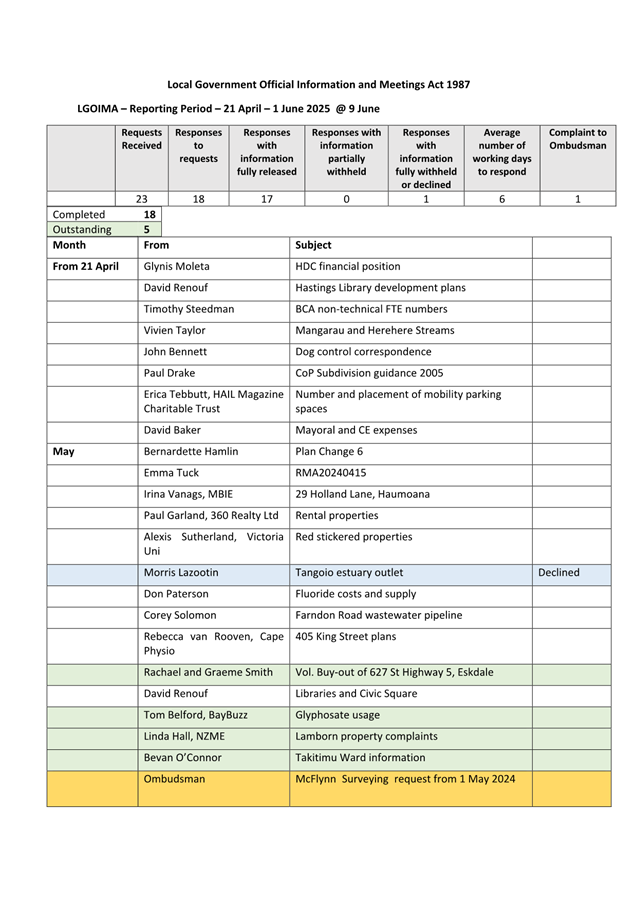

HASTINGS DISTRICT COUNCIL
Council MEETING
Thursday, 26 June 2025
RECOMMENDATION TO EXCLUDE THE PUBLIC
SECTION 48, LOCAL GOVERNMENT OFFICIAL INFORMATION AND
MEETINGS ACT 1987
THAT the public now be excluded from the following part of
the meeting, namely:
15 Ōhiti
Land Transfer to Hawkes's Bay Regional Council
The general subject of the matter to be considered while the
public is excluded, the reason for passing this Resolution in relation to the
matter and the specific grounds under Section 48 (1) of the Local Government
Official Information and Meetings Act 1987 for the passing of this Resolution
is as follows:
|
GENERAL SUBJECT OF
EACH MATTER TO BE CONSIDERED
|
REASON FOR PASSING
THIS RESOLUTION IN RELATION TO EACH MATTER, AND
PARTICULAR INTERESTS
PROTECTED
|
GROUND(S) UNDER
SECTION 48(1) FOR THE PASSING OF EACH RESOLUTION
|
|
|
|
|
|
15 Ōhiti
Land Transfer to Hawkes's Bay Regional Council
|
Section 7 (2) (h)
The withholding of the
information is necessary to enable the local authority to carry out, without
prejudice or disadvantage, commercial activities.
Section 7 (2) (i)
The withholding of the
information is necessary to enable the local authority to carry on, without
prejudice or disadvantage, negotiations (including commercial and industrial
negotiations).
Commercially sensitive and
to protect Council's negiotation position..
|
Section 48(1)(a)(i)
Where the Local Authority is
named or specified in the First Schedule to this Act under Section 6 or 7
(except Section 7(2)(f)(i)) of this Act.
|