|
Thursday, 31 July 2025 |
Te Hui o Te Kaunihera ā-Rohe o Heretaunga
Hastings District Council: Council Meeting
Te Rārangi Take
Report to Council
|
Nā: From: |
Jess Noiseux, Strategic Financial Advisor Graham Watson, Chief Financial Officer Bruce Allan, Deputy Chief Executive Craig Thew, Group Manager: Infrastructure |
|
Te Take: Subject: |
Local Water Done Well Decision |
1.0 Executive Summary – Te Kaupapa Me Te Whakarāpopototanga
1.1 The purpose of this report is to:
· Seek Council’s decision on the water service delivery option following public consultation and hearing of submissions which will set the direction for the development of a Water Service Delivery Plan (WSDP) as required under the Local Government (Water Services Preliminary Arrangement) Act 2024 (‘the Act’) and the Local Government (Water Services) Bill 2024 (‘the Bill’). The WSDP will be brought back to Council next month for adoption prior to submission to the Department of Internal Affairs (DIA) by 3 September 2025.
· Endorse the draft Heads of Agreement between the four Hawke’s Bay Councils (including Napier City Council, Wairoa District Council and Central Hawke’s Bay District Council), based on a decision to establish a regional Water Service Council Controlled Organisation (WSCCO). The Heads of Agreement outlines key transition arrangement and agreed terms/commitments to achieve the regional operating model and objectives.
1.2 In April, officers presented a comprehensive analysis of the potential delivery models for Local Water Done Well, covering both the financial impacts and the non-financial advantages and disadvantages of each option. Since that time, there have been no significant changes to this analysis. A recap of this analysis has been provided in section 4.31 to 4.56 of this report.
1.3 The regional WSCCO presents the strongest case in terms of financial sustainability, resilience, service capability, efficiencies of scale and regional collaboration. It has received strong community support, with 83% of submissions favouring a regional WSCCO.
1.4 The Heads of Agreement has been prepared collaboratively with the other Hawkes Bay Councils to support the transition to a regional WSCCO.
3.0 Background – Te Horopaki
Legislative and Policy Framework – Recap
3.1 The Local Government (Water Services Preliminary Arrangements) Act 2024 (“the Act”) was enacted on 2 September 2024. The Local Government (Water Services) Bill (“the Bill”) was introduced in early December 2024 and builds on the foundations set in the Act. The combined legislation set minimum requirements for service delivery models that included:
1. New economic, environmental and water quality regulations
2. A new planning and accountability framework
3. Financial sustainability objectives
4. New statutory objectives consistent for all water providers
5. Restrictions against privatisation
3.2 All Councils are required under this legislation to consider options and determine a preferred water service delivery model.
3.3 The Act requires that water services be delivered in a financially sustainable manner by 30 June 2028. DIA guidance is that financial sustainability means water services revenue is sufficient to meet the costs of delivering water services. The costs of delivering water services includes meeting all regulatory standards, and long-term investment requirements in water services.
3.4 There are three key factors to how financial sustainability will be assessed:
· Revenue sufficiency – is there sufficient revenue to cover the costs (including servicing debt) of water services delivery?
· Investment sufficiency – is the projected level of investment sufficient to meet levels of service, regulatory requirements and provide for growth?
· Financing sufficiency – are funding and finance arrangements sufficient to meet investment requirements?
3.5 The process to develop a one-off, transitional Water Services Delivery Plan (WSDP) for submission to DIA by 3 September 2025 is designed to get Councils to demonstrate how financially sustainable water services provision will be achieved from 30 June 2028 at the latest.
3.6 Under Local Water Done Well, the Local Government Funding Agency (LGFA) has committed to allowing Water CCOs to access debt financing, provided they are financially supported (through a guarantee) by their parent council or councils. The LGFA, as the lowest financing cost provider to local government, is already utilised by Council. The purpose of this specific lending facility is to support Councils through a WSCCO to address water investment needs while enabling ‘balance sheet separation’. This approach can help reduce debt associated with water services on Council’s balance sheet, potentially freeing-up debt capacity for other Council activities or alleviating pressure on Council rates.
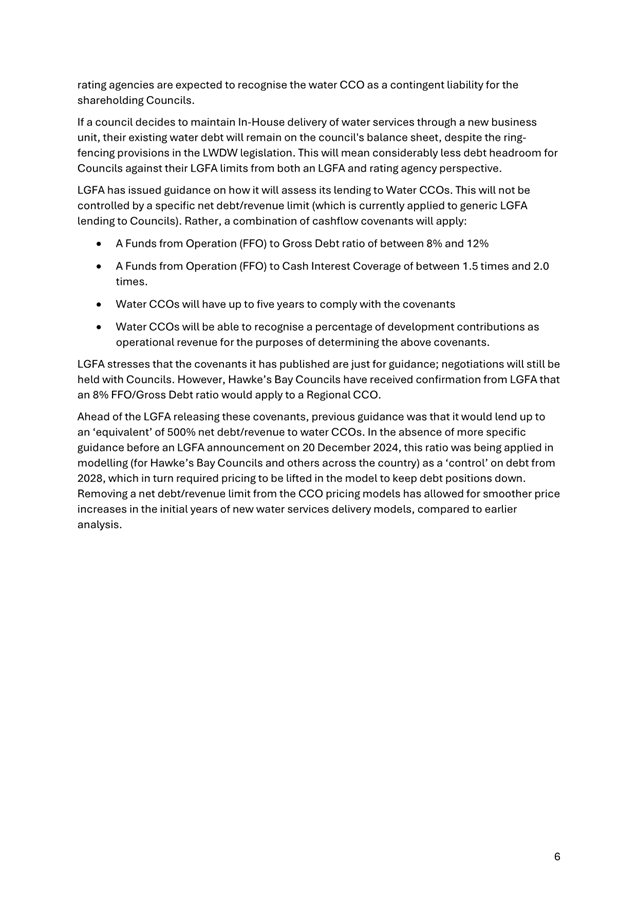
3.7 Under the CCO model (single or joint), LGFA will not consolidate the debt of a WSCCO into the overall debt position of Council. However, LGFA guidance indicates that credit rating agencies will consider the debt of a WSCCO part of the parent Council’s balance sheet if that Council owns more than 50 per cent of the WSCCO (i.e. this will impact on Councils credit rating). Councils credit rating influences the cost of borrowing for Council from the LGFA. As a result, the parent Council under a single CCO may face a lower credit rating score (and higher borrowing costs) compared to a parent Council that is part of a joint CCO, as discussed below.
3.8 For a multi-council, or Regional CCO where no council owns a majority of the organisation, both the LGFA and S&P (Councils credit rating agency) will treat the debt of the water CCO separately to the parent Council. Credit rating agencies are expected to recognise the water CCO as a contingent liability for the shareholding Councils, and assess the Council’s stand-alone debt position without the water debt held by the Regional CCO.
3.9 If a council decides to maintain In-House delivery of water services through a new business unit, their existing water debt will remain on the council's books, despite the ring-fencing provisions in the LWDW legislation. This will mean considerably less debt headroom for Councils against their LGFA limits from both an LGFA and rating agency perspective.
Water Service Delivery Plans
3.10 Council must submit a WSDP by 3 September 2025, which explicitly shows its preferred proposed water services delivery model. The WSDP must include:
1. The proposed water services delivery model
2. Whether to transfer (or not) Councils water services and/or assets
3. Financial separation of its water services from the rest of Council activities
4. Demonstrations that financial sustainability will be achieved by 30 June 2028. The plan must be adopted by Council and certified as being true by the Chief Executive, before being submitted to Central Government.
3.11 The WSDP must be accompanied by an Implementation Plan for the preferred delivery model and submitted to the Secretary of Local Government (Secretary) - via DIA, by 3 September 2025. The WSDP is then either:
1. Accepted by the Secretary, who can only accept a WSDP if it complies with the Act (as above)
2. Not accepted by the Secretary, who may make a recommendation to the Minister of Local Government (the Minister)
3.12 The Minister has the power to appoint a Crown Facilitator and/or Water Services Specialist if a council or group of councils, are failing in delivering or implementing a WSDP. This includes not meeting an accepted measure of financial sufficiency. A council can also request the appointment of a Crown Facilitator and/or Water Services Specialist.
Legislative Planning and Accountability Framework
3.13 The framework is intended to improve transparency and accountability for future delivery of water services. There are three documents that form the framework within which each water service provider’s strategic and investment priorities, and performance settings, will be developed, explained and reported.
A Statement of Expectations
3.14 A statement of expectations is prepared by shareholders and issued to the water organisation they own, relating to a period of at least ten financial years. It will set out the shareholders’ expectations for the water organisation. It will inform and guide the decisions and actions of the organisation’s board. Water organisations must give effect to these statements.
3.15 The statement of expectations provides an important opportunity for council, as the shareholder, to communicate with the water organisation. Note that in the select committee report on the Bill, amendments have been made to this part of the Bill (outlined in section 4.3 of this report). The Bill sets out in detail what a statement of expectations must include, covering:
· The shareholders’ expectations of the water organisation
· The outcomes the shareholders expect the water organisation to achieve by providing water services
· Requirements relating to the TA’s resource management planning and land use planning
The bill also includes a range of matters that shareholders may choose to include in a statement of expectation, including:
· How the shareholders require the water organisation to conduct its relationships with the shareholders, the shareholders’ communities, hapū, iwi, and other Māori organisations, consumers, and other specified consumers
· Performance indicators and measures that the shareholders may use to monitor the water organisation
· Expectations relating to the strategic priorities to be included in the water organisation’s water services strategy
· A requirement that the water organisation act in accordance with an obligation that a shareholder may have (including with hapū, iwi or other Māori organisation) and undertake a specified obligation on behalf of a shareholder
· A requirement to undertake community or consumer engagement and the contents of that engagement
· Expectations in relation to collaborating with shareholders and other parties when providing water services
· A requirement that part or all of the water organisation’s water services strategy must be independently reviewed or audited
A water services strategy (prepared by water service providers)
3.16 A water services strategy is prepared by water service providers every three years and supported by an annual budget in the other years. This document will set out how the provider is proposing to perform, respond to local expectations and priorities, and meet statutory objectives and regulatory requirements for water. It will include financial forecasting information over 10 years, and infrastructure and investment information over 30+ years. Strategies prepared by water organisations will respond to matters in the statement of expectations. Prices and charges will be set in accordance with the proposals in the strategy. An annual budget will also be prepared for each financial year, consistent with the provider’s intended approach to funding, revenue, and pricing.
A water services annual report (prepared by water service providers)
3.17 A water services annual report is prepared by water services providers every year, reporting on the provider’s actual performance against the expectations and proposals in the above documents. It will include financial reporting against the forecast financials in the water services strategy and must be audited by the Office of the Auditor General.
Previous Council Resolutions and Consultation Process
On 29 April 2025, Council resolved to consult with the community on the following three delivery models:
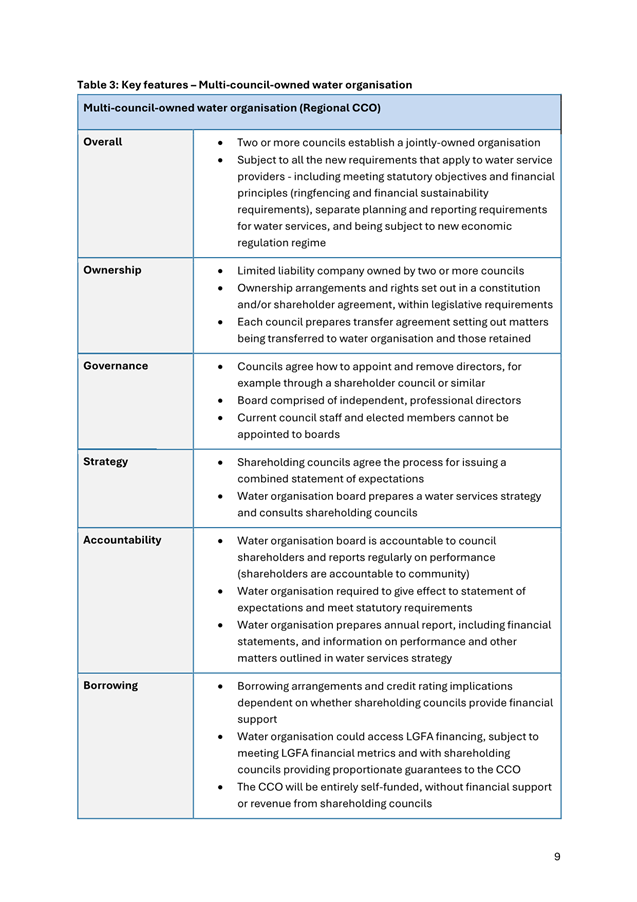
1. Option 1 – A Regional Hawke’s Bay Multi-owned Water Organisation (Regional WSCCO)
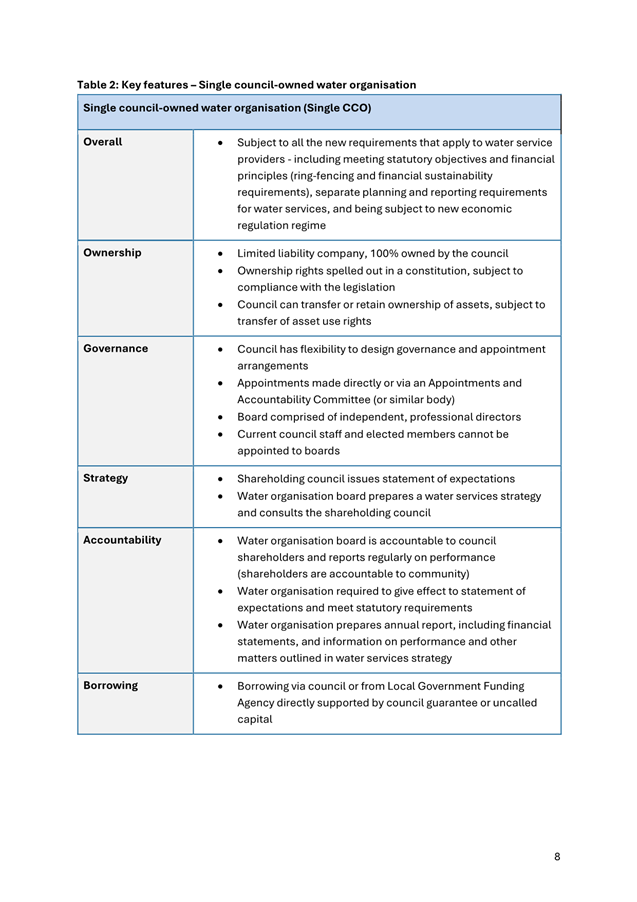
2. Option 2 – A single Council owned Water Organisation (HDC CCO); and
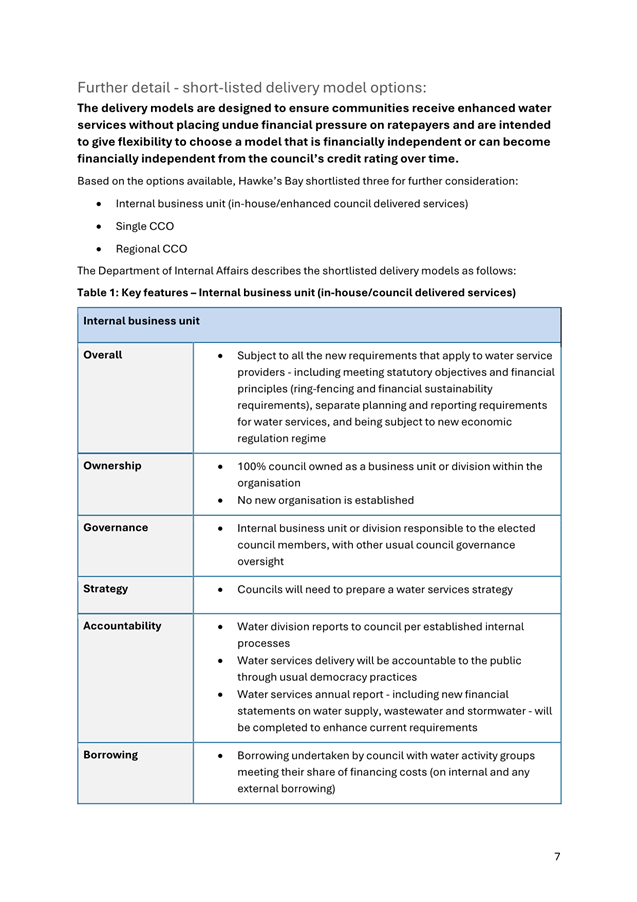
3. Option 3 – Internal Business Unit – modified status quo (also referred to as in-house and council delivered service)
Council also endorsed Option 1 as its preferred delivery model for water services.
3.18 The consultation process was extensive and in order to give significance to the communities affected, it went above the minimum consultation requirements of the Bill. The consultation process reflected a Special Consultative Process as provided for in the Local Government Act 2002.
3.19 A total of 1063 submissions were received, with 16 submitters presenting at the Hearings process on 8 July.
3.20 The submissions were split 87 per cent between the urban community and the rural community (13 per cent). From the responses received 90 per cent had at least one connection to a Council water service and 83 per cent supported Council’s preferred option for a regional WSCCO.
3.21 The main themes coming through from the consultation from those supporting the regional WSCCO option included:
· Cost efficiency and economies of scale
· Regional collaboration and shared infrastructure
· Water metering and user pays
· Independent, professional governance
3.22 The main themes coming through from those who opposed a regional WSCCO model included:
· Scepticism of financial benefits
· Desire to retain local control and accountability
· Opposition to price harmonisation
· Affordability and equity concerns
· Concerns about privatisation of assets
· Concerns over Governance complexity
Hawke’s Bay Heads of Agreement Process
3.23 Following the decision by all four Hawke’s Bay territorial authorities to endorse the joint WSCCO as the preferred option for public consultation, an independent facilitator was appointed to support discussions with respect to bespoke transitional arrangements and terms.
3.24 Although consultation was still in process and decisions yet to be made, it was agreed by Chief Executives and Mayors that progress needed to be made on these matters with a ‘no regrets’ approach given the tight timeframes councils were working to (set by Central Government) for submitting a WSDP. This information was required not only to support the implementation section of the WSDP, but more importantly to give elected members confidence in making informed decisions regarding future water service delivery for councils on behalf of their communities.
3.25 In the absence of formal decisions or a transitional entity, legal advice recommended that a Heads of Agreement (formal and binding), should be developed and entered into by participating councils. This was to cover areas such as:
· A commitment to work together to progress an overall establishment and transition plan against a timetable (which informs the implementation plan within the WSDP)
· The key structural aspects of a joint WSCCO (shareholding, governance, operational layers) to form the basis for developing and agreeing the full future documents
· Statement of Expectations minimum content/approach
· Shareholders Representative Forum (or similar) minimum content/approach
· The process for agreeing the basis on which transfers will occur
· The process for existing Councils to exit this arrangement, and the terms relating to this
· The process for admitting new Councils (if applicable) to this arrangement
· Arrangements for sharing project costs incurred
3.26 Simpson Grierson have been engaged to draft a Heads of Agreement for the Hawke’s Bay Councils. The content of this Heads of Agreement has been the subject of Council discussions and workshops over June and July, and the final recommended Heads of Agreement is attached to this Council paper (see Attachment 1) for endorsement at this meeting, should Council agree to proceed with the regional model.
3.27 Given the matters of commercial negotiation and sensitivity in Schedules 4 (Commercial Terms Sheet) and 5 (Strategic Priorities or Intentions) - these sections have been removed from the public Council paper (and Attachment 1) and will be endorsed separately in a public excluded session.
4.0 Discussion – Te Matapakitanga
Local Water Done Well Legislative and Policy Framework – Final Bill Update
4.1 On 3 July 2025, the Finance and Expenditure Select Committee reported back on the Local Government (Water Services) Bill. This is the final piece of legislation to implement the Government’s Local Water Done Well policy.
4.2 The select committee has recommended the bill pass, with extensive amendments (the select committee report notes there are more than 360 amendments proposed – although most are technical). From here, the bill is expected to pass in the coming weeks.
4.3 A summary of changes relevant to Local Government and/or the Hawke’s Bay Councils’ submission on the Bill includes:
|
Clause / Bill Section |
Comments |
|
Clause 15 - Objectives of water service providers |
· The committee has agreed with submitters that an additional objective be added to support housing growth and urban development. This was a request included in the joint submission provided to select committee by the four Hawke’s Bay Councils. · The Hawke’s Bay joint submission also suggested that objectives be added around being resilient and responsive to population growth and supporting economic development objectives, however these were not added. Our submission had also suggested a more explicit objective around water services being provided in a “cost-effective and financially sustainable manner”, as well as provide direction on the relationship between water organisations and Māori (such as acting consistently with the obligations of its shareholding councils) but these suggestions were not picked up. · The select committee did amend the way that Treaty settlement obligations are referred to in the legislation, by bringing the requirement to act consistently with Treaty settlement obligations earlier in the bill, and to make it clear that it is a requirement for all persons in relation to the Act (not just the water services providers, as previously drafted). · The select committee has also removed the objective to provide water services that do not have adverse effects on the environment, noting that any environmental effects would be regulated under the Resource Management Act 1991 rather than this legislation. |
|
Clauses 184 – 189 – Statement of Expectations: Shareholder role and influence in water organisations |
· The select committee report notes that some submissions were concerned that the statement of expectations would give shareholders too much power and control over a water organisation. While the report notes that the accountability framework in the bill, including the statement of expectations, is intended to be flexible and differ from the existing provisions around CCOs in the Local Government Act, the select committee has made some amendments. · In particular, the select committee has removed one of the purposes of the statement of expectation – to set the priorities and strategic direction of the water organisation – noting that instead strategic priorities should be set by the board of the water organisation, but can be informed and guided through the Statement of Expectations. · The amendments also now state that, unless provided for in the foundational documents of a water organisation, a statement of expectations cannot include any requirements or expectations relating to the water organisation’s performance or exercise of a duty, function or power under the Act, or require the water organisation to perform, or not perform, a specified act, or to achieve a specified result, in relation to a specified person or persons. |
|
Clauses 190 – 199, Schedule 3, Clause 9: Process for making water services strategy |
· The select committee has inserted a new clause to increase transparency in shareholder involvement in water services strategies, by requiring the final strategy to include a summary of the comments provided by shareholders, and an explanation of whether shareholders required changes and approved the final strategy. · The Hawke’s Bay joint submission did note that proposals in the bill as introduced around allowing shareholders to amend water services strategies and annual budgets seemed to undermine the purpose of the legislation and having water organisations operate independently of political influence. |
|
Development contributions |
· The transitional provisions in the bill around development contributions have been amended. This is to ensure a smoother transition from the status quo (where councils charge development contributions) to water organisations charging development contributions under this bill – and ahead of the Government’s future development levy regime under its “Going for Housing Growth” work programme. · Amendments include enabling asset-owning water organisations to adopt the relevant aspects of councils’ policies as their first development contributions policy and ensuring that water organisations can calculate development contributions based on previous capital expenditure incurred by the council. · The Hawke’s Bay joint submission noted there was a lack of clarity around how developers were meant to interact between a water organisation and the Territorial Authority. |
|
Facilitating transfers to new arrangements |
· The select committee has made a series of changes around transfer agreements, including to clarify that a council can discharge most of its responsibilities for providing water services by entering into a transfer agreement, and to make it clear that no person can require councils or water organisations to provide them with water services. Amendments have also been made to remove "gaps" in the process for entering into transfer agreements, and to expand on the required content of transfer agreements to add transparency. |
|
The financial sustainability of water organisations
|
· In the Hawke’s Bay submission, we noted that ‘financial sustainability’ was a core requirement of Water Services Delivery Plans under the Preliminary Arrangements Act, but that this had not been carried over to the financial principles for water services providers, and suggested that this be added for consistency. This was not included, but several amendments to the principles have been made, particularly relating to dividend payments. · The select committee made changes to support greater transparency and financial disciplines including to require information around dividends must be transparent to the public (in the same way as revenue and expenses are) and that water organisations must not pay a dividend that would compromise a water organisation’s ability to act in accordance with the financial principle that revenue and funding is sufficient to sustain the provider’s long-term investment in its water services. · There have also been changes to the clauses around the Commerce Commission’s regulation of water services, including to more directly link the Commission’s monitoring and enforcement powers to the financial principle of spending revenue and funding on providing water services, and enabling the Commerce Commission to limit dividends paid by a water organisation. |
Water Service Delivery Plan (WSDP)
4.4 A WSDP will be developed based on Council’s decision on the delivery model, as required by the Act. On the basis that all Hawke’s Bay councils agree to the recommended delivery model, this will be a joint regional WSDP between participating Hawke’s Bay territorial authorities.
4.5 Following the decisions across all four Hawke’s Bay territorial authorities to endorse the joint WSCCO as the preferred option for public consultation, it was agreed across councils to proceed with developing a regional WSDP template given the tight timeframes to submit a thorough document to DIA by 3 September. Any information that fed into the regional WSDP could be pulled out to support individual plans if required.
4.6 Officers across the four councils have worked together over the past month to support the development of a draft WSDP, leveraging the extensive financial modelling already. This draft has largely been driven by financial and asset data to date, given the key implementation sections of the WSDP will be finalised once all councils have made decisions on their water service delivery model and endorse the draft Heads of Agreement (that contains the majority of this information in terms of transitional steps for establishment).
4.7 The draft WSDP and figures were submitted to DIA for an initial review to gain as much feedback as possible on the Hawke’s Bay region’s and individual councils’ positions. This feedback will be incorporated into the final plan and capture any necessary changes. Officers have had a session with DIA to discuss this feedback and this will be summarised and presented back to Council (in addition to any key changes required) in August.
4.8 The final WSDP will be brought back to Council workshop on 7 August, and then to a Council meeting later in August for adoption (at the time of writing this report the August meeting date for Council is yet to be confirmed). The objectives and key principles of the implementation plan will be included in this report.
4.9 The Chief Executive will then be required to certify the WSDP prior to lodgement to the Secretary for Local Government for approval on or by 3 September 2025. The Secretary for Local Government can only accept a WSDP if it complies with the Act. Once the WSDP is submitted to the DIA for approval, amendments to the WSDP may be required should the Department propose changes to ensure the WSDP aligns with the Act.
Draft Regional Heads of Agreement
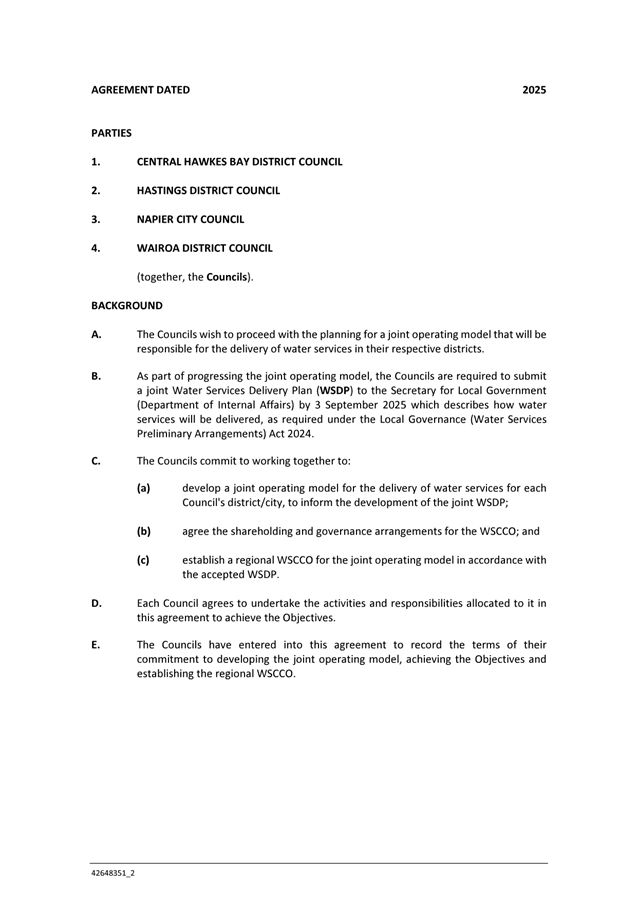
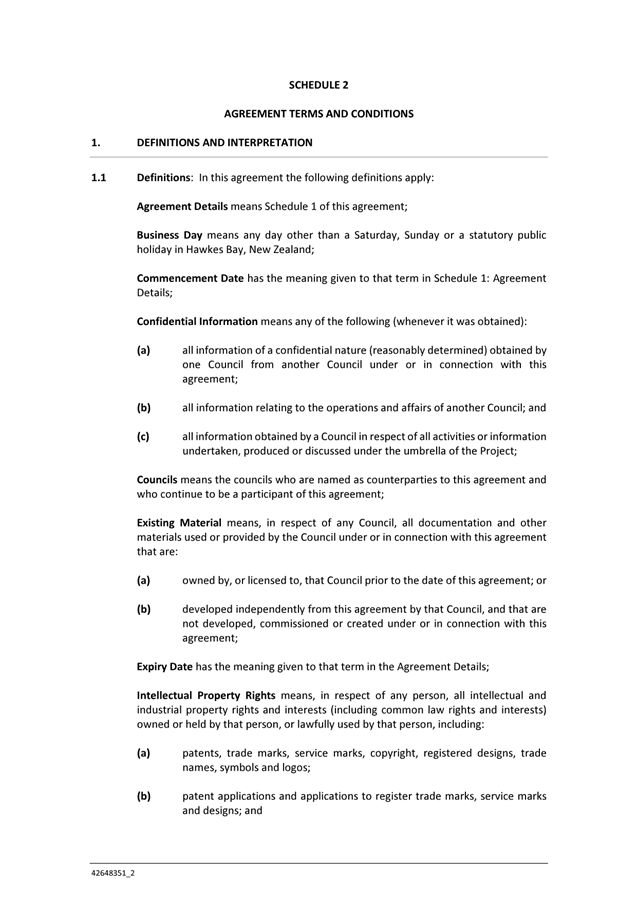
4.10 The purpose of a Heads of Agreement is to set out how councils in a multi-council WSCCO will work together to develop and establish the water organisation. It is a formal, binding agreement for Councils, recording the terms of their commitment to developing the joint operating model, achieving the Objectives of the Heads of Agreement and establishing the regional WSCCO.
4.11 Simpson Grierson have been engaged to draft a Heads of Agreement for the Hawke’s Bay Councils. The content of this Heads of Agreement has been the subject of Council discussions and workshops over June and July, and the final recommended Heads of Agreement is attached to this Council paper for endorsement at this meeting, should Council agree to proceed with the regional model. Given the matters of commercial negotiation and sensitivity in Schedules 4 (Commercial Terms Sheet) and 5 (Strategic Priorities or Intentions) - these sections have been removed from the public Council paper and attachment and will be endorsed separately in a public excluded session.
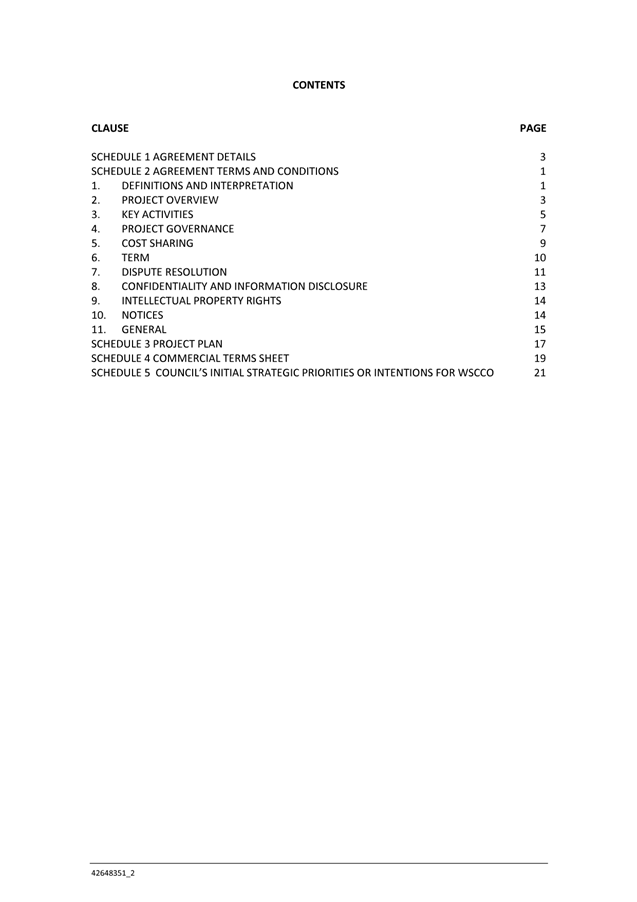
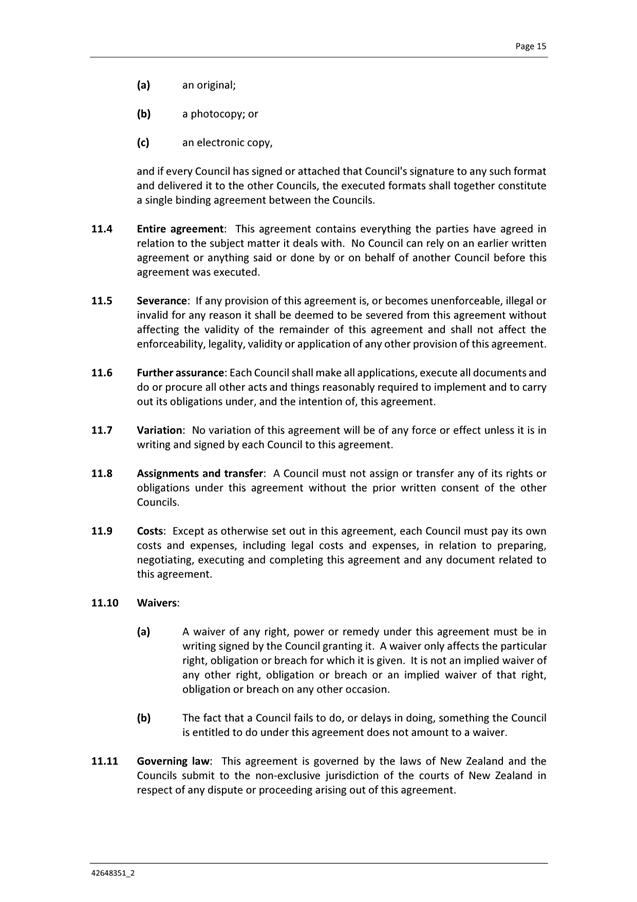
4.12 The Heads of Agreement outlines how the Councils will work together on both governance and management of the project. It also sets the initial direction for the establishment of the WSCCO, including requirements for various foundational documents (such as the Constitution and Shareholders’ Agreement) which will be brought back to Council for approval at a later date.
Key Components
4.13 The key components of the Heads of Agreement are outlined below.
4.14 The Objectives of the agreement (Schedule 2, Clause 2.1) are:
• For the councils to continue to work closely, collaboratively and successfully to:
o Progress a proposed joint operating model for the future delivery of water services in the Hawke’s Bay region; and
o Develop, adopt and submit a joint WSDP that meets each Council’s needs and objectives for their respective communities, and which satisfies the requirements of the LG(WSDPA) Act;
• To agree the process (including key terms, governance and administrative support, allocation of responsibilities, timing and budget) for the establishment of the proposed joint operating model in accordance with the accepted WSDP;
• To facilitate timely decision-making by each Council, ensuring that all relevant statutory requirements can be satisfied, and the proposed joint operating model can be established in line with the accepted WSDP implementation plan; and
• To enable the Councils to consider and reach agreement on how they will operate together to ensure effective and efficient use of the Councils’ resources, ultimately providing the greatest benefits to ratepayers as part of the transition to the proposed joint operating model.
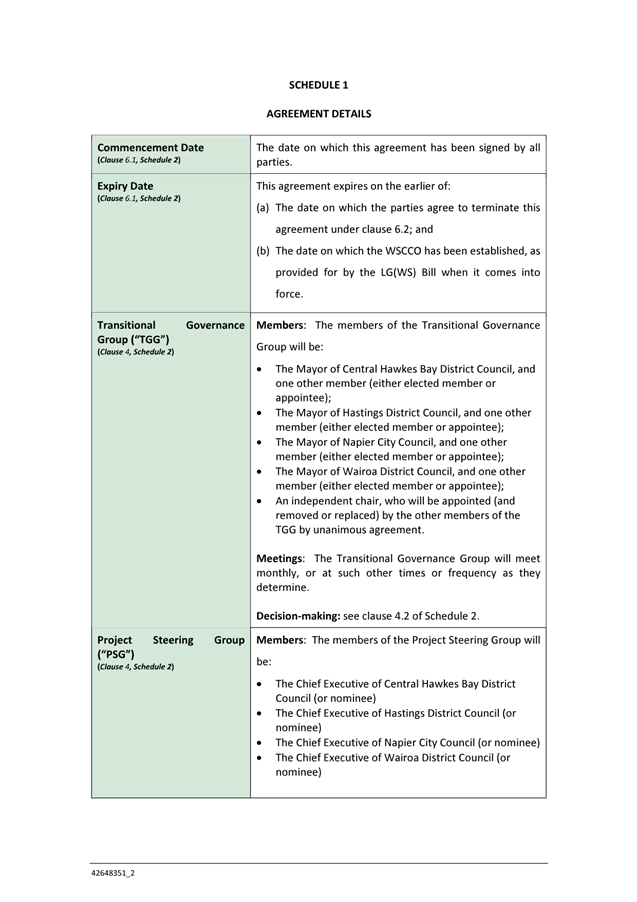
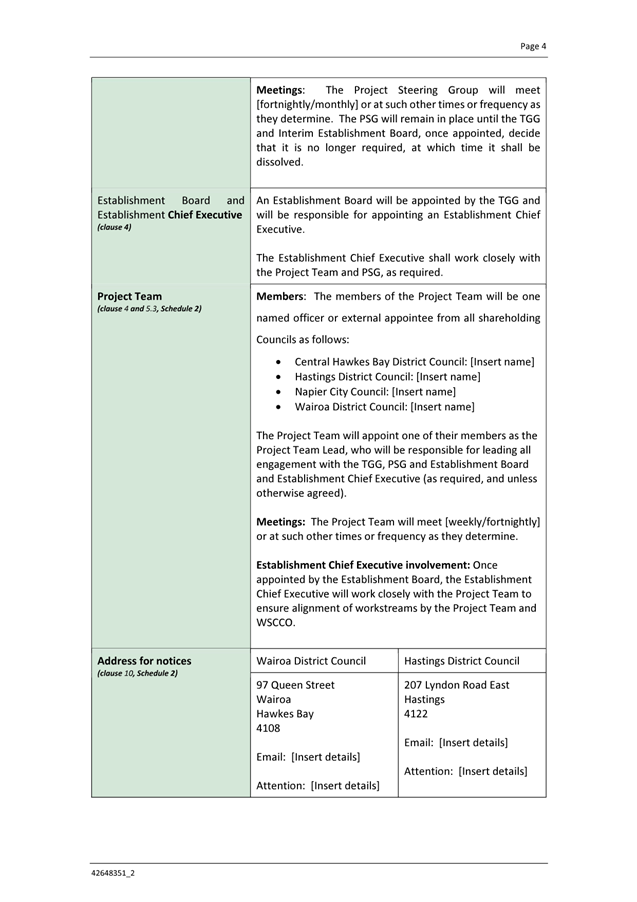
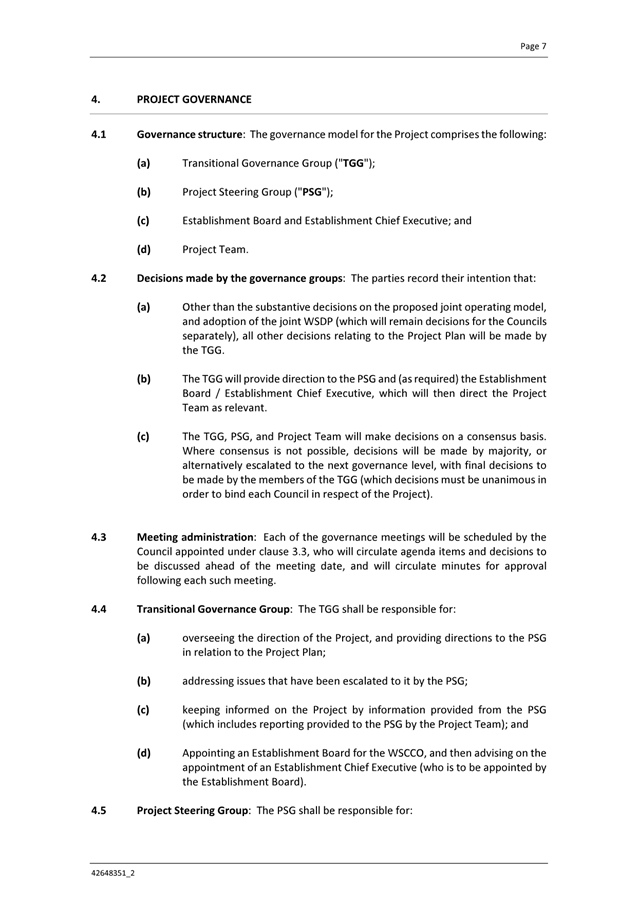
4.15 The Heads of Agreement sets out the Governance model (Schedule 1 and Schedule 2, Clause 4.1) for the Project, namely:
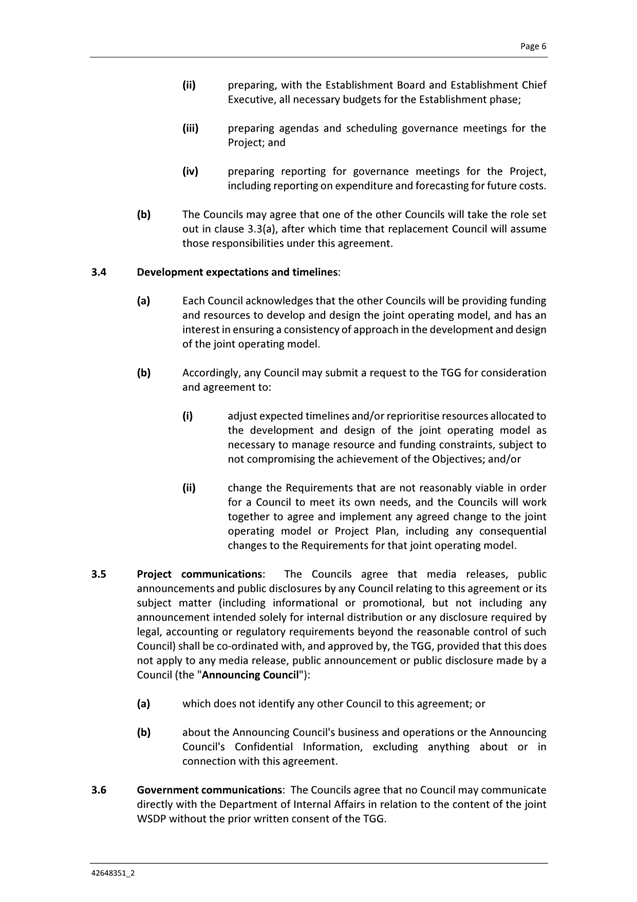
• The Transitional Governance Group (TGG), made up of the Mayor and one other member (either elected member or appointee) from each of the shareholding Councils, plus an independent chair. Responsibilities of the TGG are set out in Schedule 2, clause 4.4 of the Heads of Agreement.
• The Project Steering Group (PSG), made up of the Chief Executives (or nominee) from each of the shareholding Councils. Responsibilities of the PSG are set out in Schedule 2, clause 4.5 of the Heads of Agreement.
• The Establishment Board, to be appointed by the TGG. Responsibilities of the Establishment Board are set out in Schedule 2, clause 4.6 of the Heads of Agreement.
• The Establishment Chief Executive, to be appointed by the Establishment Board. Responsibilities of the Establishment Chief Executive are set out in Schedule 2, clause 4.6 of the Heads of Agreement.
• The Project Team, made up of one named officer or external appointee from each of the shareholding Councils, with one member appointed as Project Team Lead. Responsibilities of the Project Team are set out in Schedule 2, clause 4.7 of the Heads of Agreement.
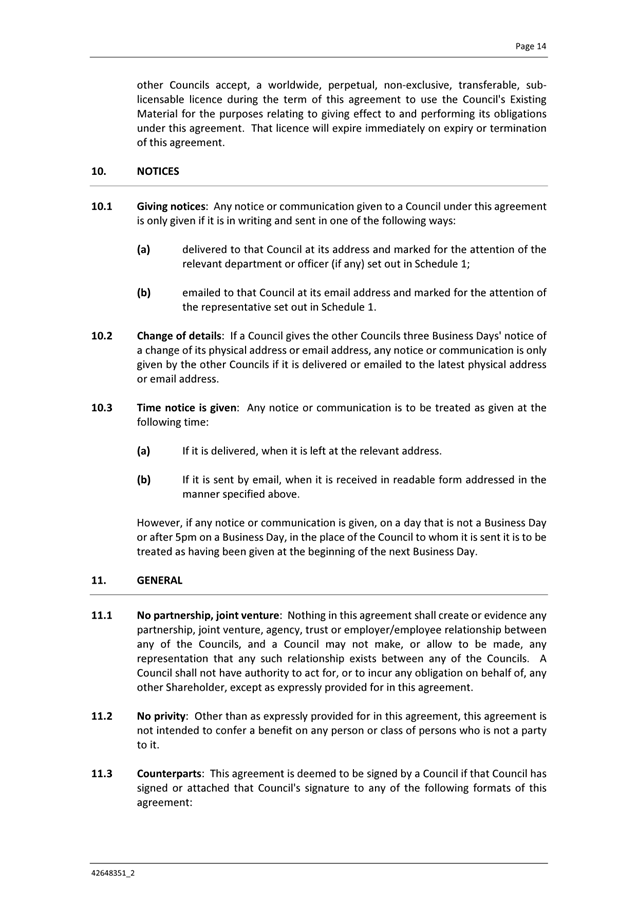
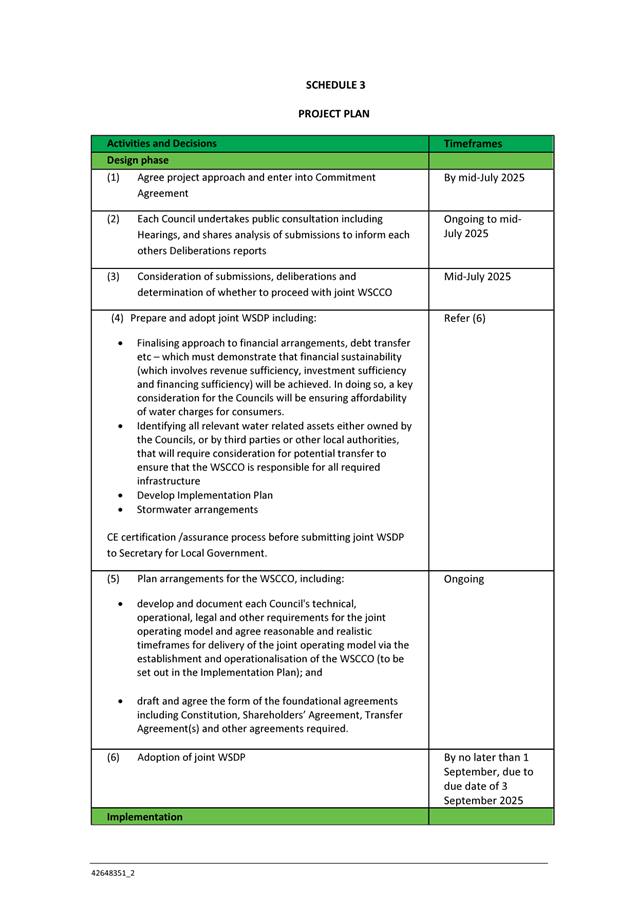
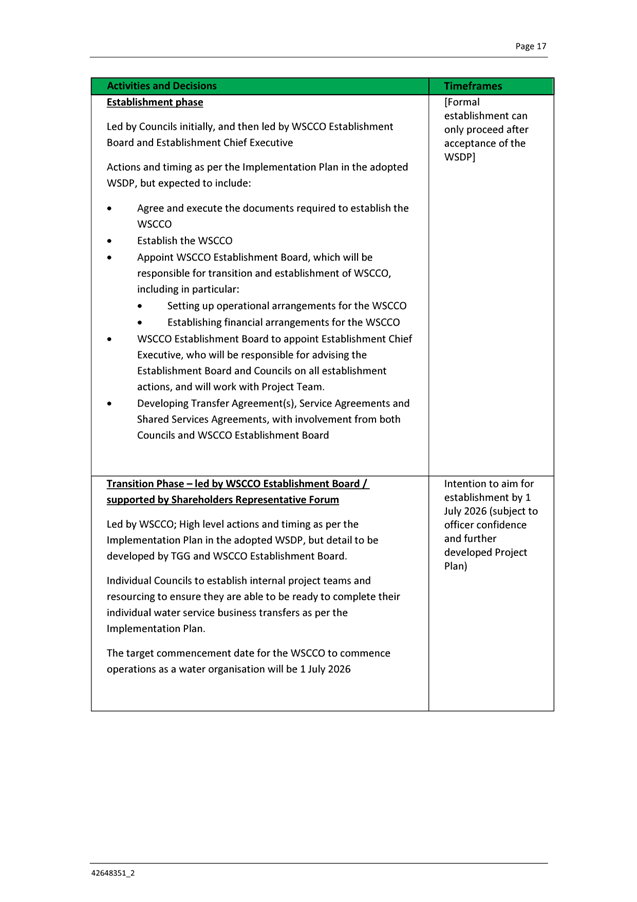
4.16 Schedule 3 of the Heads of Agreement sets out the Activities and Decisions for the different phases of the Project Plan, including the initial design phase and the implementation phase – which covers the establishment phase and the transition phase. The intention is for establishment of the new WSCCO by 1 July 2026, subject to officer confidence and a further developed Project Plan.
4.17 Schedule 4 of the Heads of Agreement is the Commercial Terms Sheet, providing an overview of key aspects of each of the foundational agreements for the new WSCCO. Each of these documents would be drafted, based on these key aspects, as a part of the Establishment Phase. The details of this Schedule have been removed from the public paper due to containing matters subject to commercial negotiations and will be reviewed separately.
4.18 Schedule 5 of the Heads of Agreement outlines the initial strategic priorities or intentions for the WSCCO. This is the section of the Heads of Agreement that reflects the priorities for the region, as well as the priorities for individual councils. The details of this Schedule have been removed from the public paper due to containing matters subject to commercial negotiations and will be reviewed separately.
Public Consultation and Hearings Feedback
4.19 The consultation process was extensive, going beyond the minimum requirements of the Bill and reflected the level of consultation required for a Special Consultative Process as per the Local Government Act 2002. This ensured that the voices of the communities were given full consideration.
4.20 A total of 1063 submissions were received, and 16 submitters presented at the hearings on 8 July.
4.21 The submissions reflected a divide between urban and rural communities, with 87% of submissions from urban communities and 13% from rural communities. Importantly, 90% of submissions had at least one connection to Council water services, while 83% expressed support for the Council’s preferred option for a regional WSCCO. These findings highlight strong overall support for the regional WSCCO option, particularly from those directly impacted by Council water services.
Speakers in favour of a regional WSCCO
4.22 Eight of the speakers at the hearings expressed strong support for the regional WSCCO model, citing key benefits such as cost efficiency, resource pooling, and the ability to future-proof infrastructure. These supporters emphasized that the regional approach would enable better collaboration across councils, resulting in improved service delivery and shared resources.
4.23 There was also a clear recognition that the model would help to address regional water management challenges, such as ensuring long-term sustainability and improving service levels through a unified approach.
Speakers in opposition of a regional WSCCO
4.24 Of the 16 members of the community who took the opportunity to speak to Council, 8 were not in favour of a regional delivery model. This was primarily due to concerns about local control, affordability, and governance complexity. A common theme was the loss of local decision-making power and the fear that a more centralised governance structure could result in a dilution of local input into water service management.
4.25 A significant number of opponents were also concerned about price harmonisation, which they viewed as potentially unfair, particularly for smaller communities. There were also worries about the financial impact on ratepayers, with concerns that the regional model could lead to rising costs.
Additional Themes Emerging from the Hearings
4.26 As outlined in the Council paper on 8 July, the key themes coming from all submissions related to:
In favour of a regional WSCCO:
· Cost efficiency and economies of scale.
· Regional collaboration and shared infrastructure
· Water metering and user pays
· Independent, professional governance
· Improved service delivery and infrastructure outcomes
· Other general comments
While supportive of regional delivery there were some concerns about retaining public ownership of water services, and quite mixed views on mana whenua engagement, with some submissions strongly supporting and others raising concerns. There were also concerns raised about management of Council’s remaining debt levels.
Opposed to a regional WSCCO
· Perception of financial benefits
· Desire to retain local control and accountability
· Opposition to price harmonisation
· Affordability and equity concerns
· Governance complexity
4.27 These themes were predominantly highlighted by speakers during the hearings process, with the only additional or strongly emphasised points being:
· Skepticism about financial benefits
A notable concern from speakers who opposed the regional model, was the perceived lack of financial transparency regarding the actual cost savings of the regional model. Some speakers believed the financial case for the regional WSCCO was not compelling enough, suggesting that the model simply shifts existing debt obligations rather than delivering real efficiencies.
· Concern about local control and accountability
Some speakers were particularly concerned about losing local influence over water services and that a centralised governance model would make it harder to address local needs effectively.
· Desire for clearer governance structure
There was concern over the complexity of the governance model and that the regional structure might make it more difficult for local ratepayers to have direct input into decisions that directly affect them.
· Mixed views on mana whenua engagement
The issue of mana whenua engagement was a central theme, with some speakers strongly advocating for more inclusive engagement (and for that engagement to include all levels of mana whenua, not just PSGEs), while others expressed concern about the level of influence or representation of Māori voices in decision-making decisions.
· Support for the regional model’s ability to improve service delivery
Speakers highlighted that regional collaboration would allow for better infrastructure planning, more effective responses to weather events, and the pooling of resources to ensure more resilient water systems. The idea was that a regional entity would have the resources to improve service quality and build a more sustainable infrastructure for the future.
· Acknowledgment of improved governance with regional expertise
Some speakers noted that a professional, technically competent governance model would be a significant improvement, enabling decisions to be made independently of local political pressures. They recognised that the regional model would bring together a broader range of expertise and ensure more efficient and effective governance. This was seen as a major advantage in addressing complex issues around water management, which often require specialised knowledge.
· Long-term financial sustainability
A few speakers reinforced the potential financial benefits of the regional model, particularly in terms of cost efficiency and the ability to spread the costs of infrastructure upgrades across a broader ratepayer base. They pointed out that regional collaboration could enable economies of scale, which would ultimately result in more cost-effective service delivery in the long term.
· Support for collaboration in water management
Speakers noted that water sources, stormwater systems, and environmental responsibilities do not adhere to council boundaries, and a regional approach would allow for better coordination and shared responsibility in managing these critical resources. They argued that a regional WSCCO would help councils collaborate on issues that affect the entire region, and water networks, leading to more sustainable and equitable water management solutions.
4.28 There were a few items brought up that showed some factual misunderstandings or highlighted where the consultation documentation wasn’t clear enough.
4.29 These included:
· Price Harmonisation: Concerns about price harmonisation were prevalent, with some speakers fearing that it would lead to increased costs and that decisions around price harmonisation would be made outside of Council control. However, any future decisions around price harmonisation would require approval through shareholder agreement, based on a majority decision. Such decisions would only be made in the future, when a regional approach to pricing is considered appropriate by all shareholders.
· Governance Structure: There were some concerns that the Governance structure for a regional CCO would mean a total loss of control. As outlined in the Heads of Agreement, it is anticipated that a Shareholder Council will sit above the board, with Council delegated nominees to represent Council decisions on voting matters. It is anticipated that some decisions will need to come back to Council for debate prior to Shareholder voting.
4.30 The consultation process has provided valuable insights into the community’s preferences and concerns. Overall, the feedback revealed a strong support for the regional WSCCO model, particularly due to the perceived benefits of cost efficiency, regional collaboration, and resource sharing. However, concerns about affordability, local control, and complexity of governance were evident among a portion of submitters and speakers.
Recap of Options Analysis
4.31 On 29 April, Officers took Council through an extensive analysis of the different delivery models and the advantages and disadvantages of each model. Below in sections 4.32 to 4.55 is a recap of this analysis.
Financial Sustainability and Cost to Ratepayer
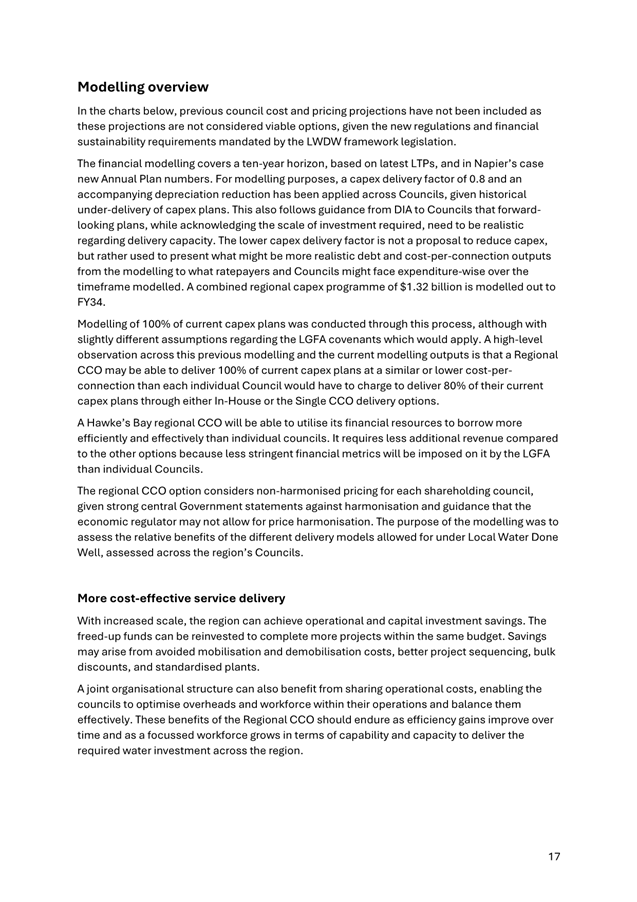
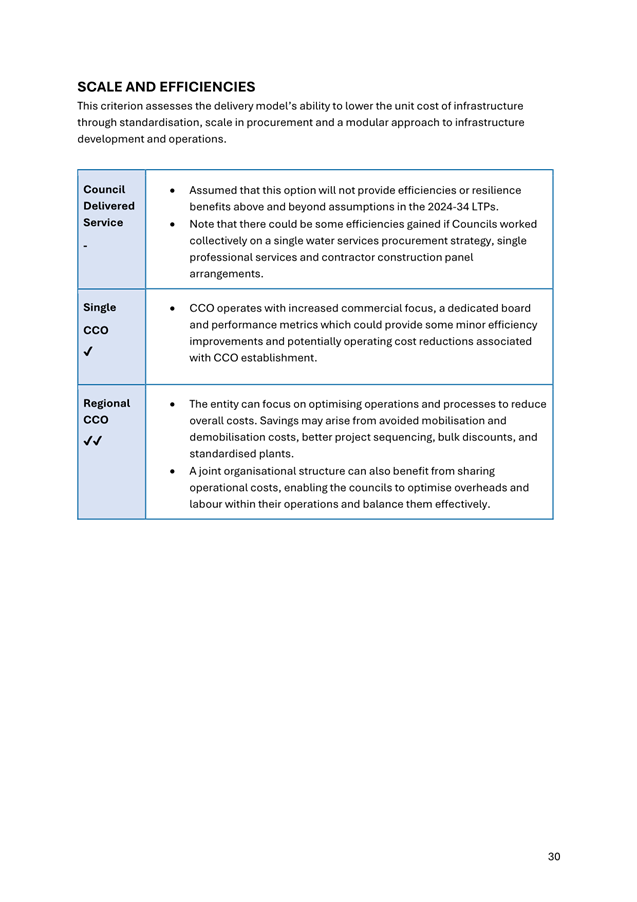
4.32 One of the primary benefits of the Regional CCO model is the improved financial sustainability it offers through operating and cost efficiencies. While costs are likely to be ring-fenced between councils to ensure financial independence, the Regional CCO allows for greater coordination and collaboration in the delivery of water services, which leads to reduced operational costs and enhanced efficiency.
4.33 For instance, by leveraging shared expertise, resources, and bulk purchasing power, the Regional CCO is expected to achieve lower per-unit costs for services and infrastructure compared to each council operating independently. These efficiencies can be achieved in areas such as procurement, maintenance, staffing, and technology investments. The result is a more cost-effective delivery model for water services, even while financial risks and liabilities remain distinct for each council.
4.34 Regardless of the model chosen, the status quo for water charges is no longer viable. Current water charges, as set in the latest Long-Term Plan (LTP), will not be sufficient to meet the financial requirements imposed by new regulatory and legislative changes. Councils will need to increase charges to consumers to meet debt covenant ratios and ensure compliance with mandatory financial sustainability measures. This increase in charges is necessary to ensure that councils remain financially stable and able to fund water services in line with the new requirements.
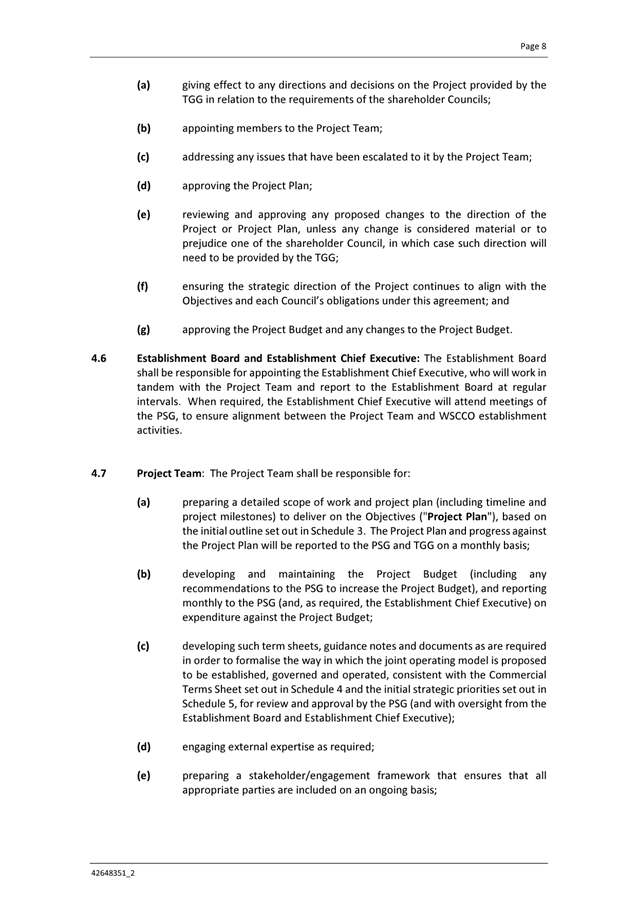
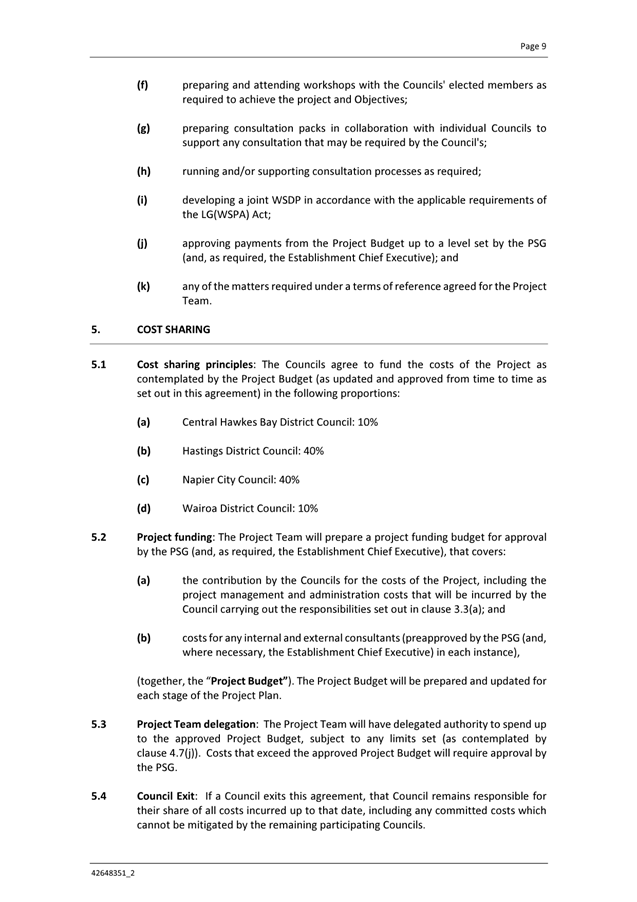
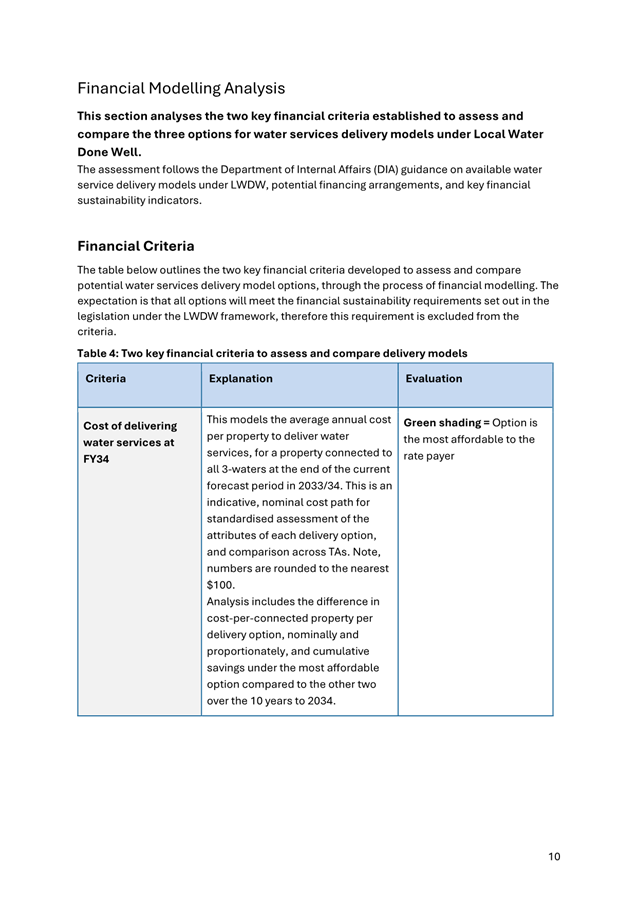
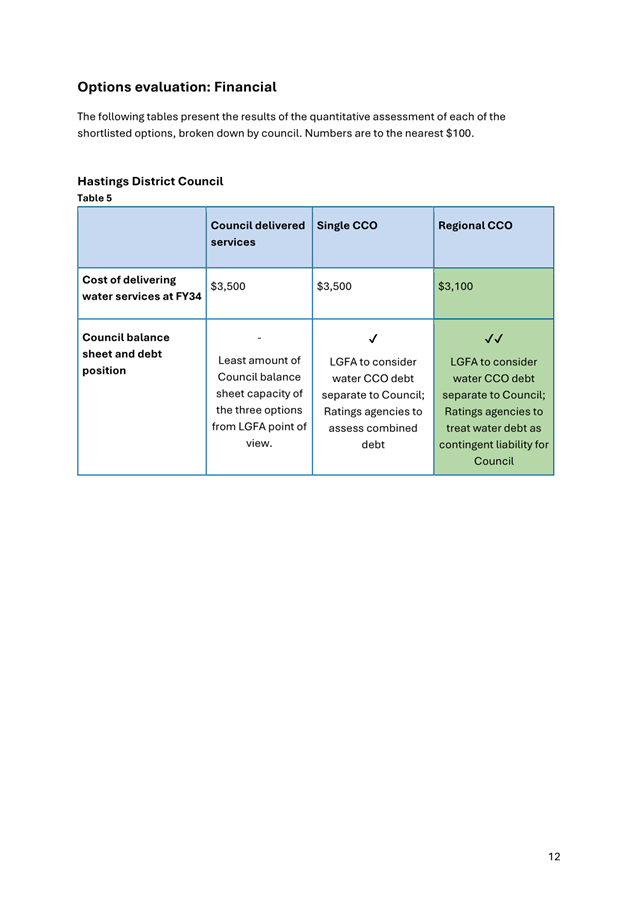
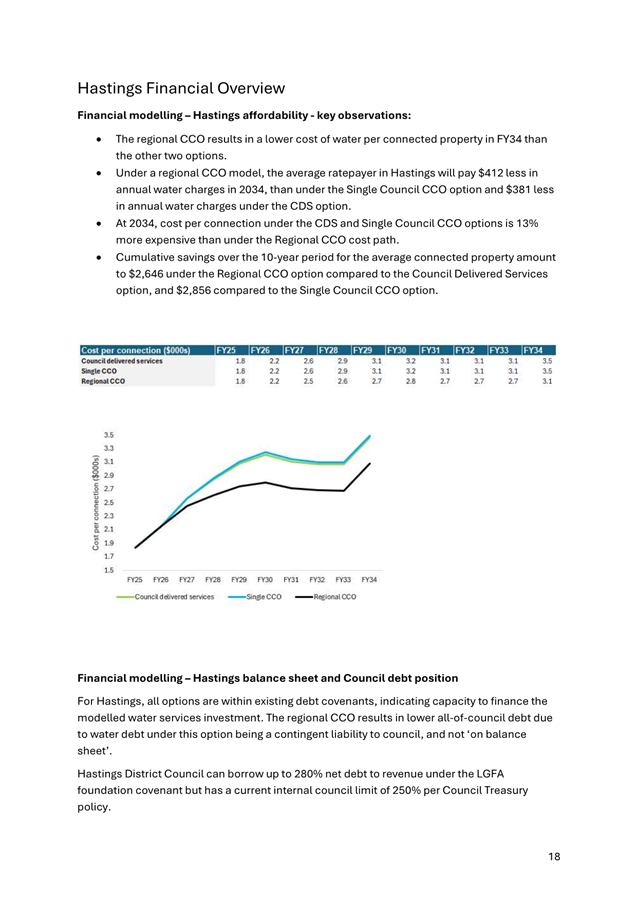
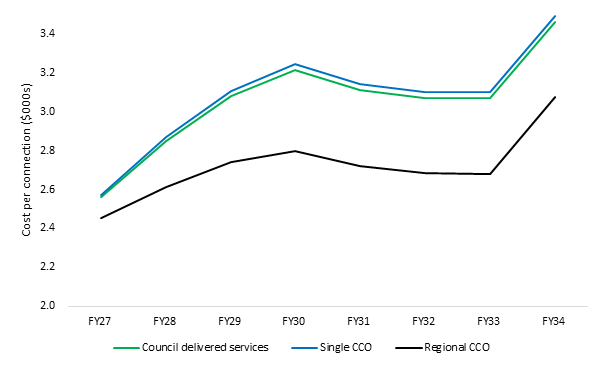
4.35 The cost per connection under each model, as per modelling data in Attachment 2 is:
Average cost per connection ($000s)
|
Model |
FY27 |
FY28 |
FY29 |
FY30 |
FY31 |
FY32 |
FY33 |
FY34 |
|
In-house |
$2.6 |
$2.9 |
$3.1 |
$3.2 |
$3.1 |
$3.1 |
$3.1 |
$3.5 |
|
Single CCO |
$2.6 |
$2.9 |
$3.1 |
$3.3 |
$3.1 |
$3.1 |
$3.1 |
$3.5 |
|
Regional CCO |
$2.5 |
$2.6 |
$2.7 |
$2.8 |
$2.7 |
$2.7 |
$2.7 |
$3.1 |
The graph below, which compares the current average connection costs outlined in the table above for each model based on the latest financial modelling.
Average cost per connection ($000s)
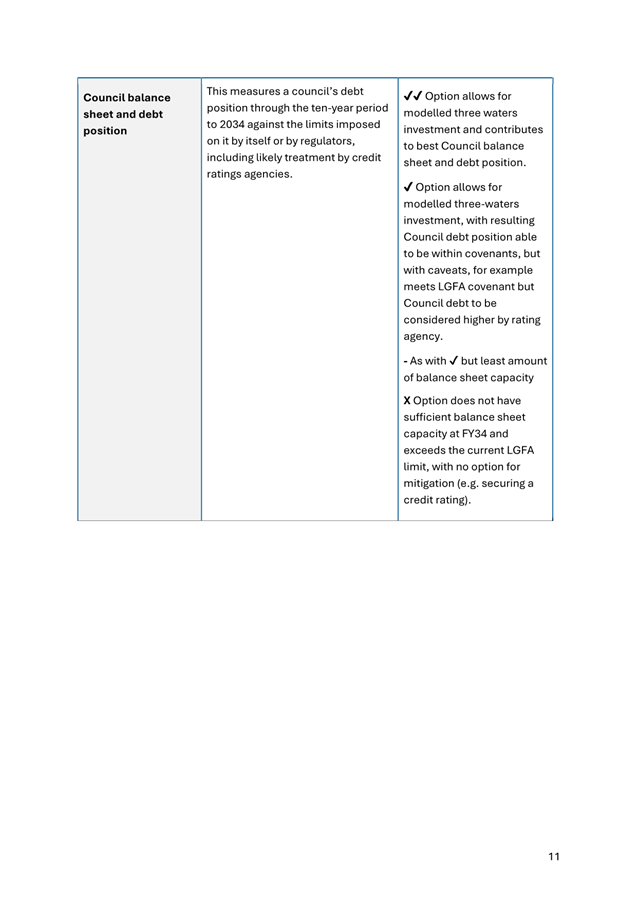
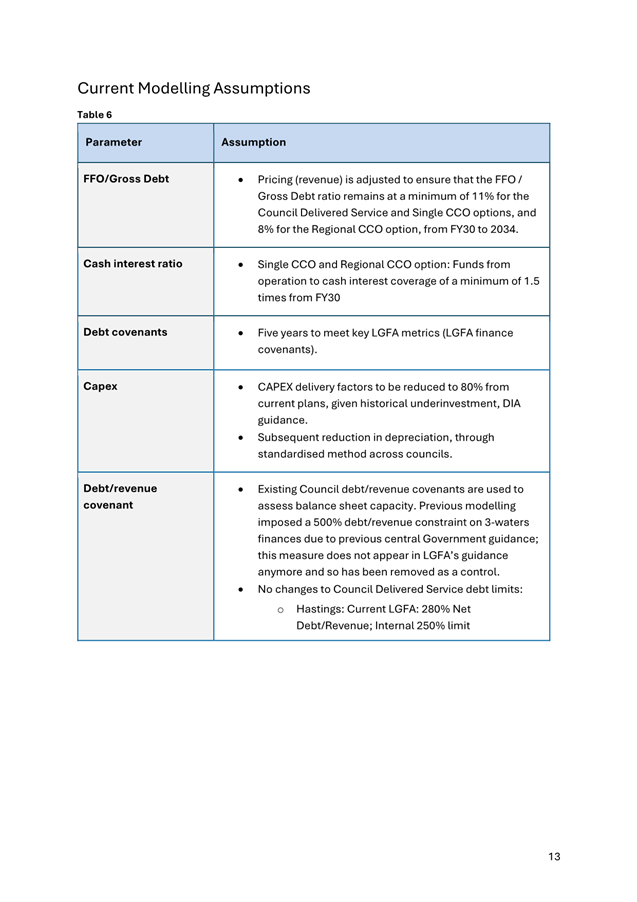
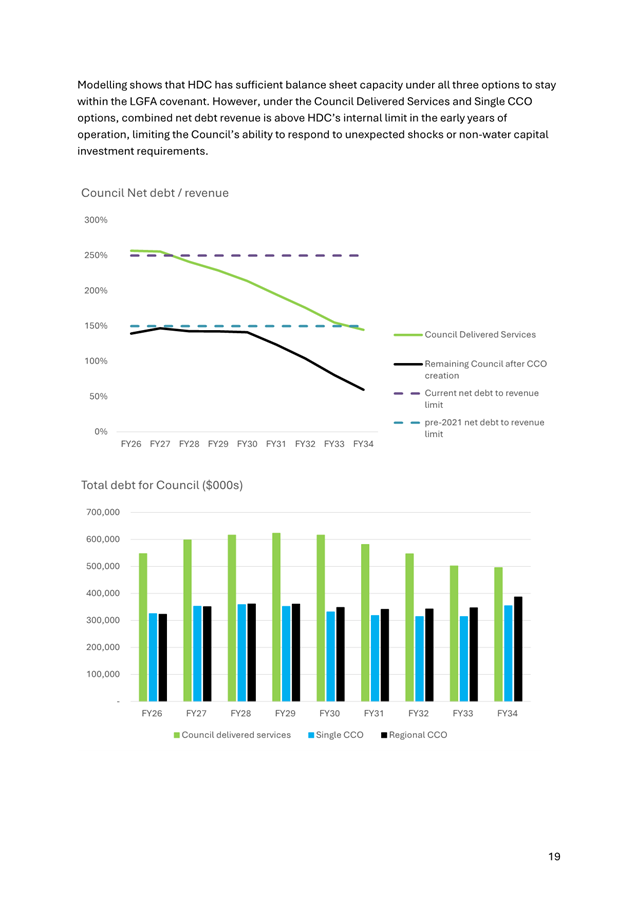
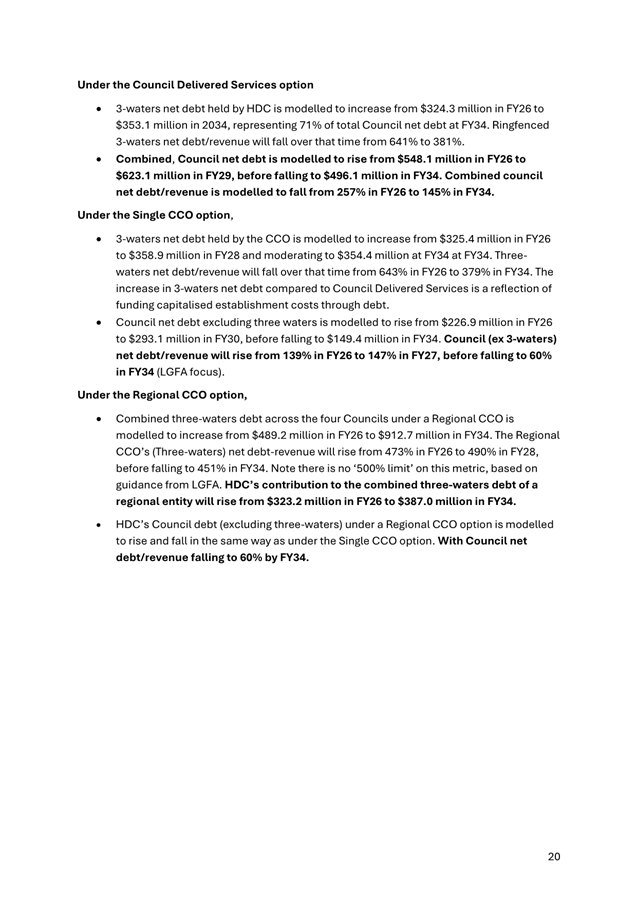
4.36 As previously outlined, retaining the management of three waters as Council delivered services would significantly constrain the Council’s debt headroom, bringing it close to the existing internal policy debt limit. Debt required to fund the necessary three waters investments and meet the new financial requirements imposed by the regulatory framework, would consume the majority of Council’s borrowing headroom, leaving minimal capacity to respond to emergencies, maintain resilience in the face of major unexpected events, or debt-fund other critical infrastructure such as roading or community facilities.
4.37 Establishing either an HDC CCO or a Regional CCO would align the Council’s net debt-to-revenue ratio more closely with pre-Cyclone Gabrielle levels and provide increased financial headroom to respond to future emergencies or make allowances for other Council activity requirements.
4.38 The graph below illustrates the impact on Council’s net debt to revenue ratio under each scenario. It compares the position where three waters remain in-house with the improved debt position resulting from the establishment of a CCO, which would remove three waters-related debt from the Council’s balance sheet.
Council net debt to revenue %
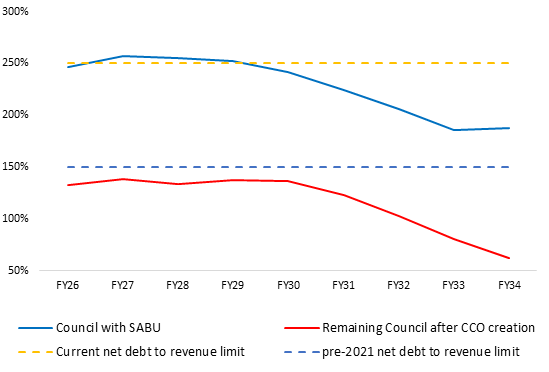
*This is based on Council’s internal net debt to revenue calculation where one off Cyclone Recovery revenue is excluded
Non-financial Criteria analysis
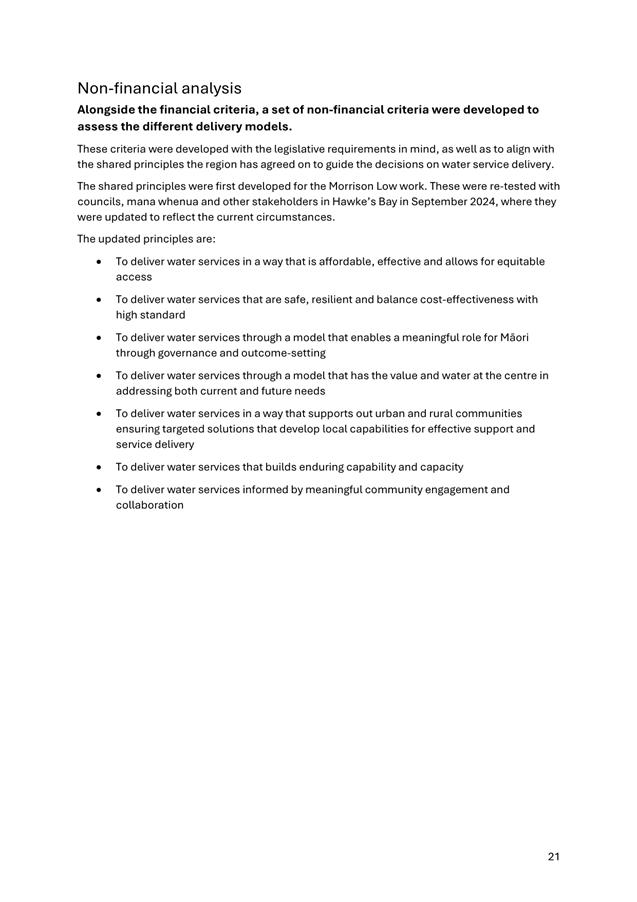
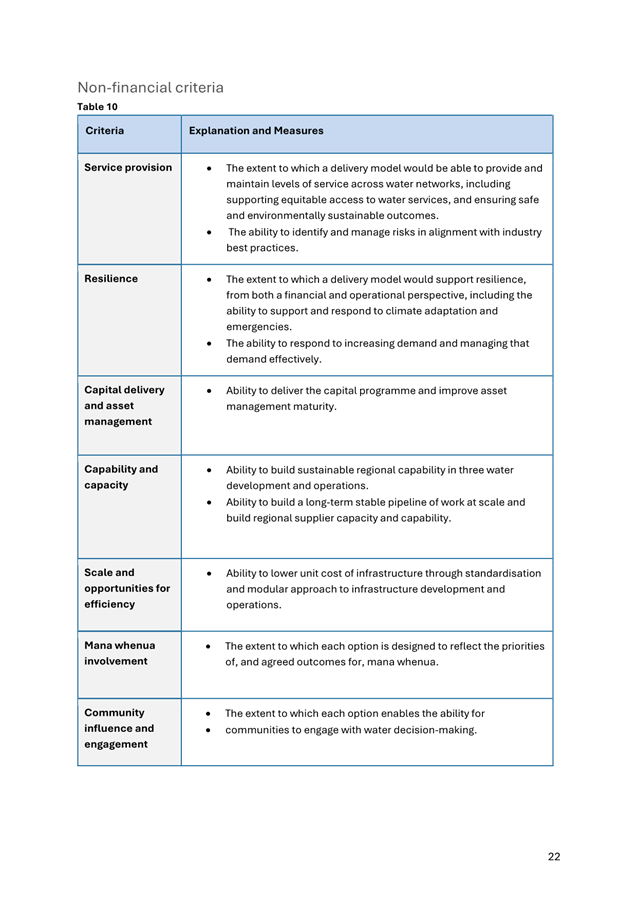
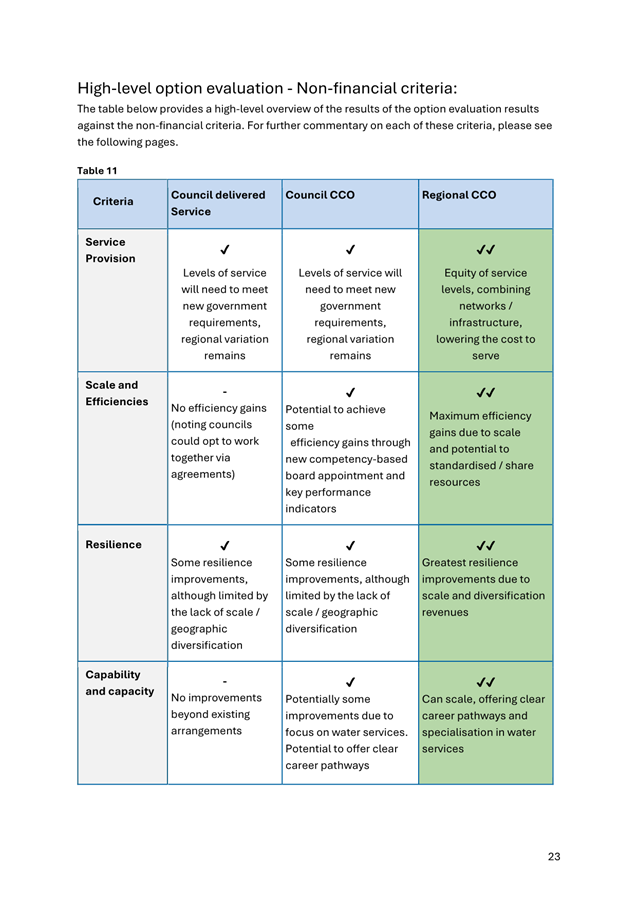
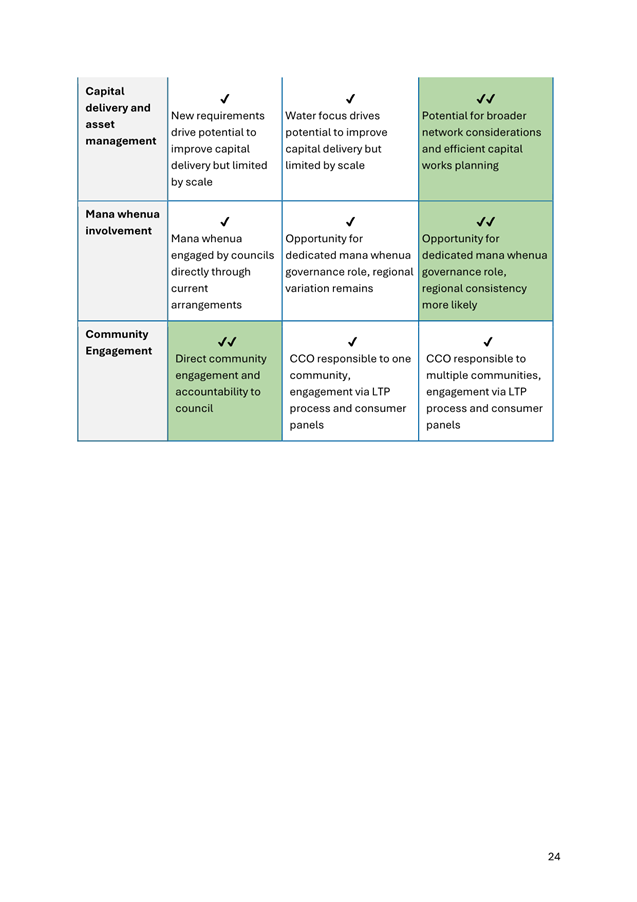
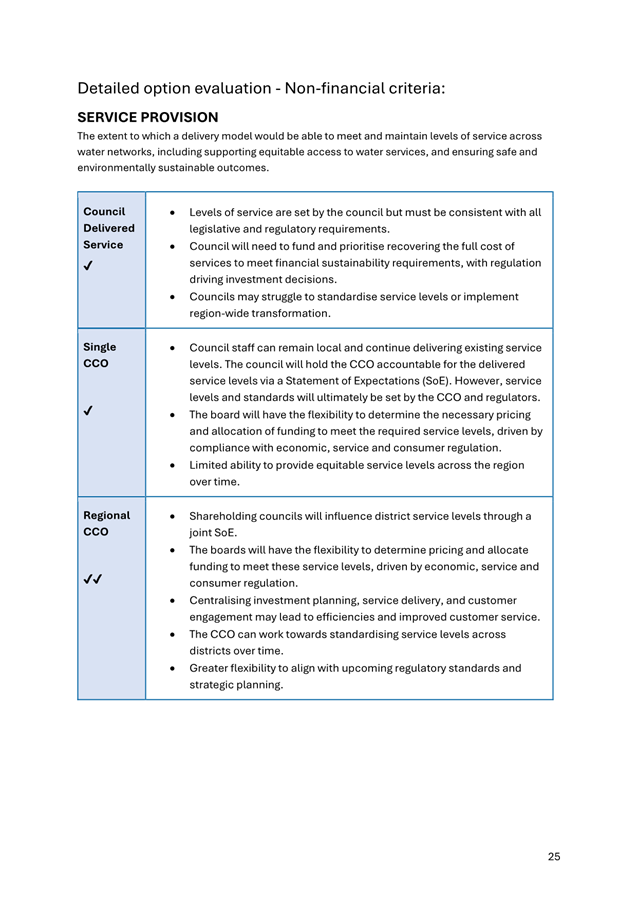
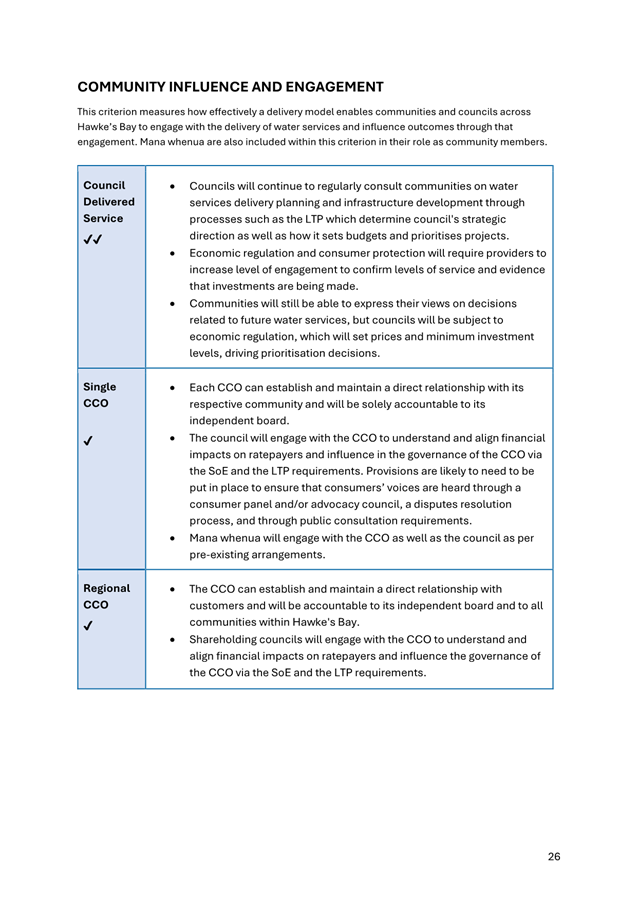
4.39 In addition to financial sustainability, Councillors have asked for an assessment of each delivery model against a wider set of non-financial criteria. These criteria reflect the strategic priorities for Council, including service quality, resilience, capability building, and partnership with mana whenua. This section outlines how each model performs against these factors.
Service Quality and Equitable Outcomes
4.40 The Regional CCO model provides the greatest potential to maintain and enhance service levels across the water networks. By leveraging shared systems, resources, and regional oversight, this model supports consistent, high-quality service delivery and improved access to safe and reliable water services. It also enables more equitable service outcomes across the region through coordinated planning and prioritisation. Importantly, while regional collaboration allows for smarter investment decisions, each council retains financial independence; ensuring that funding remains ring-fenced and that no council is required to subsidise the capital works of another.
4.41 A single council-owned CCO would provide more operational flexibility than the in-house model, with a governance structure that could support longer-term planning and service improvements. However, it lacks the ability to coordinate service levels or share capabilities across a wider area, limiting its capacity to uplift underperforming parts of the network or respond to disparities in service outcomes.
4.42 The in-house model provides direct control but is the least likely to deliver consistent, long-term service quality improvements. As regulatory requirements increase and expectations around environmental and health outcomes rise, the limitations of a single-council model – particularly around access to skilled staff and funding – may constrain the ability to maintain service levels or respond proactively to issues.
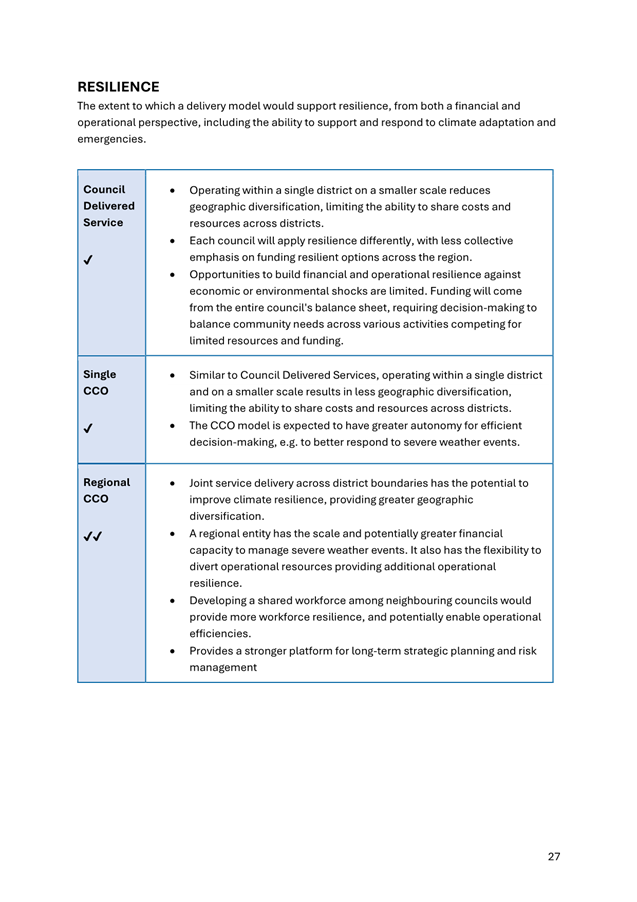
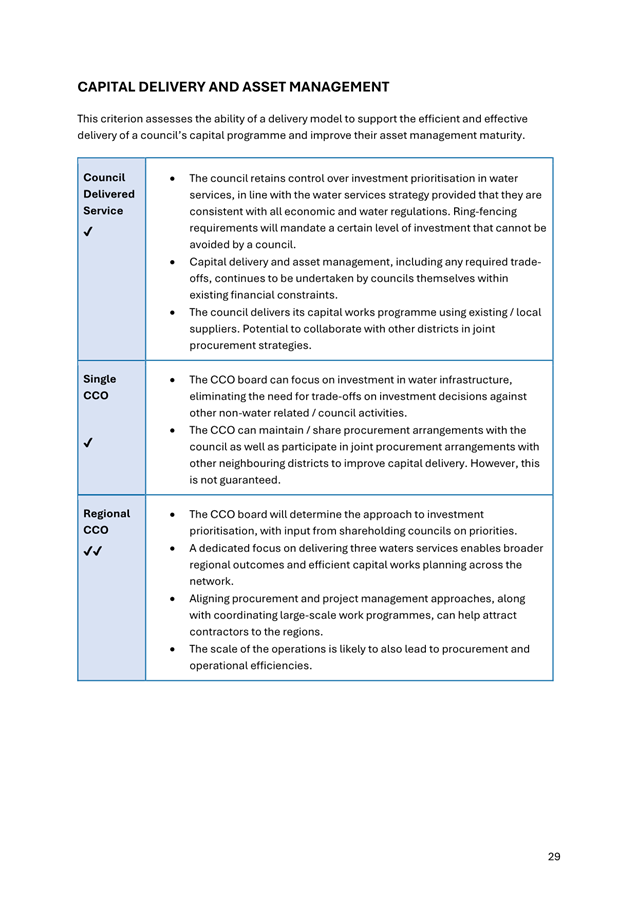
Resilience, capital delivery and asset management
4.43 Water infrastructure requires substantial, long-term investment, and resilience is critical to ensuring reliable and sustainable service delivery. This Council is facing significant financial constraints, with its limited debt headroom, and managing the risks associated with water service delivery will potentially be a challenge. The council’s indebtedness means that there is limited flexibility in its finances to invest in water infrastructure without compromising other essential services and projects across the community.
4.44 Given these financial constraints, prioritising water services due to regulatory changes, such as compliance with national water standards or the need to upgrade aging infrastructure, could divert funding away from other vital council activities. Essential areas like community facilities and transportation may suffer as a result, with projects being delayed or scaled back in favour of addressing immediate water infrastructure needs. This creates a difficult balancing act, particularly when the council is required to address pressing regulatory requirements within water services but also has obligations to ensure the ongoing well-being and development of the wider community.
4.45 The Regional CCO model offers a flexible and agile solution to this issue by enabling councils to collaborate and achieve operational and cost efficiencies. Through regional cooperation, councils can share expertise, resources, and services, leading to reduced operational costs without compromising their financial independence. Financial risks associated with water infrastructure investments, such as compliance costs and major capital projects, remain ring-fenced between councils but can be managed more effectively through shared approaches. This allows each council to continue meeting its water service obligations while minimizing the impact on other essential areas, ensuring that other activities and capital projects are not negatively affected by the demands of water infrastructure investment.
4.46 Moreover, the Regional CCO model provides greater access to expertise and investment, which means that the Regional CCO can participate in larger, more cost-effective projects that improve overall service delivery. These projects can be developed at a regional level, where economies of scale and joint investment can lead to more efficient, resilient water systems that serve the needs of multiple communities. With shared resources, the council can focus on ensuring that its water services meet regulatory requirements, while still having the capacity to fund and prioritize other critical areas.
4.47 In contrast, remaining with the in-house business unit or a single council-owned CCO would place more pressure on the council’s financial situation, making it harder to balance the competing demands of water infrastructure investment and other community services. Without the support of regional collaboration, the council would face more significant challenges in prioritising water services without impacting other areas of service delivery. The Regional CCO model mitigates these concerns by ensuring a more equitable distribution of costs, risks, and resources across all participating councils, enabling a more sustainable and resilient approach to both water services and broader community needs.
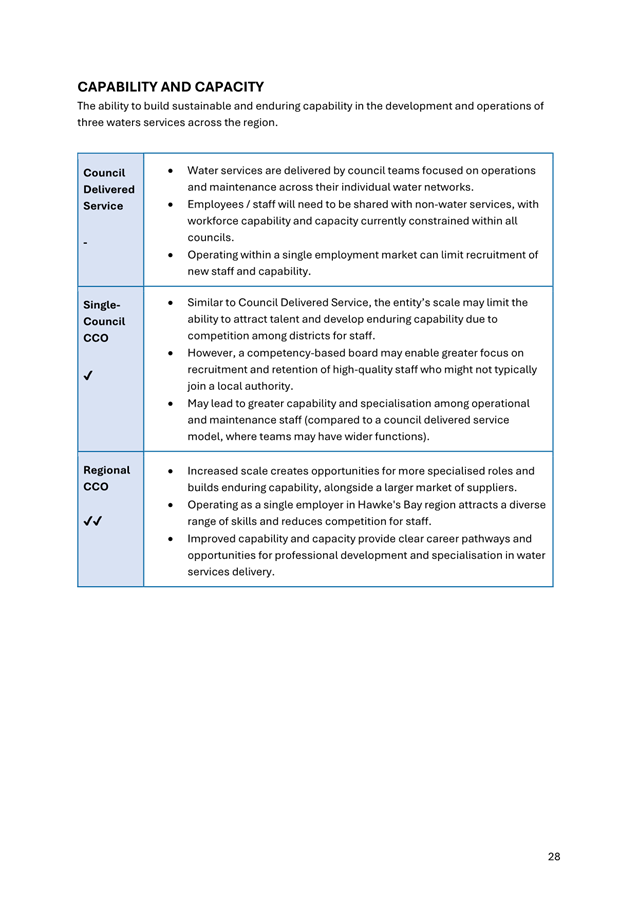
Capability and Capacity
4.48 The Regional CCO model enhances the ability to attract and retain high-quality technical expertise, which is critical for the effective management of water services. By pooling resources across multiple councils, the Regional CCO can better access specialised knowledge, technology, and skilled personnel. This is increasingly important given the growing complexity of water management, including the challenges of climate change, evolving regulatory requirements, and increasing public expectations.
4.49 Beyond internal capability, the Regional CCO model also supports the development of a stronger and more sustainable supplier market. By coordinating investment across councils, the model enables the establishment of long-term, visible procurement pipelines that give contractors and suppliers confidence to invest in workforce growth, training, and innovation. This leads to better market competition, improved delivery capability, and more consistent service outcomes across the region. The scale of this model also supports standardised procurement practices and modular delivery approaches, which can lower unit infrastructure costs and improve delivery efficiency over time.
4.50 While a single council-owned CCO could offer a degree of operational flexibility, it would not benefit from the same breadth of expertise or ability to support a region-wide industry pipeline. Similarly, the in-house business unit—while providing full operational control—may face significant challenges in accessing the technical innovation and procurement scale needed to future-proof the service. These models are less able to influence the market at scale, limiting their ability to drive down infrastructure unit costs through standardisation and modular delivery approaches.
4.51 Smaller entities also face greater challenges in retaining top-tier staff. Limited scale, resources, and advancement opportunities mean that skilled personnel may be drawn to larger regional or national organisations. This can impact service quality, continuity, and institutional knowledge retention. The Regional CCO model, by offering broader career pathways, coordinated training initiatives, and access to a larger talent pool, improves the ability to both attract and retain high-performing staff while also building sustainable capability within the wider water sector.
Mana Whenua involvement
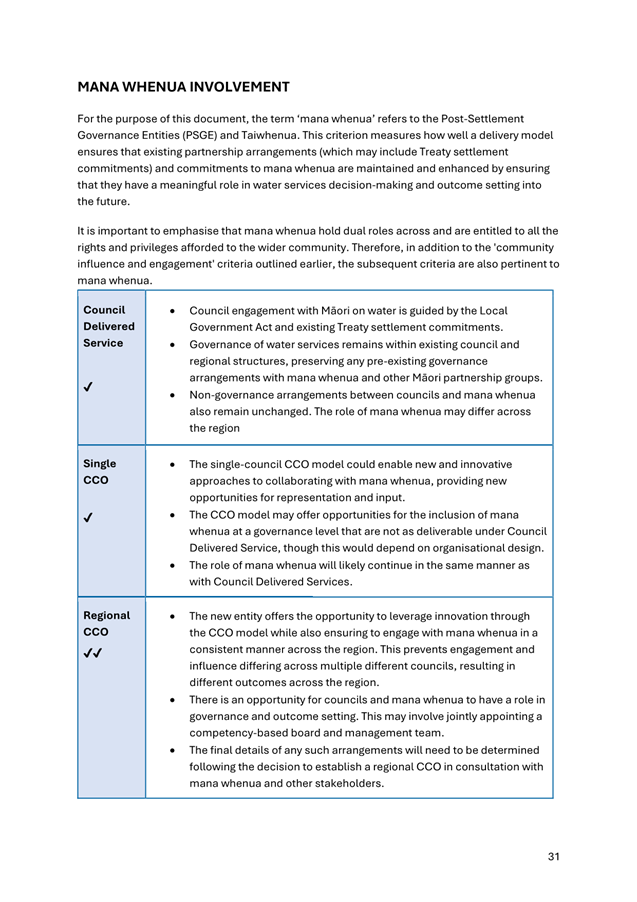
4.52 A core consideration in the selection of a delivery model is the extent to which it reflects the priorities of and supports enduring relationships with mana whenua. Each model presents different opportunities and limitations in enabling effective collaboration, influence, and shared outcomes in the governance and delivery of water services.
4.53 The Regional CCO model provides the strongest platform for embedding Te Tiriti o Waitangi partnerships in a meaningful and consistent way across the region. It enables a consolidated and coordinated approach to engagement and co-governance with mana whenua, which can help build stronger, more enduring relationships. The scale of the entity allows for dedicated capability to support partnership development, culturally grounded planning, and an outcomes framework that align with mana whenua aspirations. It also supports the creation of region-wide mechanisms that enable mana whenua voices to be reflected in strategic decision-making, investment planning, and service delivery standards.
4.54 The HDC CCO model may allow for greater flexibility in how mana whenua relationships are structured locally, but it may lack the resourcing and system maturity to consistently deliver on those relationships at a strategic level. Engagement may also be less consistent across the region, particularly where water networks and iwi/hapū interests span multiple boundaries.
4.55 The in-house business unit maintains direct council control, which could support existing local partnerships and enable place-based responses. However, it may have less capacity to invest in dedicated iwi relationship management, capability development, or co-designed initiatives than a Regional CCO. There is also a risk that resource constraints could limit the ability to respond meaningfully to mana whenua aspirations in water planning and delivery.
4.56 Overall, while each model can be structured to uphold Te Tiriti commitments, the Regional CCO provides the greatest opportunity to invest in partnership capability, embed cultural values into regional water management, and support mana whenua in shaping long-term outcomes for water.
Impact of Other Councils Decision Making
4.57 The three other territorial authorities (TAs) that Council has been working with on a collaborative regional approach are Wairoa District Council, Napier City Council and Central Hawkes Bay District Council.
4.58 Officers and Chief Executives across all TAs have consistently taken a collaborative approach to investigating and evaluating what a regional delivery model for Local Water Done Well might look like.
4.59 Following the adoption of the regional delivery model as the preferred option for consultation by all four Councils, officers have jointly developed a draft WSDP. This draft is nearing completion and will shortly be ready for review and adoption, ahead of the 3 September submission deadline to the DIA.
4.60 While each Council identified the regional model as its preferred option during consultation, final decisions on whether to adopt this model for long-term water service delivery are still pending for some Councils.
4.61 Wairoa District Council initially scheduled a decision-making meeting for 22 July 2025 to confirm its preferred delivery model. That meeting was adjourned, and the matter set to be resolved at a future date. The Council report identified two viable options for Wairoa: a Wairoa owned CCO or the regional WSCCO. At the time of writing this report it was understood that their meeting was to continue on Tuesday 29 July.
4.62 On 3 July 2025 Central Hawkes Bay District Council resolved to confirm the regional WSCCO as its preferred delivery model for water services.
4.63 Napier City Council is scheduled to consider its preferred delivery model at a Council meeting on the morning of 31 July 2025. Officers expect to be able to update Council on the outcome following that meeting.
4.64 The recommendations in this report are contingent on Napier City Council (NCC) also adopting the regional WSCCO as the delivery model for Local Water Done Well. Without NCC’s participation, the financial modelling and non-financial benefits outlined in 4.39 to 4.56 would not be realised to the extent described.
4.65 Should Wairoa District Council opt for a Wairoa-owned CCO instead of joining the regional WSCCO, there would be some impact on the distribution of shared establishment and initial operating costs. However, this impact is not considered material enough to alter the overall conclusion that the regional WSCCO remains the most cost-effective option. If Wairoa opts out, officers will revise the WSDP to exclude Wairoa-specific modelling and operational content.
Update on Mana Whenua Engagement
4.66 Engagement with mana whenua is ongoing and will need to deepen as the project progresses through its next stages. Engagement has occurred at both a regional and local level.
4.67 At a regional level, engagement has been led by the Regional Recovery Agency, supported by PwC, who have met with leaders (where available) from the Post-Settlement Treaty groups across the region, as well as NKII. These conversations took place in September 2024 and again in June 2025. PwC has summarised the draft themes emerging from these discussions as follows:
· Mana whenua consistently noted that LWDW is one of many priorities and momentum appears to have slowed since previous engagement reflecting the amount of time that has passed since this kaupapa first began. Despite this, the aspiration for mana whenua representation in governance remains strong. Water quality remains a top priority for mana whenua. The quality of water continues to be a significant focus, especially in the aftermath of incidents like the Havelock North outbreak, with one representative stating, “Quality of water is non-negotiable, especially after what we’ve seen.”
· Concerns around water scarcity - both current and future - were strongly expressed. Mana whenua are advocating for stronger policies on water management, including greater access to untreated drinking water. Issues relating to wastewater discharge and stormwater management were also raised, reinforcing the need for closely monitored practices. This is consistent with previous advice from mana whenua.
· There are differences in how councils engage with mana whenua. Some councils maintain regular dialogue with mana whenua and others less frequently. In some cases, communications have been sparse and vague, with mana whenua often left to interpret or infer what is happening. This is undermining confidence and creating skepticism about LWDW’s actual commitment to partnership. This disparity is a barrier to trust and raises concerns that the future model will embed those inconsistencies into its foundations.
· Mana whenua expressed a strong preference for governance models that embed their voices from the outset. There is a general call for an enduring, structured partnership model through mechanisms like Memorandums of Understanding (MoU), co-design panels and dedicated seat(s) on decision-making bodies. While this is consistent with previous advice, mana whenua are aware that legislative timelines are looming and feel there is a lack of clarity about how and when their input will be formalised. There is concern that the process could bypass real co-design in favour of last-minute consultation.
· Mana whenua emphasised that the Local Government Act 2002 and Treaty settlement legislation are important instruments that delineate the responsibilities and relationships between the Crown and Māori. Under the Local Government Act 2002, particularly Sections 4 and 14(1)(d), local authorities are mandated to recognise and respect the Crown's responsibility to take appropriate account of the principles of the Treaty of Waitangi. This includes maintaining and improving opportunities for Māori to contribute to local government decision-making processes. These obligations are further reinforced through specific Treaty settlement legislation.
· In the context of LWDW, mana whenua have articulated that these legislative obligations should translate into tangible actions, such as governance arrangements, shared decision-making, and the integration of mātauranga Māori into water management practices. They view these steps as essential for honouring the Treaty partnership and achieving equitable outcomes in water service delivery.
· Economic pressures continue to weigh heavily on communities. Mana whenua continue to voice concerns over rising water rates and the financial burdens faced by Māori communities. There is a perception that current governance structures may inadequately account for these economic realities of these communities.
4.68 At a local level, engagement remains ongoing, with further conversations planned, particularly with rural-focused entities. Discussions to date have focused on providing background and context about LWDW – clarifying what the programme is and is not – and outlining the processes ahead. Initial conversations have also begun regarding how mana whenua involvement and the development of key themes could be effectively progressed following a decision on the preferred delivery option.
5.0 Options – Ngā Kōwhiringa
Option One - Recommended Option - Te Kōwhiringa Tuatahi – Te Kōwhiringa Tūtohunga
5.1 Under this option, Council would approve, as its future Water Service Delivery Model, a joint Water Services Organisation (in the form of a WSCCO) with the other participating territorial authorities within the Hawke’s Bay region.
Advantages:
· Creates opportunities for operating and cost efficiencies while maintaining financial ringfencing.
· Improves ability to attract and retain specialist staff within a larger, more resilient entity.
· Offers more agile and flexible responses to regulatory and operational challenges.
· Reduces pressure on Council’s debt capacity, supporting other council activities and capital works.
· Aligns well with national expectations for scale, resilience, and service capability.
· Governance and accountability risks are mitigated through shareholder agreements, water strategies, letters of shareholder expectations, and structured reporting mechanisms.
Disadvantages:
· Requires compromise and coordination with other councils on governance and prioritisation
· Perceived reduction in local control over service delivery decisions
· May involve longer establishment timeframes due to multi-party arrangements
5.2 This option presents the Regional CCO model as the most likely to deliver long-term sustainability, efficiency, and service quality, while also addressing current financial constraints.
Option Two – Te Kōwhiringa Tuarua
5.3 Under this option, Council would approve, as its future Water Service Delivery Model, a Water Services Organisation (in the form of a WSCCO) with Council as the sole shareholder.
Advantages:
· Maintains full ownership and strategic control over service delivery
· Provides operational independence and commercial flexibility compared to in-house delivery
· More adaptable to performance-focused service delivery and contractual management
Disadvantages:
· Limited access to efficiency gains from shared services or regional expertise
· Higher exposure to staffing challenges, including risk of staff migration to larger regional entities
· Places full financial and governance burden on a single council
· May not fully align with national expectations around regional coordination or resilience
· Does not alleviate debt headroom pressure to the same extent as a regional model
Option Three – Te Kōwhiringa Tuatoru
5.4 Under this option, Council would approve an In-House Business Unit model as its future Water Service Delivery Model.
Advantages:
· Maximum direct control over operations, staffing, and service priorities
· Maintains status quo governance and organisational familiarity
· No establishment time or external negotiations required
Disadvantages:
· Poor alignment with national policy direction toward scale and capability
· Limited resilience and flexibility to respond to increasing regulatory demands
· High risk of losing skilled staff to larger regional entities
· Significantly constrained by Council’s existing debt limits, which may impact other Council services or investments
· Does not benefit from cost efficiencies or shared risk management
· Less likely to meet future compliance, financial sustainability, and service quality expectations
6.0 Next steps – Te Anga Whakamua
Summary of key next steps – contingent on participating councils’ decisions, include:
WSDP
6.1 A WSDP will be developed based on Council’s decision on the delivery model, as required by the Act. On the basis that all Hawke’s Bay councils agree to the recommended delivery model, this will be a joint regional WSDP between participating Hawke’s Bay territorial authorities. The key focus in the next two weeks will be to develop and complete the implementation plan and remaining narrative, as a result of all councils’ decisions.
6.2 A draft WSDP document will be brought to Council workshop on 7 August to work through key inputs of the document, and brief councillors on DIA feedback and implications of any assessment commentary or updates.
6.3 A final WSDP document will be presented to Council on 21 August for adoption and approval, prior to submission to DIA. The objectives and key principles of the implementation plan will be included in this report.
6.4 The Chief Executive will then be required to certify the WSDP prior to lodgement to the Secretary for Local Government for approval on or by 3 September 2025. The Secretary for Local Government can only accept a WSDP if it complies with the Act. Once the WSDP is submitted to the DIA for approval, amendments to the WSDP may be required should the Department propose changes to ensure the WSDP aligns with the Act.
Heads of Agreement
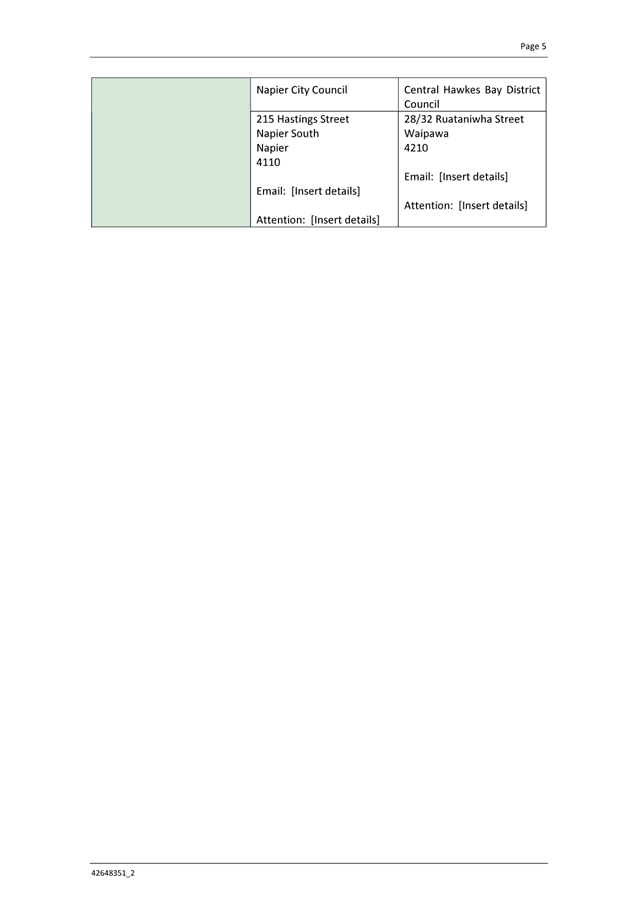
6.5 Following endorsement by all Shareholder Councils, the Heads of Agreement will need to be signed and the establishment work can begin immediately. This includes forming the TGG, PSG and the Project Team, with each then undertaking their responsibilities as set out in the Heads of Agreement.
6.6 Summary of milestones:
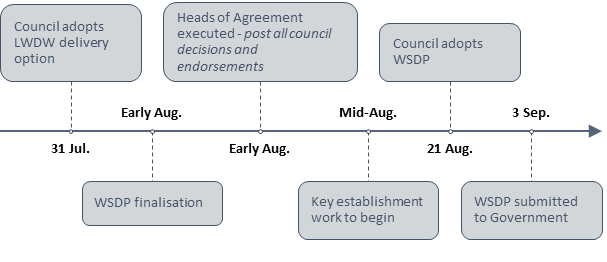
6.7 If Council’s decision at this meeting is to proceed with the regional WSCCO model, it is recommended that Council authorise the Chief Executive to sign the Heads of Agreement attached as Attachment 1. Noting that schedules 4 and 5 are to be reviewed and endorsed separately in the public excluded paper to follow.
6.8 Council will have a number of opportunities during the establishment of the new entity to influence and approve important establishment arrangements including the constitution, shareholders agreement and other transfer arrangements. The timing of these decisions will be dependent on the creation of the Establishment Board and Interim Governance Group. There may be some opportunity to approve some of these foundation documents prior to the election, however it is expected that it will be the new elected Council that will be approving most of the next steps.
|
1⇩ |
Hawkes Bay WSCCO - Heads of Agreement - excluding Schedules 4 and 5 |
CG-17-1-01713 |
|
|
2⇩ |
Appendix 2 - Modelling and Criteria Assessment |
CG-17-1-01531 |
|
|
Summary of Considerations - He Whakarāpopoto Whakaarohanga |
|
Fit with purpose of Local Government - E noho hāngai pū ai ki te Rangatōpū-ā-Rohe The Council is required to give effect to the purpose of local government as set out in section 10 of the Local Government Act 2002. That purpose is to enable democratic local decision-making and action by (and on behalf of) communities, and to promote the social, economic, environmental, and cultural wellbeing of communities in the present and for the future. Link to the Council’s Community Outcomes – Ngā Hononga ki Ngā Putanga ā-Hapori This proposal promotes the all of the wellbeings of communities in the present and for the future. |
|
Māori Impact Statement - Te Tauākī Kaupapa Māori The report details the initial mana whenua involvement and notes that this will need to continue and increase when the option is decided and the design and transition stages progress for the option adopted. |
|
Sustainability - Te Toitūtanga All options need to consider the resources and focus required to operate and manage the 3 waters services in a way that minimises the effect on the environment and makes efficient usage of finite resources. |
|
Financial considerations - Ngā Whakaarohanga Ahumoni The report considers in some detail the key financial considerations for the preferred delivery option. |
|
Significance and Engagement - Te Hiranga me te Tūhonotanga This decision/report has been assessed under the Council's Significance and Engagement Policy as being of high significance. |
|
Consultation – internal and/or external - Whakawhiti Whakaaro-ā-roto / ā-waho This report and recommendation is the culmination of an extensive consultation process with the outcomes of that consultation process reflected in the report. |
|
Risks
The establishment of a new regional WSCCO does come with some risk. There is a lot to do to establish a new entity and all endeavours must be taken to ensure the entity is established to achieve the best outcomes. During any transition period it is important that all risk mitigation measures are implemented to maintain the delivery of these critical services.
|
|
Rural Community Board – Te Poari Tuawhenua-ā-Hapori There a few rural water schemes and one rural wastewater scheme that exist in the areas covered by the Rural Community Board. The funding of the rural water schemes is via an overall drinking water targeted rate. The requirement to assess the small community water supplies exists for all options, with the WSCCO being best placed to facilitate future investment / extension of supply should this be found necessary.
|