Kaupapataka
Agenda
|
Te Rā Hui:
Meeting date:
|
Monday, 16 February 2026
|
|
Te Wā:
Time:
|
1.00pm
|
|
Te Wāhi:
Venue:
|
Council Chamber
Ground Floor
Civic Administration
Building
Lyndon Road East
Hastings
|
|
Te Hoapā:
Contact:
|
Democracy
and Governance Services
P: 06 871 5000
| E: democracy@hdc.govt.nz
|
|
Te Āpiha Matua:
Responsible Officer:
|
Transportation Manager - Jag Pannu
|
Hastings District Rural Community Board – Terms of Reference
The Community Board is a separate entity to the
Council. The role of the Community Board is set out in Section 52 of the
Local Government Act 2002. Membership of the Board is set out in Section
19F of the Local Electoral Act 2001. The Council is authorised to
delegate powers to the Community Board.
Membership (7
members)
·
Chair (elected by the Board).
·
Deputy Chair (elected by the Board).
·
4 Elected Community Board Members.
·
1 Mōhaka Ward Councillor.
·
1 Kahuranaki Ward Councillor.
·
1 Takitimu Ward Councillor.
Quorum – 4
members
|
DELEGATED POWERS
General
1)
To maintain an overview of services provided
by Council within the Community Board’s area.
2)
To represent, and act as an advocate for, the
interests of the community represented.
3)
To consider and report on all matters referred
to the Board by Council, or any matter of interest or concern to the
Community Board.
4)
To communicate with community organisations
and special interest groups within the community.
5)
To undertake any other responsibilities that
are delegated to it by Council.
6)
To appoint a member of the Community Board to
organisations approved by the Council from time to time.
|
Long Term
Plan/Annual Plan/Policy Issues
Authority to make a submission to the Long
Term Plan/Annual Plan process on activities, service levels and expenditure
(including capital works priorities) within the Board’s area or to make a
submission in relation to any policy matter which may have an effect within the
Board’s area.
Roading
and Traffic
Authority to exercise the Council’s
powers and functions in relation to roads within the Board’s area under
the following sections of the Local Government Act 1974:
·
Section 335 (vehicle crossings);
·
Section 344 (gates and cattle stops);
·
Section 355 (overhanding trees).
Authority to exercise the Council’s
statutory powers in accordance with Council policy (including any relevant
powers conferred by bylaw) over roads within the Board’s area in respect
of;
·
Road user behaviour at intersections.
·
Controls on stopping or overtaking.
·
Controls on turning.
·
Pedestrian safety.
·
Footpath maintenance and improvements.
·
Accident investigation studies, lighting and
other safety works.
For the avoidance of doubt, nothing in this
delegation authorises a Community Board to deal with a matter, in the exercise
of delegated authority, in a manner which is in conflict with any policy or
decision of Council or any standing committee of Council in relation to the
same matter.
Kaupapataka
Agenda
|
Mematanga:
Committee Members:
|
Heamana
Chair: Isabelle Crawshaw
Deputy Chair: Abby Morley
Peter Maclennan and one vacancy
Ngā KaiKaunihera
Councillors: Elisha Milmine, Derek Nowell-Usticke and Siiam
Daniel
|
|
Tokamatua:
Quorum:
|
4 members
|
|
Apiha Matua:
Officer Responsible:
|
Kaiwhakahaere Rōpū
Transportation Manager: Jag
Pannu
|
|
Te Rōpū Manapori me te Kāwanatanga:
Democracy & Governance
Services:
|
Louise Stettner (Ext 5543)
|
Te Rārangi Take
Order of Business
|
1.0
|
Apologies
– Ngā
Whakapāhatanga
At the
close of the agenda no apologies had been received.
At the
close of the agenda no requests for leave of absence had been received.
|
|
|
2.0
|
Conflict
of Interest –
He Ngākau Kōnatunatu
Members need to be vigilant to stand aside from
decision-making when a conflict arises between their role as a Member of the
Council and any private or other external interest they might have.
This note is provided as a reminder to Members to scan the agenda and assess
their own private interests and identify where they may have a pecuniary or
other conflict of interest, or where there may be perceptions of conflict of
interest.
If a Member feels they do have a conflict of interest,
they should publicly declare that at the start of the relevant item of
business and withdraw from participating in the meeting. If a Member
thinks they may have a conflict of interest, they can seek advice from the
General Counsel or the Manager: Democracy and Governance (preferably before
the meeting).
It is noted that while Members can seek advice and
discuss these matters, the final decision as to whether a conflict exists
rests with the member.
|
|
|
3.0
|
Confirmation
of Minutes –
Te Whakamana i Ngā Miniti
Minutes of the
Hastings District Rural Community Board held Monday 15 December 2025.
(Previously circulated)
|
|
|
4.0
|
Rural
Transportation Activity Report
|
9
|
|
5.0
|
Update
on regulations for product stewardship of farm plastics and
agrichemicals
|
13
|
|
6.0
|
Rural
Recycling Update
|
21
|
|
7.0
|
Community
Resilience and Rural Halls
|
25
|
|
8.0
|
Minor Items
– Ngā Take
Iti
|
|
|
9.0
|
Urgent
Items –
Ngā Take Whakahihiri
|
|
Te
Hui o Te Kaunihera ā-Rohe o Heretaunga
Hastings
District Council: Hastings District Rural Community Board
Te
Rārangi Take
Report to Hastings District Rural Community Board
|
Nā:
From:
|
Adam Jackson,
Transportation Operations Manager
|
|
Te Take:
Subject:
|
Rural Transportation
Activity Report
|
1.0 Executive Summary – Te Kaupapa Me Te
Whakarāpopototanga
1.1 This report is to update the Hastings District Rural Community Board
with the Rural Transportation Programmed Project Status and Activities Report.
1.2 This report concludes by recommending that the report be received.
|
2.0 Recommendations - Ngā Tūtohunga
That the Hastings District Rural
Community Board receive the report titled Rural Transportation Activity
Report dated 16 February 2026.
|
3.0 2025/2026 Major Works Programme
3.1 The
2025/26 financial year is the second portion of the 2024-27 Long Term Plan
(LTP) programme.
3.2 The
following is the status of the final Area Wide Pavement Treatment (AWPT)
programme for the 2025/26 financial year and beyond.
|
Road
|
Section
|
Status/Impact
|
|
Kererū Road
|
Maraekakaho to
Aorangi Road – 5km
|
Large section of
this road partially affected by the effects of TC Gabrielle, predominantly
significantly increased quarry loadings. Construction underway –
planned to complete in March.
|
|
Matapiro Road
|
Km 0 to km2
Km7 to km10
|
Construction
completed.
Construction
completed.
|
|
Mangaroa Road
|
0 to 880m
|
Construction
completed.
|
|
Soldiers
Settlement Road
|
Puketitiri Road
to Pekapeka Stream
|
Designs are complete and includes the
Soldiers Settlement culvert replacement. The works are planned to be
completed by May 2026
|
|
Waipunga Road
|
State Highway 5
to bridge
|
The investigations and designs are in
progress – Works are planned to be completed by May 2026
|
|
Raukawa Road
|
Various sections
|
Construction underway. Work to be
completed by May 2026.
|
|
Puketitiri Road
|
Various sections
|
Construction underway. Works are planned
to be completed by May 2026
|
|
Waimārama
Road
|
RP 10.55 –
10.67
|
Construction
completed.
|
The 2025/26 reseal programme has started.
All reseals are programmed to be completed by the end of February 2026.
4.0 January 2025 Storm Event
4.1 A
severe weather event crossed the entire North Island between Wednesday 21st
and Friday 23rd January. While Hastings District were not as badly
impacted as some other regions, there was still a significant amount of damage
to the road network.
4.2 The
current estimated value of the damage is $1.4M, which is funded by NZTA at 73%.
The local share impact of the event will be approximately $378,000. Councils
Transportation Asset Manager will be able to update the Board once the final
figures are known, and how the effect of this additional unbudgeted expenditure
will be accounted for.
5.0 Procurement
5.1 The
rural road maintenance contract expires on 31 June 2026. A report went to
Council in May 2025 advising of procurement options, contract models, and major
changes that will be included in the rewritten contracts
5.2 The
contract was due to expire in June 2022 however Tropical Cyclone Gabrielle put
a halt to the contract procurement despite it being written and advertised.
5.3 The
changes to the 2022 written contract are relatively minor in nature, and are
primarily due to industry changes, legislative changes, and opportunities for
continual improvement which is business as usual for operation contracts.
5.4 The
rural contract is currently out to tender and closes in early February.
6.0 NZ Transport Agency (Waka Kotahi) Update
6.1 Update
from NZ Transport Agency (Waka Kotahi).
7.0 Works Update
7.1 Attachment
1 provides the Board with a photographic snapshot of activities undertaken
between December 2025 and February 2026.
Attachments:
|
1⇨
|
RCB Photos - November 2025 to January 2026
|
CG-18-07#010
|
Under Separate Cover
|
|
Summary of
Considerations - He Whakarāpopoto Whakaarohanga
|
|
Fit
with purpose of Local Government - E noho hāngai pū ai ki te
Rangatōpū-ā-Rohe
The Council is required to give effect to the purpose of
local government as set out in section 10 of the Local Government Act 2002.
That purpose is to enable democratic local decision-making and action by (and
on behalf of) communities, and to promote the social, economic,
environmental, and cultural wellbeing of communities in the present and for
the future.
Link to the
Council’s Community Outcomes –
Ngā Hononga ki Ngā Putanga ā-Hapori
This report promotes the performance of
regulatory functions for the purpose of providing safe, reliable, and
efficient transport networks.
|
|
Māori
Impact Statement -
Te Tauākī Kaupapa Māori
No known impacts for tangata whenua over
and above the impact on the rural district.
|
|
Sustainability
- Te
Toitūtanga
This is a progress report and
sustainability issues are not addressed.
|
|
Financial
considerations -
Ngā Whakaarohanga Ahumoni
The works identified within this
report are within existing budgets.
|
|
Significance
and Engagement -
Te Hiranga me te Tūhonotanga
This report has been assessed under the Council's
Significance and Engagement Policy as being of minor significance.
Individual projects will have been addressed under the significance and
engagement policy during the planning and decision-making phase of those
projects.
|
|
Consultation
– internal and/or external - Whakawhiti Whakaaro-ā-roto / ā-waho
No consultation is required as part of
this report.
|
|
Risks
Risk management and mitigation issues have been addressed
in project planning and organisational health and safety policies. The major
risk noted in this report is the potential for increase in tender costs in
the maintenance contract rewrite. There are many ways to manage this risk
such as decreased level of service, increased funding (and rate take), loan
funding projects and negotiations with successful tenderer.
|
|
Rural
Community Board –
Te Poari Tuawhenua-ā-Hapori
The Rural Community Board will have an
interest in the operations and transportation activities within the DRA2
rating area.
|
Hastings
District Council: Hastings District Rural Community Board
Te Rārangi Take
Report to Hastings District Rural Community Board
|
Nā:
From:
|
Toni Bye, Waste
Minimisation Specialist
|
|
Te Take:
Subject:
|
Update on regulations
for product stewardship of farm plastics and agrichemicals
|
1.0 Purpose and
summary - Te Kaupapa Me Te
Whakarāpopototanga
1.1 The purpose of this
report is to update the Rural Community Board on announcements made in December
2025 regarding the introduction of regulations for farm plastics and
agrichemicals – a product stewardship scheme to be called Rural Recycling
Scheme (previously Green-farms Product Stewardship Scheme).
1.2 This is an information
report requiring no formal decisions.
|
2.0 Recommendations -
Ngā Tūtohunga
That the Hastings
District Rural Community Board receive the report titled Update on
regulations for product stewardship of farm plastics and agrichemicals dated 16
February 2026.
|
3.0 Background
3.1 On 3 December 2025 the
Government announced they have approved the drafting of regulations to support
a nationwide rural recycling scheme covering agrichemicals and plastic farm
waste.
3.2 This approval follows
the July 2020 announcement of six products to be declared ‘priority
products’ for the establishment of product stewardship schemes under the
Waste Minimisation Act 2008 (WMA).
3.3 The priority products
are:
· Tyres
(regulations came into effect 1 March 2024, accredited scheme: Tyrewise)
· plastic
packaging
· electrical
and electronic products (e-waste including large batteries)
· refrigerants
and other synthetic greenhouse gases
· agrichemicals
and their containers
· farm
plastics
4.0 Current situation
4.1 There are currently
two voluntary product stewardship schemes: Agrecovery Rural Recycling and
Plasback.
4.2 Agrecovery’s
free take back services for participating brand owner products are funded by
levies on these products, while Plasback recycling services are user pays.
4.3 The voluntary nature
of the schemes means that not all brands / products participate, and confusion
is created in terms of which programme offers which services and what charges
are incurred, if any.
4.4 Regulations will
remove some of this confusion with one accredited scheme funded through fees,
meaning take back is free for in-scope products.
4.5 As officers, some
confusion is likely to continue amongst the farming community as the Rural
Recycling Scheme will not be a ‘one stop shop’ for all farm
plastics and agrichemicals. Voluntary schemes or commercial operators will be
able to offer services for products that are not in scope (eg. irrigation pipe,
twine, unlabelled agrichemicals), and on-farm collection.
4.6 A significant change
to the services currently provided is the inclusion of household pest and weed
control products covering the broader community, not just rural
households. Currently these are typically collected through Council
hazardous waste collection events or transfer stations.
5.0 Overview of the accredited scheme when
supported by regulations
5.1 The Rural Recycling
scheme will be run by Agrecovery Foundation, a not-for-profit charitable trust.
Producers will be required to declare their sales and then pay regulated fees
for the declared sales volumes of in-scope products.
5.2 When farmers, growers
and other consumers have used these product, they will have the option of a
‘free-to-use’ recycling service, funded by the fees collected.
5.3 Participation for
farmers, growers and other consumers is not mandatory, nor is labelling
mandatory for in-scope products.
5.4 According to the MfE
website, the scheme “will roll out clear, targeted communications across
all regions, ensuring retailers, farmers and other users know exactly what is
in scope, how to return it, and why it matters.”
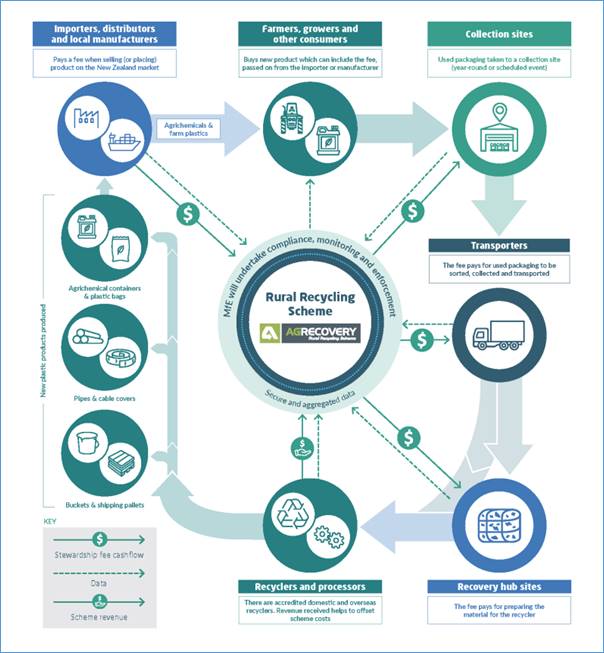
5.5 The following diagram
shows an overview of the scheme, including the flow of data and funds, under
the proposed regulations.
6.0 In-scope products
6.1 These are:
· Agrichemicals
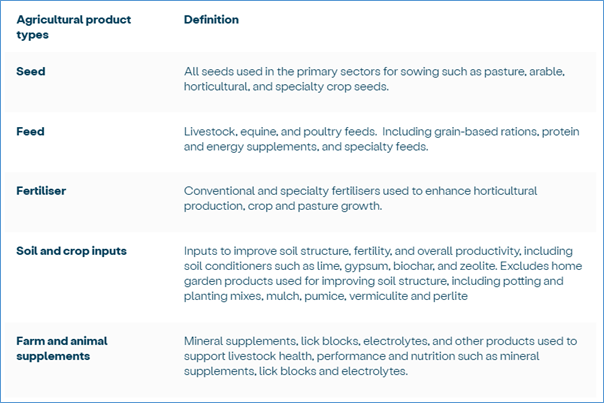
sold in plastic containers and drums of 1,000 litres or less (including
household pest and weed control products)
· all
plastic bale wrap and silage sheets
· plastic
bags containing completed agricultural products including, but not limited to
seed, feed, fertiliser, soil and crop inputs and farm and animal supplements,
in either:
- small
plastic bags (16-40 kilograms when full)
- large
woven polypropylene bags (over 40 kilograms when full).
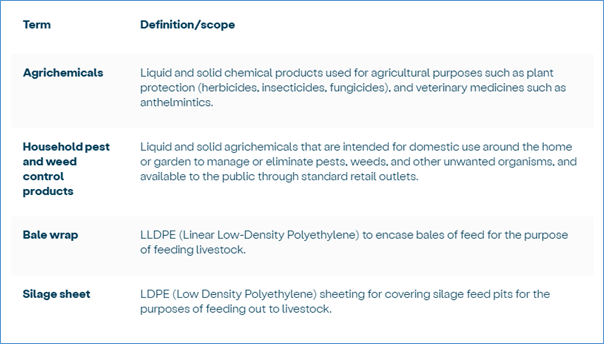
6.2 The table below
provides further details of in-scope products.
7.0 Services
7.1 According to the MfE
website, proposed take-back services provided by the scheme, will include:
· fixed
drop-off sites at convenient locations including at rural-sector retailers,
· non-fixed
schedule events, and
· collections
on-farm or nearby (for remote areas).
7.2 There may be an
opportunity for Council to apply for the Refuse Transfer Station to be an
approved collection site. This will be assessed by officers once the
regulations are finalised and the details are released.
8.0 Comparing voluntary schemes to the
proposed regulated scheme
8.1 Current Agrecovery and
Plasback product coverage compared to proposed in-scope products are summarised
in the table below.
8.2 The key differences
are:
· regulations
will be limited to key waste streams (agrichemicals and their containers,
plastic bags, bale wrap and silage sheets)
· recycling
through the accredited scheme will be ‘free-to-use’, rather than a
mix of ‘free-to-use’ and user pays under voluntary schemes
· inclusion
of household pest and weed control products
· limit
of 30 litres / kg for residual agrichemicals
|
|
Voluntary
|
Regulated
|
|
Agrecovery Rural Recycling1
|
Plasback2
|
Rural Recycling Scheme 3
|
|
Containers
|
|
Agrichemical and veterinary
medicine containers ≤60 litres
|
ü
|
|
ü
|
|
Agrichemical drums 61-1000
litres
|
ü
|
|
|
Ecolab drums 100L &
200L
|
|
ü
|
|
Household pest and weed
control containers 1000 litres and less
|
|
|
ü
|
|
Other plastics
|
|
Bale wrap and silage pit
covers
|
|
ü
|
ü
|
|
Seed,
feed, and fertiliser bags ≤40kg (LDPE)
|
ü
|
ü
|
ü
|
|
Seed,
feed, and fertiliser bags ≤40kg (woven PP)
|
ü
|
|
|
Feed and fertiliser bags 1T
& 500kg (woven PP)
|
|
ü
|
ü
|
|
Polypropylene twines
|
|
ü
|
|
|
Shrink wrap and pallet
covers
|
|
ü
|
|
|
Vineyard and monofilament
nets
|
|
ü
|
|
|
Tree guards
|
|
ü
|
|
|
Irrigation tubing and drip
line
|
|
ü
|
|
|
Chemical disposal
|
|
Agrichemicals
and veterinary medicines
|
ü
|
|
ü4
|
|
Household
pest and weed control
|
|
|
ü
|
1 Free
take-back for participating brands and user pays for non-participating brands
and unlabelled products
2 User
pays services
3
Definitions of in-scope products may vary from what is accepted under current
voluntary programmes. See Definitions table above.
4 Excludes
legacy (unlabelled) agrichemicals and residual agrichemicals in large amounts
(over 30 litres or kilograms)
9.0 Fees
9.1 Fees will be paid to
the accredited scheme by the producer (manufacturers, importers and
distributors who place the product on the NZ market) of the in-scope products.
Producers will be required to register with the scheme and declare how much
product they have sold before paying the proportional amount of fees.
9.2 The MfE website
suggests the fee is likely to be passed onto the consumer for many in-scope
products.
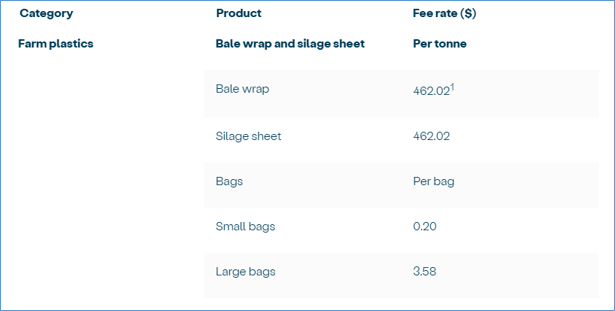
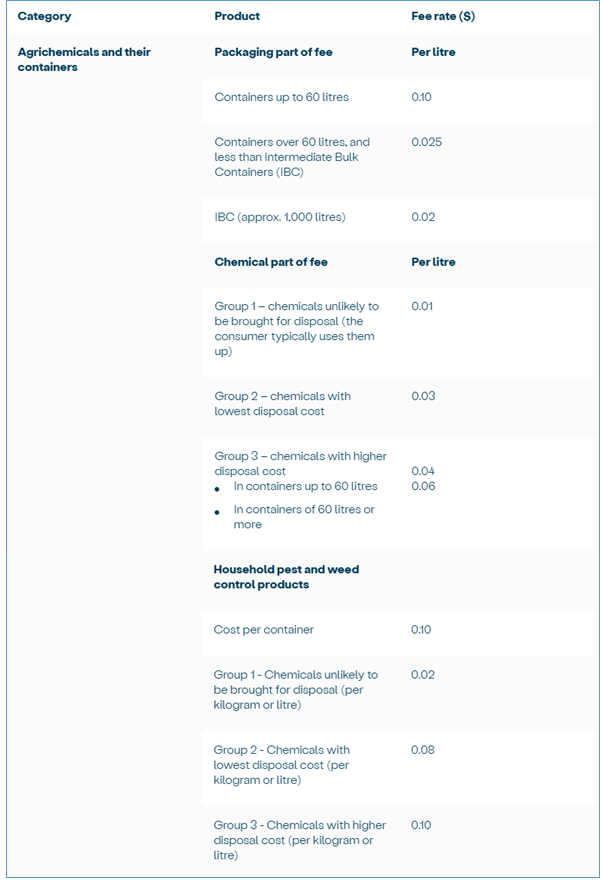
9.3 The table below sets
out the proposed stewardship fee rates
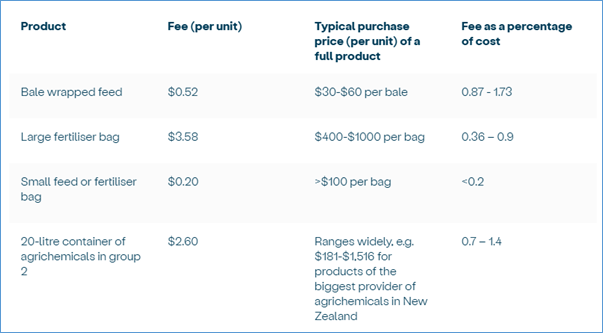
9.4 Examples of fees
relative to product cost
10.0 Compliance
10.1 According to the MfE website, ‘the
scheme will be required to operate in accordance with its accreditation. This
includes several objectives and targets relating to its performance and
effectiveness. The scheme manager will be required to report on its performance
at set intervals (e.g. annually) to the Ministry.’
11.0 Timeframes
11.1 The MfE website shows that regulations
are expected to be brought back to Cabinet for decision mid-2026. If the
Government approves, the draft regulations will come into force 6-12 months
after publication, likely to be late 2026 or early 2027.
Attachments:
There are no attachments for this report.
Hastings
District Council: Hastings District Rural Community Board
Te Rārangi Take
Report to Hastings District Rural Community Board
|
Nā:
From:
|
Danny McClure, Solid
Waste Operations & Contract Manager
|
|
Te Take:
Subject:
|
Rural Recycling Update
|
1.0 Purpose and summary - Te Kaupapa Me Te Whakarāpopototanga
1.1 The purpose of this
report is to provide an update on the rural recycling stations including
community participation.
1.2 This is to ensure the
Rural Community Board members are up to date with what is working and what is
not working in their respective community areas.
|
2.0 Recommendations -
Ngā Tūtohunga
A) That the Hastings
District Rural Community Board receive the report titled Rural Recycling
Update dated 16 February 2026.
B) That the
Rural Community Board provides feedback on the initiatives outlined in this
report.
C) That the
Rural Community Board note that officers are continuing to work with the
rural communities to identify suitable recycling site options and reinforce
community education about recycling, identifying risks associated and
providing options on mitigation of these risks.
|
3.0 Site Updates
3.1 Rural
recycling stations provide a drop off service for common recyclables, glass,
plastics, cans, paper and cardboard.
3.2 The Te Pōhue site
has been set up, and both the community and visitors have embraced this
service.
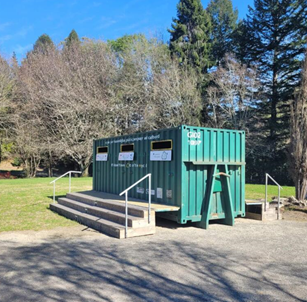
3.3 A
proposal to apply a single container, similar/same to Te Pōhue,
Tūtira and Poukawa has been discussed at a community meeting at Patoka.
3.4 With
the Rissington bridge replacement, it was discussed that the contractor would
look to apply a concrete pad when building the bridge, where a container could
site and be serviced, allowing a Rural recycling facility for the wider
Patoka/Rissington community.
3.5 The
proposal is still in its infancy and will require further investigation and
appropriate approvals prior – timeline is circa 12mths (a 12mth trial
would be initiated if approved)
3.6 Active Rural Recycling Stations
update:
3.7 Maraekākaho –
The community are proactively utilising this site. There has been a
spike in contamination reporting and images have been sent through the
community champion to highlight on their Facebook page.
3.8 Pukehamoamoa
– The rural community are proactively reporting any/all issues, with HDC
being in regular contact with the community champion. No significant
issues to report.
3.9 Poukawa –
The community are proactively utilising this site, with very little
issues occurring since the last update.
3.10 Waimārama – No
significant issues to report on this site and it continues to be well used,
contamination has reduced overall, with minor contamination highlighted.
3.11 Blackbridge continues to see
increased usage from the Havelock North and surrounding community, and we have
seen further levels of contamination – this remains consistent.
· The
site servicing is being reviewed regularly and an update provided at the next
Rural Community Board meeting.
· If
levels of contamination and site mistreatment continue to be apparent (public
leaving items on the platforms and “wish-cycling”) Council will
need to consider pausing the service as part of reset and re-education program
to enable an appreciation and value this service provides to the community.
3.12 Tūtira - The community are
proactively utilising this site, with very little issues occurring since the
last update.
3.13 Waipatiki - The community are
proactively utilising this site, with very little issues occurring since the
last update.
3.14 Henderson Road recycling station
continues to be well
used, based on the location within a manned Refuse
Transfer Station environment,
with no significant issues of contamination.
4.0 Rural Community Board Reports –
Historical Reports
4.1 This information and
subsequent recommendations provide the information required for the Rural
Community Board to make informed decisions.
5.0 National Updates and Changes
5.1 Officers
will continue to keep the board informed of any new announcements that will
influence the recycling services for rural residents.
Attachments:
There are no attachments for this report.
Hastings
District Council: Hastings District Rural Community Board
Te Rārangi Take
Report to Hastings District Rural Community Board
|
Nā:
From:
|
Emma Morgan, Community
Strategies Manager
Debbie Watts, Community
Connector Lead
Regan Smith, Chief Risk
Officer
|
|
Te Take:
Subject:
|
Community Resilience and
Rural Halls
|
1.0 Purpose and summary - Te Kaupapa Me Te Whakarāpopototanga
Community Resilience
1.1 The community
resilience programme has been a core workstream for the Community Connectors
and Risk Management teams over last 3 years since Cyclone Gabrielle. The
objective of the programme is to promote internal connection within
communities, establish locally relevant resilience plans and create connection
with Council for ongoing support during readiness and response.
1.2 In rural communities
the programme is centred on establishing Community Emergency Hubs (CEH). A CEH
is a centre run by the community, for the community, that is intended to make
the most of the local resources available at the time. The Hubs rely on local
volunteers that assist with provisioning equipment and supplies, connecting
with their local community, and supporting the development of Community
Resilience Plans (CRP). In this way the programme is community lead and each
CEH is uniquely tailored to the needs of each community.
1.3 The community leaders
who have volunteered their time are vital to the success of the programme.
Officers would like to recognise and thank all the community volunteers who
have been involved in the programme and are very grateful for the positive and
constructive approach that all community leaders have shown.
1.4 Council has
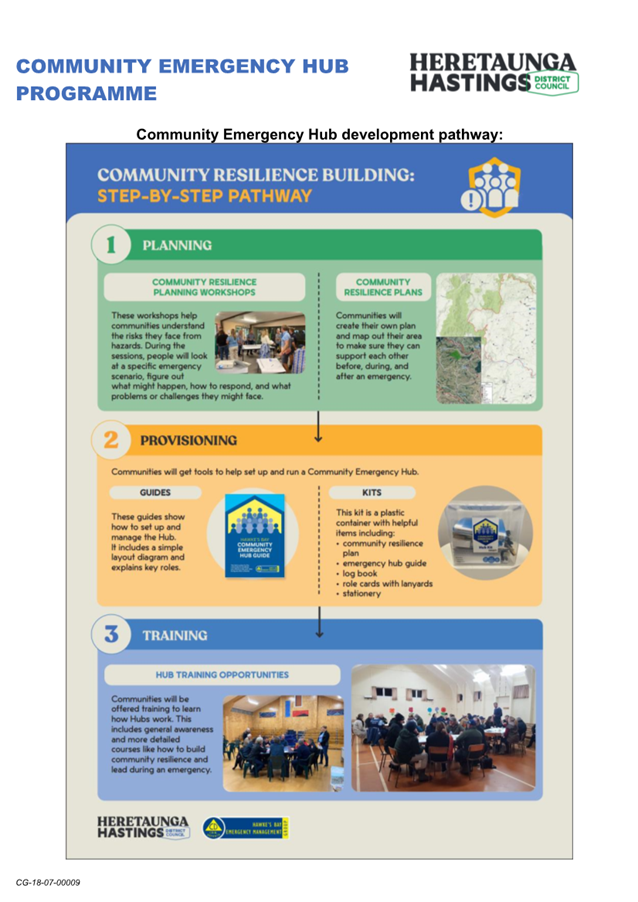
established a pathway that is used to guide the setup of a CEH (Appendix 1).
This involves gathering information from the community for a CRP, provisioning
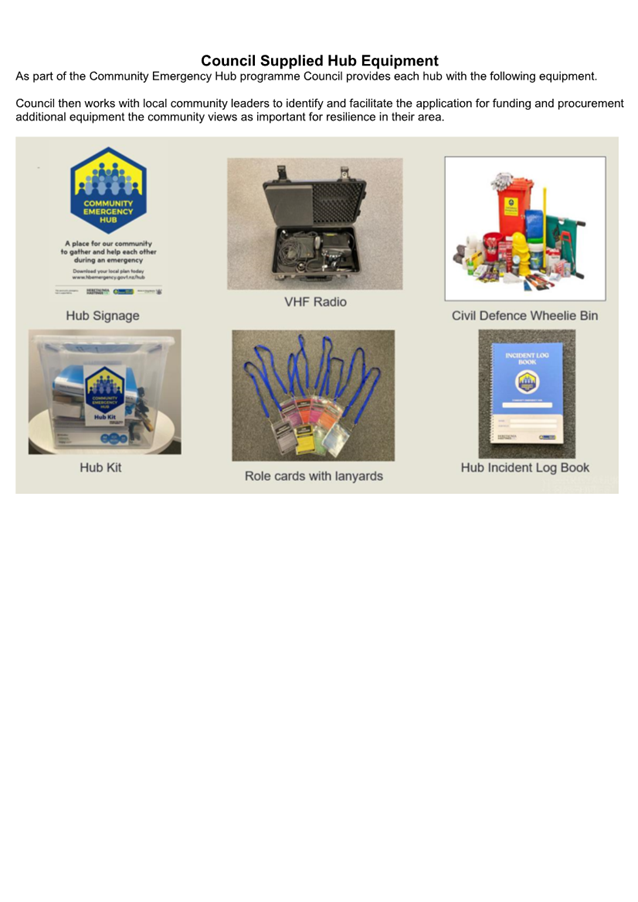
a set of standard equipment for the Hub and running training workshop with the
community to illustrate how the Hub can work. Once the standard provisions have
been deployed and the hub training completed, the Hub is marked as Established
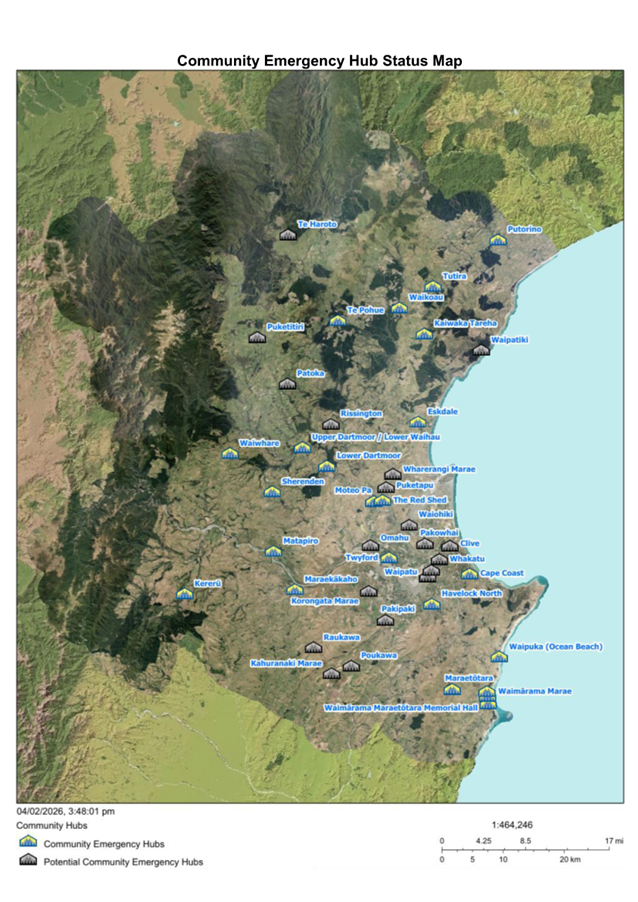
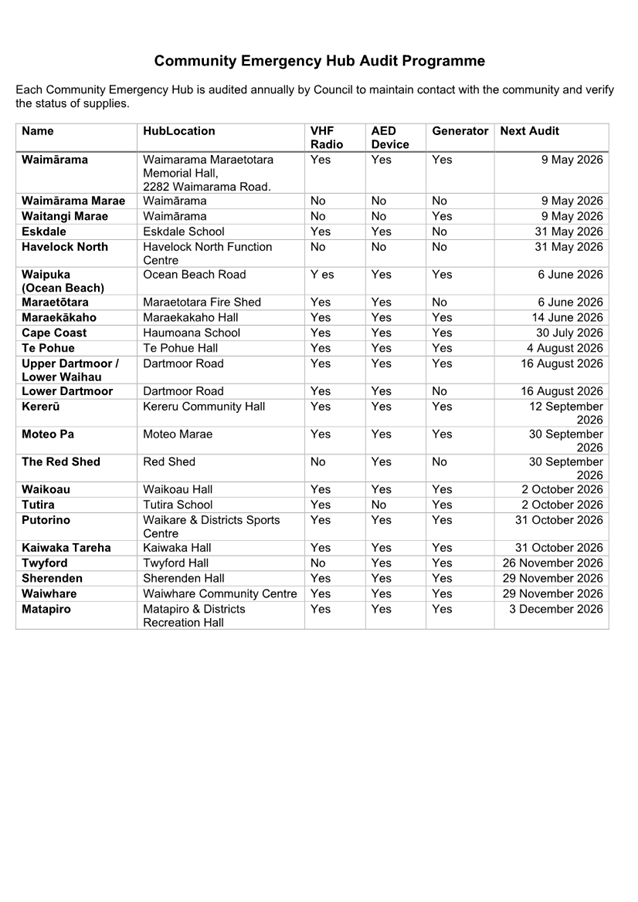
on the Community Emergency Hub map. From then on the CEH is put on an annual
audit programme that involves the Council teams visiting the Hub to confirm the
status of the equipment and to update the documented plans.
1.5 At present the
programme is just over halfway through as outlined below:
· 12
Community Resilience Plans complete.
· 20
of 30 Community Emergency Hubs have been established, and a further 4 are
underway.
· 3
of 12 Marae Hubs have been established, and a further 4 are underway.
1.6 The community
engagements undertaken in the past 6 months by the Community Connectors and
Risk Management teams are listed below.
Key Community Engagement Dates
|
Date
|
Details
|
|
9 July
|
Maraekākaho Community Resilience planning meeting
|
|
23 July
|
Waimārama Hub leads meeting
|
|
4 August
|
Te Pōhue Resilience training
|
|
8 August
|
Puketapu South
resilience meeting
|
|
17 August
|
Upper and Lower
Dartmoor 101 Hub Training
|
|
6 September
|
Waipatu Hub training
|
|
25 September
|
Twyford Community Resilience planning
|
|
30 September
|
Putorino Hub
audit and community meeting
|
|
5 October
|
Ōmāhu
Marae Community Day
|
|
25 October
|
Waimārama
Emergency Hub Open Day
|
|
1 November
|
Sherenden Market
Day / RD9 Community Emergency Hub Open Day
|
|
7 November
|
Kererū
Community Emergency Hub Open Day
|
|
8 November
|
Tūtira
Community Emergency Hub Open Day
|
|
15 November
|
Waipatiki
Community Resilience Workshop
|
|
20 November
|
Twyford
Emergency Hub training
|
|
10 December
|
Puketapu resilience planning meeting
|
|
16 December
|
Puketitiri/ Patoka/ Rissington resilience planning meeting
|
Rural Halls
1.7 There are 23 halls in
the Hastings District rural hall network, recognised for the role they play as
a venue for social and cultural events, and a focal point for rural
communities. Since Cyclone Gabrielle, many halls have also been designated as
Community Emergency Hub (CEH) locations, increasing both use and criticality.
1.8 None of the halls are
managed by Council, but there is a mix of land and building ownership between
community and Council.
1.9 To support hall
committees with building maintenance, renewal planning, and CEH readiness,
Council is undertaking condition assessments that will inform asset management
plans (AMPs) and future investment decisions.
EECA’s Community Solar
Resilience Programme
1.10 EECA’s Community Resilience
Programme (CRP) supports community buildings that act as hubs during
emergencies by installing solar PV and battery systems. These systems help
ensure the sites can continue operating during power outages and strengthen their
overall energy resilience.
1.11 The programme funds 80% of the system
cost, with the remaining 20% to be sourced externally. HDC is working alongside
each participating site to obtain multiple quotes from solar providers so they
can choose the system that best meets their needs. HDC is also supporting sites
to identify and secure the remaining 20% funding through external sources.
1.12 HDC nominated six rural halls/marae for
the programme: Te Pōhue Hall, Waipatu Marae, Moteo Marae, Kererū
Hall, Peketitiri Hall, and Waikare & District Sports Club
(Pūtōrino).
|
2.0 Recommendations -
Ngā Tūtohunga
That the Hastings
District Rural Community Board receive the report titled Community Resilience
and Rural Halls dated 16 February 2026.
|
Attachments:
|
1⇩
|
Commmuity Resilience Programme Update
|
CG-18-07-00009
|
|
|
Item 7 Community
Resilience and Rural Halls
|
|
Commmuity
Resilience Programme Update
|
Attachment 1
|