Kaupapataka
Agenda
|
Te Rā Hui:
Meeting date:
|
Wednesday, 20 May 2026
|
|
Te Wā:
Time:
|
10:00
AM
|
|
Te Wāhi:
Venue:
|
Council Chamber
Ground Floor
Civic Administration
Building
Lyndon Road East
Hastings
|
|
Te Hoapā:
Contact:
|
Democracy
and Governance Services
P: 06 871 5000
| E: democracy@hdc.govt.nz
|
|
Te Āpiha Matua:
Responsible Officer:
|
Chief Financial Officer - Graham Watson and Chief Risk Officer -
Regan Smith
|
Risk and Assurance Committee – Terms of Reference
Fields of Activity
The
Risk and Assurance Committee is responsible for assisting Council in its
general overview of financial management, risk management and internal control
systems:
1)
Ownership and monitoring of Council’s
Strategic Risk Framework
2)
Reasonable assurance as to the integrity and
reliability of the financial reporting of Council.
3)
Monitoring of Council’s requirements under
the Treasury Policy.
4)
Monitoring of Council’s insurance –
if significant change to Council’s policy of insuring all its assets.
5)
Monitoring of Council’s material legal
exposure.
6)
Monitoring of Council’s health, safety and
wellbeing risk management practices (including compliance with Health &
Safety Legislation).
7)
Monitoring significant projects, programmes of
work and procurement focussing on the appropriate management of risk.
8)
Oversight of preparation of the Long Term Plan, Annual
Plan and Annual Report.
In
light of the impacts Cyclone Gabrielle has had on the communities in the
district, the Committee will pay particular attention to activities affected
within its Fields of Activity, and always in support of the work of Council and
the Standing Committees.
Membership - 10
(including 7 Councillors)
·
7 Councillors - with one being the Chair of
Performance and Monitoring, or its equivalent and one being the Chair of
Strategy and Policy, or its equivalent.
·
2 external Independent members appointed by
Council, with one to be the Chair.
·
Deputy Chair appointed by Council from among the
membership of 10.
·
1 Heretaunga Takoto Noa Māori
Standing Committee Member nominated by the Chair of Heretaunga Takoto Noa Māori Standing Committee and appointed by Council.
Quorum – 6
members
|
DELEGATED POWERS
Authority to consider and make
recommendations on all matters detailed in the Fields of Activity and such
other matters referred to it by Council.
|
Kaupapataka
Agenda
|
Mematanga:
Membership:
|
Koromatua
Chair: Graeme McGlinn – External Independent
Appointee
Nga Kai Kaunihera
Councillors: Simon Nixon, Michael Fowler (Chair of
Performance & Monitoring Committee), Councillor Heather Te Au-Skipworth
(Chair of Strategy & Policy Committee), Yvonne Lorkin, Callum Ross, Derek
Nowell-Usticke (Deputy Chair) and Elisha Milmine
Mayor Wendy Schollum
External Independent Appointee: Vacancy
Heretaunga Takoto Noa Māori Standing Committee appointee:
Vacancy
|
|
Tokamatua:
Quorum:
|
6 members
|
|
Kaihokoe mo te Apiha
Officers Responsible:
|
Chief Risk Officer – Regan
Smith
AND
Chief Financial Officer –
Graham Watson
|
|
Te Rōpū Manapori me te Kāwanatanga
Democracy & Governance Services:
|
Christine Hilton (Extn 5633)
|
Te Rārangi Take
Order of Business
|
1.0
|
Apologies
– Ngā
Whakapāhatanga
At the
close of the agenda no apologies had been received.
At the
close of the agenda no requests for leave of absence had been received.
|
|
|
2.0
|
Conflict
of Interest –
He Ngākau Kōnatunatu
Members need to be vigilant to stand aside from
decision-making when a conflict arises between their role as a Member of the
Council and any private or other external interest they might have.
This note is provided as a reminder to Members to scan the agenda and assess
their own private interests and identify where they may have a pecuniary or
other conflict of interest, or where there may be perceptions of conflict of
interest.
If a Member feels they do have a conflict of interest,
they should publicly declare that at the start of the relevant item of
business and withdraw from participating in the meeting. If a Member
thinks they may have a conflict of interest, they can seek advice from the
General Counsel or the Manager: Democracy and Governance (preferably before
the meeting).
It is noted that while Members can seek advice and
discuss these matters, the final decision as to whether a conflict exists
rests with the member.
|
|
|
3.0
|
Confirmation
of Minutes –
Te Whakamana i Ngā Miniti
Minutes of the
Risk and Assurance Committee Meeting held Wednesday 25 February 2026.
(Previously circulated)
|
|
|
4.0
|
Infrastructure
Programme Risk Overview Update
|
7
|
|
5.0
|
Health,
Safety & Wellbeing Risk Management Update
|
13
|
|
6.0
|
Executive
Overview and Status of Actions
|
17
|
|
7.0
|
Annual
Strategic Risk Register Review
|
31
|
|
8.0
|
Artificial
Intelligence - Bowtie Risk Summaries
|
33
|
|
9.0
|
Local
Water Done Well - Programme Update and Risk Overview
|
37
|
|
10.0
|
Treasury
Activity and Funding Update
|
43
|
|
11.0
|
Minor Items
– Ngā Take
Iti
|
|
|
12.0
|
Urgent
Items –
Ngā Take Whakahihiri
|
|
|
13.0
|
Recommendation
to Exclude the Public from Items 14 and 15
|
49
|
|
14.0
|
Current
Issue Summary April 2026
|
|
|
15.0
|
Head
Start programme: key risks
|
|
Te
Hui o Te Kaunihera ā-Rohe o Heretaunga
Hastings
District Council: Risk and Assurance Committee Meeting
Te
Rārangi Take
Report to Risk and Assurance Committee
|
Nā:
From:
|
Mike Kerr, Chief
Engineer
Ansonica Botha,
Programme Controls Manager
|
|
Te Take:
Subject:
|
Infrastructure Programme
Risk Overview Update
|
1.0 Executive Summary – Te Kaupapa Me Te
Whakarāpopototanga
1.1 This
report gives the Risk and Assurance Committee an overview of the key delivery‑related risks across the
Infrastructure group’s capital projects and programmes. It highlights the
main risks, any changes since the previous reporting period, and how those
risks are being managed at a portfolio level.
1.2 There
have been no material changes to the overall portfolio-level risk profile
during the reporting period.
|
2.0 Recommendations - Ngā Tūtohunga
A) That
the Risk and Assurance Committee receive the report titled Infrastructure
Programme Update dated 20 May 2026.
B) That
the Committee offer any feedback and insights into future reporting and
information required to better understand and govern risk and assurance
related to the infrastructure programme.
|
3.0 Background – Te Horopaki
3.1 Detail
on the background of the Programme Delivery Office (PDO) and its operating
environment was provided in the report titled “Infrastructure Programme
Update” that was presented to the Risk and Assurance Committee at the
meeting held on the 25th of February 2026. This report
therefore focuses on changes in risk and current portfolio‑level exposure.
3.2 The
Project Delivery Office (PDO) is responsible for overseeing delivery of
Council’s capital and infrastructure programmes across Transportation, 3
Waters, and Growth. Delivery is undertaken by Council staff and external
consultants.
3.3 The
PDO is in an establishment phase. Reporting at this stage is therefore focused
on giving the Committee visibility of current portfolio‑level risks and any movement since last
reporting, while governance and assurance arrangements continue to develop.
3.4 This
report focuses on risks associated with delivery of capital and infrastructure
projects and programmes. It does not cover organisational or workforce‑related risks associated
with establishment of the PDO.
4.0 Discussion
4.1 Risk
Rating
4.1.1 Projects
are assigned an inherent risk rating at initiation based on the likelihood and
impact of adverse outcomes. The table below summarises the overall portfolio
risk profile to give the Committee visibility of where risk is concentrated
across the programme.
|
Risk
|
Description
|
Management
|
Review
|
Projects by Category
|
|
High
|
Activities with a high probability of negative
consequences and/or significant potential impact
|
Risk register supported by formal risk tools
|
Fortnightly
|
30 (12%)
|
|
Medium
|
Moderate probability and/or moderate impact
|
Risk register with regular team engagement to identify and
manage risks
|
Monthly
|
73 (21%)
|
|
Low
|
Low probability of negative consequences and/or minimal
potential impact
|
Risk register established to document and monitor
potential risks
|
Quarterly
|
243 (67%)
|
4.2 Project
risk status is reviewed more frequently for higher‑risk projects and updated where conditions
change or new issues emerge.
4.3 Top
Risks
4.3.1 Within
the group of higher‑risk
projects, there is typically a smaller subset of around ten projects that are
considered particularly high risk or have risks that are currently
materialising.
4.3.2 Delivery
teams manage project risks, with overall risk ownership sitting with the
relevant Programme Delivery Manager. The PDO provides oversight and escalates
issues where risks may have wider programme or Council‑level implications.
4.3.3 Programme‑level reporting and
oversight arrangements are being used to maintain visibility of delivery‑related risk.
4.3.4 Risk
movement during the period has been limited and reflects normal programme
delivery dynamics rather than systemic control issues.
4.3.5 Minor
fluctuations in individual project risk ratings have not translated into a
change in overall portfolio‑level
exposure.
4.3.6 The
table below summarises a subset of projects currently assessed as having higher
inherent or residual risk due to factors such as scale, complexity, external
dependencies, or stakeholder impact. The purpose of the table is to provide the
Committee with visibility of where portfolio‑level
risk is concentrated, rather than to provide detailed project assurance.
|
Project/Area
|
Primary Risk Driver
|
Mitigation
|
|
Rissington Bridge Replacement
|
Scale and Complexity: Currently
risk reducing as major elements near completion. Remaining activities
as on track (subject to weather)
|
Ongoing monitoring of residual
risks.
|
|
Redclyffe / Waiohiki Bridge
Replacement
|
The project is at the design and
consenting phase. Main risks are resource consenting, geotechnical
complexity and cost escalation.
|
A draft procurement plan is being
prepared recognising a constrained timeframe, this will be submitted to
Council for approval.
|
|
Dartmoor Bridge Replacement
|
Construction well advanced.
Weather has impacted the site and continues to be a key risk.
|
While there have been no material
changes to scope, budget or risk construction continues to be
monitored.
|
|
Wastewater Treatment Plant
|
Potential risks associated with
scale and complexity.
|
Ongoing monitoring of risks,
including governance framework and independent peer review.
|
|
Fuel Fluctuation
|
Risk of significant financial
uncertainty from fluctuating fuel, freight and material prices.
|
No significant impact to date.
Collating claims from contractors
to identify any significant cost changes.
Longer term contracts include
cost escalation provisions to help manage these movements.
|
|
Fuel Access
|
Risk of restricted supply of fuel
being implemented under government fuel plan, putting project delivery at
risk and potentially creating contractual implications
|
No impact to date, and current
signals from government and sector remain positive at this time.
|
Note:
the overall portfolio risk profile remains broadly consistent with the previous
reporting period.
5.0 Next Steps
5.1.1 Future
reporting to the Risk and Assurance Committee will continue to focus on
portfolio‑level
risk, changes over time, and improving assurance as the PDO matures.
5.1.2 Continue
developing alignment with Council’s enterprise risk framework, with an
increasing focus on consistent application of risk definitions, thresholds, and
reporting across the infrastructure programme.
5.1.3 Updates
on the development or refinement of risk controls and assurance processes
relevant to the Committee’s oversight role.
5.1.4 Further
development of a high‑level
dashboard to summarise portfolio status and risk trends for Committee
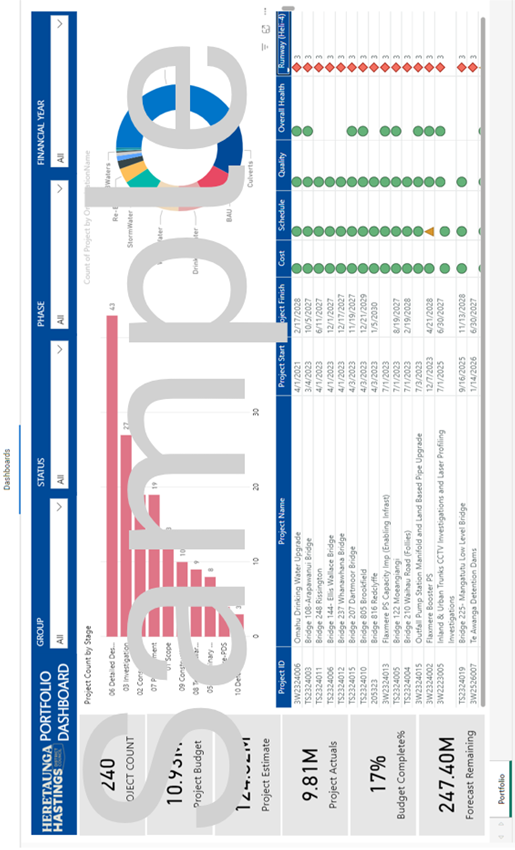
oversight. The dashboard is intended to provide context, not detailed project‑level assurance. A
sample of proposed dashboard is on the next page.
Attachments:
There are no attachments for this report.
Hastings
District Council: Risk and Assurance Committee Meeting
Te Rārangi Take
Report to Risk and Assurance Committee
|
Nā:
From:
|
Jennie Kuzman, Health,
Safety and Wellbeing Manager
|
|
Te Take:
Subject:
|
Health, Safety &
Wellbeing Risk Management Update
|
1.0 Background and
Summary – Te Kaupapa Me Te
Whakarāpopototanga
1.1 The
purpose of this report is to provide information to the Risk and Assurance
Committee about the management of health, safety and wellbeing risks within
Council.
1.2 This
issue arises due to the Health and Safety at Work Act 2015 (HSWA) and the
requirement of that legislation for Elected Members (as HSWA Officers) to
exercise due diligence to ensure that Council (as a PCBU – Person
Conducting a Business or Undertaking) complies with its health and safety
duties and obligations.
1.3 This
report provides a summary update on:
· Health and Safety
legislative reform and recent legal updates
· Heath, Safety
& Wellbeing policies under review or development.
· Health, Safety
& Wellbeing critical risk reviews
|
2.0 Recommendations -
Ngā Tūtohunga
That the Risk and Assurance Committee receive the report titled Health,
Safety & Wellbeing Risk Management Update dated 20 May 2026.
|
3.0 Discussion
– Te
Matapakitanga
3.1 Health
and Safety at Work Amendment Bill (2026)
3.2 Further
to the brief update provided at the February committee meeting, an amendment
bill has been introduced which proposes a number of changes to the Health and
Safety at Work Act 2015. A full version of the amendment bill is available
online: https://www.legislation.govt.nz/bill/government/2026/0244/latest/LMS1571561.html
3.3 In
summary, this bill aims to overhaul New Zealand's health and safety framework
by focusing on "critical risks," reducing compliance costs, and
increasing certainty for businesses. It narrows the focus to managing risks
causing serious harm, clarifies small business duties, and strengthens Approved
Codes of Practice.
3.4 Key
aspects of the Bill:
· Focus
on Critical Risk: The purpose of the Act is rewritten to prioritise managing
critical risks, defined as hazards that could cause death, notifiable
illness/injury, or disease.
· Small
PCBU Relief: Small PCBUs (fewer than 20 workers for most of the year) are
largely restricted to managing critical risks and ensuring basic, necessary
welfare facilities.
· Clarifying
Duties: The Bill clarifies the due diligence duties of officers and streamlines
obligations when multiple PCBUs (businesses/undertakings) are involved.
· Approved
Codes of Practice (ACOPs): Strengthens the "safe harbour" status of
ACOPs, meaning compliance with an ACOP for a specific risk ensures the duty
holder has met their legal obligation.
· Recreational
Land Use: Clarifies and limits PCBUs' duties when their land is used for
recreational purposes.
· Definition
of Critical Risk: Introduces a formal, statutory definition for "critical
risk" into the legislation, including a new Schedule 1A for specific
hazards.
3.5 Submissions
have closed and are currently with the Select Committee for review, and
therefore changes may occur as it goes through select committee processes.
Further updates will be provided as appropriate.
3.6 Legal
Update: Clarification regarding Trusts as PCBUs
3.7 In
February 2026 the New Zealand Court of Appeal ruled that a trust, distinct from
its individual trustees, can be prosecuted as a ‘Person Conducting a
Business or Undertaking’ (PCBU) under the Health and Safety at Work Act
2015 (HSWA).
3.8 The
majority decision found that trustees acting collectively constitute a
"body of persons" that can be named in proceedings.
3.9 This
means that a trust can be named as a defendant to a prosecution, allowing
WorkSafe to treat the trust entity as the PCBU. This finding enables WorkSafe
to pursue higher penalties ($1.5 million+), rather than the lower limits for
individual trustees ($300,000).
3.10 The
court found that trustees, acting together to manage a business, are a
"body of persons" and can be treated as a single entity rather than
as individuals with separate, limited liability. Individual trustees may still
face charges as "officers" alongside the trust.
3.11 This
landmark decision confirms that trusts holding assets used for business
purposes are fully subject to HSWA obligations. It directly addresses the issue
that trustees cannot use trust assets to pay personal liability fines.
3.1 This
likely has implications for elected members appointed by Council as a
director/board member/trustee of a Council Trust or an external Trust (such as
the Te Mata Park Trust Board) or community organisation (such as Historic
Places HB), in that they would be considered a HWSA Officer for that Council
trust /external Trust/Community organisation, and that this may be a legally
separate duty under HSWA, in comparison to their role as a HSWA Officer for
Hastings District Council.
3.2 Council
is currently seeking legal advice to clarify/confirm whether an elected member
in these situations can be prosecuted under HSWA in the same way as any other
director/trustee officer of a Trust, and whether any special considerations
arise from the appointment being made by Council.
3.3 Based
on verbal legal advice to date, this is unlikely to impact elected members when
they are appointed as an ‘advisor’ or ‘liaison’ to an
external trust / community organisation, but is likely to impact if appointed
as a director/board member/trustee. Noting that as has been the case since HSWA
legislation was introduced, when acting in their capacity as HSWA Officers of
Hastings District Council for Hastings District Council activities (in-house
and contracted), elected members cannot be prosecuted under HSWA.
3.4 Legal
Update: High Court Dismissed Appeal from Tony Gibson
3.5 In
March 2026, the New Zealand High Court dismissed the appeal by former Ports of
Auckland (POAL) CEO Tony Gibson, upholding his conviction and sentence for
failing to exercise due diligence under the Health and Safety at Work Act 2015
(HSWA). The High Court found no miscarriage of justice in the District Court's
2024 verdict that Gibson breached his due diligence duty as an officer by
failing to ensure the port effective implemented and monitored safety exclusion
zones. The court rejected arguments that the conviction was based on
"system leadership" concepts not in the HSWA, or that he was wrongly
made a "proxy" for POAL's faults. The High Court dismissed the
appeal against the sentence, which included a $130,000 fine and $60,000 in
costs.
3.6 The
decision clarifies that an officer's due diligence duty requires active steps
to verify safety systems are functioning "on the ground," rather than
just trusting top-level reports or systems.
3.7 Key
Findings on HSWA Officer Responsibility:
· Verification
Matters: Good intentions, positive initiatives, and the presence of formal
systems do not protect an officer if those systems do not effectively control
risks.
· Governance
vs. Management: The court found no bright-line separation between governance
and management roles for the purposes of officer duty. A CEO’s
responsibility extends to monitoring and testing assurance processes.
· Delegation
is Not Enough: Directors and officers cannot simply rely on subordinates to
manage critical risks; they must ensure they have, and are testing, accurate
information on safety, the judgment noted.
3.8 Elected
Member Site Tours
3.9 As
covered in the governance training earlier this year, and as documented within
Council’s ‘Health and Safety Guide for Elected Members and HSWA
Officers’ (available on the hub), one of the ways elected members can
exercise their due diligence requirements under HSWA is by enquiring about
health and safety systems and processes that are relevant to the site that is
being viewed.
3.10 Council
offers regular opportunities for elected members to undertake scheduled site
visits including a recent workshop held at the Clive Wastewater Treatment Plant
on 24 March and an upcoming workshop at the Ōmarunui Landfill
in May. Further site tours are planned for June/July.
3.11 Council
employees regularly undertake site visits, recording safety interactions and
inspections which are captured within Council’s electronic safety
management systems. Trends are reported on regularly to the Lead Team and to
elected members via the Hub, enabling a further opportunity for elected members
to exercise due diligence in relation to health and safety.
3.12 Policy
Development / Review
3.13 The table
following provides an update on the status of Council’s health, safety
and wellbeing policies and guidelines that are scheduled to be reviewed or
developed within the next 6-12 months.
HSW Policy
|
Review/Development Status
|
|
Menopause Support Framework
|
Drafted – Currently
under review by the Lead Team.
|
|
Change Management Principles
(for organisational and operational changes)
|
Drafted – draft
reviewed by Lead Team, currently seeking feedback from unions.
|
|
Health, Safety & Wellbeing Risk Management Framework
|
In Progress – policy in development.
|
|
Mauri
tū Mauri Ora (Wellbeing) Policy & Framework
|
In Progress – existing policy under review.
|
|
Working Alone Policy
|
In Progress – existing policy under review.
|
|
Fatigue Management Guidelines
|
Scheduled.
|
|
Hazardous Substances Policy
(incorporating the Agrichemical Policy)
|
Scheduled.
|
3.14 Health,
Safety & Wellbeing Critical Risk Reviews
3.15 As
previously reported to the Committee in February, Council has identified 12
Critical Health, Safety and Wellbeing risks (an overview of these critical
risks can be found on the Hub). All these critical Health, Safety and Wellbeing
risks have bowtie risk assessments, which are periodically reviewed.
3.16 The
‘Bowtie’ method is a type of risk assessment methodology that can
be used to analyse and communicate how high-risk scenarios may develop. The
method provides a visual representation of the potential risks into an
easy-to-understand diagram. This diagram allows users to clearly outline the
risks and differentiate between proactive and reactive risk management which in
turn is useful at highlighting the effectiveness of risk controls.
3.17 Following
feedback from the Committee in 2023/24, a template for critical HSW risk
profiles was developed in order to summarise each risk and its critical
controls. It was agreed that these summary critical risk profiles would
be developed/reviewed during the periodic review of the bowtie risk
assessments.
3.18 The
following critical risks are currently under review and summary risk profiles
are expected to be provided to the Committee within the next few months:
Hazardous Substances, Manual Handling and Work-related Stress.
Attachments:
There are no attachments for this report.
Hastings
District Council: Risk and Assurance Committee Meeting
Te Rārangi Take
Report to Risk and Assurance Committee
|
Nā:
From:
|
Regan Smith, Chief Risk
Officer
Steffi Reeves-Bird, Risk
Manager
|
|
Te Take:
Subject:
|
Executive Overview and
Status of Actions
|
1.0 Purpose and summary - Te Kaupapa Me Te Whakarāpopototanga
1.1 The purpose of this report is to provide the Risk and
Assurance Committee with an update on the following matters:
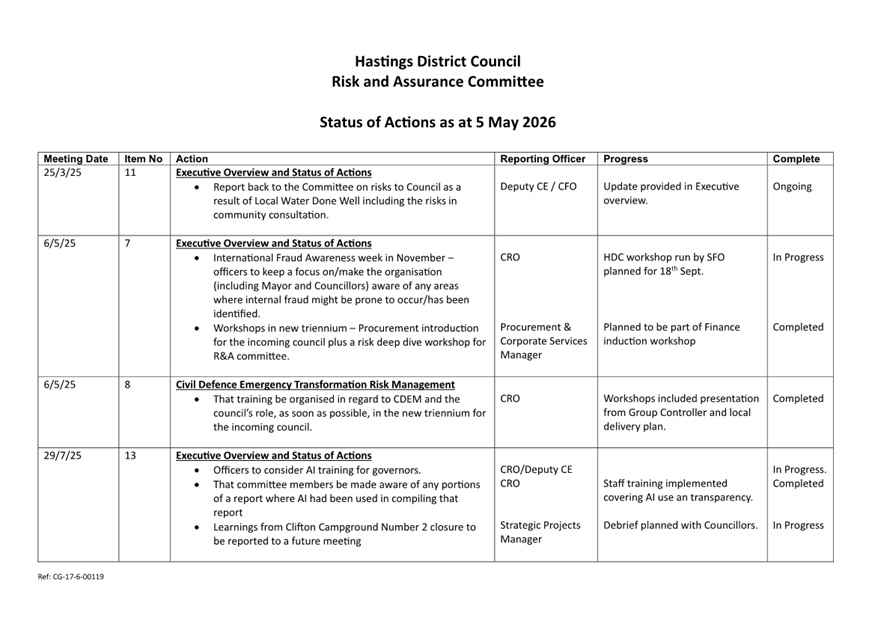
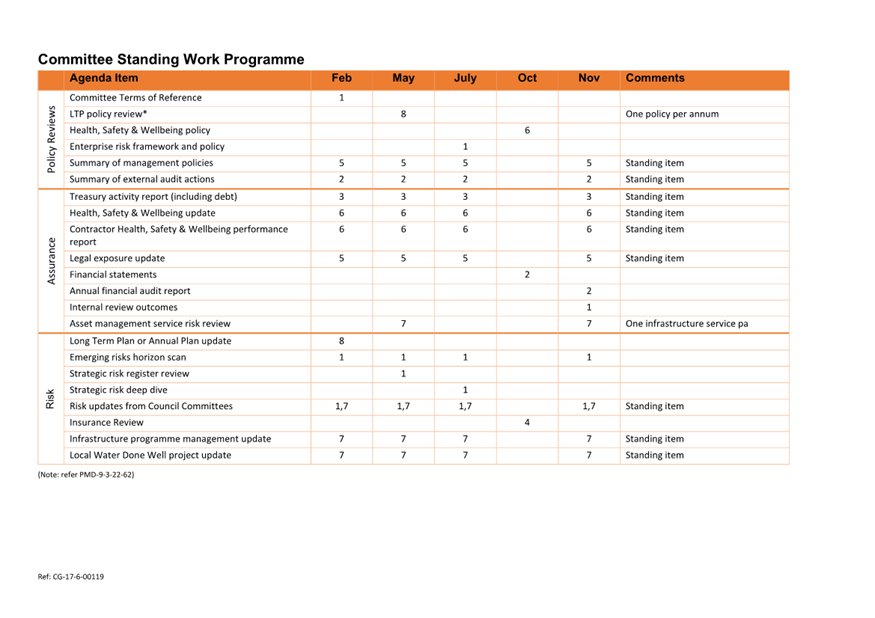
· Status
of actions and annual work programme for the Committee (Attachment 1)
· Status
of external audit actions
· Status
of corporate policies
· Business
continuity planning for fuel disruption
· Current
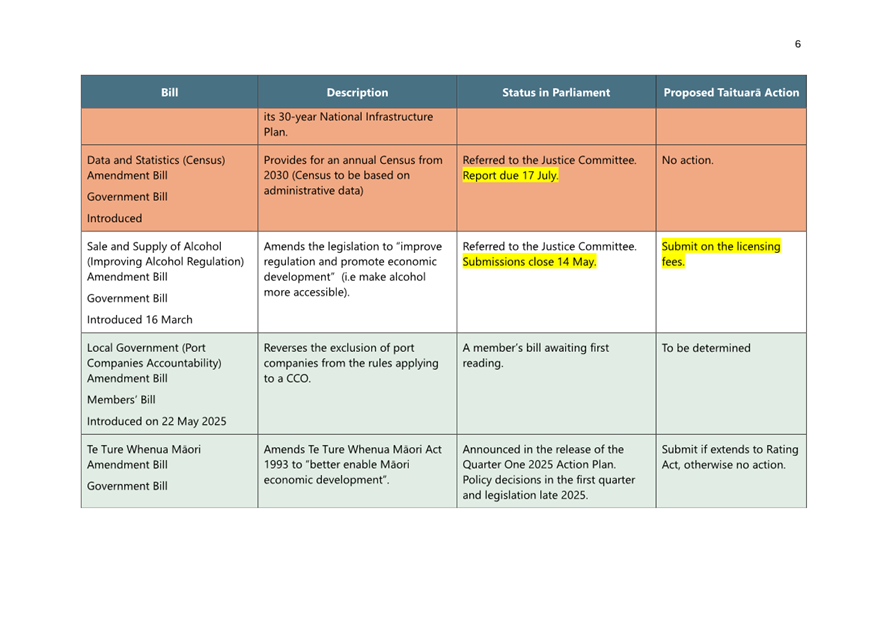
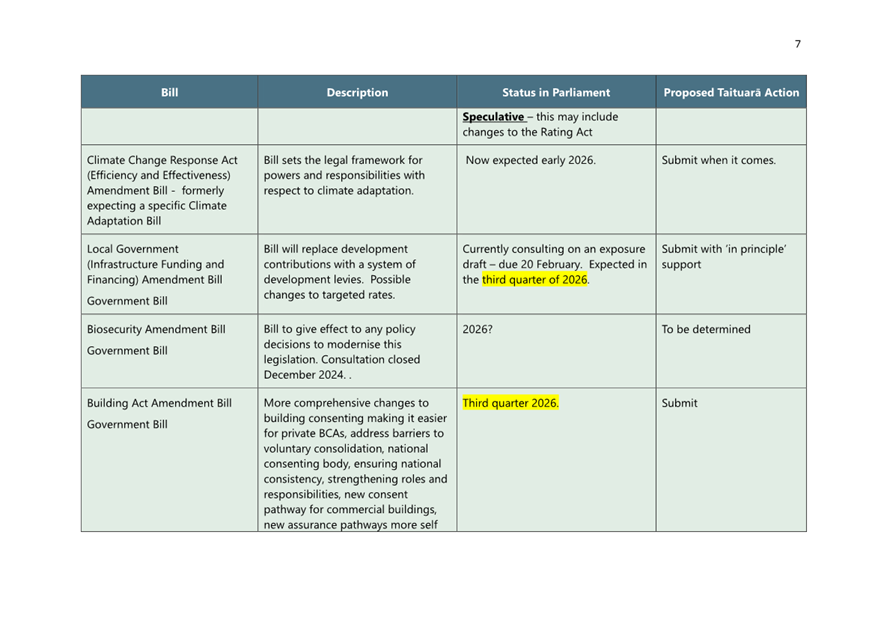
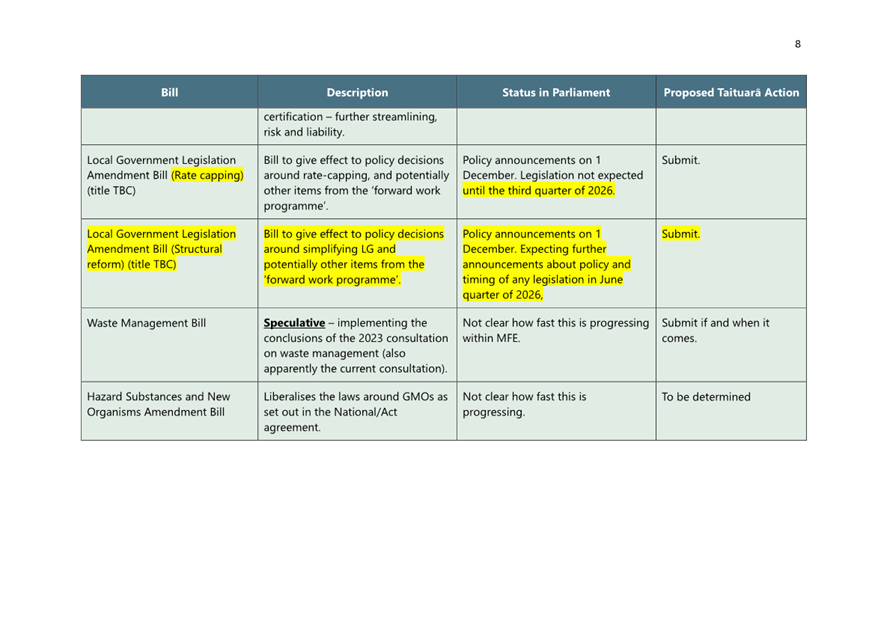
list of legislative changes (Attachment 2)
2.0 External Audit
Actions
2.1 The table below lists the actions form external audit over
the last four financial years.
|
|
New items opened
|
Items open from prior year
|
Items closed
|
Items remaining after audit
|
|
2022 (21/22)
|
5
|
0
|
0
|
5
|
|
2023 (22/23)
|
2
|
5
|
3
|
4
|
|
2024 (23/24)
|
2
|
4
|
2
|
4
|
|
2025 (25/26)
|
2
|
4
|
4
|
2
|
3.0 Council Policy Status
3.1 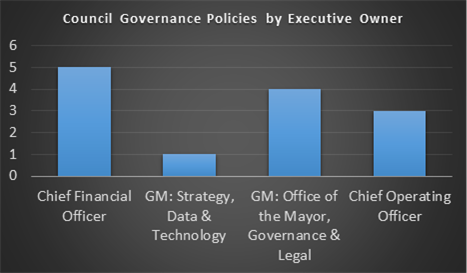
Council has 13 Governance Policies owned at the
Council level that are required under legislation. These cover Council
activities ranging from treasury management through to elected member training.
The internal owners responsible for maintaining these policies are shown in the
graph below:
3.2 To support effective
management of Council, 50 corporate policies exist to direct the way officers
should undertake work. The distribution of ownership for these policies between
Council roles is summarised in the graphic below:

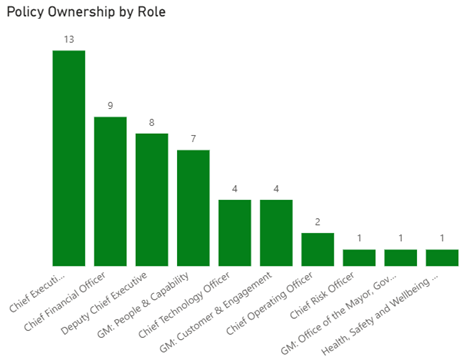
3.3 The number of overdue
policies has fallen from 44% to 40% since the last report.
4.0 Business continuity planning for fuel
disruption
4.1 In response to the
on-going disruption to the global oil supply chain due to blockade of the
Strait of Hormuz Council has established a Business Continuity Planning (BCP)
team. The project team consisting of staff from the Health, Safety and
Wellbeing and Risk teams is coordinating internal actions to prepare for a
potential change of phase of the national fuel plan.
· Current
activity is primarily focused on understanding:
· the
impact of oil price rises on the capital works programme,
· mapping
critical Council services that are highly dependent on fuel to operate, and
· providing
information and guidance to staff to help adapt to the increased fuel cost.
4.2 To date the increased
fuel price has not had a material impact on Council budgets, and the effect on
the capital works programme appears to be limited and within available
contingencies. However, Officers are expecting the increase fuel price to be
factored into future contracts, which may have an impact on the budgets for the
next financial year.
5.0 Legislative Changes
5.1 The ongoing programme of legislative change pursued by
central Government is creating a dynamic operating context. Proposed
legislative changes that are expected to have significant direct impact on
Council will be reported in detail at the time, as has been done for Local
Water Done Well.
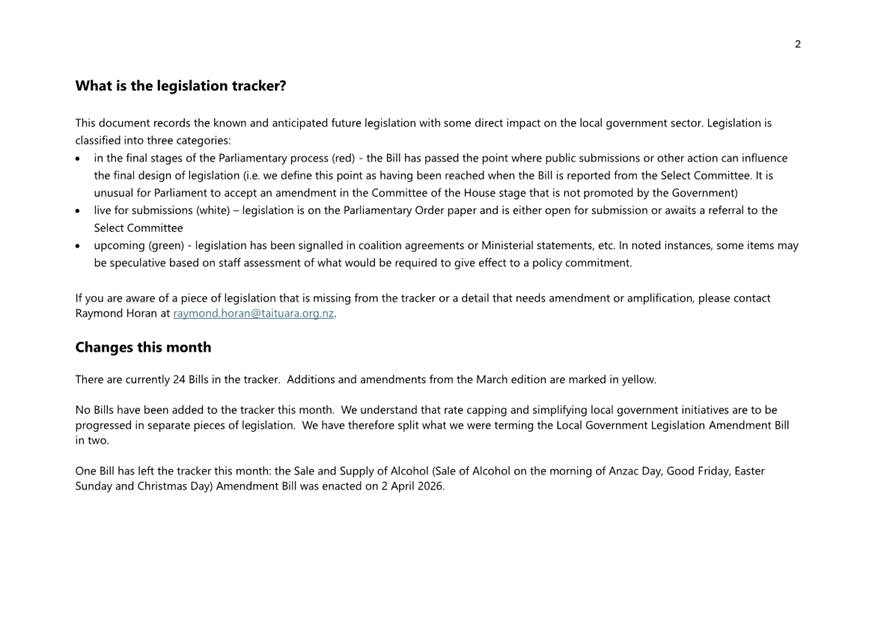
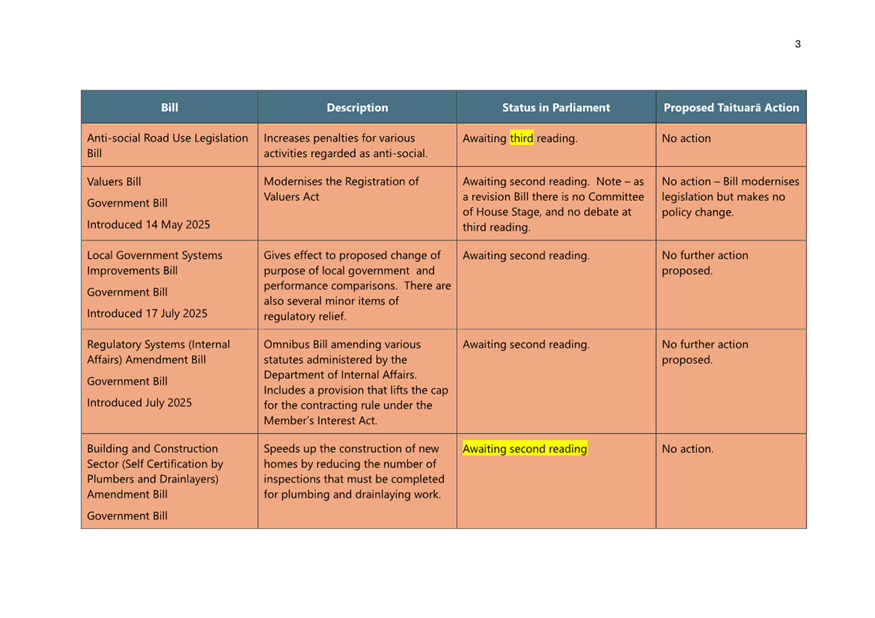
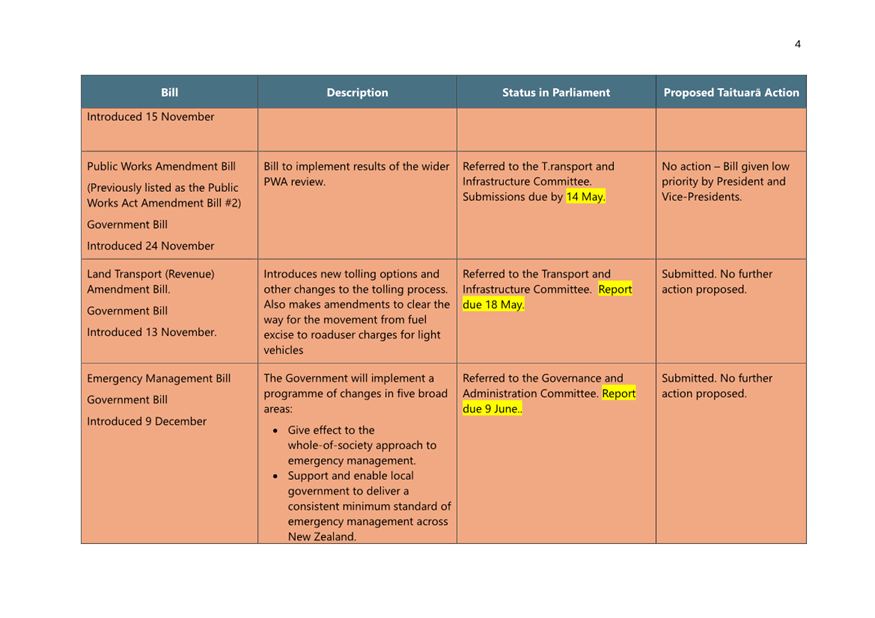
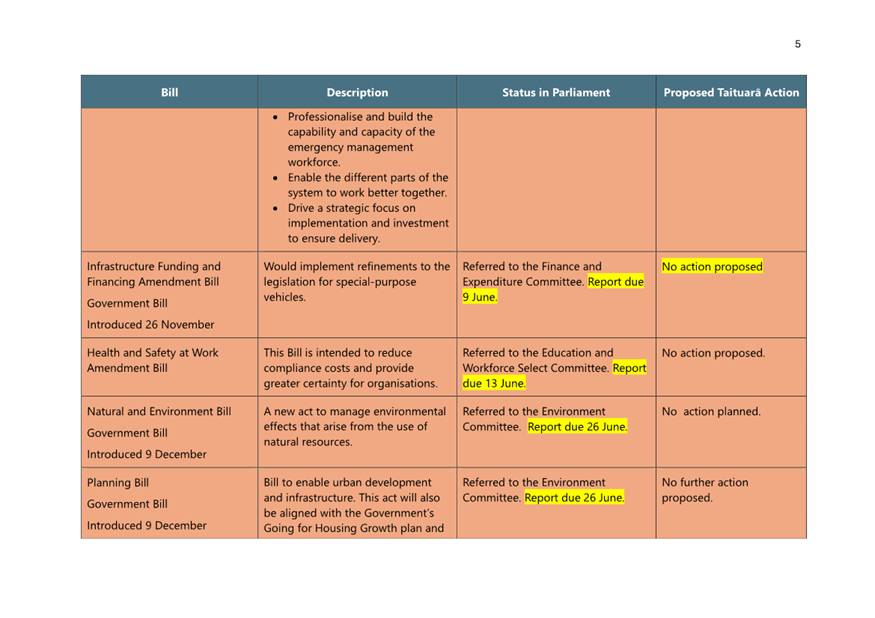
5.2 A list of current legislative changes being tracked by
Taituara is included (Attachment 2) for information on the range of
changes currently underway.
|
6.0 Recommendations -
Ngā Tūtohunga
That the Risk
and Assurance Committee receive the
report titled Executive Overview and Status of Actions dated 20 May 2026.
|
Attachments:
|
1⇩
|
Status of Actions & Work Programme
|
CG-18-06-00019
|
|
|
2⇩
|
Taituara Legislation Tracker April 2026
|
IRB-3-15-26-150
|
|
|
Item 6 Executive
Overview and Status of Actions
|
|
Status of
Actions & Work Programme
|
Attachment 1
|
|
Item 6 Executive
Overview and Status of Actions
|
|
Taituara
Legislation Tracker April 2026
|
Attachment 2
|

Hastings
District Council: Risk and Assurance Committee Meeting
Te Rārangi Take
Report to Risk and Assurance Committee
|
Nā:
From:
|
Regan Smith, Chief Risk
Officer
Steffi Reeves-Bird, Risk
Manager
|
|
Te Take:
Subject:
|
Annual Strategic Risk
Register Review
|
1.0 Purpose and summary - Te Kaupapa Me Te Whakarāpopototanga
1.1 The purpose of this
report is to present the Risk and Assurance Committee with the annual review of
the Hastings District Council (HDC) Tier 1 Strategic Risk Register for review
and endorsement by the Committee.
2.0 Strategic Risk Register
2.1 The Risk team has
undertaken a review of the Strategic Risk Register based on the following
information:
· Feedback
on the Council horizon scan from the 25 February Committee meeting.
· Review
of the Long-Term Plan 27/37 background briefs (Attachment 1).
· Review
of the AON emerging risk horizon scan (Attachment 2).
2.2 As a result of this
review the following changes to the Strategic Risk Register have been reviewed
and endorsed by the Council executive Lead Team:
· Threat
#2: The risk title is updated to “Natural or human-made hazard
exposure” and the risk description is amended to better describe the risk
and potential impacts.
· Threat
#22: Water quantity and quality risk description is amended to better
describe the sources of the risk.
· Threat
#23: Financial sustainability risk description is amended to include the
effect of rates-capping.
· Threat
#25: The risk title is updated to “Unfunded growth” and the
risk description is amended to better describe the potential impacts.
· Threat
#28: Considering the potential impact of the Government’s Head Start
pathway for local government reorganisation it is recommended that the current
risk level for Significant statutory reform is increased to high.
· Threat
#35: The Legal liability risk is transferred to the Tier 2 Lead Team risk
register for ongoing management. This is recommended due to a reduction in the
inherent risk level resulting from completion of the Voluntary Buy Out
programme.
· Threat
#41: NEW – A new risk relating to “Capital infrastructure
delivery capability” is added reflecting the size of the capital
development programme over the medium terms.
· Opportunity
#30: The risk title is updated to “Model citizen with strong cultural
competence” to better describe the opportunity for improved
understanding.
2.3 A draft version of the
Strategic Risk Register incorporating these changes (Attachment 3) and a
set of high-level Bowtie risk assessments and commentary for each strategic
risk (Attachment 4) is provided for review by the Committee. The Bowtie
risk assessments have been included to provide greater insight to each risk and
how it is managed.
|
3.0 Recommendations -
Ngā Tūtohunga
A) That the Risk
and Assurance Committee receive the report titled Annual Strategic Risk
Register Review dated 20 May 2026.
B) That the
Committee endorse the Strategic Risk Register and Bowtie risk assessments and
recommend they be tabled at Council for adoption.
|
Attachments:
|
1⇨
|
Long Term Plan 27 Background Briefs
|
PMD-9-3-26-134
|
Under Separate Cover
|
|
2⇨
|
AON Emerging Risk Horizon Scan
|
PMD-9-3-26-133
|
Under Separate Cover
|
|
3⇨
|
Draft Strategic Risk Register
|
IRB-3-15-26-148
|
Under Separate Cover
|
|
4⇨
|
Strategic Risk Bowtie Summaries
|
IRB-3-15-26-145
|
Under Separate Cover
|
Hastings
District Council: Risk and Assurance Committee Meeting
Te Rārangi Take
Report to Risk and Assurance Committee
|
Nā:
From:
|
Steffi Reeves-Bird, Risk
Manager
Regan Smith, Chief Risk
Officer
|
|
Te Take:
Subject:
|
Artificial Intelligence
- Bowtie Risk Summaries
|
1.0 Executive Summary
– Te Kaupapa Me Te
Whakarāpopototanga
1.1 The purpose of this
report is to provide the Risk and Assurance Committee with an overview of the
risk landscape relating to the use of Artificial Intelligence (AI) and to gain
assurance that the appropriate controls are in place.
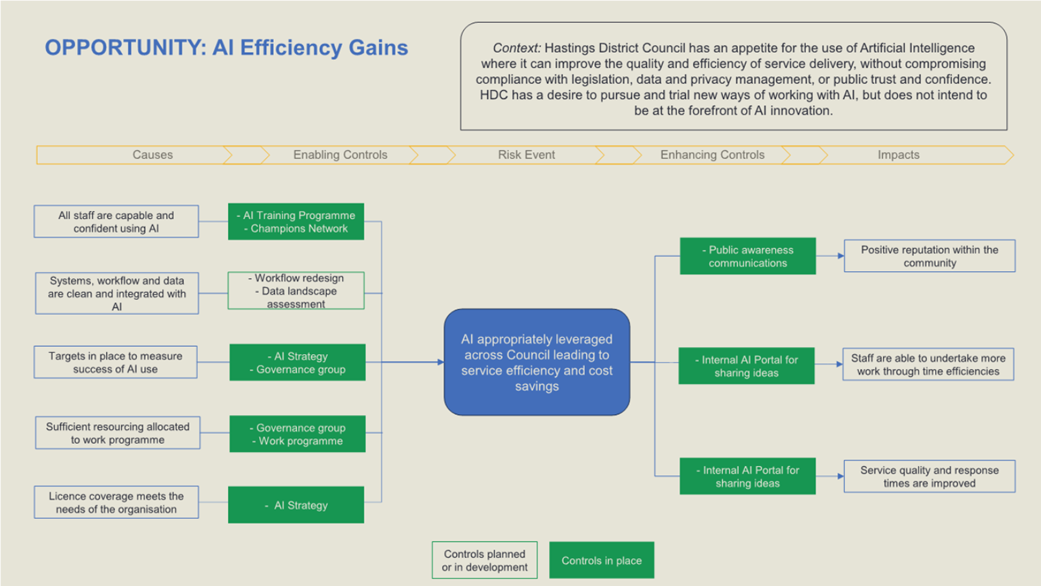
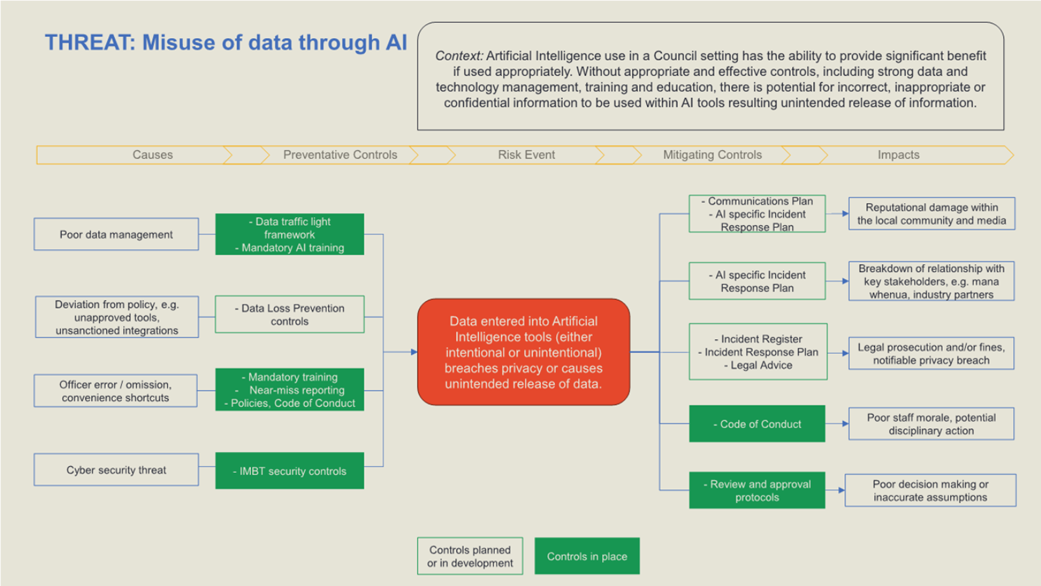
1.2 The analysis of AI has
been completed leveraging Bowtie diagrams, which are a useful tool for mapping
a risk assessment in a simplified and visual way. The centre of the diagram is
the risk event, with the causes to the left and the impacts to the right.
Between the risk event and causes and impacts are the controls.
1.3 Two bowtie diagrams
are attached for:
· An
opportunity risk, being ‘Leveraging the use of AI appropriately across
Council could lead to more efficient service delivery and potential cost
savings’. This bowtie is presented to illustrate the benefits to Council
for investigating how the use of AI can contribute to efficiencies and
improvements across the work that is undertaken.
· A
threat risk, ‘Data entered into Artificial Intelligence tools (either
intentional or unintentional) could result in a significant breach of privacy,
flawed outputs and loss of IP’. This bowtie is provided to ensure that
while pursuing the use of AI, sight is not lost of the threats associated with
this technology.
1.4 As illustrated in the
threat Bowtie cyber controls continue to be vital in an AI world. Advances in
AI models are fundamentally changing the cybersecurity risk landscape. New
models such as Claude Mythos Preview can identify and exploit software
vulnerabilities at or beyond expert human capability, doing so autonomously and
at scale. Project Glasswing is a coordinated industry response aimed at using
these same AI capabilities defensively to identify and remediate
vulnerabilities across critical systems. It brings together major global
technology organisations to accelerate vulnerability detection, strengthen
software security practices, and share learnings across the sector. The
initiative highlights the need for organisations to rapidly modernise
cybersecurity controls.
(Note: This section was compiled with the help of Copilot).
1.5 A follow up report on
Council’s cyber security and controls will be provided at the next
meeting.
|
2.0 Recommendations -
Ngā Tūtohunga
That the Risk
and Assurance Committee receive the report titled Artificial Intelligence -
Bowtie Risk Summaries dated 20 May 2026.
|
Attachments:
|
1⇩
|
Artificial Intelligence Bowtie Diagrams
|
IRB-3-15-26-151
|
|
|
Item 8 Artificial
Intelligence - Bowtie Risk Summaries
|
|
Artificial
Intelligence Bowtie Diagrams
|
Attachment 1
|
Hastings
District Council: Risk and Assurance Committee Meeting
Te Rārangi Take
Report to Risk and Assurance Committee
|
Nā:
From:
|
Graham Watson, Chief
Financial Officer
|
|
Te Take:
Subject:
|
Local Water Done Well -
Programme Update and Risk Overview
|
1.0 Executive Summary
– Te Kaupapa Me Te
Whakarāpopototanga
1.1 This report provides
the Risk and Assurance Committee with an update on progress of the Local Water
Done Well programme following recent Council decisions relating to the
establishment of the Hawke’s Bay Water Services Council Controlled
Organisation.
1.2 On 2 April 2026,
Council adopted a series of foundational decisions enabling the programme to
move from establishment planning into implementation. These included:
· Adoption
of the WaterHB Constitution and Shareholders’ Agreement
· Approval
of the establishment budget and transition funding approach
· Approval
of the Statement of Expectations process
· Appointment
of representatives to the Shareholders’ Representative Forum (SRF)
1.3 The programme is now
progressing into the detailed implementation and transition planning phase
ahead of the planned operational commencement date of 1 July 2027. Key
activities currently underway include preparation for legal incorporation,
development of the Statement of Expectations (SoE), implementation planning,
operational readiness, financial transition arrangements, and preparation for
transfer of services, assets, systems and staff.
1.4 Given the scale and
complexity of the transition, a comprehensive risk assessment from
Council’s internal point of view has been undertaken to identify the
principal strategic, operational, financial, reputational and service delivery
risks associated with the programme. The assessment also identifies several
opportunities for Council arising from the transition to a regional delivery
model.
1.5 This report summarises
the key risks and opportunities relevant to the current phase of the
Council’s internal transition programme and outlines the mitigation
measures in place. Refer to Attachment 1 for the detailed risk
assessment document.
|
2.0 Recommendations -
Ngā Tūtohunga
That the Risk
and Assurance Committee receive the report titled Local Water Done Well -
Programme Update and Risk Overview dated 20 May 2026.
|
3.0 Background – Te Horopaki
3.1 Previous updates on
Local Water Done Well (LWDW) have been provided in July 2025 and February 2026.
3.2 The July 2025 report
outlined the public consultation process, proposed regional model and the
initial transition risks associated with this. At the time these included the
following emerging risks:
· Debt
transfer arrangements
· Stranded
overheads
· Transition
management complexity
· Transfer
of assets, systems and contracts
· Impact
on remaining Council activities following transfer of water services
3.3 The last report in
February provided a further update following the adoption and acceptance of the
joint Water Services Delivery Plan (WSDP), establishment of the Transitional
Governance Group, appointment of the Establishment Advisory Board (EAB), and appointment
of the interim Chief Executive of the regional water services organisation -
Water Hawke’s Bay Limited (WaterHB).
3.4 Since the February
report, progress has been made in both the regional establishment programme and
Council’s internal transition planning.
3.5 At its meeting on 2
April 2026, Council adopted several key decisions enabling progression into the
implementation phase, including:
· Adoption
of the WaterHB Constitution and Shareholders’ Agreement
· Approval
of the establishment budget and transition funding approach
· Approval
of the Statement of Expectations process
· Appointment
of representatives to the Shareholders’ Representative Forum (SRF)
3.6 The programme
objective remains to ensure the successful transition of drinking water
wastewater, and stormwater services from the shareholder councils to the new
regional entity WaterHB, while still providing safe, compliant, and reliable
services to the community throughout the transition period.
4.0 Discussion – Te Matapakitanga
4.1 Following adoption of
the foundational governance and funding decisions by shareholder councils in
April, the programme has now transitioned from establishment planning into
implementation planning ahead of the proposed operational commencement date of
1 July 2027.
4.2 The overall transition
programme can be broadly separated into two but distinct responsibilities
· The
establishment of WaterHB and transition of all relevant services, assets,
systems and staff from each of the three shareholder councils into WaterHB
(responsibility of the WaterHB transition team)
· HDC’s
internal transition and operational readiness programme (responsibility of
council CEO and officers)
4.3 While these programmes
are closely connected and linked, they involve different responsibilities,
governance arrangements and risk ownership.
WaterHB Transition Programme
4.4 The WaterHB transition
team is responsible for creating and operationalising the future Hawke’s
Bay Water Services company, currently called Water Hawke’s Bay Limited.
4.5 This work is being
coordinated across the shareholder councils through the agreed governance
framework, including the Transitional Governance Group (TGG), Programme
Steering Group, Establishment Advisory Board and the emerging Shareholder
Representative Forum (taking over from the TGG once company incorporation
occurs).
HDC Internal Transition Programme
4.6 Separate from the
WaterHB transition programme (but heavily linked), HDC has an internal
transition project to prepare Council for the future operating environment,
manage risks and provide the support required to the WaterHB transition team to
enable the smooth transfer of services, assets, systems and staff.
4.7 This internal
programme ensures Council remains operationally, financially, strategically and
organisationally ready throughout and following the transition phase.
4.8 Key areas of work to
be delivered include:
· Planning
for stranded overheads and organisational realignment
· Review
of retained functions and service delivery models
· Workforce
and capability planning
· Management
of retained statutory and shareholder responsibilities
· Development
of operational interfaces with the future WaterHB entity (through MOUs)
· Financial
planning and debt transition considerations
· Development
of service level agreements
· Management
of asset and information dependencies (including LIMs)
· Ensuring
alignment between Council growth strategies and future water infrastructure
planning.
4.9 Unlike the risks
outlined to TGG by the WaterHB transition programme, these risks remain
directly owned by Council and will continue beyond the establishment of
WaterHB.
4.10 The internal risk assessment attached
(see Attachment 1) has been developed specifically to identiy and assess
those risks that may affect HDC during and after the transition of water
services, assets, systems and staff to WaterHB.
4.11 Key Internal Council Risks
4.12 Organisational Capability and Staff
Retention (WT1 – Staff/Contractor Retention and WT8 – Change
Fatigue)
A key internal risk for Council is the
potential loss of organisational capability and institutional knowledge during
the transition process. Uncertainty associated with the future operating
environment, combined with broader organisational change activity, may impact
staff retention, workforce stability and Council’s ability to continue
delivering planning, infrastructure, and operational functions effectively.
Mitigation work is focused on workforce planning, staff engagement,
identification of critical retained functions, and development of operational
interface arrangements with the future WaterHB entity.
4.13 Stranded Overheads and
Organisational Realignment (WT2 – Stranded Overheads and WT7 –
Failure to Realign Existing Services)
Following transfer of water services,
there is a risk that Council overheads and support costs may not reduce
proportionately, resulting in financial pressures on remaining Council
activities. There are opportunities in providing potential shared services to
WaterHB, but internal work will need to be undertaken to assess the
organisational impacts, review the retained functions and develop longer-term
service and realignment options.
4.14 Strategic Alignment and Growth
Planning (WT9 – Compromised Growth Plan Implementation, WT16 –
Deferred Decision Making, and WT18 – Excessive Infrastructure Charges)
While operational responsibility for
water infrastructure will transfer to WaterHB, Council will retain
responsibility for strategic growth and land use planning. This creates risk
around alignment of future infrastructure investment priorities, growth sequencing,
affordability, and responsiveness to changing development needs. Mitigating
measures include development of the Statement of Expectations, governance
arrangements through the SRF and ongoing strategic coordination between Council
and Water HB, likely in the form of operational MOUs.
4.15 Public Accountability and Reputation
(WT5 – Public Accountability Perception and WT14 – Loss of
Community Voice)
There remains a significant
reputational risk that the public may continue to associate water service
performance with Council following transition to WaterHB. This may create
ongoing political and reputational pressure for Council, particularly during the
transition period and early stages of the new organisation. There is also risk
that communities perceive a loss of local voice or influence over water service
delivery decisions. Mitigation work includes coordinated communications
planning, development of clear customer interface arrangements, shareholder
governance oversight, and use of the Statement of Expectations process.
4.16 Transition Delivery and Service
Continuity (WT3 – Protracted Change, WT4 – Service Response Times,
WT6 – Poor Transition Management, WT15 – Current system continuity,
WT19 – Loss of Asset Data, WT20 – Lack of Service Integration and
WT 22 – Asset Data Migration)
The scale and complexity of the
transition creates ongoing risk around coordination, operational handover,
service integration, asset and data transfer, and implementation timing. Delays
or ambiguity in transition arrangements could impact Council’s ability to
maintain service continuity and effectively support implementation activities.
These risks are being managed through formal transition planning, alignment
between council internal work and WaterHB transition workstreams, transition
agreement arrangements and continued coordination between Council officers and
the WaterHB transition team.
Key Opportunities for Council
4.17 Improved Financial Position (WO2
– Improved Debt Position)
Transition of water-related debt to
WaterHB will improve Council’s overall debt position and create potential
financial capacity for other strategic priorities, including resilience and
community infrastructure investment. The development of the LTP 27-37 Financial
Strategy provides an opportunity for Council to review longer-term financial
settings and debt management approaches, including bringing Council’s
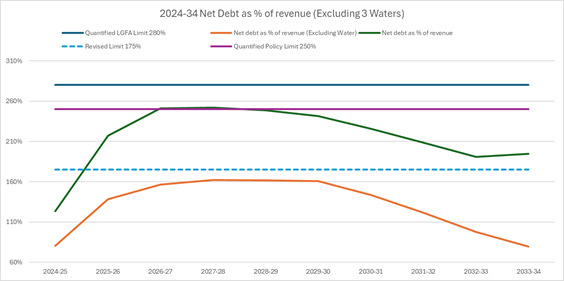
debt limit back in line with pre-Cyclone levels. Based on current available
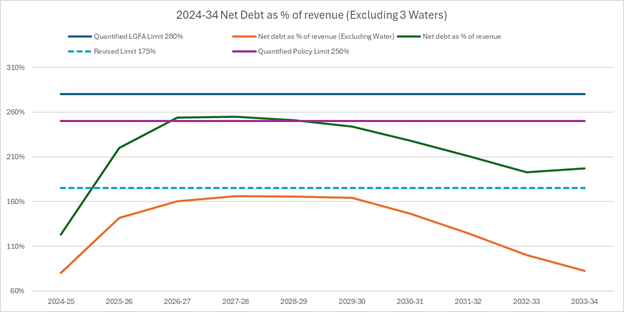
information the graph below reflects the net Debt to revenue % excluding 3
waters debt and revenue (orange line) as well as a potential new limit (blue
dotted line). The graph below will be further discussed in the Treasury
Activity and Funding Update.
4.18 Shared Services and Organisational
Capability (WO3 – Provision of Shared Services and WO7 – Project
Delivery Office)
The transition creates opportunities
for Council to provide shared support services to WaterHB through service level
arrangements. This may assist in offsetting stranded overheads, retaining
organisational capability, and creating more efficient use of specialist
resources and programme delivery expertise. There may also be opportunities to
leverage existing Council capability, including programme and project delivery
functions, to support the future organisation.
4.19 Improved Regional Collaboration and
Service Delivery (WO1 – Contracted Services Transfer and WO4 –
Maintaining Good Quality Assets)
The regional delivery model provides
opportunities for improved regional coordination, economies of scale, and more
consistent long-term infrastructure planning. Existing outsourced operational
arrangements and continued investment in water infrastructure also support the
ability to transition services while maintaining service continuity and asset
quality during establishment of WaterHB.
4.20 Transition and Organisational
Improvement Opportunities (WO5 – Effective Transition Management and WO6
– Post Transfer Service Optimisation)
The transition process provides an
opportunity for Council to review and optimise its remaining organisational
structure, support services, and operating model following transfer of water
services. The establishment of dedicated transition planning and programme
governance arrangements also provides opportunities to strengthen internal
programme management capability, improve organisational processes, and identify
efficiencies across retained Council functions.
5.0 Next steps – Te Anga Whakamua
5.1 Both the water
transition programme and Council’s internal transition programme will
continue progressing in parallel.
5.2 Key next steps for
Council include:
· Continued
monitoring and review of transition risks
· Further
development and alignment of Council’s internal transition programme with
WaterHB’s transition programme
· Development
of operational and governance interfaces with WaterHB
· Refinement
of financial and organisational impact assessments
· Ongoing
reporting to Council and this Committee
5.3 The detailed risk
assessment (see Attachment 1) will continue to be updated as programme
planning progresses and implementation risks evolve.
Attachments:
|
1⇨
|
Local CCO for Water Service Delivery Risk Assessment
|
CG-18-06-00020
|
Under Separate Cover
|
Te
Hui o Te Kaunihera ā-Rohe o Heretaunga
Hastings
District Council: Risk and Assurance Committee Meeting
Te
Rārangi Take
Report to Risk and Assurance Committee
|
Nā:
From:
|
Aaron Wilson, Financial
Controller
|
|
Te Take:
Subject:
|
Treasury Activity and
Funding Update
|
1.0 Executive Summary – Te Kaupapa Me Te
Whakarāpopototanga
1.1 The
purpose of this report is to update the Risk and Assurance Committee on
Treasury activity and Funding issues.
1.2 Since the last
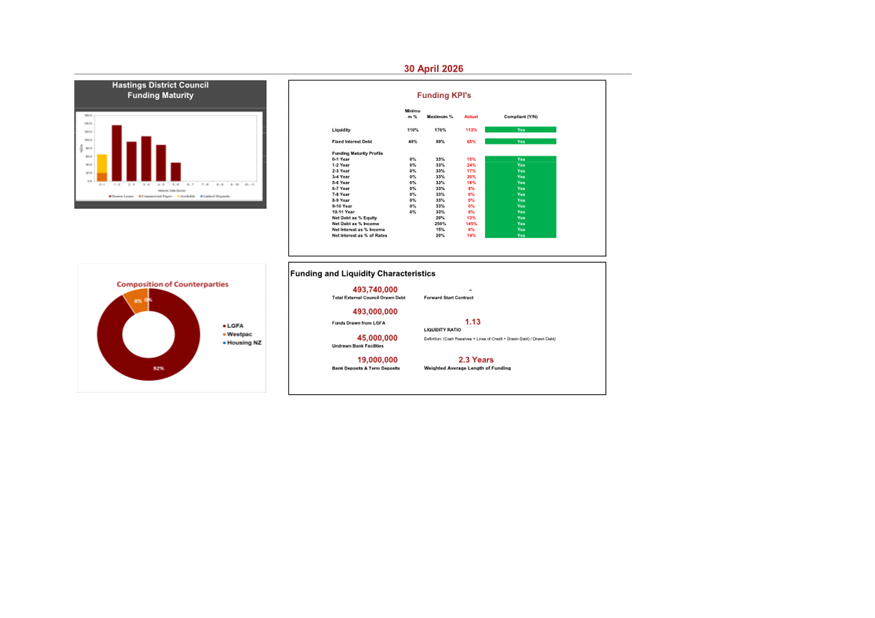
update on 25 February 2026, $55m of Council debt was rolled over in April 2026
with multiple maturity dates. Council has not taken out any new debt.
1.3 Council’s
total external debt as at the end of April 2026 is $493.7m, with cash on hand
of $19m. Based on the latest estimates of cash requirements Council will not
need to borrow any additional funds this financial year to fund Council
activities. For comparison the year end external debt as per the LTP is
$572m. The lower debt is primarily due to lower than budgeted capex
spends.
1.4 Council
has facilities of $45m with the cost of these facilities 0.3%.
1.5 Standards
and Poors (Global) visited Council and had meetings with the Mayor, CE and
officers as part of their annual ratings review. This committee will be updated
on the result of that rating outcome at the next meeting.
1.6 To
continue to operate within Treasury Policy parameters (refer 3.1 below)
Officers have taken swap contracts at a total value of $50m. Officers will
continue to enter swap contracts through May to ensure continued adherence to
the treasury policy.
1.7 Since
the last update in February 2026 the Monetary Policy Committee in the April
review agreed to hold the OCR at 2.25%. Events in the middle East have
materially altered the outlook with inflation expected to increase and the
economic recovery to weaken. The market and banks in particular believe
that there will be an increase in the OCR either late 2026 or early 2027.
.
|
2.0 Recommendations - Ngā Tūtohunga
That
the Risk and Assurance Committee receive the report titled Treasury Activity and Funding
Update dated 20 May 2026.
|
3.0 Background – Te Horopaki
3.1 The
Hastings District Council has a Treasury Policy which is a summarised version
of the Treasury Management Policy and forms part of the 2024-2034 Long Term
Plan. Under these policy documents, responsibility for monitoring treasury
activity is delegated to the Risk and Assurance Committee.
3.2 Council
is provided with independent treasury advice by Bancorp Treasury Services and
receives daily and monthly updates on market conditions.
3.3 A
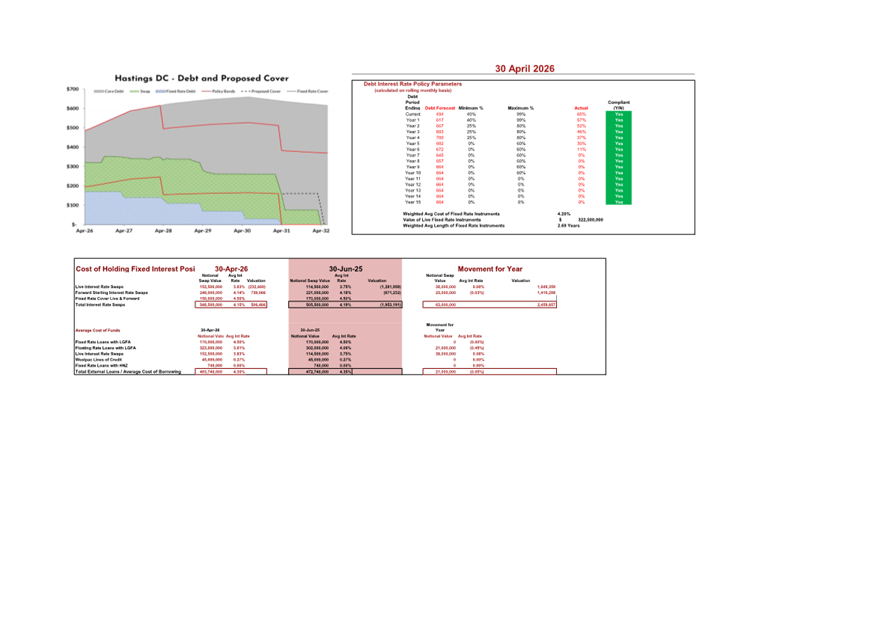
financial report is attached to supplement this report: Attachment 1
– April 2026 Treasury Dashboard.
4.0 Discussion – Te Matapakitanga
Treasury
Transactions
4.1 Council
has had $55m of debt maturing in April of 2026 which has been rolled over
across the following maturities. The table below shows the relevant
detail. As noted in the following table $20m was taken out in Commercial
paper (CP) for a term of three months.
4.2 A
portion of the maturing debt ($20m) was taken out in Commercial paper (CP) for
a term of three months. There are two reasons for rolling part of the maturing
debt over as CP. Firstly, it forms part of Council strategy in relation to
novating over water related debt to the Water entity as of the 1st
of July 2027. Secondly, the margin on borrowing is significantly lower than our
longer-term debt.
|
Deal Date
|
Fixed /Floating
|
Amount
|
Margin
|
Effective
Interest Rate
|
Maturity Date
|
|
15/04/2026
|
Floating
|
$20m
|
0.58%
|
3.21%
|
20/04/2029
|
|
15/04/2026
|
Floating
|
$15m
|
0.75%
|
3.38%
|
20/05/2031
|
|
15/04/2026
|
Commercial Paper Floating
|
$20m
|
0.15%
|
2.715%
|
15/07/2026
|
4.3 The
Council Treasury Policy dictates the amount of debt that can mature in any one
year. Already planned in 2026/27 to provide flexibility in how the Water entity
debt is transferred Council will Council will have a total of $155m maturing.
4.4
Officers entered into $50m interest rate swaps in February 2026 subsequent to
the last report to the committee to maintain cover within Treasury policy
limits as per the table below:
|
Deal Date
|
Live /Forward Start
|
Swap Value
|
Interest Rate
|
Start Date
|
Maturity Date
|
|
19/02/2026
|
Live
|
$25m
|
3.680%
|
23/02/2026
|
15/04/2032
|
|
19/02/2026
|
Forward Start
|
$25m
|
3.825%
|
15/10/2026
|
15/04/2032
|
Treasury Policy Limits
4.5 Below
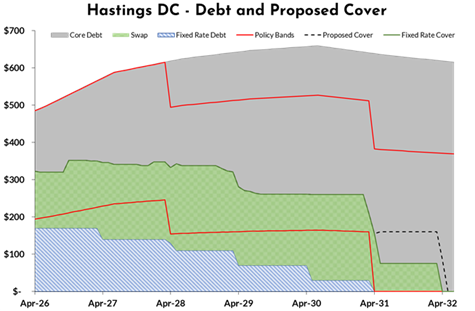
is the debt cover as at 30th of April 2026 showing Council is within
policy. Note that the dotted line near the right end of the graph shows
the swap cover that officers intend to take out in the May period to maintain
cover within Council treasury policy. Council are working with treasury
advisors to optimise timing.
Debt Capacity
4.6 The
graph below represents the current view of ongoing debt capacity measured by
the net revenue to debt calculation. The data reflects the current adopted LTP
and actuals and updated Annual Plan to date. Council is within its self-imposed
policy limit of 250% (excluding one offs). This position is expected to
continue. The graph further shows an estimate of what the net to revenue
position would look like with the removal of 3 Waters.
4.7 Overall,
the graph indicates that there is sufficient debt capacity today and, in the
future, even if the self-imposed policy limit reduces as has been recommended.
Attachments:
|
1⇩
|
Treasury Report April 2026
|
FIN-15-01-26-36
|
|
|
Item 10 Treasury
Activity and Funding Update
|
|
Treasury
Report April 2026
|
Attachment 1
|
HASTINGS DISTRICT COUNCIL
Risk and Assurance Committee
MEETING
Wednesday, 20 May 2026
RECOMMENDATION TO EXCLUDE THE PUBLIC
SECTION 48, LOCAL GOVERNMENT OFFICIAL INFORMATION AND
MEETINGS ACT 1987
THAT the public now be excluded from the following part of
the meeting, namely:
14 Current
Issue Summary April 2026
15 Head
Start programme: key risks
The general subject of the matter to be considered while the
public is excluded, the reason for passing this Resolution in relation to the
matter and the specific grounds under Section 48 (1) of the Local Government
Official Information and Meetings Act 1987 for the passing of this Resolution
is as follows:
|
GENERAL SUBJECT OF
EACH MATTER TO BE CONSIDERED
|
REASON FOR PASSING
THIS RESOLUTION IN RELATION TO EACH MATTER, AND
PARTICULAR INTERESTS
PROTECTED
|
GROUND(S) UNDER
SECTION 48(1) FOR THE PASSING OF EACH RESOLUTION
|
|
|
|
|
|
14 Current
Issue Summary April 2026
|
Section 7 (2) (f) (ii)
The withholding of the
information is necessary to maintain the effective conduct of public affairs
through the protection of such members, officers, employees and persons from
improper pressure or harassment.
To enable the Committee to
have oversight of legally senstive issues.
|
Section 48(1)(a)(i)
Where the Local Authority is
named or specified in the First Schedule to this Act under Section 6 or 7
(except Section 7(2)(f)(i)) of this Act.
|
|
15 Head
Start programme: key risks
|
Section 7 (2) (i)
The withholding of the
information is necessary to enable the local authority to carry on, without
prejudice or disadvantage, negotiations (including commercial and industrial
negotiations).
The PX resolution is based
on s48 of LGOIMA, and 7(2)(i) provides the reason as linked in by
s48(1)(a)(i).
|
Section 48(1)(a)(i)
Where the Local Authority is
named or specified in the First Schedule to this Act under Section 6 or 7
(except Section 7(2)(f)(i)) of this Act.
|